Fundamentals of Chemistry
Cheatsheet Content
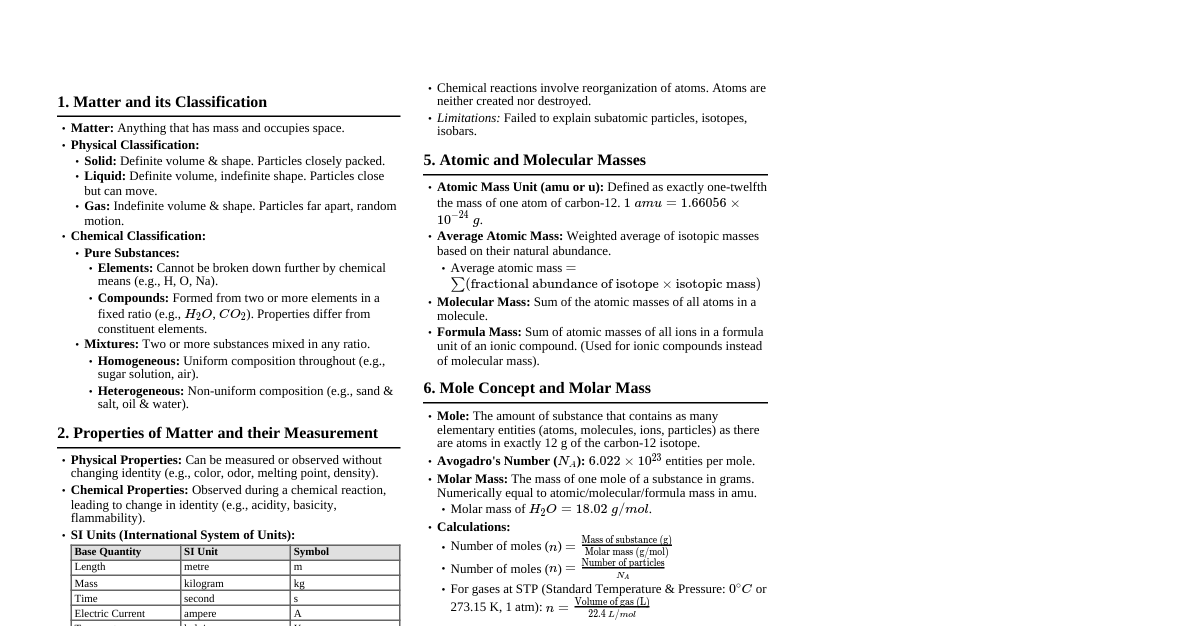
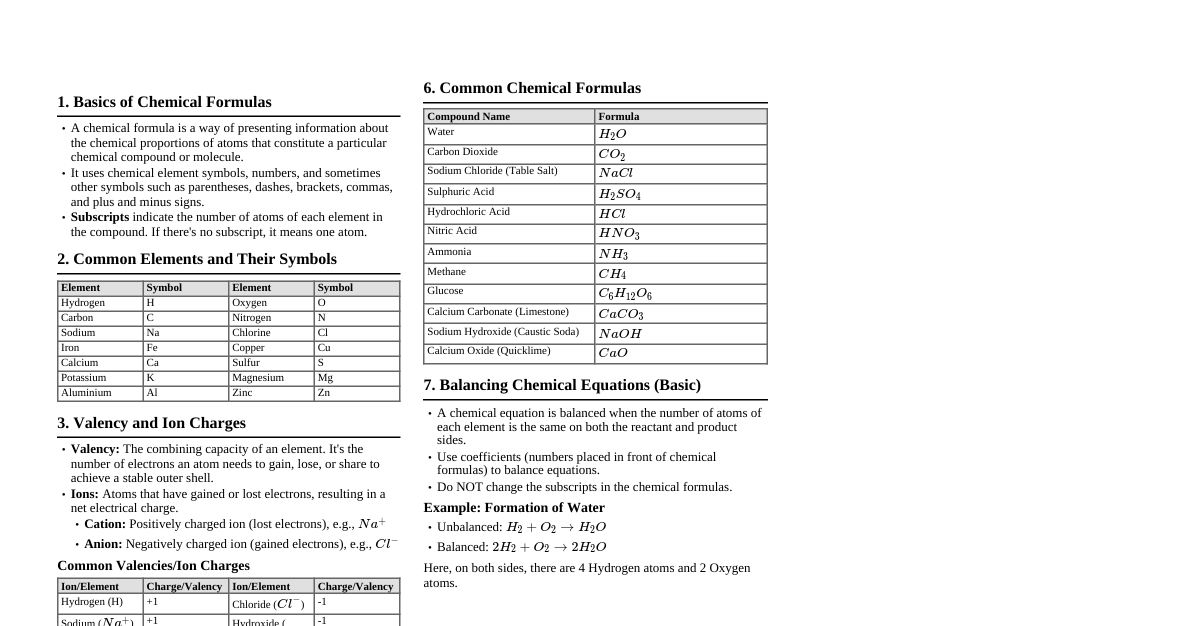
1. Basic Concepts Atom: Smallest unit of matter retaining element's identity. Consists of protons, neutrons, electrons. Atomic Mass: Mass of an atom, typically expressed in atomic mass units (amu). Approximated by the sum of protons and neutrons. Molecule: Two or more atoms chemically bonded together. Molecular Mass: Sum of the atomic masses of all atoms in a molecule. Mole Concept: A mole is the amount of substance containing Avogadro's number ($6.022 \times 10^{23}$) of particles (atoms, molecules, ions). Molar mass (g/mol) is numerically equal to atomic/molecular mass (amu). Numerical Problems: Often involve converting between mass, moles, and number of particles using molar mass and Avogadro's number. $n = \frac{\text{mass}}{\text{molar mass}}$ Number of particles $= n \times N_A$ 2. States of Matter Solid: Definite shape and volume, particles tightly packed and vibrate in fixed positions. Liquid: Definite volume but no definite shape, particles close but can move past each other. Gas: No definite shape or volume, particles far apart and move randomly. 3. Classification of Matter Element: Pure substance consisting of only one type of atom (e.g., $O_2$, $Fe$). Compound: Pure substance formed when two or more different elements are chemically bonded in fixed proportions (e.g., $H_2O$, $CO_2$). Mixture: Two or more substances physically combined, not chemically bonded. Homogeneous Mixture: Uniform composition throughout (e.g., saltwater, air). Heterogeneous Mixture: Non-uniform composition; components are visible (e.g., sand and water, oil and water). 4. Chemical Formulas Empirical Formula: Simplest whole-number ratio of atoms in a compound (e.g., $CH_2O$ for glucose). Molecular Formula: Actual number of atoms of each element in a molecule (e.g., $C_6H_{12}O_6$ for glucose). Molecular Formula $= (\text{Empirical Formula})_n$, where $n = \frac{\text{Molecular Mass}}{\text{Empirical Formula Mass}}$ 5. Laws of Chemical Combination Law of Conservation of Mass (Lavoisier): Mass is neither created nor destroyed in a chemical reaction. Total mass of reactants = Total mass of products. Law of Definite Proportions (Proust): A given chemical compound always contains its component elements in fixed ratio by mass, regardless of source or preparation. (e.g., water ($H_2O$) always has H and O in a 1:8 mass ratio). Law of Multiple Proportions (Dalton): When two elements combine to form more than one compound, the masses of one element that combine with a fixed mass of the other element are in ratios of small whole numbers. (e.g., $CO$ ($C:O = 12:16$) and $CO_2$ ($C:O = 12:32$); the oxygen masses (16 and 32) combining with fixed carbon (12) are in a 1:2 ratio). Law of Reciprocal Proportions (Richter): If two elements (A and B) combine separately with a fixed mass of a third element (C), then the ratio of the masses in which A and B combine with each other is either the same or a simple multiple of the ratios in which they combine with C. 6. Types of Chemical Reactions Combination Reaction: Two or more reactants combine to form a single product. $A + B \rightarrow AB$ (e.g., $2H_2 + O_2 \rightarrow 2H_2O$) Decomposition Reaction: A single compound breaks down into two or more simpler substances. $AB \rightarrow A + B$ (e.g., $CaCO_3 \rightarrow CaO + CO_2$) Displacement Reaction (Single Displacement): A more reactive element displaces a less reactive element from its compound. $A + BC \rightarrow AC + B$ (e.g., $Zn + CuSO_4 \rightarrow ZnSO_4 + Cu$) Double Displacement Reaction: Exchange of ions between two compounds. Often forms a precipitate, gas, or water. $AB + CD \rightarrow AD + CB$ (e.g., $AgNO_3 + NaCl \rightarrow AgCl(s) + NaNO_3$) Neutralization Reaction: A specific type of double displacement reaction where an acid reacts with a base to form salt and water. Acid + Base $\rightarrow$ Salt + Water (e.g., $HCl + NaOH \rightarrow NaCl + H_2O$) Redox Reactions (Reduction-Oxidation): Reactions involving the transfer of electrons. Oxidation: Loss of electrons, increase in oxidation state. Reduction: Gain of electrons, decrease in oxidation state. Often occur simultaneously (e.g., $2Na + Cl_2 \rightarrow 2NaCl$; Na is oxidized, Cl is reduced).