Non-Chordates
Cheatsheet Content
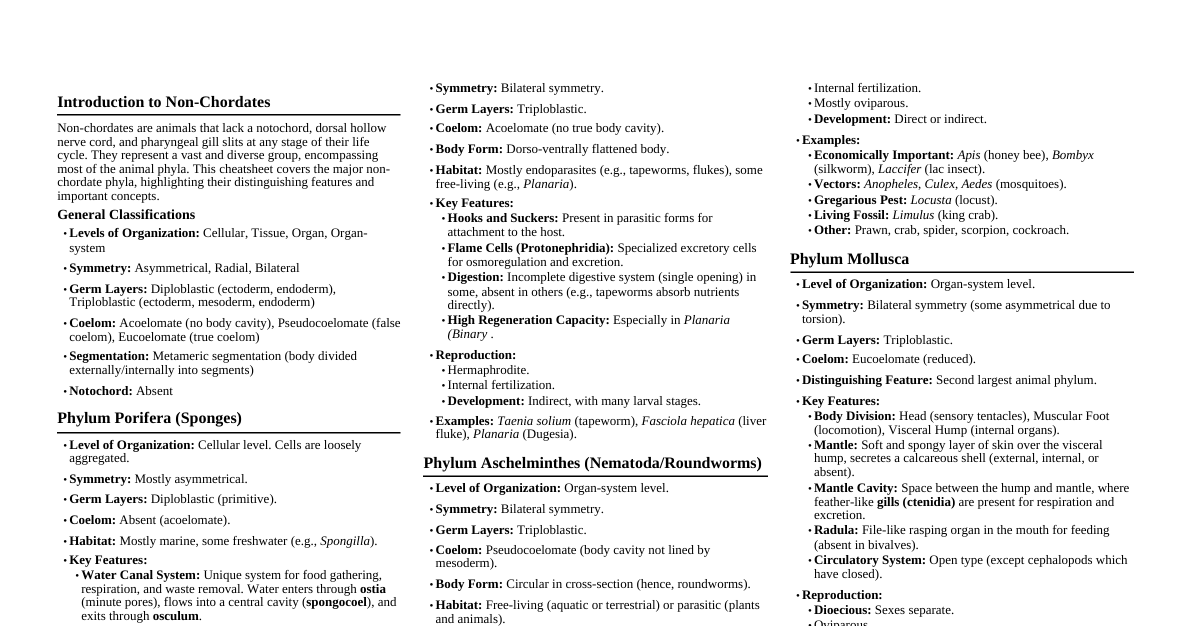
### Introduction (NCERT Basics) - **Basis of Classification:** Levels of organization, symmetry, germ layers, coelom, segmentation, notochord. - **Levels of Organization:** - **Cellular:** Porifera - **Tissue:** Cnidaria, Ctenophora - **Organ:** Platyhelminthes - **Organ-system:** Aschelminthes to Chordata - **Symmetry:** - **Asymmetrical:** Porifera (some are radial/bilateral) - **Radial:** Cnidaria, Ctenophora, Echinodermata (adults) - **Bilateral:** Platyhelminthes, Aschelminthes, Annelida, Arthropoda, Mollusca, Echinodermata (larvae), Hemichordata, Chordata - **Germ Layers:** - **Diploblastic:** Cnidaria, Ctenophora (Ectoderm + Endoderm, Mesoglea in between) - **Triploblastic:** Platyhelminthes to Chordata (Ectoderm + Mesoderm + Endoderm) - **Coelom:** - **Acoelomate:** Platyhelminthes (body cavity absent) - **Pseudocoelomate:** Aschelminthes (body cavity not lined by mesoderm, scattered pouches) - **Coelomate:** Annelida to Chordata (body cavity lined by mesoderm) - **Segmentation:** Metameric segmentation (true segmentation) in Annelida, Arthropoda, Chordata. - **Notochord:** Rod-like structure formed on dorsal side during embryonic development. Present in Chordates. ### Phylum Porifera (Sponges) 1. **Habitat:** Mostly marine, few freshwater (*Spongilla*). Sessile. 2. **Symmetry:** Mostly asymmetrical. 3. **Germ layers:** Primitive multicellular, no true germ layers (cellular level). 4. **Coelom:** Acoelomate. 5. **Level of organization:** Cellular level. 6. **Unique identifying features:** - **Water canal system** (PYQ favorite): Water enters through **ostia** → **spongocoel** → exits through **osculum**. - Functions of water canal system: Food gathering, respiratory exchange, waste removal. - **Choanocytes** (collar cells): Line spongocoel & canals, filter food. - Body supported by **spicules** (calcareous/siliceous) and/or **spongin fibres**. - Intracellular digestion. 7. **Digestive system:** Absent (intracellular digestion). 8. **Circulatory system:** Absent. 9. **Respiration:** Diffusion (via water current). 10. **Excretion:** Diffusion (via water current). 11. **Reproduction:** - Asexual: Fragmentation, Budding, Gemmules. - Sexual: Hermaphrodite (bisexual), internal fertilisation. - Development: Indirect (larval stage is morphologically distinct from adult). 12. **Larva:** Amphiblastula, Parenchymula. 13. **NCERT keywords:** Spongin fibres, ostia, osculum, spongocoel, choanocytes, spicules, hermaphrodite, indirect development. 14. **PYQ traps:** Water canal system is *not* water vascular system. 15. **Exceptions:** *Spongilla* (freshwater). 16. **Important examples:** *Sycon* (Scypha), *Spongilla* (freshwater sponge), *Euspongia* (bath sponge). ### Phylum Cnidaria (Coelenterata) 1. **Habitat:** Aquatic, mostly marine. Sessile or free-swimming. 2. **Symmetry:** Radial. 3. **Germ layers:** Diploblastic. 4. **Coelom:** Acoelomate. 5. **Level of organization:** Tissue level. 6. **Unique identifying features:** - **Cnidoblasts/Cnidocytes** (stinging cells) on tentacles & body, contain **nematocysts** (stinging capsules). - Functions of cnidoblasts: Anchorage, defense, capture of prey. - **Gastro-vascular cavity** (coelenteron) with single opening (mouth/anus) on hypostome. - Digestion: Extracellular and Intracellular. - Two basic body forms: - **Polyp:** Sessile, cylindrical (*Hydra*, *Adamsia*). Reproduces asexually. - **Medusa:** Free-swimming, umbrella-shaped (*Aurelia*). Reproduces sexually. - **Metagenesis** (Alternation of Generation): Some show both forms (*Obelia*). Polyp produces medusae asexually, medusae form polyps sexually. 7. **Digestive system:** Incomplete (single opening). 8. **Circulatory system:** Absent. 9. **Respiration:** Diffusion. 10. **Excretion:** Diffusion. 11. **Reproduction:** Asexual (polyp-budding), Sexual (medusa-gametes). 12. **Larva:** Planula (in some). 13. **NCERT keywords:** Cnidoblasts, nematocysts, gastro-vascular cavity, polyp, medusa, metagenesis, hypostome. 14. **PYQ traps:** Metagenesis is *not* alternation of generations in plants. Diploblastic (Cnidaria, Ctenophora) vs. Triploblastic. 15. **Exceptions:** *Hydra* (freshwater). 16. **Important examples:** *Physalia* (Portuguese man-of-war), *Adamsia* (sea anemone), *Obelia* (sea fur), *Aurelia* (jellyfish), *Meandrina* (brain coral), *Gorgonia* (sea fan), *Pennatula* (sea pen). ### Phylum Ctenophora (Comb Jellies/Sea Walnuts) 1. **Habitat:** Exclusively marine. 2. **Symmetry:** Radial (often biradial). 3. **Germ layers:** Diploblastic. 4. **Coelom:** Acoelomate. 5. **Level of organization:** Tissue level. 6. **Unique identifying features:** - Body bears **8 external rows of ciliated comb plates** for locomotion. - **Bioluminescence** (property of living organisms to emit light) is well-marked. - Digestion: Extracellular and Intracellular. - Lack nematocysts (distinction from Cnidaria). 7. **Digestive system:** Incomplete (mouth & two anal pores, but often described as having a mouth and anal pores, making it effectively complete but NCERT implies incomplete with single opening in Cnidaria and then calls Ctenophora similar, so stick to NCERT's implied incomplete for safety). 8. **Circulatory system:** Absent. 9. **Respiration:** Diffusion. 10. **Excretion:** Diffusion. 11. **Reproduction:** Hermaphrodite. Sexual reproduction only. External fertilisation. Indirect development. 12. **Larva:** Cydippid larva. 13. **NCERT keywords:** Comb plates, bioluminescence, hermaphrodite. 14. **PYQ traps:** Exclusively marine (like Echinoderms). Bioluminescence is a key characteristic. 15. **Exceptions:** None mentioned specifically in NCERT. 16. **Important examples:** *Pleurobrachia*, *Ctenoplana*. ### Phylum Platyhelminthes (Flatworms) 1. **Habitat:** Mostly endoparasites (animals, including humans), some free-living (*Planaria*). 2. **Symmetry:** Bilateral. 3. **Germ layers:** Triploblastic. 4. **Coelom:** Acoelomate. 5. **Level of organization:** Organ level. 6. **Unique identifying features:** - **Dorso-ventrally flattened** body. - Parasitic forms have **hooks and suckers**. - **Flame cells** (protonephridia): Specialized for osmoregulation and excretion. - High regeneration capacity (*Planaria*). - Digestion: Incomplete (branched gut, single opening). 7. **Digestive system:** Incomplete (single opening, or absent in tapeworms). 8. **Circulatory system:** Absent. 9. **Respiration:** Diffusion. 10. **Excretion:** Flame cells (protonephridia). 11. **Reproduction:** Hermaphrodite. Internal fertilisation. Indirect development (many larval stages). 12. **Larva:** Miracidium, Redia, Cercaria (for liver fluke). 13. **NCERT keywords:** Dorso-ventrally flattened, hooks, suckers, flame cells, protonephridia, regeneration, hermaphrodite. 14. **PYQ traps:** First triploblastic & bilateral animals. First with organ level organization. Acoelomate. 15. **Exceptions:** *Planaria* (free-living). 16. **Important examples:** *Taenia solium* (tapeworm), *Fasciola hepatica* (liver fluke), *Planaria*. ### Phylum Aschelminthes (Nematoda / Roundworms) 1. **Habitat:** Free-living (aquatic, terrestrial) or parasitic (plants, animals). 2. **Symmetry:** Bilateral. 3. **Germ layers:** Triploblastic. 4. **Coelom:** **Pseudocoelomate**. 5. **Level of organization:** Organ-system level. 6. **Unique identifying features:** - Body is **circular in cross-section**. - Complete digestive system with muscular pharynx. - Sexes are separate (**dioecious**). - Often show sexual dimorphism (females longer than males). 7. **Digestive system:** Complete (mouth + anus). 8. **Circulatory system:** Absent. 9. **Respiration:** Diffusion. 10. **Excretion:** Excretory tube (removes body wastes from body cavity through excretory pore). 11. **Reproduction:** Dioecious. Internal fertilisation. Direct or indirect development. 12. **Larva:** Rhabditiform larva (for *Ascaris*). 13. **NCERT keywords:** Circular cross-section, pseudocoelomate, muscular pharynx, dioecious, sexual dimorphism, excretory tube. 14. **PYQ traps:** First pseudocoelomate. First with organ-system level organization. Complete digestive system. 15. **Exceptions:** None specific mentioned in NCERT for general characteristics. 16. **Important examples:** *Ascaris* (roundworm), *Wuchereria* (filarial worm), *Ancylostoma* (hookworm). ### Phylum Annelida (Segmented Worms) 1. **Habitat:** Aquatic (marine, freshwater) or terrestrial. Free-living, some parasitic. 2. **Symmetry:** Bilateral. 3. **Germ layers:** Triploblastic. 4. **Coelom:** **Coelomate** (true coelom). 5. **Level of organization:** Organ-system level. 6. **Unique identifying features:** - Body surface distinctly marked into segments (**metameres**). - **Longitudinal and circular muscles** for locomotion. - **Nephridia** for osmoregulation and excretion. - **Closed circulatory system**. - **Parapodia** (lateral appendages) in aquatic annelids (*Nereis*) for swimming. - Neural system: Paired ganglia (ganglion) connected by lateral nerves to a double ventral nerve cord. 7. **Digestive system:** Complete. 8. **Circulatory system:** Closed. 9. **Respiration:** Skin (cutaneous respiration), gills (in some aquatic forms). 10. **Excretion:** Nephridia. 11. **Reproduction:** - Dioecious (*Nereis*). - Hermaphrodite (earthworms, leeches). - Sexual reproduction. Indirect development. 12. **Larva:** Trochophore larva. 13. **NCERT keywords:** Metameres, longitudinal and circular muscles, nephridia, closed circulatory system, parapodia, dioecious, hermaphrodite. 14. **PYQ traps:** First true coelomates. First with closed circulatory system. Metameric segmentation. 15. **Exceptions:** *Nereis* (dioecious, has parapodia). 16. **Important examples:** *Nereis* (sandworm), *Pheretima* (earthworm), *Hirudinaria* (blood-sucking leech). ### Phylum Arthropoda 1. **Habitat:** Terrestrial, aquatic (marine, freshwater). Most successful group. 2. **Symmetry:** Bilateral. 3. **Germ layers:** Triploblastic. 4. **Coelom:** Coelomate (reduced, body cavity is hemocoel). 5. **Level of organization:** Organ-system level. 6. **Unique identifying features:** - **Largest phylum** of Animalia (includes insects). - **Chitinous exoskeleton**. - **Jointed appendages**. - Body divided into head, thorax, and abdomen (may be fused, e.g., cephalothorax). - **Open circulatory system**. - Sensory organs: Antennae, simple/compound eyes, statocysts (balancing organs). - Excretion by **Malpighian tubules** (insects), green glands/coxal glands (in others). 7. **Digestive system:** Complete. 8. **Circulatory system:** Open (blood fills hemocoel). 9. **Respiration:** Gills (aquatic), book gills, book lungs (arachnids), tracheal system (insects). 10. **Excretion:** Malpighian tubules, green glands/coxal glands. 11. **Reproduction:** Dioecious. Internal fertilisation. Oviparous. Direct or indirect development. 12. **Larva:** Caterpillars, maggots (indirect development). 13. **NCERT keywords:** Largest phylum, chitinous exoskeleton, jointed appendages, head, thorax, abdomen, open circulatory system, antennae, eyes, statocysts, Malpighian tubules, gills, book gills, book lungs, tracheal system, oviparous. 14. **PYQ traps:** Largest phylum. Open vs. Closed circulatory system. Diverse respiratory organs. 15. **Exceptions:** None major for general features, but specific examples have unique adaptations. 16. **Important examples:** - **Economically important:** *Apis* (honey bee), *Bombyx* (silkworm), *Laccifer* (lac insect). - **Vectors:** *Anopheles*, *Culex*, *Aedes* (mosquitoes). - **Gregarious pest:** *Locusta* (locust). - **Living fossil:** *Limulus* (King crab). - Others: Prawn, Crab, Spider, Scorpion, Centipede, Millipede. ### Phylum Mollusca 1. **Habitat:** Terrestrial or aquatic (marine, freshwater). 2. **Symmetry:** Bilateral. 3. **Germ layers:** Triploblastic. 4. **Coelom:** Coelomate (reduced, around heart). 5. **Level of organization:** Organ-system level. 6. **Unique identifying features:** - **Second largest phylum**. - Soft body, usually protected by a **calcareous shell** (external or internal). - Body divided into **head** (sensory tentacles), muscular **foot** (locomotion), and **visceral hump/mass**. - **Mantle:** Soft, spongy layer of skin over visceral hump, secretes shell. - **Mantle cavity:** Space between hump and mantle, contains feather-like gills (**ctenidia**) for respiration and excretion. - **Radula:** File-like rasping organ with rows of chitinous teeth for feeding (absent in bivalves like *Unio*). - **Open circulatory system** (except cephalopods like *Octopus*). 7. **Digestive system:** Complete. 8. **Circulatory system:** Open (except cephalopods). 9. **Respiration:** Feather-like gills (ctenidia) in mantle cavity. 10. **Excretion:** Kidneys (metanephridia). 11. **Reproduction:** Dioecious. Oviparous. Indirect development (veliger/glochidium larva). 12. **Larva:** Trochophore, Veliger, Glochidium. 13. **NCERT keywords:** Second largest phylum, calcareous shell, head, foot, visceral hump, mantle, mantle cavity, feather-like gills (ctenidia), radula, open circulatory system, oviparous. 14. **PYQ traps:** Second largest phylum. Radula is a feeding organ. Open circulatory system (exception Octopus). 15. **Exceptions:** *Octopus* (closed circulatory system, no external shell). Radula absent in bivalves. 16. **Important examples:** *Pila* (apple snail), *Octopus* (devilfish), *Sepia* (cuttlefish), *Loligo* (squid), *Unio* (freshwater mussel), *Dentalium* (tusk shell), *Chaetopleura* (chiton). ### Phylum Echinodermata 1. **Habitat:** Exclusively marine. 2. **Symmetry:** Adults **radial**, larvae **bilateral**. 3. **Germ layers:** Triploblastic. 4. **Coelom:** Coelomate. 5. **Level of organization:** Organ-system level. 6. **Unique identifying features:** - **Spiny-bodied** (endoskeleton of calcareous ossicles). - **Water vascular system** (ambulacral system) - most distinctive feature. - Functions of water vascular system: Locomotion, capture & transport of food, respiration. - Absence of excretory system. - High regeneration capacity. 7. **Digestive system:** Complete (mouth on ventral, anus on dorsal side). 8. **Circulatory system:** Reduced/poorly developed (no heart, blood vessels). 9. **Respiration:** Tube feet, dermal branchiae (papulae), respiratory tree (in sea cucumber). 10. **Excretion:** Absent. Ammonia diffuses through body surface & tube feet. 11. **Reproduction:** Dioecious. External fertilisation. Indirect development (free-swimming larva). 12. **Larva:** Bipinnaria, Brachiolaria (for starfish). 13. **NCERT keywords:** Exclusively marine, spiny-bodied, calcareous ossicles, water vascular system, ambulacral system, radial symmetry (adult), bilateral symmetry (larva), absence of excretory system, regeneration. 14. **PYQ traps:** Radial in adult, bilateral in larva. Water vascular system (not canal system). Exclusively marine. Absence of excretory system. 15. **Exceptions:** None major. 16. **Important examples:** *Asterias* (starfish), *Echinus* (sea urchin), *Antedon* (sea lily), *Cucumaria* (sea cucumber), *Ophiura* (brittle star). ### Phylum Hemichordata 1. **Habitat:** Exclusively marine. 2. **Symmetry:** Bilateral. 3. **Germ layers:** Triploblastic. 4. **Coelom:** Coelomate. 5. **Level of organization:** Organ-system level. 6. **Unique identifying features:** - Worm-like marine animals. - Cylindrical body divided into **proboscis, collar, and trunk**. - Earlier considered a subphylum under Chordata due to rudimentary structure in collar region called **stomochord** (similar to notochord) - **NCERT now states: "This phylum consists of a small group of worm-like marine animals...".** - **Open circulatory system.** - Respiration by gills. - Excretion by **proboscis gland**. 7. **Digestive system:** Complete. 8. **Circulatory system:** Open type. 9. **Respiration:** Gills. 10. **Excretion:** Proboscis gland. 11. **Reproduction:** Dioecious. External fertilisation. Indirect development (larval stage, tornaria larva). 12. **Larva:** Tornaria larva. 13. **NCERT keywords:** Worm-like, proboscis, collar, trunk, open circulatory system, gills, proboscis gland, dioecious, tornaria larva. 14. **PYQ traps:** Exclusively marine (like Echinoderms, Ctenophores). Stomochord is *not* a true notochord (**NCERT now clarifies it's no longer considered a subphylum of Chordata**). 15. **Exceptions:** None major. 16. **Important examples:** *Balanoglossus* (acorn worm), *Saccoglossus*. ### SECTION 1 → Phylum Comparison (High-Yield Table) - **Levels of Org:** - Cellular: Porifera - Tissue: Cnidaria, Ctenophora - Organ: Platyhelminthes - Organ-system: Aschelminthes to Hemichordata - **Symmetry:** - Asymmetrical: Porifera - Radial: Cnidaria, Ctenophora, Echinodermata (adult) - Bilateral: Platyhelminthes to Hemichordata (Echinodermata larvae) - **Germ Layers:** - Diploblastic: Cnidaria, Ctenophora - Triploblastic: Platyhelminthes to Hemichordata - **Coelom:** - Acoelomate: Platyhelminthes, Cnidaria, Ctenophora, Porifera - Pseudocoelomate: Aschelminthes - Coelomate: Annelida, Arthropoda, Mollusca, Echinodermata, Hemichordata - **Digestive System:** - Absent: Porifera - Incomplete (single opening): Cnidaria, Platyhelminthes (some) - Complete (mouth + anus): Aschelminthes to Hemichordata - **Circulatory System:** - Absent: Porifera, Cnidaria, Ctenophora, Platyhelminthes, Aschelminthes - Closed: Annelida - Open: Arthropoda, Mollusca (except cephalopods), Hemichordata - **Respiration:** - Diffusion: Porifera, Cnidaria, Ctenophora, Platyhelminthes, Aschelminthes, Annelida (skin) - Gills/Book Gills/Book Lungs/Trachea: Arthropoda - Gills (ctenidia): Mollusca - Tube feet/Dermal branchiae/Respiratory tree: Echinodermata - Gills: Hemichordata - **Excretion:** - Diffusion: Porifera, Cnidaria, Ctenophora - Flame cells: Platyhelminthes - Excretory tube: Aschelminthes - Nephridia: Annelida - Malpighian tubules/Green glands: Arthropoda - Kidneys (metanephridia): Mollusca - Absent: Echinodermata - Proboscis gland: Hemichordata - **Key Unique Features (Quick Scan):** - Porifera: Water canal system, Choanocytes, Spicules/Spongin - Cnidaria: Cnidoblasts/Nematocysts, Metagenesis (Polyp/Medusa) - Ctenophora: Comb plates (8 rows), Bioluminescence - Platyhelminthes: Flattened, Hooks/Suckers, Flame cells, Regeneration - Aschelminthes: Round, Pseudocoelom, Sexual Dimorphism - Annelida: Metameres, Nephridia, Closed circulation, Parapodia - Arthropoda: Chitinous exoskeleton, Jointed appendages, Largest phylum - Mollusca: Calcareous shell, Mantle/Mantle cavity, Radula, Second largest phylum - Echinodermata: Water vascular system, Calcareous ossicles, Radial adult/Bilateral larva, Exclusively marine, No excretory system - Hemichordata: Proboscis/Collar/Trunk, Proboscis gland, Gills, Exclusively marine - **Exclusively Marine:** Ctenophora, Echinodermata, Hemichordata. ### SECTION 2 → NCERT Direct Lines to Memorize - "The sponges are generally marine and mostly asymmetrical animals." (Porifera) - "Cnidoblasts are used for anchorage, defense and for the capture of prey." (Cnidaria) - "Digestion is both extracellular and intracellular." (Cnidaria, Ctenophora) - "Bioluminescence (the property of a living organism to emit light) is well-marked in ctenophores." (Ctenophora) - "Flame cells or protonephridia are specialized cells which help in osmoregulation and excretion." (Platyhelminthes) - "The body of the aschelminthes is circular in cross-section, hence, the name roundworms." (Aschelminthes) - "They are triploblastic, pseudocoelomate animals and organ-system level of body organisation." (Aschelminthes) - "Neural system consists of paired ganglia connected by lateral nerves to a double ventral nerve cord." (Annelida) - "The body is covered by a chitinous exoskeleton." (Arthropoda) - "They have an open circulatory system." (Arthropoda) - "Malpighian tubules are the excretory organs." (Arthropoda) - "Mollusca is the second largest animal phylum." (Mollusca) - "A file-like rasping organ for feeding, called radula, is present in the mouth." (Mollusca) - "The most distinctive feature of echinoderms is the presence of water vascular system." (Echinodermata) - "An excretory system is absent." (Echinodermata) - "Exclusively marine animals." (Ctenophora, Echinodermata, Hemichordata) - "Body is cylindrical and is composed of an anterior proboscis, a collar and a long trunk." (Hemichordata) - "Excretion takes place through a proboscis gland." (Hemichordata) ### SECTION 3 → Top 50 PYQ-Based Facts 1. Cellular level organization → Porifera. 2. Tissue level organization → Cnidaria, Ctenophora. 3. Organ level organization → Platyhelminthes. 4. Organ-system level organization → Aschelminthes to Hemichordata. 5. Radial symmetry → Cnidaria, Ctenophora, Echinodermata (adult). 6. Bilateral symmetry → Platyhelminthes to Hemichordata (Echinodermata larvae). 7. Diploblastic → Cnidaria, Ctenophora. 8. Triploblastic → Platyhelminthes to Hemichordata. 9. Acoelomate → Platyhelminthes. (Also Porifera, Cnidaria, Ctenophora lack true coelom). 10. Pseudocoelomate → Aschelminthes. 11. True coelom (Coelomate) → Annelida onwards. 12. Water canal system → Porifera. 13. Choanocytes (collar cells) → Porifera. 14. Spicules/Spongin fibers → Porifera. 15. Cnidoblasts/Nematocysts → Cnidaria. 16. Metagenesis (Polyp → Medusa asexually; Medusa → Polyp sexually) → *Obelia* (Cnidaria). 17. Gastro-vascular cavity → Cnidaria. 18. Comb plates (8 ciliated rows) for locomotion → Ctenophora. 19. Bioluminescence → Ctenophora. 20. Flame cells (protonephridia) for osmoregulation/excretion → Platyhelminthes. 21. High regeneration capacity → *Planaria* (Platyhelminthes). 22. Dorso-ventrally flattened → Platyhelminthes. 23. Pseudocoelom is NOT lined by mesoderm → Aschelminthes. 24. Sexual dimorphism (females longer) → *Ascaris* (Aschelminthes). 25. Excretory tube for waste removal → Aschelminthes. 26. Metameric segmentation → Annelida. 27. Nephridia for osmoregulation/excretion → Annelida. 28. Closed circulatory system → Annelida (first phylum). 29. Parapodia for swimming → *Nereis* (Annelida). 33. Largest phylum → Arthropoda. 34. Chitinous exoskeleton → Arthropoda. 35. Jointed appendages → Arthropoda. 36. Diverse respiratory organs (gills, book gills, book lungs, tracheae) → Arthropoda. 37. Malpighian tubules for excretion → Arthropoda. 38. Open circulatory system (blood in hemocoel) → Arthropoda, Mollusca, Hemichordata. 39. Second largest phylum → Mollusca. 40. Calcareous shell, Mantle, Mantle cavity → Mollusca. 41. Radula (file-like rasping organ) → Mollusca (absent in bivalves). 42. Water vascular system (ambulacral system) → Echinodermata. 43. Functions of WVS: Locomotion, food capture/transport, respiration → Echinodermata. 44. Adults radial, larvae bilateral → Echinodermata. 45. Excretory system ABSENT → Echinodermata. 46. Endoskeleton of calcareous ossicles (spiny-bodied) → Echinodermata. 47. Exclusively marine → Ctenophora, Echinodermata, Hemichordata. 48. Body divided into proboscis, collar, trunk → Hemichordata. 49. Proboscis gland for excretion → Hemichordata. 50. Stomochord (now considered notochord-like but not a true notochord) → Hemichordata. ### SECTION 4 → Most Confusing Concepts - **Water Canal System (Porifera) vs. Water Vascular System (Echinodermata):** - Canal System: Simple pores (ostia), spongocoel, osculum. For basic body functions. - Vascular System: Complex system of canals, tube feet. Primarily for locomotion, food capture. - **Radial vs. Biradial Symmetry (Ctenophora):** NCERT states Ctenophora show radial symmetry. While technically biradial, for NEET, stick to NCERT's "radial". - **Diploblastic vs. Triploblastic:** Diploblastic (Cnidaria, Ctenophora) have ecto & endoderm with mesoglea. Triploblastic (Platyhelminthes+) have ecto, meso & endoderm. - **Acoelomate vs. Pseudocoelomate vs. Coelomate:** - Acoelomate: No body cavity. - Pseudocoelomate: Body cavity not lined by mesoderm. - Coelomate: Body cavity lined by mesoderm. (True coelom). - **Incomplete vs. Complete Digestive System:** - Incomplete: Single opening (mouth/anus). - Complete: Two openings (mouth and anus). - **Open vs. Closed Circulatory System:** - Open: Blood flows through open spaces (sinuses/hemocoel). - Closed: Blood flows in closed vessels. - **Metagenesis (Cnidaria) vs. Alternation of Generations (Plants):** Metagenesis is between two diploid forms (polyp/medusa). Plant alternation is between diploid sporophyte and haploid gametophyte. - **Larval Symmetry in Echinodermata:** Adults are radial, but **larvae are bilaterally symmetrical** (important distinction). - **Stomochord (Hemichordata):** NCERT now places Hemichordata as a separate phylum, NOT a subphylum of Chordata, and the stomochord is NOT a true notochord. Avoid old information. ### SECTION 5 → One-Day Revision Notes (Ultra-Condensed) - **Porifera:** Cellular, Asymm, Water Canal System (ostia→spongocoel→osculum), Choanocytes, Spicules/Spongin, Hermaphrodite, Indirect dev. (Amphiblastula). Ex: *Sycon, Spongilla*. - **Cnidaria:** Tissue, Radial, Diploblastic, Cnidoblasts/Nematocysts, Gastro-vascular cavity (incomplete), Polyp/Medusa forms, Metagenesis (*Obelia*). Ex: *Hydra, Aurelia, Physalia*. - **Ctenophora:** Tissue, Radial, Diploblastic, Exclusively marine, 8 Comb plates (locomotion), Bioluminescence, Hermaphrodite. Ex: *Pleurobrachia*. - **Platyhelminthes:** Organ, Bilateral, Triploblastic, Acoelomate, Flattened, Hooks/Suckers (parasitic), Flame cells (osmo/excr.), Hermaphrodite, High regeneration (*Planaria*). Ex: *Taenia, Fasciola*. - **Aschelminthes:** Organ-system, Bilateral, Triploblastic, Pseudocoelomate, Round, Complete digestive (muscular pharynx), Dioecious (sexual dimorphism), Excretory tube. Ex: *Ascaris, Wuchereria, Ancylostoma*. - **Annelida:** Organ-system, Bilateral, Triploblastic, Coelomate, Metameric segmentation, Longitudinal & Circular muscles, Nephridia (osmo/excr.), Closed circulatory, Parapodia (*Nereis*). Ex: *Pheretima, Hirudinaria*. - **Arthropoda:** Organ-system, Bilateral, Triploblastic, Coelomate (reduced), **Largest phylum**, Chitinous exoskeleton, Jointed appendages, Head/Thorax/Abdomen, Open circulatory, Malpighian tubules, Gills/Trachea/Book lungs. Ex: *Apis, Anopheles, Limulus*. - **Mollusca:** Organ-system, Bilateral, Triploblastic, Coelomate (reduced), **Second largest phylum**, Calcareous shell, Head/Foot/Visceral hump, Mantle/Mantle cavity, Radula (feeding, absent in bivalves), Open circulatory (except *Octopus*). Ex: *Pila, Octopus, Unio*. - **Echinodermata:** Organ-system, Radial (adult)/Bilateral (larva), Triploblastic, Coelomate, **Exclusively marine**, Spiny-bodied (calcareous ossicles), **Water Vascular System** (loco, food, resp), **No excretory system**, High regeneration. Ex: *Asterias, Echinus*. - **Hemichordata:** Organ-system, Bilateral, Triploblastic, Coelomate, **Exclusively marine**, Worm-like, Proboscis/Collar/Trunk, Open circulatory, Gills, Proboscis gland (excr.). Ex: *Balanoglossus*. ### SECTION 6 → Assertion-Reason & Statement Trap Facts - **Porifera:** - A: Sponges are asymmetrical. R: Water canal system is present. (Both true, but R not direct reason for A). - Statement: All sponges are marine. (False, *Spongilla* is freshwater). - **Cnidaria:** - A: Cnidarians are diploblastic. R: They have mesoglea between ectoderm and endoderm. (Both true, R is correct explanation). - Statement: *Obelia* exhibits metagenesis, where medusae produce polyps sexually. (True). - **Ctenophora:** - Statement: Ctenophores possess nematocysts for defense. (False, they lack nematocysts). - Statement: All ctenophores are bioluminescent. (Generally true, "well-marked"). - **Platyhelminthes:** - A: *Taenia* possesses hooks and suckers. R: It is an endoparasite. (Both true, R is correct explanation for A's presence). - Statement: All flatworms are parasitic. (False, *Planaria* is free-living). - **Aschelminthes:** - A: Aschelminthes are pseudocoelomates. R: Their body cavity is not lined by mesoderm. (Both true, R is correct explanation). - Statement: Aschelminthes have an incomplete digestive system. (False, they have complete). - **Annelida:** - A: Annelids have a closed circulatory system. R: Blood flows only in vessels. (Both true, R is correct explanation). - Statement: All annelids are hermaphrodite. (False, *Nereis* is dioecious). - **Arthropoda:** - A: Arthropods have an open circulatory system. R: Blood is pumped out of heart and into body cavities. (Both true, R is correct explanation). - Statement: All arthropods respire through tracheal system. (False, varies: gills, book lungs, etc.). - **Mollusca:** - A: Molluscs have a radula. R: Radula helps in filter feeding. (False, radula is rasping organ, not filter feeding, and absent in bivalves). - Statement: All molluscs have an external calcareous shell. (False, *Octopus* has internal/no shell). - **Echinodermata:** - A: Adult echinoderms are radially symmetrical. R: Their larvae are bilaterally symmetrical. (Both true, but R is not direct reason for A). - Statement: Echinoderms have a well-developed excretory system. (False, excretory system is absent). - **Hemichordata:** - A: Hemichordates are chordates. R: They possess a stomochord. (False, Hemichordata is now a separate phylum, and stomochord is not a true notochord). - Statement: Hemichordates are exclusively marine. (True). ### SECTION 7 → Important Examples & Diseases - **Porifera:** *Sycon* (Scypha), *Spongilla* (freshwater), *Euspongia* (bath sponge). - **Cnidaria:** *Physalia* (Portuguese man-of-war), *Adamsia* (sea anemone), *Obelia* (sea fur), *Aurelia* (jellyfish), *Meandrina* (brain coral), *Gorgonia* (sea fan), *Pennatula* (sea pen). - **Ctenophora:** *Pleurobrachia*, *Ctenoplana*. - **Platyhelminthes:** - *Taenia solium* (tapeworm) → Taeniasis. - *Fasciola hepatica* (liver fluke) → Fascioliasis. - *Planaria* (free-living). - **Aschelminthes:** - *Ascaris* (roundworm) → Ascariasis. - *Wuchereria* (filarial worm) → Filariasis/Elephantiasis. - *Ancylostoma* (hookworm) → Ancylostomiasis. - **Annelida:** *Nereis* (dioecious, parapodia), *Pheretima* (earthworm, hermaphrodite), *Hirudinaria* (blood-sucking leech, hermaphrodite). - **Arthropoda:** - **Economically important:** *Apis* (honey bee), *Bombyx* (silkworm), *Laccifer* (lac insect). - **Vectors:** *Anopheles*, *Culex*, *Aedes* (mosquitoes) → Malaria, Filariasis, Dengue/Chikungunya. - **Gregarious pest:** *Locusta* (locust). - **Living fossil:** *Limulus* (King crab). - **Mollusca:** *Pila* (apple snail), *Octopus* (devilfish), *Sepia* (cuttlefish), *Loligo* (squid), *Unio* (freshwater mussel), *Dentalium* (tusk shell), *Chaetopleura* (chiton). - **Echinodermata:** *Asterias* (starfish), *Echinus* (sea urchin), *Antedon* (sea lily), *Cucumaria* (sea cucumber), *Ophiura* (brittle star). - **Hemichordata:** *Balanoglossus* (acorn worm), *Saccoglossus*. ### SECTION 8 → Most Expected NEET Questions (Areas) - **Direct identification of phyla based on unique features:** E.g., "Which phylum is characterized by water vascular system?" - **Matching type questions:** Match phylum with level of organization, symmetry, coelom, excretory organ, or example. - **Statement-based questions:** "Which of the following statements is incorrect regarding Phylum X?" - **Exceptions:** Questions on specific exceptions (e.g., freshwater sponge, dioecious annelid, closed circulatory mollusc). - **Larval forms:** Matching larval form with phylum/example. - **Difference between similar terms:** E.g., Water canal vs. Water vascular system, Pseudocoelom vs. Coelom. - **Evolutionary advancements:** Identifying the first phylum to show a particular feature (e.g., true coelom, closed circulation, organ-system level). - **Examples & their common names/economic importance/vector roles.** ### Top 20 Lines to Memorize Word-for-Word from NCERT 1. "The sponges are generally marine and mostly asymmetrical animals." 2. "The most distinctive feature of sponges is the presence of water canal system." 3. "Choanocytes or collar cells line the spongocoel and the canals." 4. "Cnidoblasts are used for anchorage, defense and for the capture of prey." 5. "Some of the cnidarians like corals have a skeleton composed of calcium carbonate." 6. "Those cnidarians which exist in both forms exhibit alternation of generation (Metagenesis)." 7. "Bioluminescence (the property of a living organism to emit light) is well-marked in ctenophores." 8. "Flame cells or protonephridia are specialized cells which help in osmoregulation and excretion." 9. "The body of the aschelminthes is circular in cross-section, hence, the name roundworms." 10. "They are triploblastic, pseudocoelomate animals and organ-system level of body organisation." 11. "Their body surface is distinctly marked out into segments or metameres and, hence, the phylum name Annelida." 12. "They possess longitudinal and circular muscles which help in locomotion." 13. "A closed circulatory system is present." 14. "Arthropoda is the largest phylum of Animalia." 15. "They have an open circulatory system." 16. "Mollusca is the second largest animal phylum." 17. "A file-like rasping organ for feeding, called radula, is present in the mouth." 18. "The most distinctive feature of echinoderms is the presence of water vascular system (ambulacral system)." 19. "An excretory system is absent." 20. "This phylum consists of a small group of worm-like marine animals with organ-system level of organisation." (Hemichordata) ### 20 Highest-Yield PYQ Concepts 1. Distinction between Water Canal and Water Vascular System. 2. Metagenesis in *Obelia* (Cnidaria). 3. Bioluminescence as a unique feature of Ctenophora. 4. Identification of Pseudocoelomates (Aschelminthes). 5. Flame cells in Platyhelminthes. 6. First phylum with organ-system level (Aschelminthes). 7. First phylum with true coelom (Annelida). 8. First phylum with closed circulatory system (Annelida). 9. Malpighian tubules as excretory organs (Arthropoda). 10. Chitinous exoskeleton and jointed appendages (Arthropoda). 11. Largest phylum (Arthropoda) and second largest (Mollusca). 12. Radula in Mollusca (and its absence in bivalves). 13. Open circulatory system (Arthropoda, Mollusca, Hemichordata) vs. Closed (Annelida, Cephalopods). 14. Water vascular system functions (locomotion, food, respiration) in Echinodermata. 15. Echinodermata: Adult radial, Larva bilateral symmetry. 16. Absence of excretory system in Echinodermata. 17. Exclusively marine phyla: Ctenophora, Echinodermata, Hemichordata. 18. Body division of Hemichordata: Proboscis, Collar, Trunk. 19. Stomochord vs. Notochord (Hemichordata is NOT a chordate subphylum). 20. Examples and their specific characteristics/diseases they cause/vectors. ### 30-Minute Rapid Revision - **Porifera:** Cellular, Asymm, Canal, Choanocytes, Spicules. *Sycon*. - **Cnidaria:** Tissue, Radial, Diploblastic, Cnidoblasts, Metagenesis. *Aurelia*. - **Ctenophora:** Tissue, Radial, Diploblastic, Comb plates, Bioluminescence, Exclusively marine. *Pleurobrachia*. - **Platyhelminthes:** Organ, Bilateral, Triploblastic, Acoelomate, Flame cells, Flattened. *Taenia*. - **Aschelminthes:** Organ-system, Bilateral, Triploblastic, Pseudocoelomate, Round, Complete gut, Dioecious. *Ascaris*. - **Annelida:** Organ-system, Bilateral, Triploblastic, Coelomate, Metameric, Nephridia, Closed circulation. *Pheretima*. - **Arthropoda:** Organ-system, Bilateral, Triploblastic, Coelomate (reduced), **Largest**, Chitin, Jointed, Open circulation, Malpighian. *Apis*. - **Mollusca:** Organ-system, Bilateral, Triploblastic, Coelomate (reduced), **2nd Largest**, Shell, Mantle, Radula, Open circulation. *Pila*. - **Echinodermata:** Organ-system, Radial (adult)/Bilateral (larva), Triploblastic, Coelomate, **Exclusively marine**, Spiny, **Water Vascular System**, **No excretory**. *Asterias*. - **Hemichordata:** Organ-system, Bilateral, Triploblastic, Coelomate, **Exclusively marine**, Proboscis/Collar/Trunk, Proboscis gland, Gills, Open circulation. *Balanoglossus*.