Python Overview & Q&A
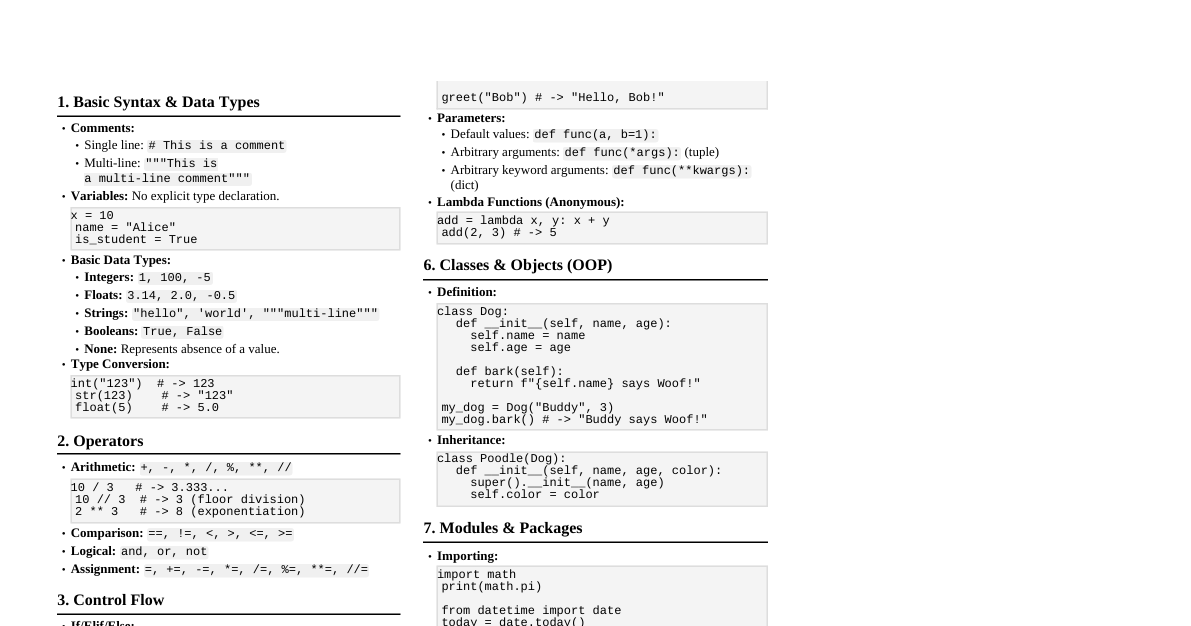
Cheatsheet Content
### Python Language: An Overview The final result or output of the program. In short: Source Code (.py) $\rightarrow$ (Compiled to) $\rightarrow$ Bytecode (.pyc) $\rightarrow$ (Executed by) $\rightarrow$ PVM (Python Virtual Machine) ### Review Questions #### Short Answer Questions #### How to write a comment line in Python? Mention two types. There are two primary ways to write comments in Python: 1. **Single-line Comments:** Use the hash symbol (`#`) to start a comment. Everything after the `#` on that line is ignored by the Python interpreter. ```python # This is a single-line comment x = 10 # This is an inline comment ``` 2. **Multi-line Comments (Docstrings or Block Comments):** While Python doesn't have a specific multi-line comment syntax like `/* ... */` in C++/Java, you can use triple quotes (`'''` or `"""`) for multi-line strings. If these strings are not assigned to a variable, they act as block comments. When placed as the first statement in a module, function, class, or method, they are called docstrings. ```python ''' This is a multi-line comment. It spans across multiple lines. ''' """ This is also a multi-line comment. Often used as a docstring for functions or classes. """ ``` #### List any four flavors of Python. "Flavors" of Python refer to different implementations of the Python language. Here are four common ones: 1. **CPython:** This is the original and most widely used implementation of Python, written in C. When you download and install Python from `python.org`, you are typically getting CPython. 2. **Jython:** An implementation of Python that runs on the Java Virtual Machine (JVM). It allows Python code to seamlessly interact with Java libraries and classes. 3. **IronPython:** An implementation of Python that runs on the .NET Common Language Runtime (CLR). It allows Python code to interact with .NET libraries and frameworks. 4. **PyPy:** A fast and highly compliant alternative implementation of Python, written in Python itself (with some C). It uses a Just-In-Time (JIT) compiler to achieve significant speed improvements over CPython for many types of applications. 5. **MicroPython:** A lean and efficient open-source implementation of the Python 3 programming language that includes a small subset of the Python standard library and is optimized to run on microcontrollers and in embedded systems. #### What is Python Virtual Machine? The **Python Virtual Machine (PVM)** is the runtime engine that executes Python bytecode. When you run a Python script, the CPython interpreter first compiles your human-readable Python code (`.py` file) into an intermediate form called **bytecode** (`.pyc` file). The PVM then takes this bytecode and executes it line by line. The PVM acts as an abstraction layer between your Python code and the underlying hardware. This makes Python a platform-independent language, as the same bytecode can be executed on any system that has a compatible PVM installed. It's similar in concept to the Java Virtual Machine (JVM). #### Give 2 step process of Python program execution. The execution of a Python program (specifically using CPython) generally involves these two steps: 1. **Compilation to Bytecode:** The Python source code (`.py` file) is first compiled into an intermediate low-level format called bytecode. This bytecode is platform-independent and is usually saved in `.pyc` files (Python compiled files) for faster loading in subsequent runs. 2. **Execution by PVM:** The Python Virtual Machine (PVM) then takes this bytecode and interprets it, executing the instructions one by one. The PVM translates the bytecode into machine-specific instructions and interacts with the operating system to perform tasks. #### Long Answer Questions #### Explain any five features of Python. Python is a popular, high-level, interpreted programming language known for its versatility and readability. Here are five key features: 1. **Easy to Learn and Use:** Python has a simple, clean syntax that emphasizes readability, making it relatively easy for beginners to learn. Its structure is clear and concise, reducing the cost of program maintenance. 2. **Interpreted Language:** Python code is executed line by line by an interpreter, rather than being compiled into machine code before runtime. This makes the debugging process easier and faster, as errors are typically caught at runtime. 3. **High-Level Language:** Python abstracts away low-level details like memory management, making it easier for developers to focus on solving problems rather than managing system resources. It supports dynamic typing and automatic garbage collection. 4. **Platform Independent:** Python programs can run on various operating systems (Windows, macOS, Linux, etc.) without modification. This is because the Python interpreter (PVM) handles the translation of bytecode to the specific machine's architecture. 5. **Extensible and Embeddable:** Python can be extended with modules written in other languages like C or C++, allowing developers to integrate high-performance components. Conversely, Python can be embedded into applications written in other languages, enabling scripting functionality. 6. **Large Standard Library:** Python comes with a vast and comprehensive standard library that provides modules and packages for a wide range of tasks, from web development (e.g., `http`, `json`) to data manipulation (e.g., `csv`, `math`) and operating system interfaces (e.g., `os`, `sys`). 7. **Object-Oriented Language:** Python fully supports object-oriented programming (OOP) paradigms, including encapsulation, inheritance, and polymorphism. This allows for modular, reusable, and organized code development. #### Explain any five flavors of Python. As mentioned earlier, "flavors" refer to different implementations of the Python language, each designed for specific environments or performance characteristics. Here are five prominent examples: 1. **CPython:** This is the most common and standard implementation of Python. Developed in C, it's the reference implementation that nearly all Python libraries and frameworks are built upon. When you download Python from `python.org`, you are getting CPython. It's known for its broad compatibility and extensive ecosystem. 2. **Jython:** Jython allows Python code to run on the Java Virtual Machine (JVM). This means Python programs written in Jython can directly import and use Java classes and libraries, offering seamless integration with the Java ecosystem. It's particularly useful for projects that need to leverage existing Java codebases or run within Java applications. 3. **IronPython:** Similar to Jython but for Microsoft's .NET platform, IronPython enables Python code to execute on the Common Language Runtime (CLR). It provides full access to .NET libraries and frameworks, allowing Python developers to build applications for Windows and other .NET environments or integrate Python scripting into .NET applications. 4. **PyPy:** PyPy is an alternative implementation known for its speed. It uses a Just-In-Time (JIT) compiler, which dynamically translates parts of the Python code into machine code during execution, often resulting in significant performance improvements over CPython, especially for long-running processes. PyPy aims for high compatibility with CPython. 5. **MicroPython:** Designed for microcontrollers and embedded systems with limited resources, MicroPython is a highly optimized and lightweight implementation of Python 3. It offers a subset of the Python standard library and is tailored for efficient execution on small hardware, making it popular for IoT devices and hobbyist electronics projects. 6. **Anaconda Python (Distribution):** While not an *implementation* in the same sense as CPython or Jython, Anaconda is a very popular *distribution* of Python (specifically CPython) that comes pre-packaged with a vast collection of scientific computing libraries (like NumPy, Pandas, Scikit-learn, Matplotlib). It simplifies environment management and is widely used in data science, machine learning, and scientific research. *****