Physics Formulas
Shared 3/24/2026•95 views
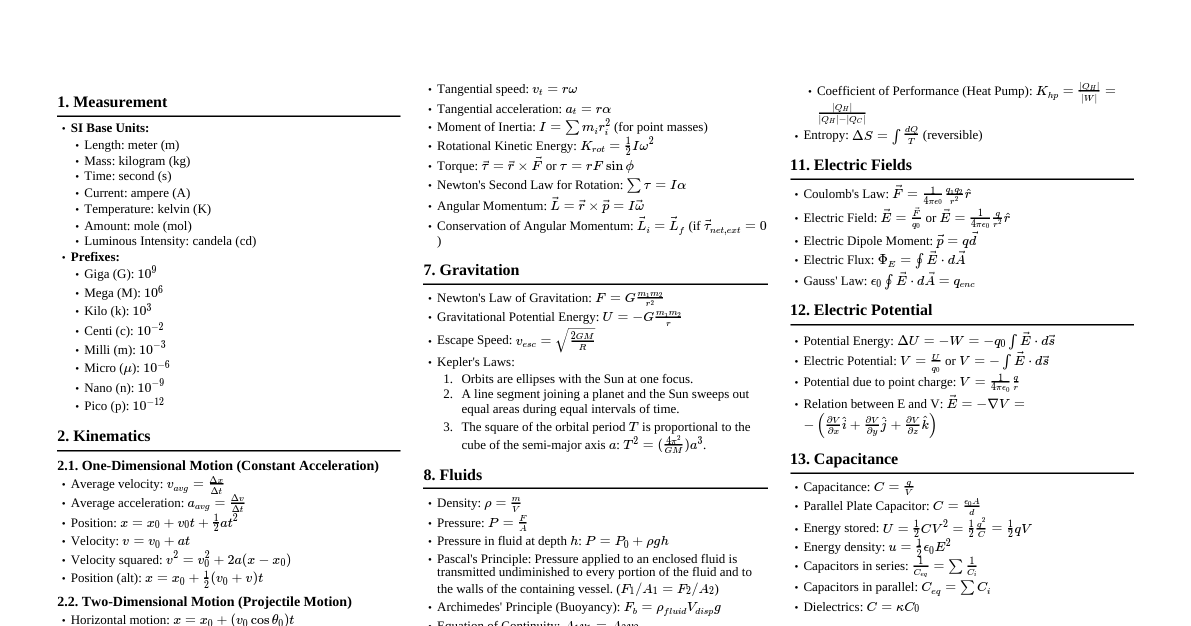
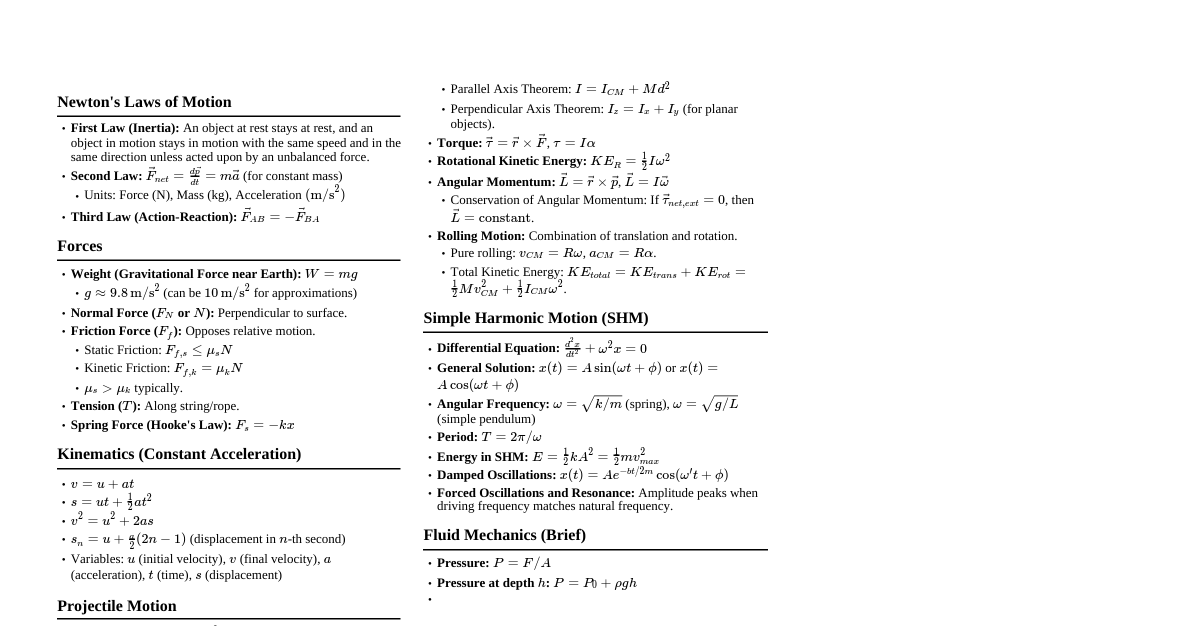
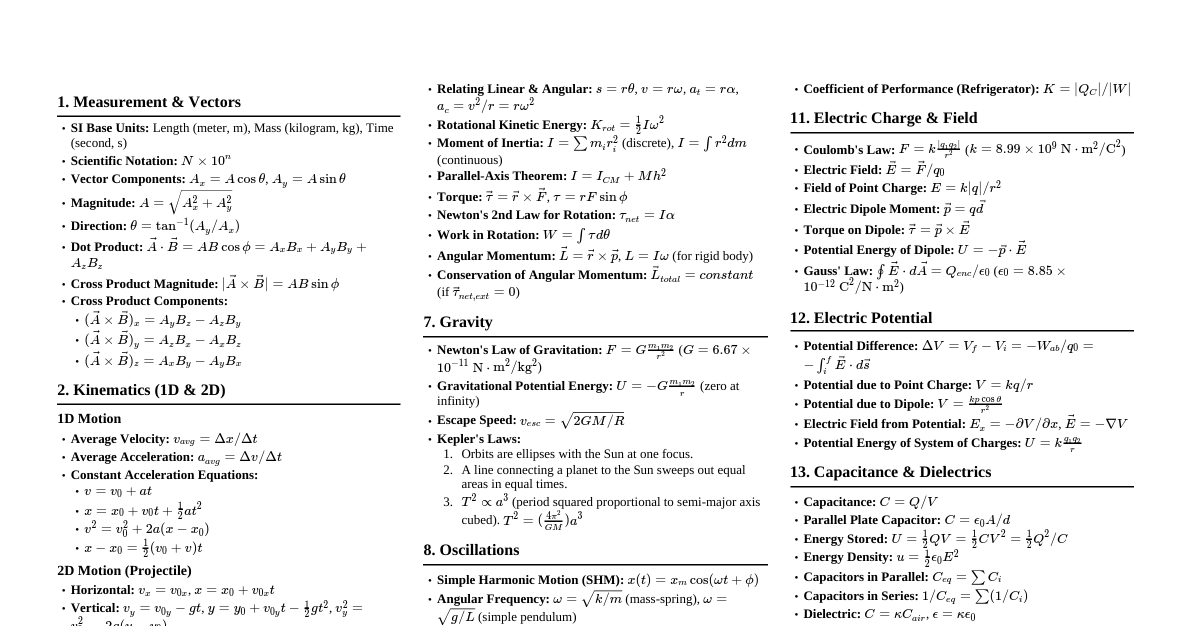
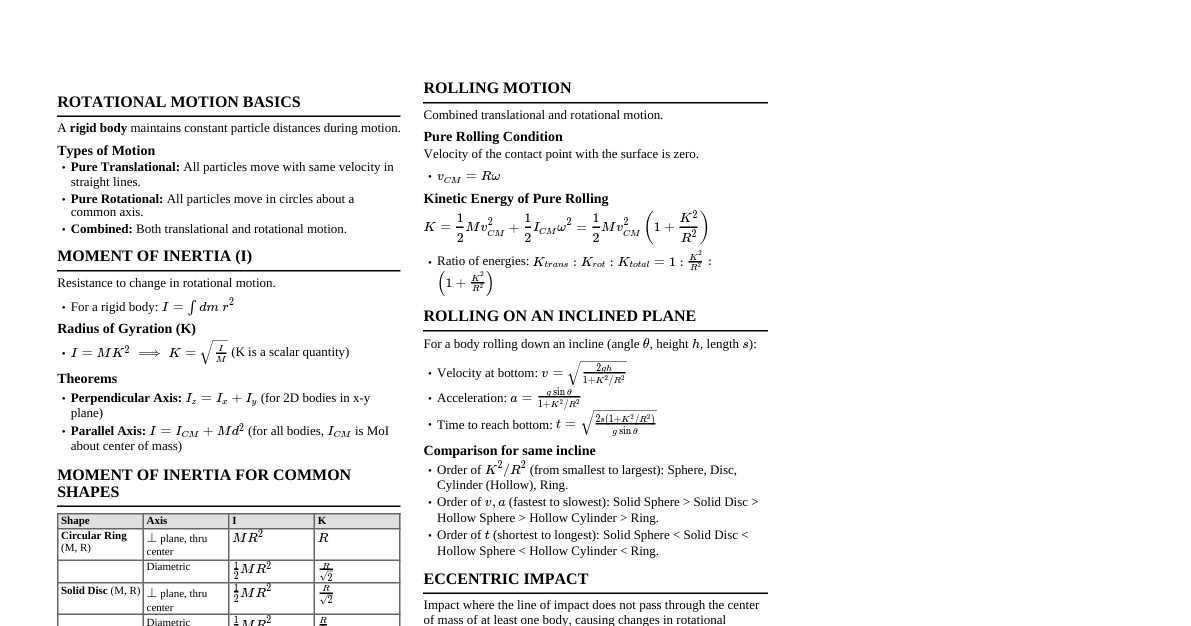
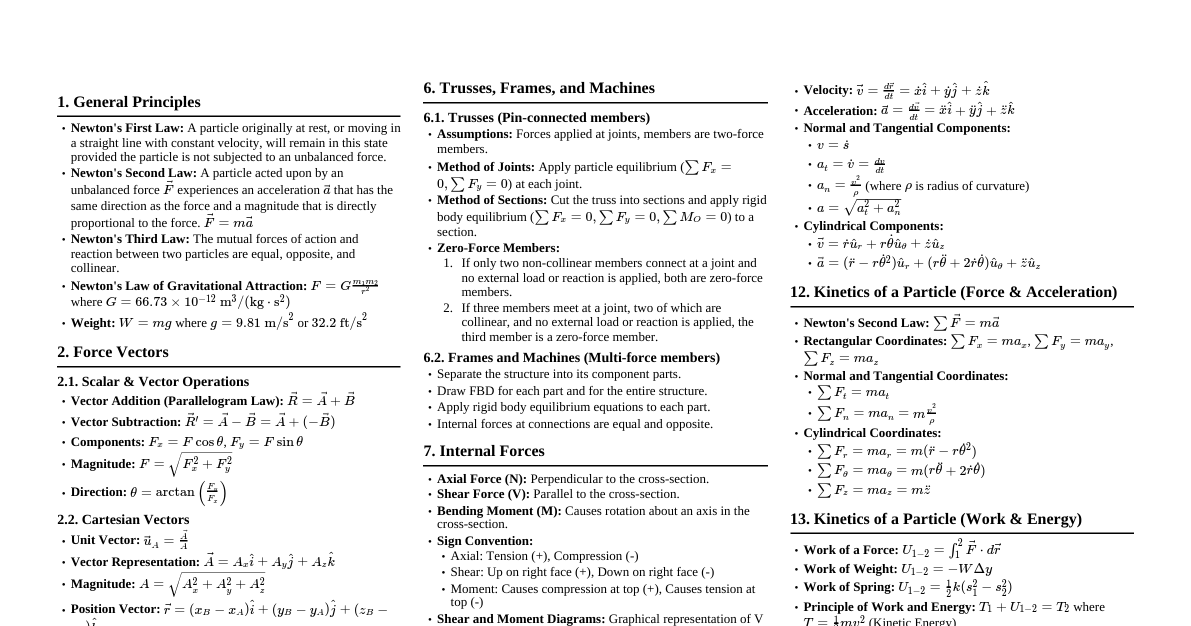
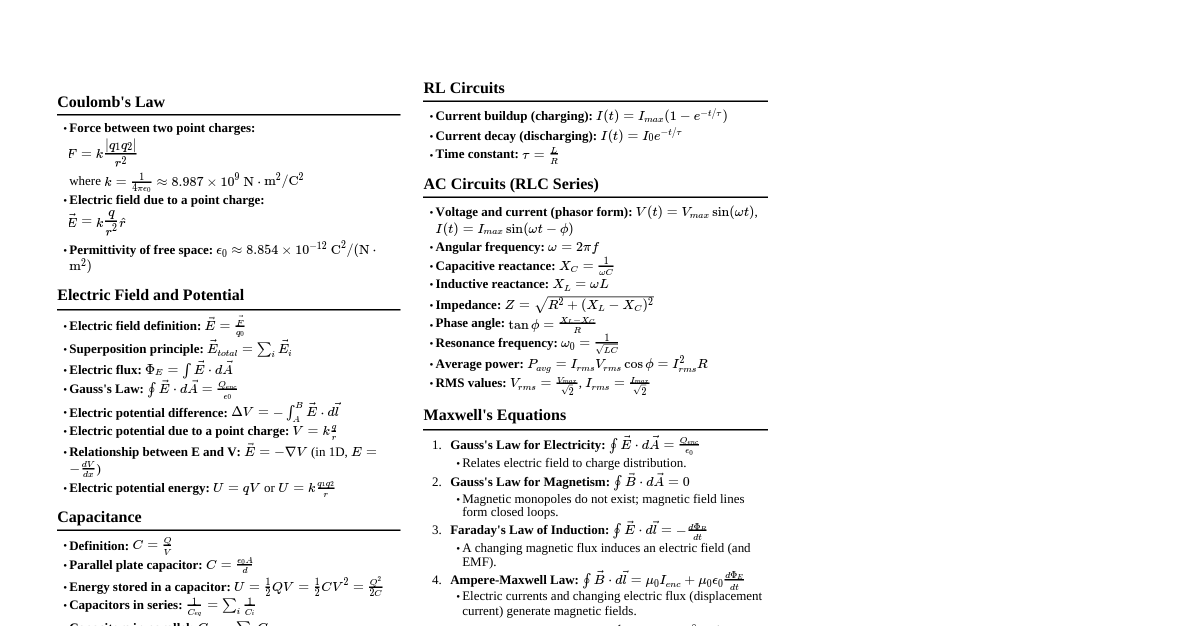
### Mathematical Methods #### Vector Algebra - **Vector Addition (Triangle Law):** $\vec{R} = \vec{A} + \vec{B}$ - **Magnitude of Resultant:** $|\vec{R}| = \sqrt{A^2 + B^2 + 2AB\cos\theta}$ - **Dot Product:** $\vec{A} \cdot \vec{B} = AB\cos\theta = A_x B_x + A_y B_y + A_z B_z$ - **Cross Product:** $\vec{A} \times \vec{B} = (A_y B_z - A_z B_y)\hat{i} + (A_z B_x - A_x B_z)\hat{j} + (A_x B_y - A_y B_x)\hat{k}$ - **Magnitude of Cross Product:** $|\vec{A} \times \vec{B}| = AB\sin\theta$ #### Calculus Essentials - **Derivative (Power Rule):** $\frac{d}{dx}(x^n) = nx^{n-1}$ - **Derivative (Chain Rule):** $\frac{d}{dx}[f(g(x))] = f'(g(x))g'(x)$ - **Integral (Power Rule):** $\int x^n dx = \frac{x^{n+1}}{n+1} + C \quad (n \ne -1)$ - **Definite Integral:** $\int_a^b f(x) dx = F(b) - F(a)$ #### Quadratic Equation - **Roots:** $x = \frac{-b \pm \sqrt{b^2 - 4ac}}{2a}$ for $ax^2 + bx + c = 0$ ### Motion in a Plane #### Projectile Motion - **Horizontal Range:** $R = \frac{u^2 \sin(2\theta)}{g}$ - **Maximum Height:** $H = \frac{u^2 \sin^2\theta}{2g}$ - **Time of Flight:** $T = \frac{2u \sin\theta}{g}$ - **Equation of Trajectory:** $y = x\tan\theta - \frac{gx^2}{2u^2\cos^2\theta}$ #### Uniform Circular Motion - **Angular Displacement:** $\Delta\theta = \frac{\Delta s}{r}$ - **Angular Velocity:** $\omega = \frac{d\theta}{dt} = \frac{v}{r}$ - **Angular Acceleration:** $\alpha = \frac{d\omega}{dt} = \frac{a_t}{r}$ - **Centripetal Acceleration:** $a_c = \frac{v^2}{r} = \omega^2 r$ - **Centripetal Force:** $F_c = \frac{mv^2}{r} = m\omega^2 r$ #### Relative Velocity (2D) - $\vec{v}_{AB} = \vec{v}_A - \vec{v}_B$ ### Laws of Motion #### Newton's Laws - **First Law (Inertia):** An object in motion stays in motion with the same speed and in the same direction unless acted upon by an unbalanced force. - **Second Law (Force):** $\vec{F} = m\vec{a}$ - **Third Law (Action-Reaction):** For every action, there is an equal and opposite reaction. #### Friction - **Static Friction:** $f_s \le \mu_s N$ - **Kinetic Friction:** $f_k = \mu_k N$ #### Work, Energy, and Power - **Work Done:** $W = \vec{F} \cdot \vec{d} = Fd\cos\theta$ - **Kinetic Energy:** $K = \frac{1}{2}mv^2$ - **Potential Energy (Gravitational):** $U_g = mgh$ - **Work-Energy Theorem:** $W_{net} = \Delta K$ - **Power:** $P = \frac{dW}{dt} = \vec{F} \cdot \vec{v}$ #### Collisions - **Impulse:** $\vec{J} = \Delta\vec{p} = \vec{F}_{avg}\Delta t$ - **Conservation of Momentum:** $m_1\vec{u}_1 + m_2\vec{u}_2 = m_1\vec{v}_1 + m_2\vec{v}_2$ (for isolated system) - **Coefficient of Restitution (e):** $e = \frac{\text{relative velocity after collision}}{\text{relative velocity before collision}} = \frac{v_2 - v_1}{u_1 - u_2}$ - **Elastic Collision:** $e=1$ (Kinetic energy conserved) - **Inelastic Collision:** $0 ### Thermal Properties of Matter #### Temperature and Heat - **Temperature Conversion:** - $T_F = \frac{9}{5}T_C + 32$ - $T_K = T_C + 273.15$ - **Heat Transfer (Specific Heat):** $Q = mc\Delta T$ - **Latent Heat (Phase Change):** $Q = mL$ #### Thermal Expansion - **Linear Expansion:** $\Delta L = L_0 \alpha \Delta T$ - **Area Expansion:** $\Delta A = A_0 \beta \Delta T \approx 2A_0 \alpha \Delta T$ - **Volume Expansion:** $\Delta V = V_0 \gamma \Delta T \approx 3V_0 \alpha \Delta T$ #### Heat Transfer Mechanisms - **Conduction:** $P = \frac{kA(T_H - T_C)}{L}$ - **Convection:** (Complex, no simple universal formula for all cases) - **Radiation (Stefan-Boltzmann Law):** $P = e\sigma A T^4$ #### Ideal Gas Law - $PV = nRT = NkT$ - R = Universal Gas Constant ($8.314 \text{ J/mol}\cdot\text{K}$) - k = Boltzmann Constant ($1.38 \times 10^{-23} \text{ J/K}$) #### Thermodynamics - **First Law of Thermodynamics:** $\Delta U = Q - W$ - (Q = Heat added to system, W = Work done BY system) ### Ray Optics #### Reflection - **Law of Reflection:** Angle of incidence = Angle of reflection ($\theta_i = \theta_r$) - **Mirror Formula (Spherical Mirrors):** $\frac{1}{f} = \frac{1}{u} + \frac{1}{v}$ - $f = R/2$ (for concave mirror, f is negative; for convex, f is positive) - **Magnification:** $m = -\frac{v}{u} = \frac{h_i}{h_o}$ #### Refraction - **Snell's Law:** $n_1 \sin\theta_1 = n_2 \sin\theta_2$ - **Critical Angle:** $\sin\theta_c = \frac{n_2}{n_1}$ (for $n_1 > n_2$) - **Lens Maker's Formula:** $\frac{1}{f} = (n-1)\left(\frac{1}{R_1} - \frac{1}{R_2}\right)$ - **Lens Formula (Thin Lenses):** $\frac{1}{f} = \frac{1}{v} - \frac{1}{u}$ - **Power of a Lens:** $P = \frac{1}{f}$ (in diopters, f in meters) - **Magnification (Lenses):** $m = \frac{v}{u} = \frac{h_i}{h_o}$ #### Simple Microscope - **Magnifying Power (Image at infinity):** $M = \frac{D}{f}$ - **Magnifying Power (Image at near point, D):** $M = 1 + \frac{D}{f}$ - D = Least distance of distinct vision (typically 25 cm)