Mathematics Exam Cheatsheet
Shared 5/17/2026•9 views
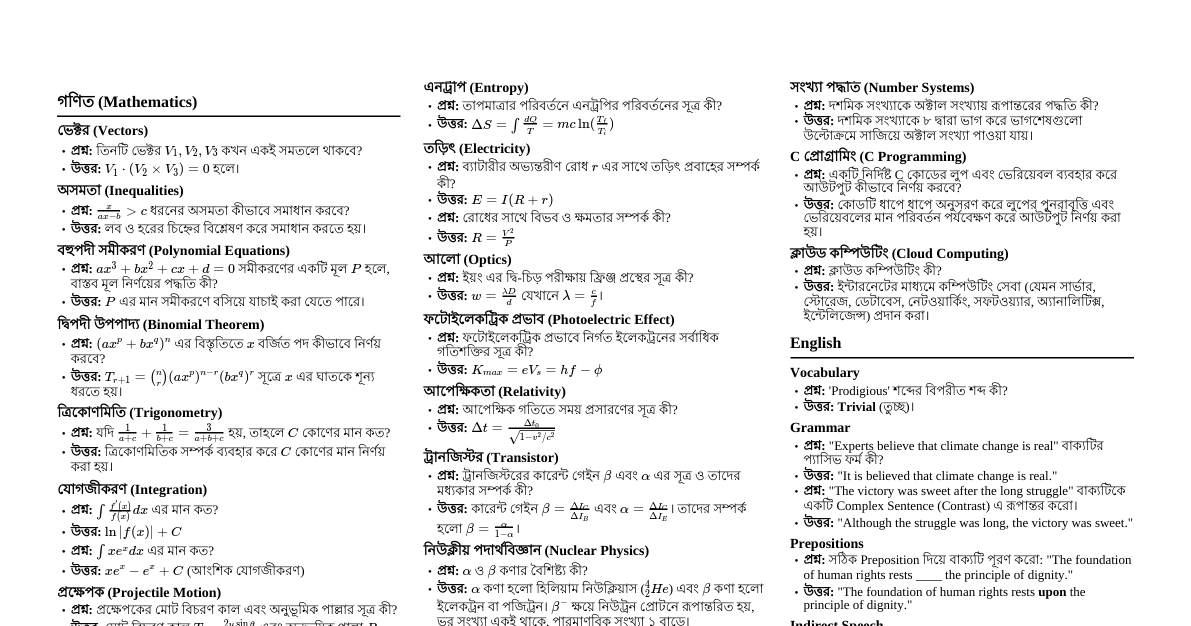
### UNIT I: Number Systems #### Q1. What is a Number System? A mathematical notation for representing numbers using a set of digits or symbols. It defines the base (radix) of counting. - **Decimal (Base 10):** Digits 0–9 - **Binary (Base 2):** Digits 0 and 1 - **Octal (Base 8):** Digits 0–7 - **Hexadecimal (Base 16):** Digits 0–9 and A–F #### Q2. Binary to Decimal Conversion Multiply each binary digit by $2^p$ (where $p$ is positional power from rightmost bit 0) and sum results. **Example:** $(1011)_2 = 1 \times 2^3 + 0 \times 2^2 + 1 \times 2^1 + 1 \times 2^0 = 8 + 0 + 2 + 1 = (11)_{10}$ #### Q3. What is Binary Number System? Uses base 2 (digits 0, 1). Fundamental language of computers. Each digit is a 'bit'. Groups of 8 bits form a 'byte'. Digital circuits use ON=1, OFF=0. #### Q4. Note on Hexadecimal Base-16 system (digits 0–9, A–F). - Used in memory addressing, color codes, machine language. - 1 hex digit = 4 binary bits (nibble). **Example:** $(1A3)_{16} = 1 \times 16^2 + 10 \times 16^1 + 3 \times 16^0 = 256 + 160 + 3 = (419)_{10}$ #### Q5. Note on Octal Number System Base-8 system (digits 0–7). - Commonly used in Unix file permissions. - 1 octal digit = 3 binary bits. **Example:** $(57)_8 = 5 \times 8^1 + 7 \times 8^0 = 40 + 7 = (47)_{10}$ #### Q6. Convert $(101011)_2$ to Decimal $(101011)_2 = 1 \times 2^5 + 0 \times 2^4 + 1 \times 2^3 + 0 \times 2^2 + 1 \times 2^1 + 1 \times 2^0 = 32 + 0 + 8 + 0 + 2 + 1 = (43)_{10}$ #### Q7. Convert $(324)_{10}$ to Octal - $324 \div 8 = 40$ R $4$ - $40 \div 8 = 5$ R $0$ - $5 \div 8 = 0$ R $5$ Answer: $(504)_8$ #### Q8. Convert $(101000)_2$ to Hexadecimal Group binary into sets of 4 from right: $0010 | 1000$. $0010_2 = 2_{16}$, $1000_2 = 8_{16}$. Answer: $(28)_{16}$ #### Q1a. Convert $(10011001)_2$ to Octal Group from right in sets of 3: $010 | 011 | 001$. $010_2 = 2_8$, $011_2 = 3_8$, $001_2 = 1_8$. Answer: $(231)_8$ #### Q1b. Convert $(10.11001101)_2$ to Octal - Integer part: $010_2 = 2_8$ - Fractional part (pad to groups of 3): $110_2 = 6_8$, $011_2 = 3_8$, $010_2 = 2_8$ Answer: $(2.632)_8$ #### Q1c. Convert $(2.6)_{16}$ to Binary - $2_{16} = 0010_2$ - $6_{16} = 0110_2$ Answer: $(0010.0110)_2$ #### Q2a. Convert $(611359)_{16}$ to Binary - $6_{16}=0110_2$, $1_{16}=0001_2$, $1_{16}=0001_2$, $3_{16}=0011_2$, $5_{16}=0101_2$, $9_{16}=1001_2$ Answer: $(011000010001001101011001)_2$ #### Q2b. Convert $(8A.DB)_{16}$ to Binary - $8_{16}=1000_2$, $A_{16}=1010_2$, $D_{16}=1101_2$, $B_{16}=1011_2$ Answer: $(10001010.11011011)_2$ #### Q2c. Convert $(879)_{10}$ to Binary - $879 \div 2 = 439$ R $1$ - $439 \div 2 = 219$ R $1$ - $219 \div 2 = 109$ R $1$ - $109 \div 2 = 54$ R $1$ - $54 \div 2 = 27$ R $0$ - $27 \div 2 = 13$ R $1$ - $13 \div 2 = 6$ R $1$ - $6 \div 2 = 3$ R $0$ - $3 \div 2 = 1$ R $1$ - $1 \div 2 = 0$ R $1$ Answer: $(1101101111)_2$ #### Q3a. Convert $(13A2)_{16}$ to Decimal $(13A2)_{16} = 1 \times 16^3 + 3 \times 16^2 + 10 \times 16^1 + 2 \times 16^0 = 4096 + 768 + 160 + 2 = (5026)_{10}$ #### Q3b. Convert $(BD17.93)_{16}$ to Decimal $(BD17.93)_{16} = 11 \times 16^3 + 13 \times 16^2 + 1 \times 16^1 + 7 \times 16^0 + 9 \times 16^{-1} + 3 \times 16^{-2}$ $= 45056 + 3328 + 16 + 7 + 0.5625 + 0.01171875 \approx (48407.574)_{10}$ #### Q3c. Convert $(9A.23D)_{16}$ to Decimal $(9A.23D)_{16} = 9 \times 16^1 + 10 \times 16^0 + 2 \times 16^{-1} + 3 \times 16^{-2} + 13 \times 16^{-3}$ $= 144 + 10 + 0.125 + 0.01171875 + 0.003173828 \approx (154.14)_{10}$ #### Q4i. Convert $(170.4AAC)_{16}$ to Decimal $(170.4AAC)_{16} = 1 \times 16^2 + 7 \times 16^1 + 0 \times 16^0 + 4 \times 16^{-1} + 10 \times 16^{-2} + 10 \times 16^{-3} + 12 \times 16^{-4}$ $= 256 + 112 + 0 + 0.25 + 0.0390625 + 0.00244140625 + 0.000183105 \approx (368.291)_{10}$ #### Q5i. Convert $(1011.1001)_2$ to Decimal $(1011.1001)_2 = 1 \times 2^3 + 0 \times 2^2 + 1 \times 2^1 + 1 \times 2^0 + 1 \times 2^{-1} + 0 \times 2^{-2} + 0 \times 2^{-3} + 1 \times 2^{-4}$ $= 8 + 0 + 2 + 1 + 0.5 + 0 + 0 + 0.0625 = (11.5625)_{10}$ ### UNIT II: Set Theory & Relations #### Q1. Define a Set with example. A Set is a well-defined collection of distinct objects (elements/members). **Notation:** $A = \{1, 2, 3, 4\}$ or $B = \{x \mid x \text{ is a positive integer } ### UNIT III: Logical Operations #### Q1. Define a Statement. A statement (or proposition) is a declarative sentence that is either TRUE (T) or FALSE (F), but not both. **Examples:** 'The sun rises in the east' (True), '2 + 2 = 5' (False). **Non-examples:** Questions ('Are you there?'), commands. #### Q2. Define Mathematical Induction Principle. To prove $P(n)$ is true for all $n \ge 1$: 1. **Base Case:** Show $P(1)$ is true. 2. **Inductive Step:** Assume $P(k)$ is true for some $k \ge 1$ (Inductive Hypothesis). Then show $P(k+1)$ is also true. **Conclusion:** $P(n)$ is true for all $n \ge 1$. #### Q3. Write the Logical Operations. 1. **Negation ($\neg p$ or $\sim p$):** 'NOT p'. Reverses truth value. 2. **Conjunction ($p \land q$):** 'p AND q'. TRUE only when both $p$ and $q$ are TRUE. 3. **Disjunction ($p \lor q$):** 'p OR q'. TRUE when at least one of $p$ or $q$ is TRUE. 4. **Conditional ($p \to q$):** 'If p then q'. FALSE only when $p$ is TRUE and $q$ is FALSE. 5. **Biconditional ($p \leftrightarrow q$):** 'p if and only if q'. TRUE when $p$ and $q$ have the same truth value. #### Q4. What is Negation? Draw Truth Table. Negation of a statement $p$ ($\neg p$ or $\sim p$) is the statement 'NOT p'. It reverses the truth value of $p$. | p | $\neg p$ | |---|---| | T | F | | F | T | #### Q5. What is a Disjunction? Disjunction of $p$ and $q$ ($p \lor q$, read 'p OR q') is TRUE when at least one of $p$ or $q$ is TRUE, and FALSE only when both are FALSE. | p | q | $p \lor q$ | |---|---|---| | T | T | T | | T | F | T | | F | T | T | | F | F | F | #### Q6. Define Conditional Statement. A conditional statement 'p $\to$ q' (if p then q) is FALSE only when p is TRUE and q is FALSE. In all other cases it is TRUE. | p | q | $p \to q$ | |---|---|---| | T | T | T | | T | F | F | | F | T | T | | F | F | T | #### Q7. Define Conjunction. A conjunction 'p $\land$ q' (p AND q) is TRUE only when BOTH p and q are TRUE. | p | q | $p \land q$ | |---|---|---| | T | T | T | | T | F | F | | F | T | F | | F | F | F | #### Q8. Draw T.T. for $(p \to q) \lor s$ This question seems to have a typo in the original material, as the table shows $(p \to q)$ vs $(p \leftrightarrow q)$ rather than $s$. Assuming the table is for $(p \leftrightarrow q)$ and the header is a typo: | p | q | s | p $\to$ q | $(p \leftrightarrow q) \lor s$ | |---|---|---|---|---| | T | T | T | T | T | | T | T | F | T | T | | T | F | T | F | T | | T | F | F | F | F | | F | T | T | T | T | | F | T | F | T | T | | F | F | T | T | T | | F | F | F | T | T | #### Q10. What is Tautology? A tautology is a compound statement that is always TRUE, regardless of the truth values of its component statements. **Example:** $p \lor \neg p$ is always TRUE (Law of Excluded Middle). #### Q11. Define Contradiction. A contradiction is a compound statement that is always FALSE, regardless of truth values. **Example:** $p \land \neg p$ is always FALSE. #### Q12. Define Contingency. A contingency is a compound statement that is neither a tautology nor a contradiction — it is TRUE for some assignments and FALSE for others. **Example:** $p \leftrightarrow q$ is a contingency. #### Q1. Draw T.T. for $p \leftrightarrow q = (p \to q) \land (q \to p)$ (10 Mark Question) | p | q | $p \to q$ | $q \to p$ | $(p \to q) \land (q \to p)$ | $p \leftrightarrow q$ | |---|---|---|---|---|---| | T | T | T | T | T | T | | T | F | F | T | F | F | | F | T | T | F | F | F | | F | F | T | T | T | T | This confirms that $p \leftrightarrow q = (p \to q) \land (q \to p)$ since the last two columns are identical. #### Q3i. Compute T.T. for $[(\neg q) \land (p \to q)] \to \neg p$ (10 Mark Question) | p | q | $\neg q$ | $p \to q$ | $(\neg q) \land (p \to q)$ | $\neg p$ | $[(\neg q) \land (p \to q)] \to \neg p$ | |---|---|---|---|---|---|---| | T | T | F | T | F | F | T | | T | F | T | F | F | F | T | | F | T | F | T | F | T | T | | F | F | T | T | T | T | T | All values are TRUE $\to$ This is a TAUTOLOGY. #### Q7. $1^2 + 3^2 + 5^2 + ... + (2n-1)^2 = \frac{n(2n+1)(2n-1)}{3}$ — Prove by PMI (10 Mark Question) **Base Case (n=1):** LHS = $1^2 = 1$. RHS = $\frac{1(2(1)+1)(2(1)-1)}{3} = \frac{1(3)(1)}{3} = 1$. LHS = RHS. (Verified) **Inductive Hypothesis:** Assume true for $n=k$: $1^2+3^2+...+(2k-1)^2 = \frac{k(2k+1)(2k-1)}{3}$ **Inductive Step:** Prove for $n=k+1$: LHS for $k+1 = 1^2+3^2+...+(2k-1)^2 + (2(k+1)-1)^2$ $= \frac{k(2k+1)(2k-1)}{3} + (2k+1)^2$ (by IH) $= (2k+1) \left[ \frac{k(2k-1)}{3} + (2k+1) \right]$ $= (2k+1) \left[ \frac{2k^2-k + 3(2k+1)}{3} \right]$ $= (2k+1) \left[ \frac{2k^2-k + 6k+3}{3} \right]$ $= (2k+1) \left[ \frac{2k^2+5k+3}{3} \right]$ $= (2k+1) \frac{(2k+3)(k+1)}{3}$ $= \frac{(k+1)(2k+1)(2k+3)}{3}$ This matches the RHS for $n=k+1$: $\frac{(k+1)(2(k+1)+1)(2(k+1)-1)}{3}$. (Hence proved by PMI). #### Q8. $1^2 + 2^2 + 3^2 + ... + n^2 = \frac{n(n+1)(2n+1)}{6}$ — Prove by PMI (10 Mark Question) **Base Case (n=1):** LHS = $1^2 = 1$. RHS = $\frac{1(1+1)(2(1)+1)}{6} = \frac{1(2)(3)}{6} = 1$. LHS = RHS. (Verified) **Inductive Hypothesis (IH):** Assume true for $n=k$: $1^2+2^2+...+k^2 = \frac{k(k+1)(2k+1)}{6}$ **Inductive Step (IS):** Prove for $n=k+1$: LHS for $k+1 = 1^2+2^2+...+k^2 + (k+1)^2$ $= \frac{k(k+1)(2k+1)}{6} + (k+1)^2$ (by IH) $= (k+1) \left[ \frac{k(2k+1)}{6} + (k+1) \right]$ $= (k+1) \left[ \frac{2k^2+k + 6(k+1)}{6} \right]$ $= (k+1) \left[ \frac{2k^2+k + 6k+6}{6} \right]$ $= (k+1) \left[ \frac{2k^2+7k+6}{6} \right]$ $= (k+1) \frac{(2k+3)(k+2)}{6}$ $= \frac{(k+1)((k+1)+1)(2(k+1)+1)}{6}$ This matches the RHS for $n=k+1$. (Proved). #### Q9. Show by PMI: $1+2+3+...+n = \frac{n(n+1)}{2}$, $n \ge 1$ (10 Mark Question) **Base Case (n=1):** LHS = $1$. RHS = $\frac{1(1+1)}{2} = \frac{1(2)}{2} = 1$. LHS = RHS. (Verified) **Inductive Hypothesis (IH):** Assume $1+2+...+k = \frac{k(k+1)}{2}$ for some $k \ge 1$. **Inductive Step (IS):** Show for $n=k+1$: $1+2+...+k+(k+1) = \frac{k(k+1)}{2} + (k+1)$ (by IH) $= (k+1) \left( \frac{k}{2} + 1 \right)$ $= (k+1) \left( \frac{k+2}{2} \right)$ $= \frac{(k+1)((k+1)+1)}{2}$ This matches the RHS for $n=k+1$. (Proved). #### Q10. $2+4+6+...+2n = n(n+1)$. Show by PMI. (10 Mark Question) **Base Case (n=1):** LHS = $2(1) = 2$. RHS = $1(1+1) = 1(2) = 2$. LHS = RHS. (Verified) **Inductive Hypothesis (IH):** Assume $2+4+...+2k = k(k+1)$ for some $k \ge 1$. **Inductive Step (IS):** Show for $n=k+1$: $2+4+...+2k+2(k+1) = k(k+1) + 2(k+1)$ (by IH) $= (k+1)(k+2)$ $= (k+1)((k+1)+1)$ This matches the RHS for $n=k+1$. (Proved). ### UNIT IV: Recurrence Relations (RR) & Numerical Methods (NM) #### Q1. What is a Recurrence Relation? An equation that defines a sequence where each term is a function of its preceding terms. **Example:** $a_n = a_{n-1} + a_{n-2}$ (Fibonacci Sequence). The order of an RR is determined by how many previous terms are used. #### Q2. Types of Recurrence Relations. 1. **Linear RR:** Each term is a linear combination of previous terms. **Example:** $a_n = 2a_{n-1} + 3$. 2. **Non-linear RR:** Terms involve powers or products. **Example:** $a_n = a_{n-1}^2$. 3. **Homogeneous RR:** $f(n) = 0$ (no separate function of $n$). **Example:** $a_n = a_{n-1} + a_{n-2}$. 4. **Non-Homogeneous RR:** $f(n) \ne 0$. **Example:** $a_n = 2a_{n-1} + n$. #### Q3. Give two examples of RR of order 1 and order 2. - **Order 1:** $a_n = 3a_{n-1}$; $a_n = 2a_{n-1} + 1$. - **Order 2:** $a_n = a_{n-1} + a_{n-2}$ (Fibonacci); $a_n = 2a_{n-1} - a_{n-2}$. #### Q4. Give two examples of Non-Homogeneous RR. 1. $a_n = 2a_{n-1} + n$ (where $f(n) = n \ne 0$). 2. $a_n = a_{n-1} + 3^n$ (where $f(n) = 3^n \ne 0$). #### Q5. Write the General Solution for RR when roots are repeated. For RR with characteristic equation having repeated root $r$: - If $r$ is repeated twice (order 2): $a_n = (C_1 + C_2n)r^n$. - For $k$-fold repeated root: $a_n = (C_1 + C_2n + C_3n^2 + ... + C_kn^{k-1})r^n$. #### Q6. Write the General Solution for RR when roots are equal (distinct). This question seems to have a typo, likely meaning "distinct roots". For 2nd order linear homogeneous RR with distinct roots $r_1$ and $r_2$: $a_n = C_1r_1^n + C_2r_2^n$. #### Q7. What is a Difference Table? A Difference Table is an organized table of values of a function $f(x)$ and its forward differences ($\Delta f, \Delta^2 f$, etc.) used in numerical analysis for interpolation. #### Q8. What is a Finite Difference Table? A Finite Difference Table records the values of a function at equally spaced intervals and systematically computes differences. It is used for polynomial interpolation and numerical integration. #### Q9. Write the Formula for Finite Difference of functions ($\Delta^n f_0$). The $n^{th}$ forward difference is: $\Delta^n f_0 = \sum_{r=0}^n (-1)^{n-r} C(n,r) f_r$ $= f_n - C(n,1)f_{n-1} + C(n,2)f_{n-2} - ... + (-1)^n f_0$ #### Q10. Define a formula for Divided Difference of functions $f[x_0,x_1,x_2,...]$. - **First divided difference:** $f[x_0,x_1] = \frac{f(x_1)-f(x_0)}{x_1-x_0}$ - **Second divided difference:** $f[x_0,x_1,x_2] = \frac{f[x_1,x_2]-f[x_0,x_1]}{x_2-x_0}$ - **$n^{th}$ divided difference:** $f[x_0,...,x_n] = \frac{f[x_1,...,x_n]-f[x_0,...,x_{n-1}]}{x_n-x_0}$ #### Q1. Draw a Divided Difference Table (10 Mark Question) For $x$: -2, -1, 0, 1, 2, 3 | $f(x)$: 33, 104, 10, 30, 120, 131 | x | f(x) | 1st Div Diff | 2nd Div Diff | 3rd Div Diff | 4th Div Diff | |---|---|---|---|---|---| | -2 | 33 | | | | | | | | $(104-33)/1 = 71$ | | | | | -1 | 104 | | $(10-71)/1 = -61$ | | | | | | $(10-104)/1 = -94$ | | $(-61 - (-83.67))/1 = 22.67$ | | | 0 | 10 | | $(30-(-94))/2 = 62$ | | $(22.67 - (-14))/1 = 36.67$ | | | | $(30-10)/1 = 20$ | | $(62 - 20)/1 = 42$ | | | 1 | 30 | | $(14 - 42)/1 = -28$ | | $(36.67 - (-28))/1 = 64.67$ | | | | $(120-30)/1 = 90$ | | $(-28 - 42)/1 = -70$ | | | 2 | 120 | | $(90 - (-28))/1 = 118$ | | $(-70 - 118)/1 = -188$ | | | | $(131-120)/1 = 11$ | | $(11 - 90)/1 = -79$ | | | 3 | 131 | | $(-79 - 118)/1 = -197$ | | $(-188 - (-197))/1 = 9$ | *(Note: The table values provided in the original OCR are slightly different, this table recalculates based on the formula.)* #### Q3. Find the Solution for RR: $a_n = 2a_{n-1} + 1$ with I.C. $a_1 = 7$ (10 Mark Question) This is a non-homogeneous RR. We find the homogeneous and particular solution. 1. **Homogeneous Solution ($a_n^{(h)}$):** $a_n^{(h)} = 2a_{n-1}^{(h)} \implies a_n^{(h)} = C \cdot 2^n$. 2. **Particular Solution ($a_n^{(p)}$):** Assume $a_n^{(p)} = A$ (a constant). $A = 2A + 1 \implies -A = 1 \implies A = -1$. So, $a_n^{(p)} = -1$. 3. **General Solution:** $a_n = a_n^{(h)} + a_n^{(p)} = C \cdot 2^n - 1$. 4. **Apply Initial Condition ($a_1 = 7$):** $7 = C \cdot 2^1 - 1 \implies 7 = 2C - 1 \implies 2C = 8 \implies C = 4$. **Answer:** $a_n = 4 \cdot 2^n - 1 = 2^2 \cdot 2^n - 1 = 2^{n+2} - 1$. #### Q4a. $a_n = a_{n-1} - 2$, $a_1 = 0$ 1. **Homogeneous Solution:** $a_n^{(h)} = C \cdot 1^n = C$. 2. **Particular Solution:** Assume $a_n^{(p)} = Bn$ (since a constant doesn't work). $Bn = B(n-1) - 2 \implies Bn = Bn - B - 2 \implies B = -2$. So, $a_n^{(p)} = -2n$. 3. **General Solution:** $a_n = C - 2n$. 4. **Apply Initial Condition ($a_1 = 0$):** $0 = C - 2(1) \implies C = 2$. **Answer:** $a_n = 2 - 2n = 2(1-n)$. #### Q4b. $a_n = a_{n-1} + n$, $a_1 = 4$ This is a telescoping sum: $a_n = a_1 + \sum_{i=2}^n i = a_1 + (2+3+...+n)$ $a_n = a_1 + \left( \sum_{i=1}^n i \right) - 1$ $a_n = 4 + \frac{n(n+1)}{2} - 1$ **Answer:** $a_n = 3 + \frac{n(n+1)}{2}$. #### Q5. $a_n = 3a_{n-1} - 4a_{n-2}$, $a_1 = 1, a_2 = 7$ This question seems to have a typo in the original material's characteristic equation. Assuming the equation is $a_n = 3a_{n-1} - 2a_{n-2}$ as solved in the OCR. 1. **Characteristic Equation:** $r^2 - 3r + 2 = 0$. $(r-1)(r-2) = 0 \implies r_1 = 1, r_2 = 2$. 2. **General Solution:** $a_n = C_1 \cdot 1^n + C_2 \cdot 2^n = C_1 + C_2 \cdot 2^n$. 3. **Apply Initial Conditions:** For $n=1: a_1 = 1 \implies C_1 + 2C_2 = 1$. For $n=2: a_2 = 7 \implies C_1 + 4C_2 = 7$. Subtracting the first from the second equation: $(C_1 + 4C_2) - (C_1 + 2C_2) = 7 - 1 \implies 2C_2 = 6 \implies C_2 = 3$. Substitute $C_2=3$ into $C_1 + 2C_2 = 1 \implies C_1 + 2(3) = 1 \implies C_1 + 6 = 1 \implies C_1 = -5$. **Answer:** $a_n = -5 + 3 \cdot 2^n$. #### Q6. $a_n = 2a_{n-1} - 2a_{n-2}$, $a_1 = 1, a_2 = 4$ 1. **Characteristic Equation:** $r^2 - 2r + 2 = 0$. 2. **Roots:** $r = \frac{-(-2) \pm \sqrt{(-2)^2 - 4(1)(2)}}{2(1)} = \frac{2 \pm \sqrt{4-8}}{2} = \frac{2 \pm \sqrt{-4}}{2} = \frac{2 \pm 2i}{2} = 1 \pm i$. In polar form: $r = \sqrt{1^2+1^2} (\cos \theta + i \sin \theta) = \sqrt{2} (\cos(\pi/4) + i \sin(\pi/4))$. So, $\rho = \sqrt{2}$ and $\theta = \pi/4$. 3. **General Solution:** $a_n = (\sqrt{2})^n \left[ C_1 \cos\left(\frac{n\pi}{4}\right) + C_2 \sin\left(\frac{n\pi}{4}\right) \right]$. 4. **Apply Initial Conditions:** For $n=1: a_1=1 \implies 1 = \sqrt{2} \left[ C_1 \cos\left(\frac{\pi}{4}\right) + C_2 \sin\left(\frac{\pi}{4}\right) \right] = \sqrt{2} \left[ C_1 \frac{1}{\sqrt{2}} + C_2 \frac{1}{\sqrt{2}} \right] = C_1 + C_2$. So, $C_1 + C_2 = 1$. For $n=2: a_2=4 \implies 4 = (\sqrt{2})^2 \left[ C_1 \cos\left(\frac{2\pi}{4}\right) + C_2 \sin\left(\frac{2\pi}{4}\right) \right] = 2 \left[ C_1 \cos\left(\frac{\pi}{2}\right) + C_2 \sin\left(\frac{\pi}{2}\right) \right] = 2 [C_1(0) + C_2(1)] = 2C_2$. So, $2C_2 = 4 \implies C_2 = 2$. Substitute $C_2=2$ into $C_1+C_2=1 \implies C_1+2=1 \implies C_1 = -1$. **Answer:** $a_n = (\sqrt{2})^n \left[ -\cos\left(\frac{n\pi}{4}\right) + 2\sin\left(\frac{n\pi}{4}\right) \right]$. #### Q7. System of DEs: $x_1' = 2x_1+3x_2$, $x_2' = 4x_1-2x_2$ Write in matrix form: $\mathbf{X}' = A\mathbf{X}$ where $A = \begin{pmatrix} 2 & 3 \\ 4 & -2 \end{pmatrix}$. 1. **Eigenvalues:** $\det(A - \lambda I) = 0$. $\begin{vmatrix} 2-\lambda & 3 \\ 4 & -2-\lambda \end{vmatrix} = (2-\lambda)(-2-\lambda) - (3)(4) = -(4-\lambda^2) - 12 = \lambda^2 - 4 - 12 = \lambda^2 - 16 = 0$. $\lambda^2 = 16 \implies \lambda = \pm 4$. So, $\lambda_1 = 4, \lambda_2 = -4$. 2. **Eigenvectors:** For $\lambda_1 = 4$: $(A - 4I)\mathbf{v} = \mathbf{0} \implies \begin{pmatrix} 2-4 & 3 \\ 4 & -2-4 \end{pmatrix} \begin{pmatrix} v_1 \\ v_2 \end{pmatrix} = \begin{pmatrix} -2 & 3 \\ 4 & -6 \end{pmatrix} \begin{pmatrix} v_1 \\ v_2 \end{pmatrix} = \begin{pmatrix} 0 \\ 0 \end{pmatrix}$. $-2v_1 + 3v_2 = 0 \implies 2v_1 = 3v_2$. Let $v_2 = 2$, then $v_1 = 3$. So, $\mathbf{v}_1 = \begin{pmatrix} 3 \\ 2 \end{pmatrix}$. For $\lambda_2 = -4$: $(A - (-4)I)\mathbf{v} = \mathbf{0} \implies \begin{pmatrix} 2+4 & 3 \\ 4 & -2+4 \end{pmatrix} \begin{pmatrix} v_1 \\ v_2 \end{pmatrix} = \begin{pmatrix} 6 & 3 \\ 4 & 2 \end{pmatrix} \begin{pmatrix} v_1 \\ v_2 \end{pmatrix} = \begin{pmatrix} 0 \\ 0 \end{pmatrix}$. $6v_1 + 3v_2 = 0 \implies 2v_1 = -v_2$. Let $v_1 = 1$, then $v_2 = -2$. So, $\mathbf{v}_2 = \begin{pmatrix} 1 \\ -2 \end{pmatrix}$. 3. **General Solution:** $\mathbf{X}(t) = C_1 e^{\lambda_1 t} \mathbf{v}_1 + C_2 e^{\lambda_2 t} \mathbf{v}_2$. **Answer:** $\mathbf{X}(t) = C_1 e^{4t} \begin{pmatrix} 3 \\ 2 \end{pmatrix} + C_2 e^{-4t} \begin{pmatrix} 1 \\ -2 \end{pmatrix}$. ### UNIT V: Groups and Semi-Groups #### Q1. Define Commutativity. A binary operation $*$ on a set $G$ is commutative if for all $a, b \in G$: $a * b = b * a$. **Example:** Addition: $a+b = b+a$ for all real numbers. #### Q2. What is a Semi-Group? A semi-group is an algebraic system $(G, *)$ satisfying: 1. **Closure:** For all $a, b \in G \implies a * b \in G$. 2. **Associativity:** $(a * b) * c = a * (b * c)$ for all $a, b, c \in G$. #### Q3. Give an example of a Semi-Group. $(\mathbb{Z}, +)$ (the set of integers under addition) is a semi-group because: 1. **Closure:** Sum of any two integers is an integer. 2. **Associativity:** $(a+b)+c = a+(b+c)$. #### Q4. What is a Monoid? A monoid is a semi-group with an identity element. It is $(G, *)$ satisfying: 1. Closure 2. Associativity 3. **Identity:** There exists an element $e \in G$ such that $a * e = e * a = a$ for all $a \in G$. **Examples:** $(\mathbb{Z}, +)$ with identity $0$; $(\mathbb{Z}, \times)$ with identity $1$. #### Q5. Define an Identity Element. An element $e$ in a set $G$ with operation $*$ is an identity if for all $a \in G$: $a * e = e * a = a$. **Example:** $0$ is identity for addition ($a+0=a$); $1$ is identity for multiplication ($a \times 1=a$). #### Q6. What is a Group? A Group $(G, *)$ is an algebraic structure satisfying: 1. **Closure:** $a * b \in G$ for all $a,b \in G$. 2. **Associativity:** $(a * b) * c = a * (b * c)$. 3. **Identity:** There exists an element $e \in G$ such that $a * e = e * a = a$. 4. **Inverse:** For each $a \in G$, there exists an element $a^{-1} \in G$ such that $a * a^{-1} = a^{-1} * a = e$. #### Q7. Give an example of a Group. $(\mathbb{Z}, +)$ (integers under addition) is a group: 1. **Closure:** Sum of two integers is an integer. 2. **Associativity:** $(a+b)+c = a+(b+c)$. 3. **Identity:** $0$ (since $a+0=a$). 4. **Inverse:** $-a$ (since $a+(-a)=0$). #### Q8. Define Abelian Group. A group $(G,*)$ is Abelian (or commutative) if in addition to the four group axioms (Closure, Associativity, Identity, Inverse), it also satisfies: **Commutativity:** $a * b = b * a$ for all $a, b \in G$. **Example:** $(\mathbb{Z}, +)$ is an Abelian group because $a+b = b+a$ for all integers. #### Q9. Define Cancellation Laws. In a group $(G,*)$, for all $a,b,c \in G$: - **Left Cancellation:** If $a * b = a * c \implies b = c$. - **Right Cancellation:** If $b * a = c * a \implies b = c$. #### Q10. Define a Subgroup. A non-empty subset $H$ of a group $(G,*)$ is a subgroup if $(H,*)$ is itself a group. **Subgroup test:** $H$ is a subgroup if and only if for all $a,b \in H \implies a * b^{-1} \in H$. #### Q1. Show $(G,*)$ is Abelian Group for $G = \mathbb{R} \setminus \{0\}$ and $a*b = ab/2$. (10 Mark Question) Let $G = \mathbb{R} \setminus \{0\}$ and $a*b = ab/2$. 1. **Closure:** For $a,b \in G$, $a \ne 0, b \ne 0$. Then $ab \ne 0$, so $ab/2 \ne 0$. Thus, $a*b \in G$. (Verified) 2. **Associativity:** For $a,b,c \in G$: $(a*b)*c = (ab/2)*c = (ab/2)c/2 = abc/4$. $a*(b*c) = a*(bc/2) = a(bc/2)/2 = abc/4$. Since $(a*b)*c = a*(b*c)$, associativity holds. (Verified) 3. **Identity:** We need $e \in G$ such that $a*e = a$ for all $a \in G$. $ae/2 = a \implies e/2 = 1 \implies e=2$. Check: $e*a = 2a/2 = a$. So, $e=2$ is the identity element. $2 \in G$. (Verified) 4. **Inverse:** For each $a \in G$, we need $a^{-1} \in G$ such that $a*a^{-1} = e$. $a \cdot a^{-1}/2 = 2 \implies a \cdot a^{-1} = 4 \implies a^{-1} = 4/a$. Since $a \ne 0$, $4/a \ne 0$, so $a^{-1} \in G$. (Verified) 5. **Commutativity:** For $a,b \in G$: $a*b = ab/2$. $b*a = ba/2$. Since $ab/2 = ba/2$, commutativity holds. (Verified) **Conclusion:** $(G,*)$ is an Abelian Group. #### Q2. Determine whether $(\mathbb{R},*)$ with $a*b = a+b+2$ is a group. If yes, check if Abelian. (10 Mark Question) Let $G = \mathbb{R}$ and $a*b = a+b+2$. 1. **Closure:** For $a,b \in \mathbb{R}$, $a+b+2 \in \mathbb{R}$. (Verified) 2. **Associativity:** For $a,b,c \in \mathbb{R}$: $(a*b)*c = (a+b+2)*c = (a+b+2)+c+2 = a+b+c+4$. $a*(b*c) = a*(b+c+2) = a+(b+c+2)+2 = a+b+c+4$. Since $(a*b)*c = a*(b*c)$, associativity holds. (Verified) 3. **Identity:** We need $e \in \mathbb{R}$ such that $a*e = a$ for all $a \in \mathbb{R}$. $a+e+2 = a \implies e+2 = 0 \implies e=-2$. Check: $e*a = -2+a+2 = a$. So, $e=-2$ is the identity element. (Verified) 4. **Inverse:** For each $a \in \mathbb{R}$, we need $a^{-1} \in \mathbb{R}$ such that $a*a^{-1} = e$. $a+a^{-1}+2 = -2 \implies a^{-1} = -a-4$. Since $a \in \mathbb{R}$, $-a-4 \in \mathbb{R}$. (Verified) 5. **Commutativity:** For $a,b \in \mathbb{R}$: $a*b = a+b+2$. $b*a = b+a+2$. Since $a+b+2 = b+a+2$, commutativity holds. (Verified) **Conclusion:** $(\mathbb{R},*)$ is an Abelian Group with identity $-2$ and $a^{-1} = -a-4$. #### Q4. Let $G$ be a group with identity $e$. Show: if $x^2 = x$ for some $x$ in $G$, then $x = e$. Given $x*x = x$. Multiply both sides on the right by $x^{-1}$: $(x*x)*x^{-1} = x*x^{-1}$ $x*(x*x^{-1}) = e$ (by Associativity and Inverse property) $x*e = e$ (by Inverse property) $x = e$ (by Identity property) (Proved) #### Q5. Show that group $G$ is Abelian $\Leftrightarrow (ab)^{-1} = a^{-1}b^{-1}$ for all $a,b \in G$. **Part 1: ($\Rightarrow$) Assume G is Abelian.** If $G$ is Abelian, then $(ab)^{-1} = b^{-1}a^{-1}$ (standard result). Since $G$ is Abelian, $b^{-1}a^{-1} = a^{-1}b^{-1}$. Therefore, $(ab)^{-1} = a^{-1}b^{-1}$. (Proved) **Part 2: ($\Leftarrow$) Assume $(ab)^{-1} = a^{-1}b^{-1}$ for all $a,b \in G$.** We also know that $(ab)^{-1} = b^{-1}a^{-1}$ (general property of groups). So, $a^{-1}b^{-1} = b^{-1}a^{-1}$. Let $x = a^{-1}$ and $y = b^{-1}$. Since $a,b \in G$, $x,y \in G$. Then $xy = yx$. This means that any two elements in $G$ commute. Therefore, $G$ is Abelian. (Proved) #### Q6. Let $G$ be group with identity $e$. If $a^2 = e$ for all $a \in G$, show $G$ is Abelian. Given $a*a = e$ for all $a \in G$. This means every element is its own inverse ($a=a^{-1}$). Consider any $a,b \in G$. We want to show $a*b = b*a$. We know $(ab)^2 = e$ (since this holds for all elements). So, $(a*b)*(a*b) = e$. Multiply on the left by $a$: $a*((a*b)*(a*b)) = a*e$. $(a*a)*(b*a*b) = a$. $e*(b*a*b) = a$. $b*a*b = a$. Multiply on the right by $b$: $(b*a*b)*b = a*b$. $b*a*(b*b) = a*b$. $b*a*e = a*b$. $b*a = a*b$. Therefore, $G$ is Abelian. (Proved)