Integral Calculus Techniques
Cheatsheet Content
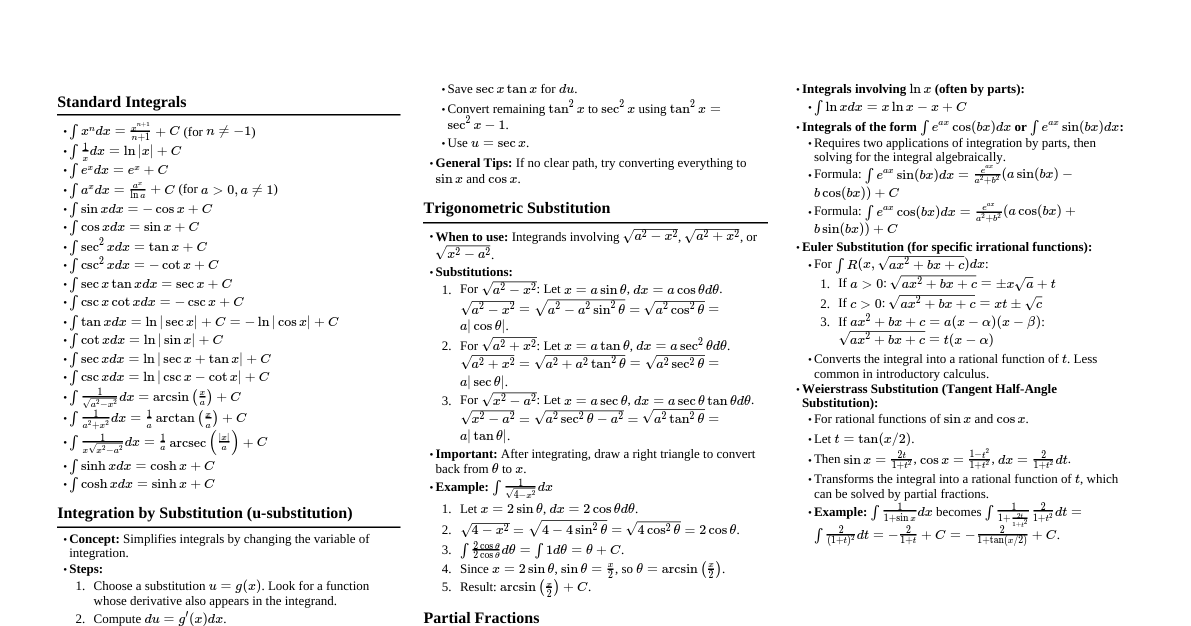
### U-Substitution - **Purpose:** Simplifies integrals of composite functions. - **Form:** $\int f(g(x))g'(x) dx$ - **Steps:** 1. Choose $u = g(x)$. 2. Calculate $du = g'(x) dx$. 3. Substitute $u$ and $du$ into the integral. 4. Integrate with respect to $u$. 5. Substitute $g(x)$ back for $u$. - **Example:** $$\int (2x+1)^3 dx$$ Let $u = 2x+1$, $du = 2 dx \implies dx = \frac{1}{2} du$. $$\int u^3 \frac{1}{2} du = \frac{1}{2} \int u^3 du = \frac{1}{2} \frac{u^4}{4} + C = \frac{(2x+1)^4}{8} + C$$ ### Integration by Parts - **Purpose:** Integrates products of functions. - **Formula:** $\int u \, dv = uv - \int v \, du$ - **LIATE Rule (for choosing u):** 1. **L**ogarithmic functions ($\ln x$) 2. **I**nverse trigonometric functions ($\arcsin x$) 3. **A**lgebraic functions ($x^n$) 4. **T**rigonometric functions ($\sin x$) 5. **E**xponential functions ($e^x$) - **Steps:** 1. Choose $u$ (using LIATE) and $dv$. 2. Calculate $du$ and $v$. 3. Apply the formula. 4. Evaluate the new integral. - **Example:** $$\int x e^x dx$$ Let $u=x$, $dv=e^x dx$. Then $du=dx$, $v=e^x$. $$x e^x - \int e^x dx = x e^x - e^x + C$$ ### Trigonometric Substitution - **Purpose:** Simplifies integrals containing $\sqrt{a^2 \pm x^2}$ or $\sqrt{x^2 - a^2}$. - **Common Substitutions:** | Expression | Substitution | $dx$ | Identity | |------------|--------------|------|----------| | $\sqrt{a^2 - x^2}$ | $x = a\sin\theta$ | $a\cos\theta d\theta$ | $a^2\cos^2\theta$ | | $\sqrt{a^2 + x^2}$ | $x = a\tan\theta$ | $a\sec^2\theta d\theta$ | $a^2\sec^2\theta$ | | $\sqrt{x^2 - a^2}$ | $x = a\sec\theta$ | $a\sec\theta\tan\theta d\theta$ | $a^2\tan^2\theta$ | - **Steps:** 1. Identify the form and choose the appropriate substitution. 2. Substitute $x$ and $dx$ into the integral. 3. Simplify using trigonometric identities. 4. Integrate with respect to $\theta$. 5. Convert back to $x$ using a reference triangle. - **Example:** $$\int \frac{1}{\sqrt{9-x^2}} dx$$ Let $x = 3\sin\theta$, $dx = 3\cos\theta d\theta$. $$\int \frac{3\cos\theta}{\sqrt{9-9\sin^2\theta}} d\theta = \int \frac{3\cos\theta}{\sqrt{9\cos^2\theta}} d\theta = \int \frac{3\cos\theta}{3\cos\theta} d\theta = \int 1 d\theta = \theta + C$$ Since $x = 3\sin\theta$, $\sin\theta = x/3$, so $\theta = \arcsin(x/3)$. $$= \arcsin(x/3) + C$$ ### Partial Fractions - **Purpose:** Integrates rational functions $\frac{P(x)}{Q(x)}$ where $Q(x)$ can be factored. - **Prerequisites:** Degree of $P(x)$ must be less than degree of $Q(x)$. If not, use polynomial long division first. - **Factor Types and Forms:** - **Linear Factor ($ax+b$):** $\frac{A}{ax+b}$ - **Repeated Linear Factor ($(ax+b)^n$):** $\frac{A_1}{ax+b} + \frac{A_2}{(ax+b)^2} + \dots + \frac{A_n}{(ax+b)^n}$ - **Irreducible Quadratic Factor ($ax^2+bx+c$):** $\frac{Ax+B}{ax^2+bx+c}$ - **Repeated Irreducible Quadratic Factor ($(ax^2+bx+c)^n$):** $\frac{A_1x+B_1}{ax^2+bx+c} + \dots + \frac{A_nx+B_n}{(ax^2+bx+c)^n}$ - **Steps:** 1. Factor the denominator $Q(x)$. 2. Set up the partial fraction decomposition. 3. Solve for the unknown constants (e.g., $A, B, C$) by equating coefficients or choosing convenient values for $x$. 4. Integrate each resulting simple fraction. - **Example:** $$\int \frac{1}{x^2-1} dx = \int \frac{1}{(x-1)(x+1)} dx$$ Decomposition: $\frac{1}{(x-1)(x+1)} = \frac{A}{x-1} + \frac{B}{x+1}$ $1 = A(x+1) + B(x-1)$ If $x=1 \implies 1 = 2A \implies A = 1/2$. If $x=-1 \implies 1 = -2B \implies B = -1/2$. $$\int \left(\frac{1/2}{x-1} - \frac{1/2}{x+1}\right) dx = \frac{1}{2}\ln|x-1| - \frac{1}{2}\ln|x+1| + C = \frac{1}{2}\ln\left|\frac{x-1}{x+1}\right| + C$$ ### Inverse Trigonometric Integrals - **Purpose:** Recognize integrals whose antiderivatives are inverse trigonometric functions. - **Common Forms:** - $\int \frac{1}{\sqrt{a^2 - x^2}} dx = \arcsin\left(\frac{x}{a}\right) + C$ - $\int \frac{1}{a^2 + x^2} dx = \frac{1}{a}\arctan\left(\frac{x}{a}\right) + C$ - $\int \frac{1}{x\sqrt{x^2 - a^2}} dx = \frac{1}{a}\operatorname{arcsec}\left(\frac{|x|}{a}\right) + C$ - **Key Idea:** Often involves completing the square in the denominator to match one of these forms. - **Example:** $$\int \frac{1}{x^2+4x+13} dx$$ Complete the square: $x^2+4x+13 = (x^2+4x+4) + 9 = (x+2)^2 + 3^2$. Let $u = x+2$, $du = dx$. $$\int \frac{1}{u^2+3^2} du = \frac{1}{3}\arctan\left(\frac{u}{3}\right) + C = \frac{1}{3}\arctan\left(\frac{x+2}{3}\right) + C$$