IB HL Vectors
Cheatsheet Content
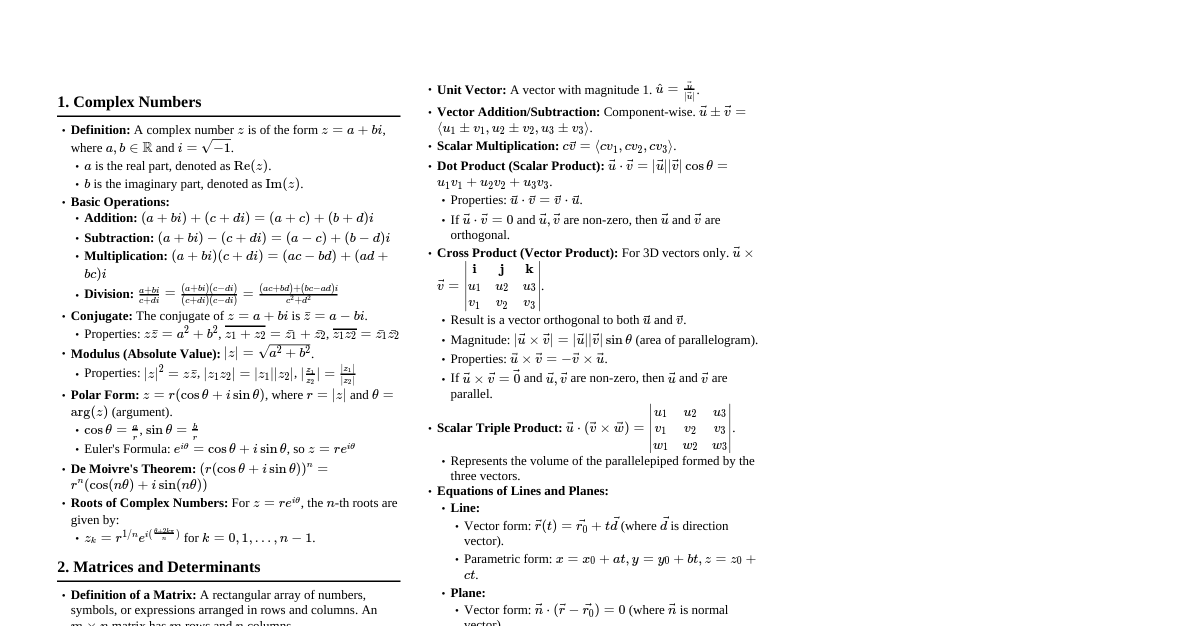
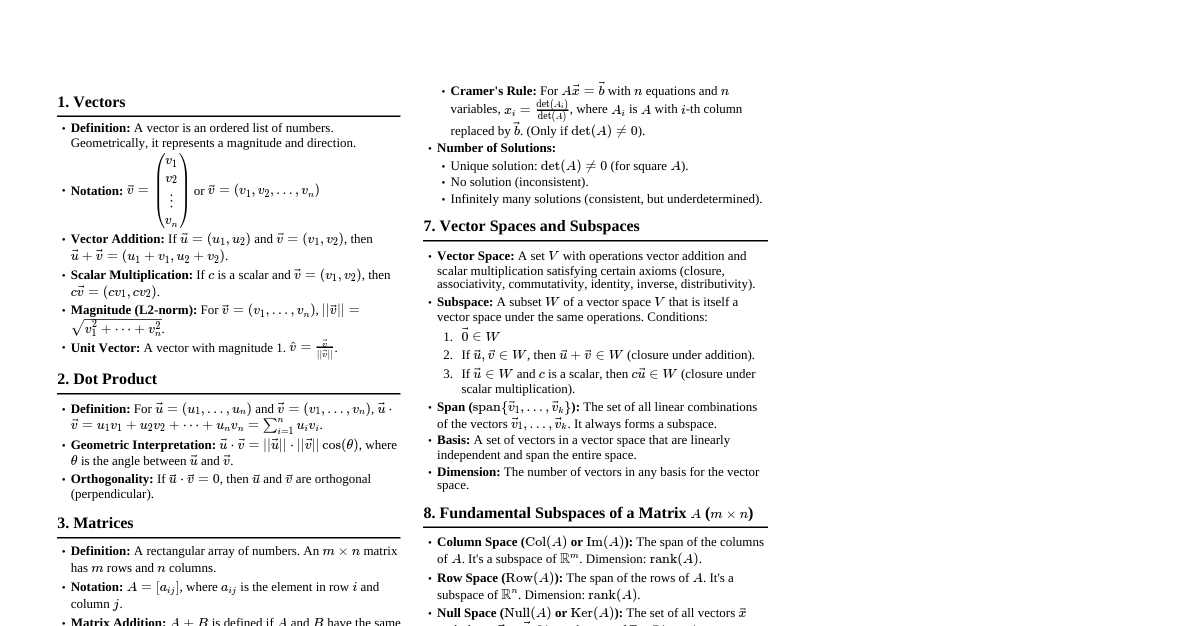
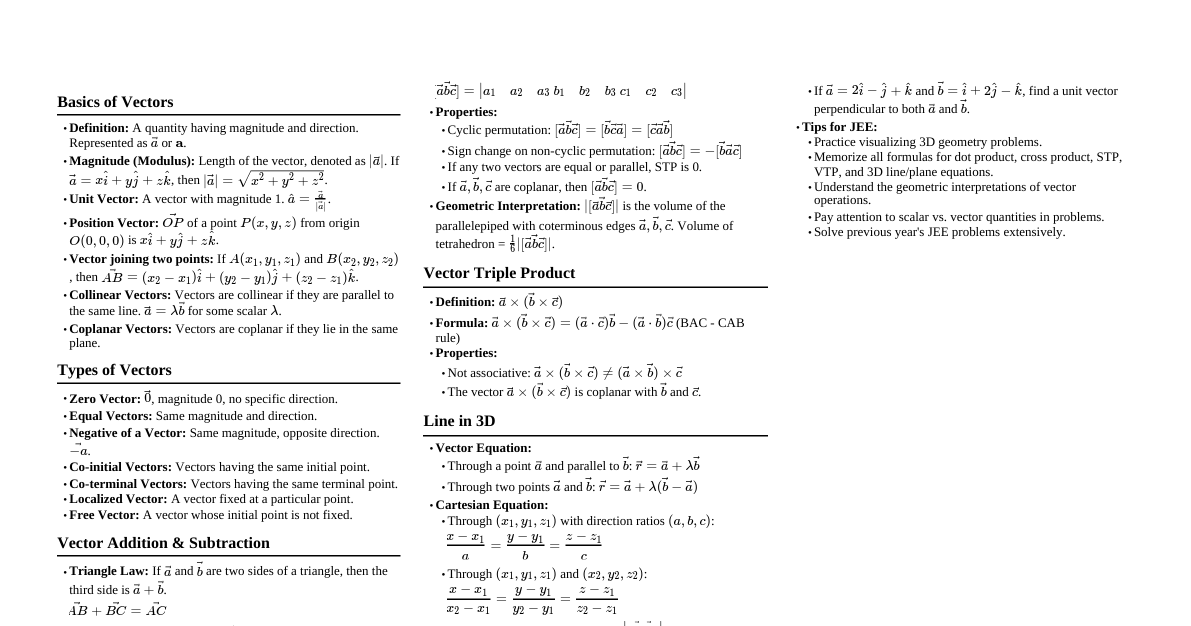
### Vector Basics - **Definition:** A quantity having magnitude and direction. - **Notation:** $\vec{v}$ or $\mathbf{v}$ or $\begin{pmatrix} x \\ y \\ z \end{pmatrix}$ - **Position Vector:** Vector from origin to a point. $\vec{OA} = \mathbf{a}$. - **Vector between two points:** $\vec{AB} = \mathbf{b} - \mathbf{a}$. - **Magnitude (Length):** For $\mathbf{v} = \begin{pmatrix} x \\ y \\ z \end{pmatrix}$, $|\mathbf{v}| = \sqrt{x^2 + y^2 + z^2}$. - **Unit Vector:** A vector with magnitude 1. $\hat{\mathbf{v}} = \frac{1}{|\mathbf{v}|}\mathbf{v}$. ### Vector Operations - **Addition:** $\begin{pmatrix} x_1 \\ y_1 \\ z_1 \end{pmatrix} + \begin{pmatrix} x_2 \\ y_2 \\ z_2 \end{pmatrix} = \begin{pmatrix} x_1+x_2 \\ y_1+y_2 \\ z_1+z_2 \end{pmatrix}$ (Parallelogram rule) - **Subtraction:** $\begin{pmatrix} x_1 \\ y_1 \\ z_1 \end{pmatrix} - \begin{pmatrix} x_2 \\ y_2 \\ z_2 \end{pmatrix} = \begin{pmatrix} x_1-x_2 \\ y_1-y_2 \\ z_1-z_2 \end{pmatrix}$ - **Scalar Multiplication:** $k\begin{pmatrix} x \\ y \\ z \end{pmatrix} = \begin{pmatrix} kx \\ ky \\ kz \end{pmatrix}$. Changes magnitude, not direction (if $k>0$). - **Parallel Vectors:** Two vectors $\mathbf{a}$ and $\mathbf{b}$ are parallel if $\mathbf{a} = k\mathbf{b}$ for some scalar $k \neq 0$. ### Dot Product (Scalar Product) - **Definition:** $\mathbf{a} \cdot \mathbf{b} = |\mathbf{a}||\mathbf{b}|\cos\theta$, where $\theta$ is the angle between the vectors. - **Component form:** For $\mathbf{a} = \begin{pmatrix} a_1 \\ a_2 \\ a_3 \end{pmatrix}$, $\mathbf{b} = \begin{pmatrix} b_1 \\ b_2 \\ b_3 \end{pmatrix}$, $\mathbf{a} \cdot \mathbf{b} = a_1b_1 + a_2b_2 + a_3b_3$. - **Angle between vectors:** $\cos\theta = \frac{\mathbf{a} \cdot \mathbf{b}}{|\mathbf{a}||\mathbf{b}|}$. - **Perpendicular Vectors:** If $\mathbf{a} \cdot \mathbf{b} = 0$, then $\mathbf{a}$ and $\mathbf{b}$ are perpendicular (orthogonal), assuming $\mathbf{a}, \mathbf{b} \neq \mathbf{0}$. - **Projection of $\mathbf{a}$ onto $\mathbf{b}$:** - Scalar projection: $\text{Comp}_{\mathbf{b}}\mathbf{a} = \frac{\mathbf{a} \cdot \mathbf{b}}{|\mathbf{b}|}$ - Vector projection: $\text{Proj}_{\mathbf{b}}\mathbf{a} = \left(\frac{\mathbf{a} \cdot \mathbf{b}}{|\mathbf{b}|^2}\right)\mathbf{b}$ ### Cross Product (Vector Product) - 3D Only - **Definition:** $\mathbf{a} \times \mathbf{b} = (|\mathbf{a}||\mathbf{b}|\sin\theta)\hat{\mathbf{n}}$, where $\hat{\mathbf{n}}$ is a unit vector perpendicular to both $\mathbf{a}$ and $\mathbf{b}$ (right-hand rule). - **Component form:** For $\mathbf{a} = \begin{pmatrix} a_1 \\ a_2 \\ a_3 \end{pmatrix}$, $\mathbf{b} = \begin{pmatrix} b_1 \\ b_2 \\ b_3 \end{pmatrix}$, $\mathbf{a} \times \mathbf{b} = \begin{pmatrix} a_2b_3 - a_3b_2 \\ a_3b_1 - a_1b_3 \\ a_1b_2 - a_2b_1 \end{pmatrix}$. - **Properties:** - $\mathbf{a} \times \mathbf{b} = -(\mathbf{b} \times \mathbf{a})$ - $\mathbf{a} \times \mathbf{a} = \mathbf{0}$ - If $\mathbf{a}$ and $\mathbf{b}$ are parallel, then $\mathbf{a} \times \mathbf{b} = \mathbf{0}$. - **Geometric Interpretation:** - $|\mathbf{a} \times \mathbf{b}|$ is the area of the parallelogram formed by $\mathbf{a}$ and $\mathbf{b}$. - Area of triangle = $\frac{1}{2}|\mathbf{a} \times \mathbf{b}|$. ### Vector Equations of Lines - **Vector form:** $\mathbf{r} = \mathbf{a} + t\mathbf{d}$, where $\mathbf{a}$ is a position vector of a point on the line, $\mathbf{d}$ is the direction vector, and $t$ is a scalar parameter. - **Parametric form:** If $\mathbf{r} = \begin{pmatrix} x \\ y \\ z \end{pmatrix}$, $\mathbf{a} = \begin{pmatrix} a_1 \\ a_2 \\ a_3 \end{pmatrix}$, $\mathbf{d} = \begin{pmatrix} d_1 \\ d_2 \\ d_3 \end{pmatrix}$, then: $x = a_1 + td_1$ $y = a_2 + td_2$ $z = a_3 + td_3$ - **Cartesian form (2D):** $y - y_1 = m(x - x_1)$ or $Ax + By = C$. - **Cartesian form (3D, symmetric form):** $\frac{x-a_1}{d_1} = \frac{y-a_2}{d_2} = \frac{z-a_3}{d_3}$ (if $d_1, d_2, d_3 \neq 0$). - If a component of $\mathbf{d}$ is 0, e.g., $d_1=0$, then $x=a_1$ and $\frac{y-a_2}{d_2} = \frac{z-a_3}{d_3}$. ### Vector Equations of Planes - **Vector form (point and two direction vectors):** $\mathbf{r} = \mathbf{a} + s\mathbf{b} + t\mathbf{c}$, where $\mathbf{a}$ is a position vector of a point on the plane, $\mathbf{b}$ and $\mathbf{c}$ are non-parallel direction vectors in the plane, and $s, t$ are scalar parameters. - **Vector form (point and normal vector):** $\mathbf{r} \cdot \mathbf{n} = \mathbf{a} \cdot \mathbf{n}$ or $\mathbf{r} \cdot \mathbf{n} = D$. - $\mathbf{n}$ is the normal vector to the plane ($\mathbf{n} \perp$ plane). - $\mathbf{n} = \mathbf{b} \times \mathbf{c}$ if $\mathbf{b}$ and $\mathbf{c}$ are direction vectors in the plane. - **Cartesian form:** $Ax + By + Cz = D$, where $\mathbf{n} = \begin{pmatrix} A \\ B \\ C \end{pmatrix}$. ### Intersections - **Line and Line:** - Set $\mathbf{r}_1 = \mathbf{r}_2$ (using different parameters, e.g., $t$ and $s$). - Solve the system of equations. - If a consistent solution for $t$ and $s$ exists, they intersect at a point. - If parallel (direction vectors are scalar multiples) and consistent, they are the same line. - If parallel and inconsistent, they are parallel and distinct. - If not parallel and inconsistent, they are skew lines (3D only). - **Line and Plane:** - Substitute parametric equations of the line into the Cartesian equation of the plane. - Solve for the parameter ($t$). - If a unique solution for $t$, they intersect at a point. - If no solution for $t$, the line is parallel to the plane and does not intersect. - If infinite solutions for $t$ (0=0), the line lies in the plane. - **Plane and Plane:** - Intersection is a line. - Solve the system of two Cartesian equations. - The direction vector of the line of intersection is $\mathbf{n}_1 \times \mathbf{n}_2$. ### Distances - **Point to Line:** - Let $P$ be the point, $L$ be the line $\mathbf{r} = \mathbf{a} + t\mathbf{d}$. - Find a vector $\vec{AP}$ from a point $A$ on the line to $P$. - Distance $ = \frac{|\vec{AP} \times \mathbf{d}|}{|\mathbf{d}|}$. - **Point to Plane:** - Let $P(x_0, y_0, z_0)$ be the point, plane $Ax + By + Cz = D$. - Distance $ = \frac{|Ax_0 + By_0 + Cz_0 - D|}{\sqrt{A^2 + B^2 + C^2}}$. - **Line to Plane (parallel):** Find distance from any point on the line to the plane. - **Plane to Plane (parallel):** Find distance from any point on one plane to the other plane. - **Skew Lines:** - Let lines be $\mathbf{r}_1 = \mathbf{a}_1 + t\mathbf{d}_1$ and $\mathbf{r}_2 = \mathbf{a}_2 + s\mathbf{d}_2$. - The shortest distance is projected onto the common perpendicular vector $\mathbf{n} = \mathbf{d}_1 \times \mathbf{d}_2$. - Distance $ = \frac{|(\mathbf{a}_2 - \mathbf{a}_1) \cdot \mathbf{n}|}{|\mathbf{n}|}$. ### Angles - **Between two vectors:** Use dot product: $\cos\theta = \frac{\mathbf{a} \cdot \mathbf{b}}{|\mathbf{a}||\mathbf{b}|}$. - **Between two lines:** Angle between their direction vectors. Use dot product. Take acute angle: $\cos\theta = \frac{|\mathbf{d}_1 \cdot \mathbf{d}_2|}{|\mathbf{d}_1||\mathbf{d}_2|}$. - **Between line and plane:** - Let $\theta$ be the angle between the line's direction vector $\mathbf{d}$ and the plane's normal vector $\mathbf{n}$. - The angle $\phi$ between the line and the plane is $90^\circ - \theta$. - Use $\sin\phi = \frac{|\mathbf{d} \cdot \mathbf{n}|}{|\mathbf{d}||\mathbf{n}|}$. - **Between two planes:** Angle between their normal vectors. Use dot product. Take acute angle: $\cos\theta = \frac{|\mathbf{n}_1 \cdot \mathbf{n}_2|}{|\mathbf{n}_1||\mathbf{n}_2|}$.