Financial Basics
Cheatsheet Content
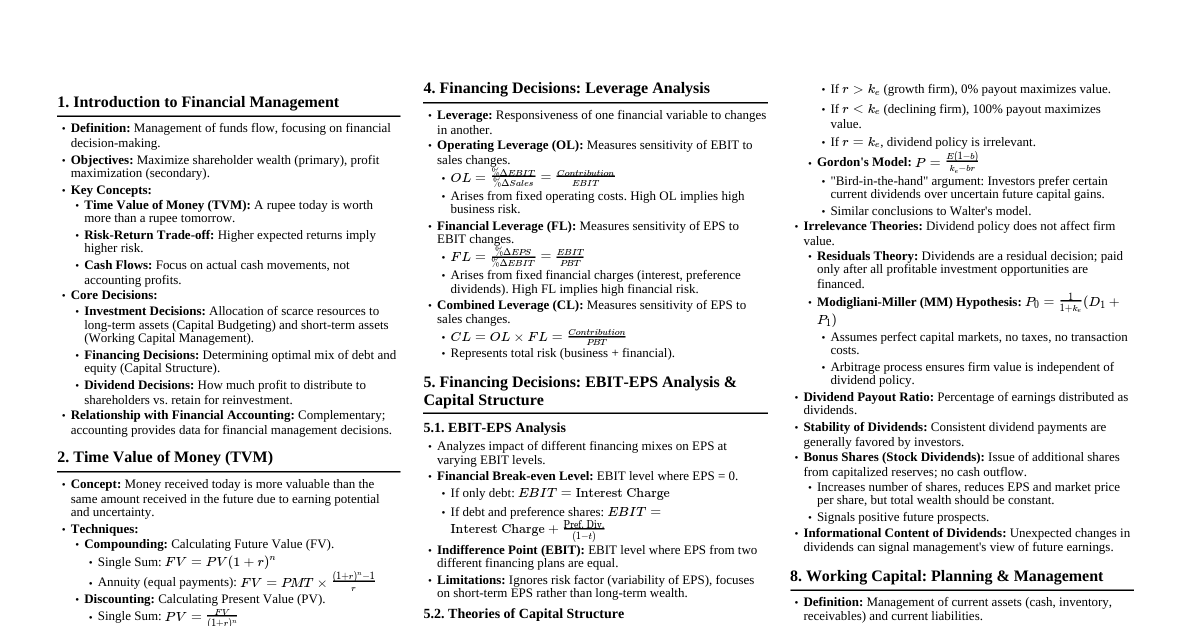
Time Value of Money (TVM) The concept that money available at the present time is worth more than the identical sum in the future due to its potential earning capacity. Future Value (FV) The value of a current asset at a specified date in the future, based on an assumed rate of growth. Single Payment: $FV = PV (1 + r)^n$ Annuity Due: $FV_A = PMT \frac{(1+r)^n - 1}{r} (1+r)$ Ordinary Annuity: $FV_A = PMT \frac{(1+r)^n - 1}{r}$ Where: $PV =$ Present Value $PMT =$ Payment per period $r =$ Interest rate per period $n =$ Number of periods Present Value (PV) The current value of a future sum of money or stream of cash flows given a specified rate of return. Single Payment: $PV = \frac{FV}{(1 + r)^n}$ Ordinary Annuity: $PV_A = PMT \frac{1 - (1+r)^{-n}}{r}$ Perpetuity: $PV_P = \frac{PMT}{r}$ Effective Annual Rate (EAR) The actual annual rate of return taking into account the effect of compounding interest. $EAR = (1 + \frac{r_{nom}}{m})^m - 1$ Where: $r_{nom} =$ Nominal annual interest rate $m =$ Number of compounding periods per year Investment Performance Return on Investment (ROI) A performance measure used to evaluate the efficiency of an investment or compare the efficiency of a number of different investments. $ROI = \frac{\text{Net Profit}}{\text{Cost of Investment}}$ Compound Annual Growth Rate (CAGR) The mean annual growth rate of an investment over a specified period longer than one year. $CAGR = (\frac{FV}{PV})^{\frac{1}{n}} - 1$ Holding Period Return (HPR) The total return received from holding an asset or portfolio of assets over a period of time, expressed as a percentage. $HPR = \frac{(\text{Ending Value} - \text{Beginning Value} + \text{Income})}{\text{Beginning Value}}$ Debt and Loans Loan Amortization The process of paying off a debt with regular payments, where each payment covers both principal and interest. Monthly Payment (P&I): $M = P \frac{r(1+r)^n}{(1+r)^n - 1}$ Where: $M =$ Monthly payment $P =$ Principal loan amount $r =$ Monthly interest rate (annual rate / 12) $n =$ Total number of payments (loan term in years * 12) Interest Calculation Simple Interest: $I = P \times r \times t$ Where: $I =$ Interest amount $P =$ Principal amount $r =$ Annual interest rate $t =$ Time in years Financial Ratios Liquidity Ratios Measure a company's ability to pay off its short-term debts. Current Ratio: $\frac{\text{Current Assets}}{\text{Current Liabilities}}$ Quick Ratio (Acid-Test): $\frac{\text{Current Assets} - \text{Inventory}}{\text{Current Liabilities}}$ Profitability Ratios Measure a company's ability to generate revenue and profits. Gross Profit Margin: $\frac{\text{Gross Profit}}{\text{Revenue}}$ Net Profit Margin: $\frac{\text{Net Income}}{\text{Revenue}}$ Return on Assets (ROA): $\frac{\text{Net Income}}{\text{Total Assets}}$ Return on Equity (ROE): $\frac{\text{Net Income}}{\text{Shareholder Equity}}$ Solvency Ratios Measure a company's ability to meet its long-term obligations. Debt-to-Equity Ratio: $\frac{\text{Total Debt}}{\text{Shareholder Equity}}$ Debt-to-Assets Ratio: $\frac{\text{Total Debt}}{\text{Total Assets}}$ Valuation Ratios Used by investors to determine the attractiveness of an investment. Price-to-Earnings (P/E) Ratio: $\frac{\text{Share Price}}{\text{Earnings Per Share}}$ Dividend Yield: $\frac{\text{Annual Dividends Per Share}}{\text{Share Price}}$ Budgeting and Personal Finance 50/30/20 Rule A simple budgeting guideline for allocating income: 50% Needs: Housing, utilities, groceries, transportation, insurance. 30% Wants: Dining out, entertainment, hobbies, vacations. 20% Savings & Debt Repayment: Emergency fund, retirement, investments, extra debt payments. Emergency Fund Typically 3-6 months of essential living expenses, saved in an easily accessible account. Net Worth A key indicator of financial health. $\text{Net Worth} = \text{Total Assets} - \text{Total Liabilities}$ Risk and Diversification Types of Risk Systematic Risk (Market Risk): Non-diversifiable risk affecting the entire market (e.g., inflation, interest rates). Unsystematic Risk (Specific Risk): Diversifiable risk specific to a company or industry (e.g., product recall, management change). Diversification Spreading investments across various asset classes, industries, and geographies to reduce unsystematic risk. Asset Allocation: Deciding how to divide an investment portfolio among different asset categories (e.g., stocks, bonds, real estate). Key Financial Concepts Inflation The rate at which the general level of prices for goods and services is rising, and subsequently, purchasing power is falling. Deflation A decrease in the general price level of goods and services. Compounding The process of earning returns on previous returns, leading to exponential growth over time. Opportunity Cost The value of the next best alternative that was not taken when a decision was made. Marginal Analysis Examining the additional benefits of an activity compared to the additional costs incurred by that same activity.