Hibbeler Mechanics Cheatsheet
Shared 3/23/2026•77 views
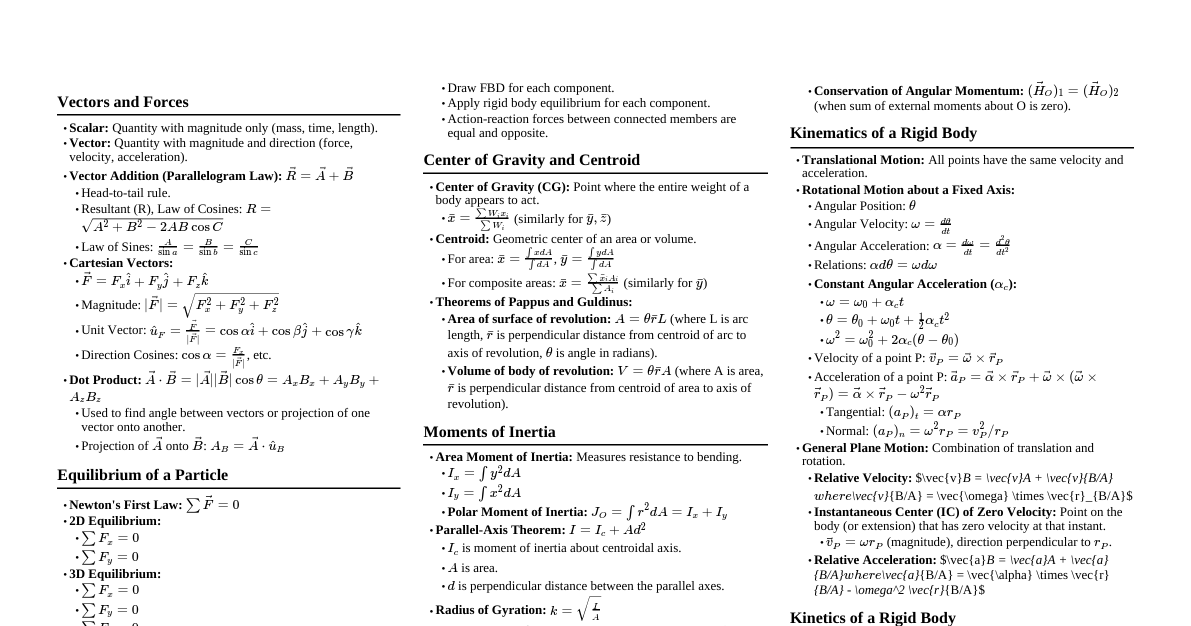
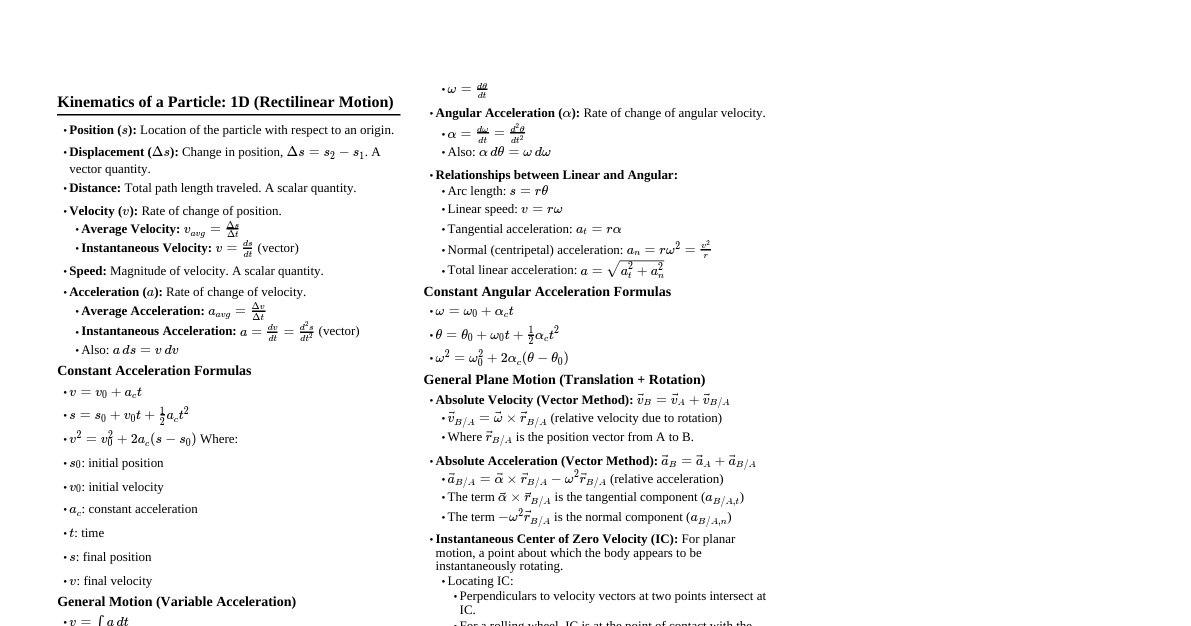
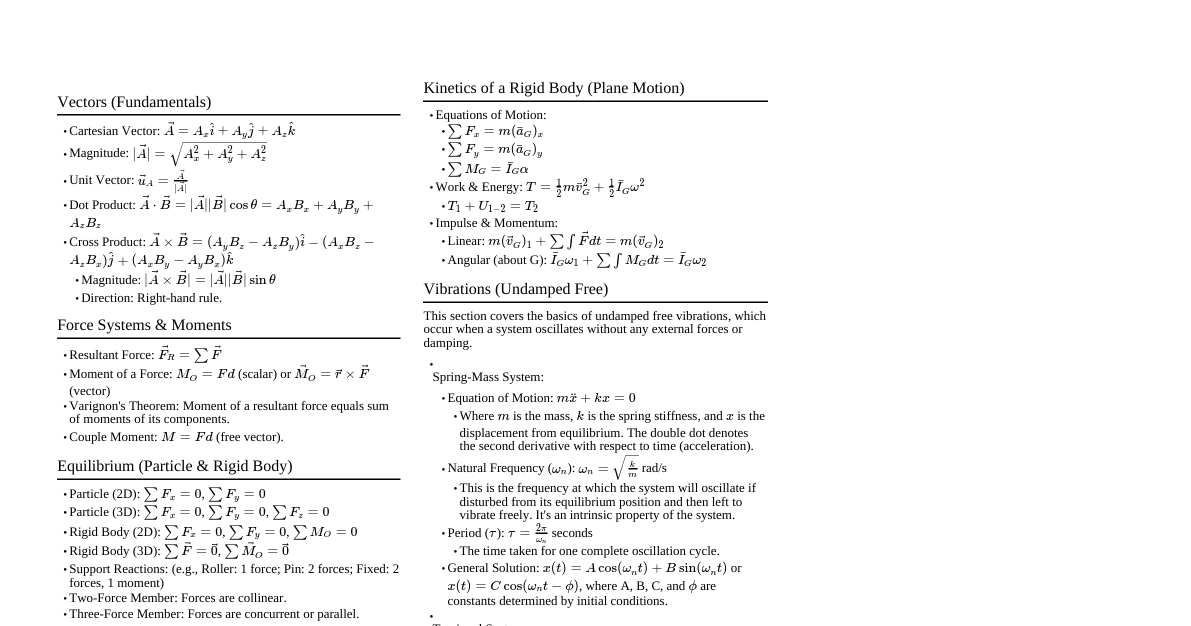
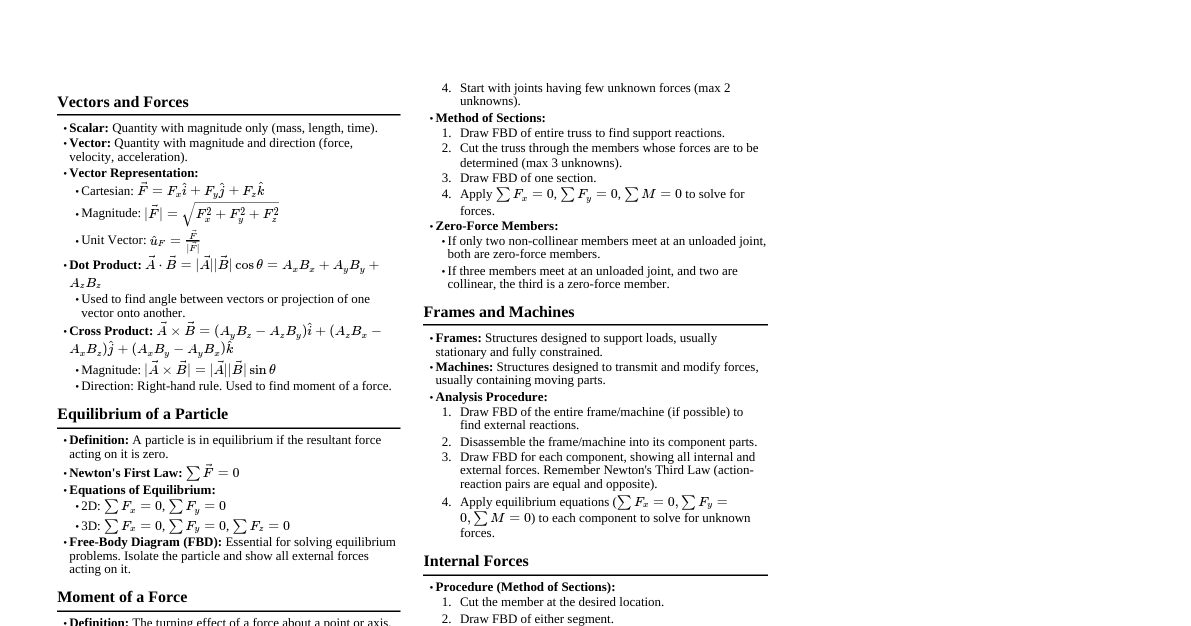
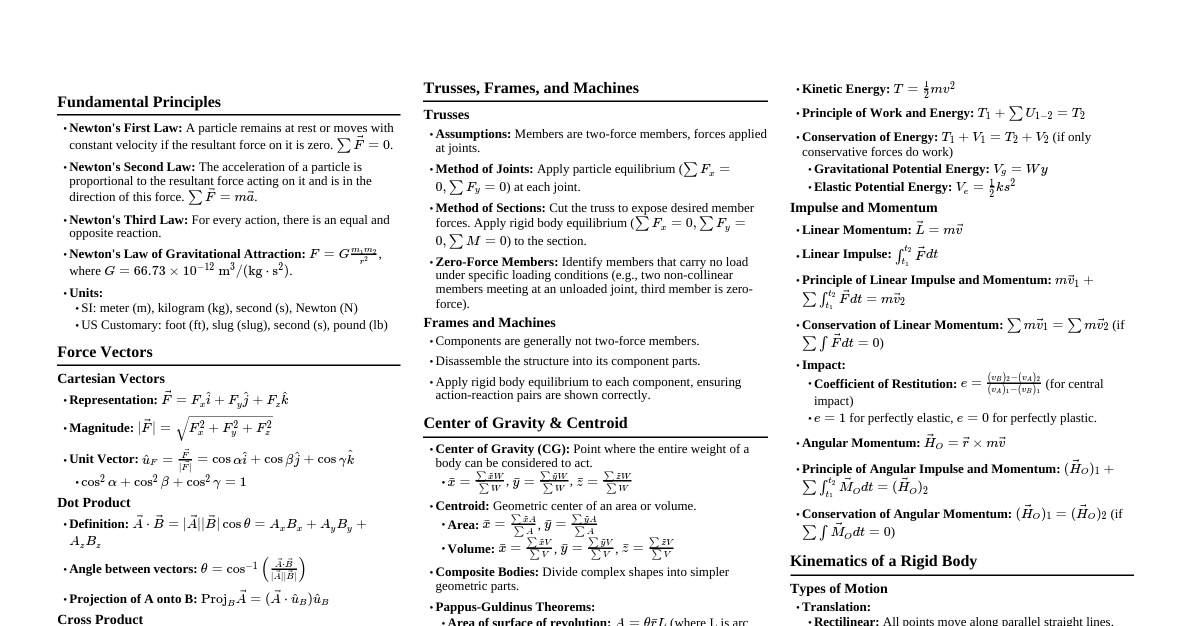
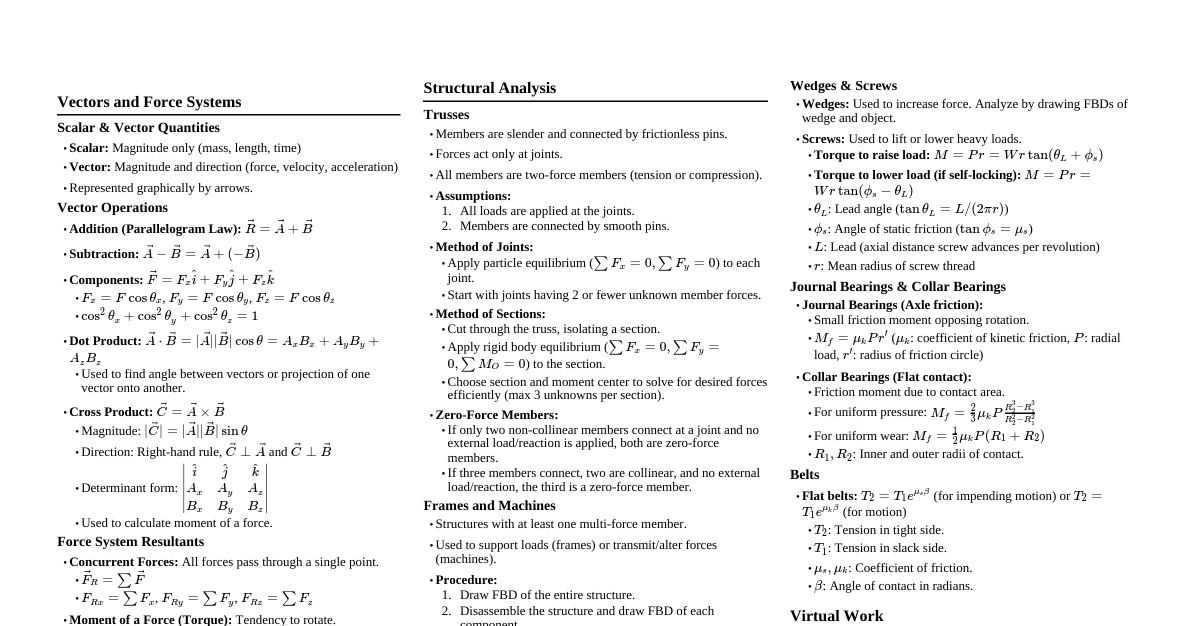
### Vectors and Forces - **Scalar:** Quantity with magnitude only (e.g., mass, time, length). - **Vector:** Quantity with both magnitude and direction (e.g., force, velocity, acceleration). - **Vector Operations:** - **Addition (Parallelogram Law):** $\vec{R} = \vec{A} + \vec{B}$ - **Subtraction:** $\vec{R}' = \vec{A} - \vec{B} = \vec{A} + (-\vec{B})$ - **Components of a Vector:** - **2D:** $F_x = F \cos\theta$, $F_y = F \sin\theta$ - **3D:** $\vec{F} = F_x\hat{i} + F_y\hat{j} + F_z\hat{k}$ where $F_x = F \cos\alpha$, $F_y = F \cos\beta$, $F_z = F \cos\gamma$ - **Unit Vector:** $\hat{u}_F = \frac{\vec{F}}{|\vec{F}|} = \cos\alpha\hat{i} + \cos\beta\hat{j} + \cos\gamma\hat{k}$ - **Dot Product:** $\vec{A} \cdot \vec{B} = |\vec{A}||\vec{B}|\cos\theta = A_xB_x + A_yB_y + A_zB_z$ - Used to find angle between vectors or projection of one vector onto another. - **Cross Product:** $\vec{C} = \vec{A} \times \vec{B}$ - $|\vec{C}| = |\vec{A}||\vec{B}|\sin\theta$ - Direction by right-hand rule. - Determinant form: $$\begin{vmatrix} \hat{i} & \hat{j} & \hat{k} \\ A_x & A_y & A_z \\ B_x & B_y & B_z \end{vmatrix}$$ ### Equilibrium of a Particle - **Newton's First Law:** $\sum \vec{F} = 0$ - **2D Equilibrium:** $\sum F_x = 0$, $\sum F_y = 0$ - **3D Equilibrium:** $\sum F_x = 0$, $\sum F_y = 0$, $\sum F_z = 0$ - **Free-Body Diagram (FBD):** Essential for solving equilibrium problems. Show all external forces acting on the particle. ### Force System Resultants - **Moment of a Force (Scalar):** $M_O = Fd$ (d is perpendicular distance from O to line of action of F). - **Moment of a Force (Vector):** $\vec{M}_O = \vec{r} \times \vec{F}$ - $\vec{r}$ is position vector from point O to any point on the line of action of $\vec{F}$. - **Varignon's Theorem:** The moment of a resultant force about a point is equal to the sum of the moments of its components about the same point. - **Couple Moment:** $\vec{M} = \vec{r} \times \vec{F}$ (for two equal, opposite, and non-collinear forces) - Magnitude: $M = Fd$ - **Resultant of a Force System:** - **Resultant Force:** $\vec{F}_R = \sum \vec{F}$ - **Resultant Moment:** $\vec{M}_{R_O} = \sum \vec{M}_O + \sum (\vec{r} \times \vec{F})$ - **Wrench (Poinsot's) Theorem:** Any system of forces and couple moments can be reduced to a single resultant force and a single resultant couple moment acting along the line of action of the resultant force. ### Equilibrium of a Rigid Body - **Conditions for Equilibrium:** - $\sum \vec{F} = 0$ (Sum of forces is zero) - $\sum \vec{M}_O = 0$ (Sum of moments about any point O is zero) - **2D Equations:** - $\sum F_x = 0$ - $\sum F_y = 0$ - $\sum M_O = 0$ - **3D Equations:** - $\sum F_x = 0$, $\sum F_y = 0$, $\sum F_z = 0$ - $\sum M_x = 0$, $\sum M_y = 0$, $\sum M_z = 0$ - **Supports and Reactions:** - **Pin/Hinge:** Two force components (Fx, Fy) - **Roller:** One force component (perpendicular to surface) - **Fixed Support:** Two force components (Fx, Fy) and one couple moment (Mz) in 2D. Three force components and three couple moments in 3D. - **Cable/Rope:** Tension force along the cable. - **Two-Force Member:** A member subjected to forces at only two points. The forces must be equal, opposite, and collinear. - **Three-Force Member:** A member subjected to forces at only three points. The lines of action of the three forces must be concurrent or parallel. ### Structural Analysis - **Trusses:** - **Assumptions:** Members are two-force members, forces applied only at joints. - **Method of Joints:** Apply particle equilibrium ($\sum F_x=0, \sum F_y=0$) at each joint. - **Method of Sections:** Cut through members, apply rigid body equilibrium ($\sum F_x=0, \sum F_y=0, \sum M=0$) to a section. - **Zero-Force Members:** Identify members that carry no load to simplify analysis. - **Frames and Machines:** - Disassemble the structure into its component parts. - Draw FBDs for each component. - Apply rigid body equilibrium to each component. - Internal forces between connected parts are equal and opposite (Newton's Third Law). ### Internal Forces - **Shear Force (V):** Sum of perpendicular forces to the member's axis. - **Axial Force (N):** Sum of parallel forces to the member's axis. - **Bending Moment (M):** Sum of moments about the cut section. - **Sign Convention (Hibbeler):** - **Axial:** Tension positive, compression negative. - **Shear:** Upward on left face positive. - **Moment:** Causes compression at top, tension at bottom of beam positive. - **Shear and Moment Diagrams:** - $w = \frac{dV}{dx}$ (distributed load is slope of shear diagram) - $V = \frac{dM}{dx}$ (shear force is slope of moment diagram) - $\Delta V = \int w \, dx$ (change in shear is area under load diagram) - $\Delta M = \int V \, dx$ (change in moment is area under shear diagram) ### Friction - **Static Friction ($F_s$):** Opposes impending motion. $F_s \le \mu_s N$ - $\mu_s$: coefficient of static friction. - Maximum static friction occurs just before motion begins: $F_{s,max} = \mu_s N$. - **Kinetic Friction ($F_k$):** Opposes actual motion. $F_k = \mu_k N$ - $\mu_k$: coefficient of kinetic friction. ($\mu_k ### Center of Gravity and Centroid - **Center of Gravity (CG):** Point where the entire weight of a body can be considered to act. - $\bar{x} = \frac{\sum W_i x_i}{\sum W_i}$, $\bar{y} = \frac{\sum W_i y_i}{\sum W_i}$, $\bar{z} = \frac{\sum W_i z_i}{\sum W_i}$ - **Centroid:** Geometric center of an area or volume. For homogeneous materials, coincides with CG. - **Area:** $\bar{x} = \frac{\int x \, dA}{\int dA}$, $\bar{y} = \frac{\int y \, dA}{\int dA}$ - **Composite Areas:** $\bar{x} = \frac{\sum A_i \bar{x}_i}{\sum A_i}$, $\bar{y} = \frac{\sum A_i \bar{y}_i}{\sum A_i}$ - **Theorems of Pappus and Guldinus:** - **Area of surface of revolution:** $A = \theta \bar{y} L$ (L = arc length, $\bar{y}$ = centroid distance to axis of revolution, $\theta$ in radians) - **Volume of body of revolution:** $V = \theta \bar{y} A$ (A = area, $\bar{y}$ = centroid distance to axis of revolution, $\theta$ in radians) ### Moments of Inertia - **Area Moment of Inertia (Second Moment of Area):** Measures resistance to bending. - $I_x = \int y^2 \, dA$, $I_y = \int x^2 \, dA$ - **Polar Moment of Inertia:** $J_O = \int r^2 \, dA = I_x + I_y$ - **Parallel-Axis Theorem:** $I = \bar{I} + Ad^2$ - $\bar{I}$ is moment of inertia about centroidal axis. - $A$ is area. - $d$ is perpendicular distance between parallel axes. - **Radius of Gyration:** $k = \sqrt{\frac{I}{A}}$ - **Mass Moment of Inertia:** Measures resistance to angular acceleration. - $I = \int r^2 \, dm$ - **Parallel-Axis Theorem (Mass):** $I = \bar{I} + md^2$ ### Kinematics of a Particle - **Rectilinear Motion:** - **Velocity:** $v = \frac{ds}{dt}$ - **Acceleration:** $a = \frac{dv}{dt} = \frac{d^2s}{dt^2}$ - **Chain Rule:** $a \, ds = v \, dv$ - **Constant Acceleration:** - $v = v_0 + a_c t$ - $s = s_0 + v_0 t + \frac{1}{2} a_c t^2$ - $v^2 = v_0^2 + 2 a_c (s - s_0)$ - **Curvilinear Motion (Rectangular Components):** - $\vec{r} = x\hat{i} + y\hat{j} + z\hat{k}$ - $\vec{v} = \dot{x}\hat{i} + \dot{y}\hat{j} + \dot{z}\hat{k}$ - $\vec{a} = \ddot{x}\hat{i} + \ddot{y}\hat{j} + \ddot{z}\hat{k}$ - **Curvilinear Motion (Normal and Tangential Components):** - $\vec{v} = v\hat{u}_t$ - $\vec{a} = a_t\hat{u}_t + a_n\hat{u}_n$ - $a_t = \dot{v}$ or $a_t = v \frac{dv}{ds}$ (tangential acceleration, changes speed) - $a_n = \frac{v^2}{\rho}$ (normal acceleration, changes direction, $\rho$ is radius of curvature) - **Curvilinear Motion (Cylindrical Components):** - $\vec{r} = r\hat{u}_r + z\hat{k}$ - $\vec{v} = \dot{r}\hat{u}_r + r\dot{\theta}\hat{u}_\theta + \dot{z}\hat{k}$ - $\vec{a} = (\ddot{r} - r\dot{\theta}^2)\hat{u}_r + (r\ddot{\theta} + 2\dot{r}\dot{\theta})\hat{u}_\theta + \ddot{z}\hat{k}$ ### Kinetics of a Particle - **Newton's Second Law:** $\sum \vec{F} = m\vec{a}$ - **Rectangular:** $\sum F_x = m a_x$, $\sum F_y = m a_y$, $\sum F_z = m a_z$ - **Normal-Tangential:** $\sum F_t = m a_t$, $\sum F_n = m a_n = m\frac{v^2}{\rho}$ - **Cylindrical:** $\sum F_r = m a_r$, $\sum F_\theta = m a_\theta$, $\sum F_z = m a_z$ - **Work and Energy:** - **Work of a Force:** $U_{1-2} = \int_{s_1}^{s_2} \vec{F} \cdot d\vec{r}$ - **Work of Weight:** $U_g = -W\Delta y$ - **Work of Spring:** $U_s = \frac{1}{2}k(s_1^2 - s_2^2)$ - **Principle of Work and Energy:** $T_1 + U_{1-2} = T_2$ - Kinetic Energy: $T = \frac{1}{2}mv^2$ - **Conservation of Energy:** $T_1 + V_1 = T_2 + V_2$ (when only conservative forces do work) - Potential Energy: $V = V_g + V_e = Wy + \frac{1}{2}ks^2$ - **Impulse and Momentum:** - **Linear Impulse:** $\vec{I} = \int_{t_1}^{t_2} \vec{F} \, dt$ - **Linear Momentum:** $\vec{p} = m\vec{v}$ - **Principle of Linear Impulse and Momentum:** $m\vec{v}_1 + \sum \int_{t_1}^{t_2} \vec{F} \, dt = m\vec{v}_2$ - **Conservation of Linear Momentum:** $\sum m\vec{v}_1 = \sum m\vec{v}_2$ (when sum of external impulses is zero) - **Impact:** - **Coefficient of Restitution (e):** $e = \frac{(v_B)_2 - (v_A)_2}{(v_A)_1 - (v_B)_1}$ (along line of impact) - $e=1$ for elastic impact, $e=0$ for plastic impact. ### Kinematics of a Rigid Body - **Types of Motion:** - **Translation:** All points move along parallel paths. - Rectilinear: Straight paths. - Curvilinear: Curved paths. - **Rotation about a Fixed Axis:** All points move in concentric circles. - Angular Velocity: $\omega = \frac{d\theta}{dt}$ - Angular Acceleration: $\alpha = \frac{d\omega}{dt} = \frac{d^2\theta}{dt^2}$ - $v = r\omega$, $a_t = r\alpha$, $a_n = r\omega^2 = \frac{v^2}{r}$ - **General Plane Motion:** Translation + Rotation. - **Absolute Motion Analysis:** Use geometry and derivatives. - **Relative Motion Analysis (Translating Axes):** - $\vec{r}_B = \vec{r}_A + \vec{r}_{B/A}$ - $\vec{v}_B = \vec{v}_A + \vec{v}_{B/A}$ - $\vec{a}_B = \vec{a}_A + \vec{a}_{B/A}$ - **Relative Motion Analysis (Rotating Axes):** - $\vec{v}_B = \vec{v}_A + \vec{\omega} \times \vec{r}_{B/A} + (\vec{v}_{B/A})_{xyz}$ - $\vec{a}_B = \vec{a}_A + \vec{\alpha} \times \vec{r}_{B/A} + \vec{\omega} \times (\vec{\omega} \times \vec{r}_{B/A}) + 2\vec{\omega} \times (\vec{v}_{B/A})_{xyz} + (\vec{a}_{B/A})_{xyz}$ - Last term is Coriolis acceleration: $2\vec{\omega} \times (\vec{v}_{B/A})_{xyz}$ - **Instantaneous Center of Zero Velocity (IC):** For plane motion, a point about which the body appears to be momentarily rotating. - $v = \omega r_{IC}$ ### Kinetics of a Rigid Body - **Equations of Motion:** - **Translation:** $\sum \vec{F} = m\vec{a}_G$ - **Rotation about a Fixed Axis:** - $\sum F_n = m a_{G_n} = m \omega^2 r_G$ - $\sum F_t = m a_{G_t} = m \alpha r_G$ - $\sum M_O = I_O \alpha$ (O is fixed axis) - **General Plane Motion:** - $\sum F_x = m (a_G)_x$ - $\sum F_y = m (a_G)_y$ - $\sum M_G = I_G \alpha$ (G is center of mass) - Can also sum moments about any point P: $\sum M_P = I_G \alpha + m a_G d$ or $\sum M_P = I_P \alpha$ if P is IC and $a_P=0$. - **Work and Energy:** - **Kinetic Energy (Plane Motion):** $T = \frac{1}{2}m v_G^2 + \frac{1}{2}I_G \omega^2$ - **Principle of Work and Energy:** $T_1 + U_{1-2} = T_2$ - **Impulse and Momentum:** - **Linear Impulse and Momentum:** $m(\vec{v}_G)_1 + \sum \int_{t_1}^{t_2} \vec{F} \, dt = m(\vec{v}_G)_2$ - **Angular Impulse and Momentum:** $(H_G)_1 + \sum \int_{t_1}^{t_2} \vec{M}_G \, dt = (H_G)_2$ - Angular Momentum about G: $H_G = I_G \omega$ - Angular Momentum about fixed point O: $H_O = I_O \omega$ - **Conservation of Momentum:** If $\sum \int \vec{F} \, dt = 0$, then $\sum m\vec{v}_G$ is conserved. - If $\sum \int \vec{M}_G \, dt = 0$, then $H_G$ is conserved.