Mechanics (NSW Physics)
Cheatsheet Content
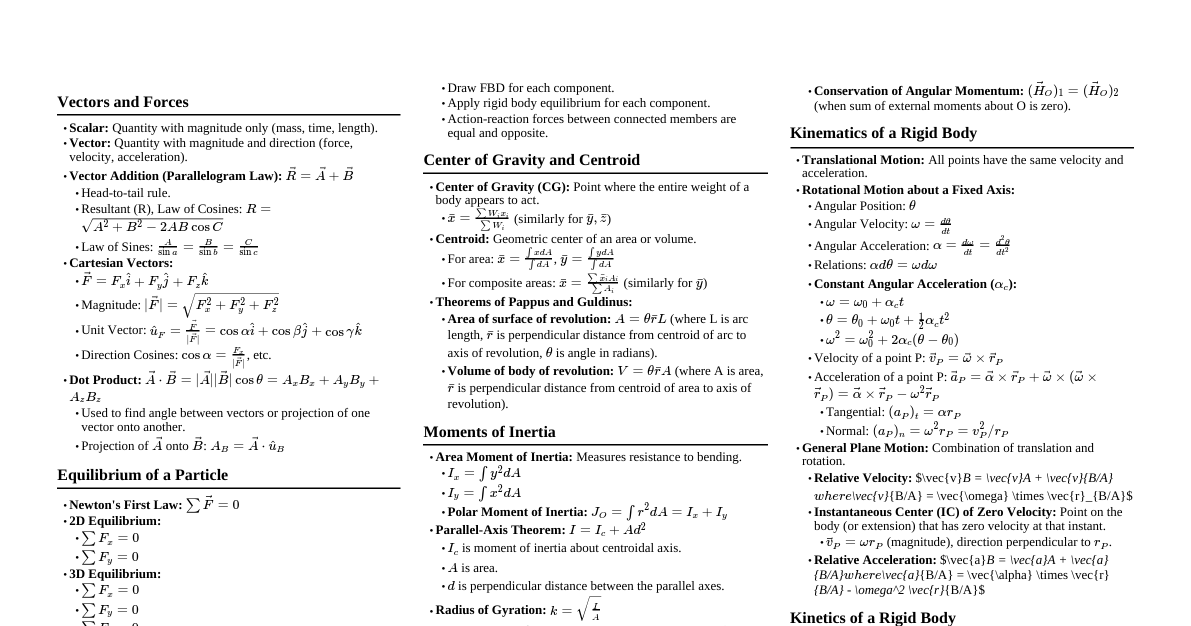
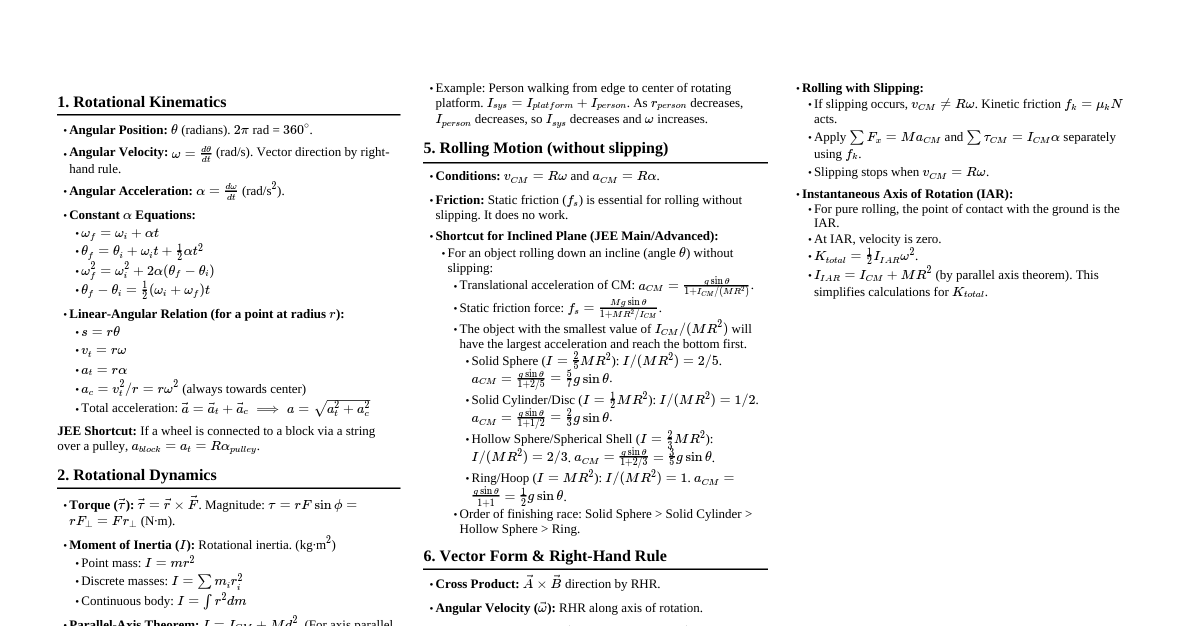
### Kinematics #### Uniform Motion - **Displacement:** $\vec{s}$ (m) – change in position - **Velocity:** $\vec{v} = \frac{\Delta\vec{s}}{\Delta t}$ (m/s) – rate of change of displacement - **Speed:** Scalar magnitude of velocity - **Acceleration:** $\vec{a} = \frac{\Delta\vec{v}}{\Delta t}$ (m/s²) – rate of change of velocity #### Equations of Motion (SUVAT) For constant acceleration: - $v = u + at$ - $s = ut + \frac{1}{2}at^2$ - $v^2 = u^2 + 2as$ - $s = \frac{(u+v)}{2}t$ Where: - $u$ = initial velocity - $v$ = final velocity - $a$ = acceleration - $t$ = time - $s$ = displacement #### Projectile Motion - **Horizontal component:** Constant velocity ($a_x = 0$) - $v_x = u_x$ - $s_x = u_x t$ - **Vertical component:** Constant acceleration ($a_y = g = -9.8 \text{ m/s}^2$) - $v_y = u_y + gt$ - $s_y = u_y t + \frac{1}{2}gt^2$ - $v_y^2 = u_y^2 + 2gs_y$ - **Launch angle:** $u_x = u \cos\theta$, $u_y = u \sin\theta$ ### Dynamics #### Newton's Laws of Motion - **First Law (Inertia):** An object at rest stays at rest, and an object in motion stays in motion with the same speed and in the same direction unless acted upon by an unbalanced force. - **Second Law (Force & Acceleration):** $\vec{F}_{net} = m\vec{a}$ (N) - $\vec{F}_{net}$ is the net force, $m$ is mass (kg), $\vec{a}$ is acceleration. - **Third Law (Action-Reaction):** For every action, there is an equal and opposite reaction. $\vec{F}_{AB} = -\vec{F}_{BA}$ #### Types of Forces - **Weight (Gravity):** $F_g = mg$ (N) - $g$ = acceleration due to gravity ($9.8 \text{ m/s}^2$ on Earth) - **Normal Force:** $F_N$ – Perpendicular force from a surface - **Friction Force:** $F_f = \mu F_N$ (N) - $\mu_s$ = coefficient of static friction - $\mu_k$ = coefficient of kinetic friction ($\mu_k ### Momentum and Energy #### Momentum - **Linear Momentum:** $\vec{p} = m\vec{v}$ (kg m/s) - **Impulse:** $\vec{J} = \vec{F}\Delta t = \Delta\vec{p}$ (N s or kg m/s) - **Conservation of Momentum:** In an isolated system, total momentum before collision equals total momentum after collision. - $m_1 u_1 + m_2 u_2 = m_1 v_1 + m_2 v_2$ #### Collisions - **Elastic Collision:** Kinetic energy is conserved. - **Inelastic Collision:** Kinetic energy is NOT conserved (some is converted to other forms like heat, sound). Momentum is still conserved. - **Perfectly Inelastic Collision:** Objects stick together after collision. #### Work, Energy, and Power - **Work Done:** $W = Fd\cos\theta$ (J) - $\theta$ is the angle between force and displacement. - Work is positive if force aids motion, negative if opposes. - **Kinetic Energy:** $E_k = \frac{1}{2}mv^2$ (J) - **Gravitational Potential Energy:** $E_p = mgh$ (J) - **Work-Energy Theorem:** $W_{net} = \Delta E_k$ - **Conservation of Mechanical Energy:** In the absence of non-conservative forces (like friction), $E_k + E_p = \text{constant}$. - $E_{k,initial} + E_{p,initial} = E_{k,final} + E_{p,final}$ - **Power:** $P = \frac{W}{\Delta t} = F\bar{v}$ (W) – Rate at which work is done. ### Circular Motion #### Uniform Circular Motion - **Centripetal Force:** $F_c = \frac{mv^2}{r}$ (N) - Directed towards the center of the circle. - Caused by tension, friction, gravity, normal force, etc. - **Centripetal Acceleration:** $a_c = \frac{v^2}{r} = \omega^2 r$ (m/s²) - Directed towards the center of the circle. - **Velocity:** $v = \frac{2\pi r}{T} = \omega r$ (m/s) - $T$ = period (time for one revolution) - $\omega$ = angular velocity (rad/s) - **Angular Velocity:** $\omega = \frac{2\pi}{T} = 2\pi f$ - $f$ = frequency (revolutions per second, Hz) #### Examples - **Horizontal Circle:** Tension in a string, friction on a road (banking). - **Vertical Circle:** Tension in a string, normal force on a loop-the-loop. - At the top: $F_N + F_g = F_c$ - At the bottom: $F_N - F_g = F_c$ ### Gravity #### Newton's Law of Universal Gravitation - **Force of Gravity:** $F_g = \frac{GMm}{r^2}$ (N) - $G$ = Universal Gravitational Constant ($6.67 \times 10^{-11} \text{ N m}^2\text{/kg}^2$) - $M, m$ = masses of two objects (kg) - $r$ = distance between their centers (m) #### Gravitational Field Strength - **Field Strength:** $g = \frac{F_g}{m} = \frac{GM}{r^2}$ (N/kg or m/s²) - On Earth's surface, $g \approx 9.8 \text{ N/kg}$. - **Gravitational Potential Energy (General):** $U = -\frac{GMm}{r}$ (J) - Zero potential energy at infinite separation. #### Orbital Motion - For a satellite in circular orbit: $F_g = F_c$ - $\frac{GMm}{r^2} = \frac{mv^2}{r}$ - **Orbital Velocity:** $v = \sqrt{\frac{GM}{r}}$ - **Period:** $T = \frac{2\pi r}{v} = 2\pi r \sqrt{\frac{r}{GM}}$ - **Kepler's Third Law:** $T^2 \propto r^3 \implies \frac{T^2}{r^3} = \frac{4\pi^2}{GM}$ (constant for all objects orbiting the same central mass $M$)