Gravitation
Cheatsheet Content
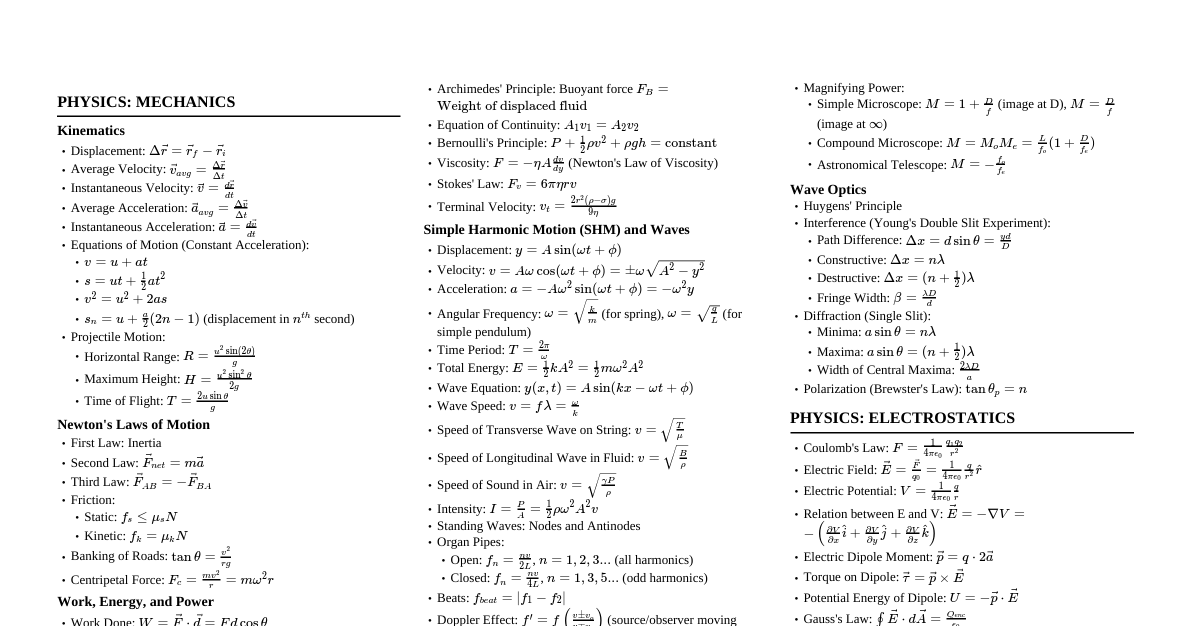
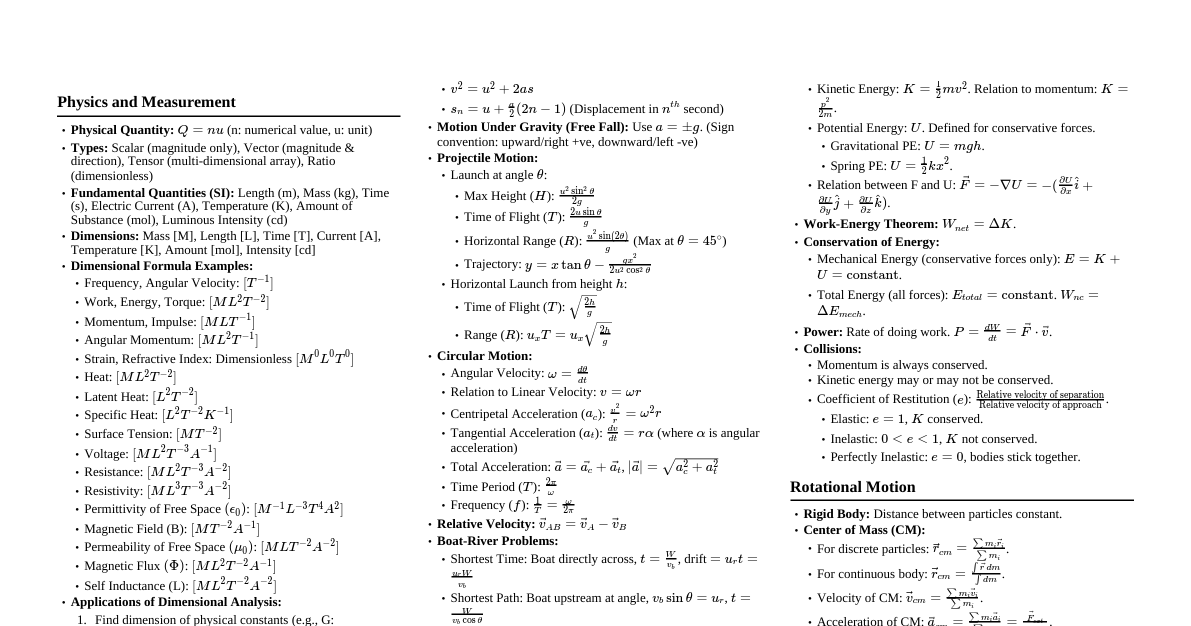
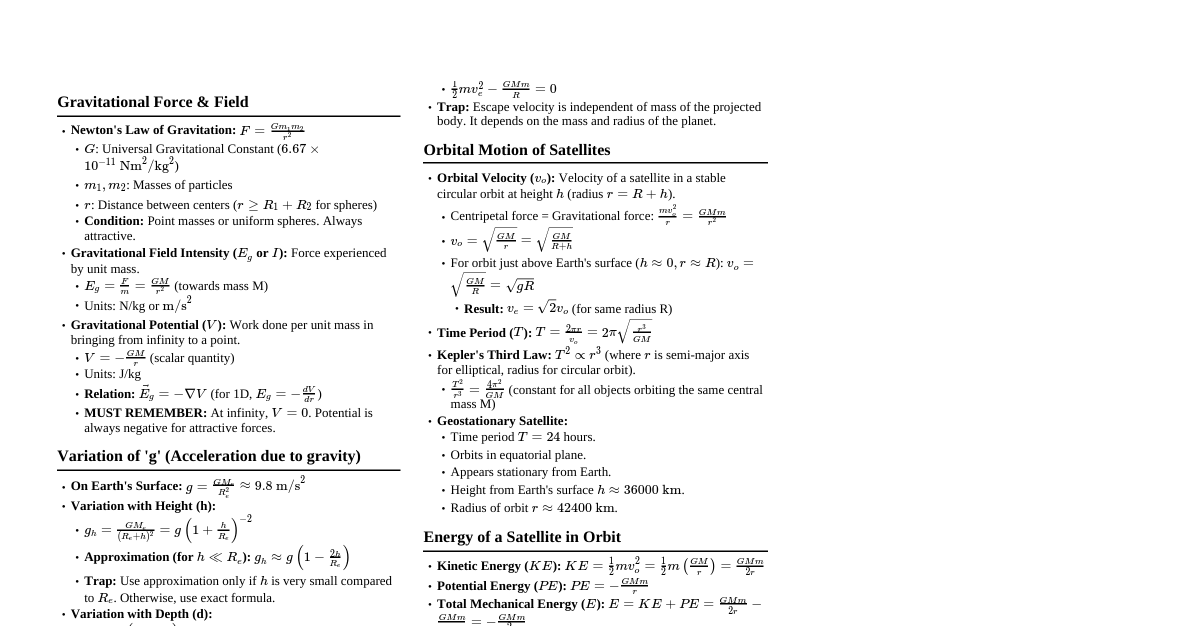
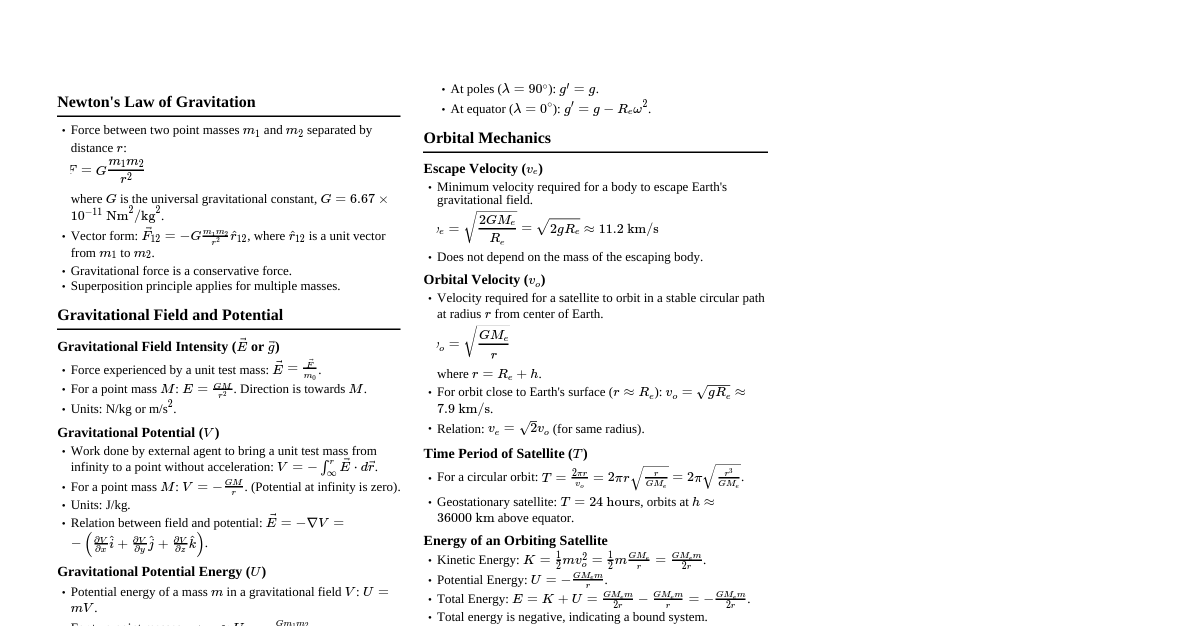
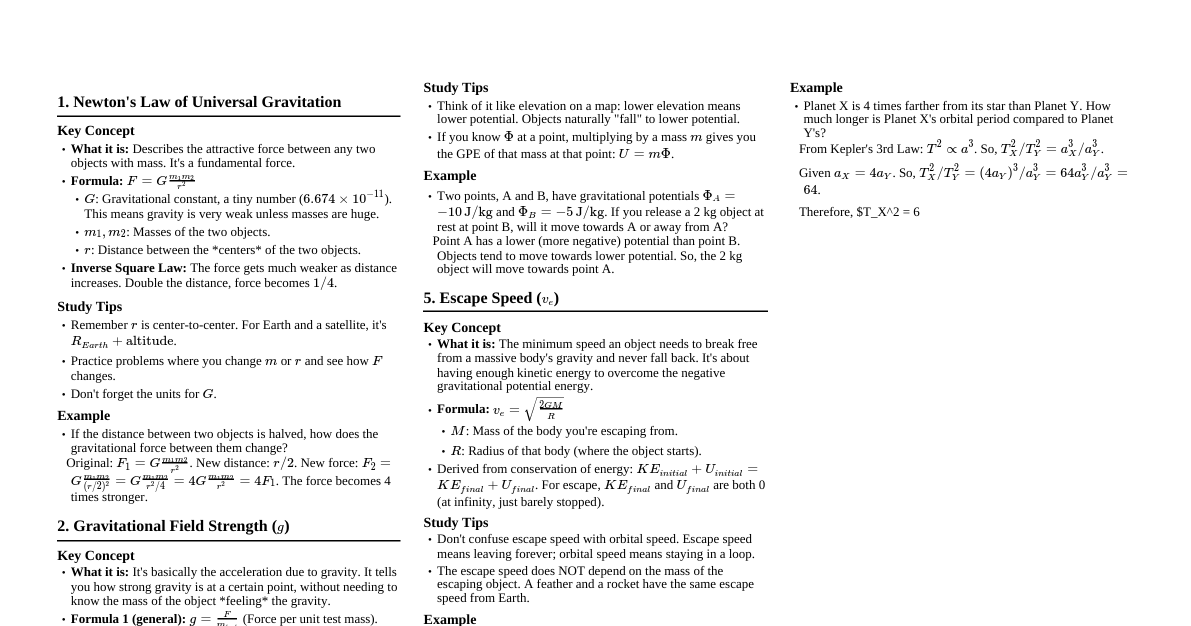
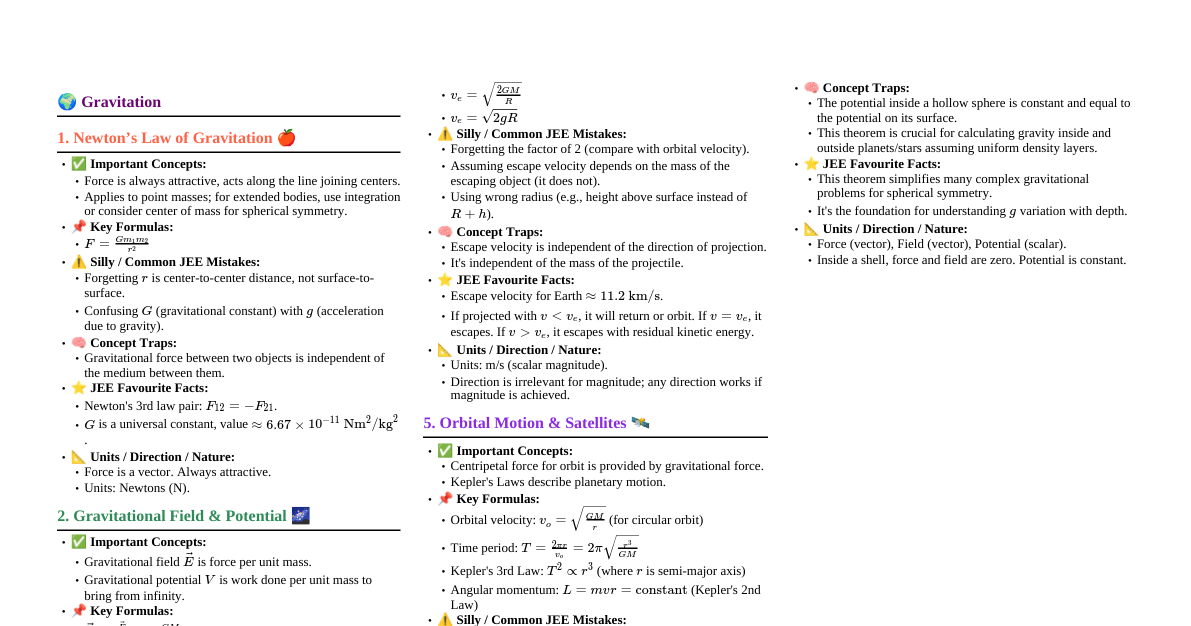
### Newton's Law of Universal Gravitation - **Statement:** "Every particle in the Universe attracts every other particle with a force that is directly proportional to the product of their masses and inversely proportional to the square of the distance between their centers." - **Mathematical Form:** - Scalar: $$ F = G \frac{m_1 m_2}{r^2} $$ - Vector: $$ \vec{F}_{12} = -G \frac{m_1 m_2}{r^2} \hat{r}_{21} $$ - $\vec{F}_{12}$: Gravitational force exerted on $m_1$ by $m_2$. - $\hat{r}_{21}$: Unit vector pointing from $m_2$ to $m_1$. The negative sign indicates an attractive force. - **Key Terms:** - $F$: Magnitude of the gravitational force (Newtons, N). - $G$: **Universal Gravitational Constant**. - Value: $6.674 \times 10^{-11} \text{ N m}^2 \text{ kg}^{-2}$. - First measured by Henry Cavendish. - $m_1, m_2$: Masses of the two interacting particles (kilograms, kg). - $r$: Distance between the centers of the two particles (meters, m). - **Characteristics of Gravitational Force:** 1. **Universal:** Applies to all objects, from elementary particles to galaxies. 2. **Always Attractive:** Gravity only pulls objects together; it never pushes them apart. 3. **Central Force:** Acts along the line joining the centers of the two masses. This implies zero torque and thus conservation of angular momentum for a two-body system. 4. **Conservative Force:** The work done by gravity depends only on the initial and final positions, not on the path taken. This allows for the definition of gravitational potential energy. 5. **Weakest Fundamental Force:** Much weaker than the strong nuclear, electromagnetic, and weak nuclear forces. It is significant only for large masses or over vast cosmic distances. 6. **Independent of Medium:** The force between two masses is not affected by the presence of other matter between them. 7. **Action-Reaction Pair:** $\vec{F}_{12} = -\vec{F}_{21}$ (Newton's Third Law). - **Principle of Superposition:** For a system of multiple masses, the net gravitational force on any one mass is the vector sum of the individual gravitational forces exerted by all other masses. $$ \vec{F}_{\text{net}} = \sum_{i \neq j} \vec{F}_{ij} $$ ### Acceleration Due to Gravity (g) - **Definition:** The acceleration experienced by an object solely due to the gravitational pull of a massive body (e.g., a planet). - **Formula on the surface of a spherical body (mass M, radius R):** $$ g = \frac{GM}{R^2} $$ - This formula assumes a uniform density sphere and neglects rotation. - **Average value on Earth's surface:** $g \approx 9.80665 \text{ m/s}^2$ (standard gravity). - **Relationship with Weight:** Weight ($W$) is the force of gravity acting on an object of mass $m$. $$ W = mg $$ - Unit of weight is Newton (N). ### Variation of g (Acceleration Due to Gravity) #### 1. With Height (Altitude) - **Exact Formula at height h above surface:** $$ g_h = \frac{GM}{(R+h)^2} $$ - **Approximate Formula (for $h \ll R$):** $$ g_h \approx g \left(1 - \frac{2h}{R}\right) $$ - **Conclusion:** As height $h$ increases, $g_h$ decreases. This is because the distance from the center of mass increases. #### 2. With Depth - **Formula at depth d below surface:** $$ g_d = g \left(1 - \frac{d}{R}\right) $$ - This formula assumes a uniformly dense Earth. - **At the center of Earth ($d=R$):** $g_d = g(1 - R/R) = 0$. - **Conclusion:** As depth $d$ increases, $g_d$ decreases linearly. At the center, gravity is zero. #### 3. With Shape of Earth (Latitude) - **Earth's Shape:** The Earth is not a perfect sphere; it's an **oblate spheroid** (bulges at the equator, flattened at the poles) due to its rotation. - **Equatorial Radius ($R_e$) vs. Polar Radius ($R_p$):** $R_e > R_p$. - **Effect on g:** Since $g = GM/R^2$, a smaller radius leads to a larger $g$. - $g_{\text{pole}} > g_{\text{equator}}$. - $g$ is maximum at the poles and minimum at the equator due to shape. #### 4. With Rotation of Earth (Latitude) - **Effect:** The Earth's rotation creates a centrifugal force that opposes gravity, reducing the *apparent* weight of objects. This effect is maximum at the equator and zero at the poles. - **Effective Gravity ($g'$) at Latitude $\lambda$:** $$ g' = g - R\omega^2 \cos^2\lambda $$ - $g'$: Apparent acceleration due to gravity. - $g$: True acceleration due to gravity (without rotation). - $R$: Radius of Earth. - $\omega$: Angular velocity of Earth's rotation ($2\pi/T$, where $T=24 \text{ hours}$). - $\lambda$: Latitude (angle from the equator). - **At Poles ($\lambda = 90^\circ$):** $\cos 90^\circ = 0 \implies g' = g$. No effect of rotation. - **At Equator ($\lambda = 0^\circ$):** $\cos 0^\circ = 1 \implies g' = g - R\omega^2$. Maximum reduction in $g'$. - **Conclusion:** The rotational effect further contributes to $g$ being minimum at the equator and maximum at the poles. ### Gravitational Field - **Concept:** A region of space around a mass where another mass would experience a gravitational force. It's a convenient way to describe the influence of a mass without considering the presence of a second mass. - **Gravitational Field Intensity ($\vec{E}$ or $\vec{I}$):** Also known as gravitational field strength. It is the gravitational force experienced per unit test mass placed at that point. - **Mathematical Form:** - Scalar Magnitude: $$ E = \frac{F}{m_0} = \frac{GM}{r^2} $$ - Vector: $$ \vec{E} = -\frac{GM}{r^2} \hat{r} $$ - $\hat{r}$: Unit vector pointing radially outward from the source mass $M$. The negative sign indicates the field is directed towards the source mass. - **Unit:** N/kg or m/s$^2$. - **Relationship with Acceleration due to Gravity:** The gravitational field intensity $\vec{E}$ at a point is numerically equal to the acceleration due to gravity $\vec{g}$ at that point. $$ \vec{E} = \vec{g} $$ - **Gravitational Lines of Force:** Imaginary lines that represent the direction of the gravitational field. They are always directed towards the mass creating the field and never intersect. ### Gravitational Potential (V) - **Definition:** The work done per unit mass by an external agent in bringing a test mass from infinity to a point in the gravitational field without accelerating it. It is a scalar quantity. - **Mathematical Form:** $$ V = -\frac{GM}{r} $$ - $V$: Gravitational potential (Joules per kilogram, J/kg). - $G$: Universal Gravitational Constant. - $M$: Source mass. - $r$: Distance from the source mass to the point where potential is being calculated. - **Characteristics:** - **Reference Point:** Gravitational potential is conventionally taken as zero at infinity ($r \to \infty \implies V \to 0$). - **Always Negative:** Because gravity is an attractive force, work is done *by* the field as a mass comes from infinity, so an external agent does negative work. - **Maximum at infinity (0), Minimum (most negative) at the surface of the mass.** - **Relationship with Field Intensity:** $$ \vec{E} = -\nabla V $$ - In one dimension: $E = -\frac{dV}{dr}$. The gravitational field is the negative gradient of the gravitational potential. ### Gravitational Potential Energy (U) - **Definition:** The work done by an external agent in assembling a system of masses by bringing them from infinite separation to their current configuration. It represents the energy stored in the gravitational field of a system of masses. - **For a system of two point masses $m_1, m_2$ separated by $r$:** $$ U = -\frac{Gm_1m_2}{r} $$ - **Unit:** Joule (J). - **Relationship with Gravitational Potential:** $$ U = m \cdot V $$ - **Change in Potential Energy:** The work done in moving a mass $m$ from a point $r_1$ to $r_2$ within a gravitational field created by mass $M$ is: $$ W = U_2 - U_1 = GMm \left(\frac{1}{r_1} - \frac{1}{r_2}\right) $$ - If $r_2 > r_1$, $W$ is positive, meaning work is done *against* gravity. - **Significance:** Like potential, it's generally negative, indicating that the system is bound. Positive potential energy would mean the system is unbound. ### Escape Velocity ($v_e$) - **Definition:** The minimum initial velocity required for an object to be projected from the surface of a celestial body so that it completely escapes the body's gravitational field and never returns. It implies the object reaches infinity with zero kinetic energy. - **Derivation (from Conservation of Energy):** - Initial Energy (surface): $E_i = \frac{1}{2}mv_e^2 - \frac{GMm}{R}$ - Final Energy (infinity): $E_f = 0 + 0 = 0$ - $E_i = E_f \implies \frac{1}{2}mv_e^2 = \frac{GMm}{R}$ - **Formula:** $$ v_e = \sqrt{\frac{2GM}{R}} $$ - Can also be expressed in terms of $g$: Since $g = GM/R^2$, then $GM = gR^2$. $$ v_e = \sqrt{\frac{2gR^2}{R}} = \sqrt{2gR} $$ - **For Earth:** $v_e \approx 11.2 \text{ km/s}$. - **Key Points:** - Independent of the mass of the escaping object. - Independent of the direction of projection (assuming no atmospheric resistance). - Depends only on the mass ($M$) and radius ($R$) of the celestial body from which the object is escaping. ### Orbital Velocity ($v_o$) - **Definition:** The velocity required for an object (satellite) to maintain a stable circular orbit around a celestial body at a given radius. - **Derivation (from Centripetal Force = Gravitational Force):** - $\frac{mv_o^2}{r} = \frac{GMm}{r^2}$ - **Formula for a circular orbit at radius $r$ (from center of central body):** $$ v_o = \sqrt{\frac{GM}{r}} $$ - Where $r = R+h$ ($R$ = radius of central body, $h$ = height above surface). - **For an orbit close to the surface ($h \approx 0 \implies r \approx R$):** $$ v_o = \sqrt{\frac{GM}{R}} = \sqrt{gR} $$ - **For Earth (close orbit):** $v_o \approx 7.9 \text{ km/s}$. - **Relationship with Escape Velocity:** $$ v_e = \sqrt{2} v_o $$ ### Energy of an Orbiting Satellite (Circular Orbit) - **Kinetic Energy (K):** $$ K = \frac{1}{2}mv_o^2 = \frac{1}{2}m \left(\frac{GM}{r}\right) = \frac{GMm}{2r} $$ - **Potential Energy (U):** $$ U = -\frac{GMm}{r} $$ - **Total Mechanical Energy (E):** $$ E = K + U = \frac{GMm}{2r} - \frac{GMm}{r} = -\frac{GMm}{2r} $$ - $r$: Orbital radius ($R+h$). - **Key Implications:** - The total energy $E$ is negative, indicating that the satellite is **bound** to the central body. Work must be done to remove it from orbit. - The kinetic energy is half the magnitude of the potential energy, and the total energy is half the potential energy (and negative of the kinetic energy). ### Binding Energy - **Definition:** The minimum energy required to completely remove a satellite from its orbit to infinity (i.e., to make it unbound). It is the positive value of the total mechanical energy of the orbiting satellite. - **Formula:** $$ \text{Binding Energy} = -E = \frac{GMm}{2r} $$ ### Time Period of Satellite (T) - **Definition:** The time taken for a satellite to complete one full revolution around its central body. - **Derivation:** $T = \frac{2\pi r}{v_o}$. Substitute $v_o = \sqrt{\frac{GM}{r}}$: $$ T = \frac{2\pi r}{\sqrt{GM/r}} = 2\pi \sqrt{\frac{r^3}{GM}} $$ - **Kepler's Third Law:** From the above formula, $T^2 = \frac{4\pi^2}{GM} r^3$. $$ T^2 \propto r^3 $$ - This applies to all satellites orbiting the same central mass $M$. ### Height of Satellite - If the time period $T$ is known, the orbital radius $r$ can be found: $$ r^3 = \frac{GMT^2}{4\pi^2} \implies r = \left(\frac{GMT^2}{4\pi^2}\right)^{1/3} $$ - **Height above surface:** $h = r - R_{\text{central body}}$ ### Geostationary Satellite - **Definition:** A special type of geosynchronous satellite that orbits directly above the Earth's equator and has an orbital period equal to the Earth's rotational period (24 hours). - **Key Characteristics:** 1. **Orbital Period:** $T = 24 \text{ hours} = 86400 \text{ seconds}$. 2. **Orbital Direction:** Orbits in the same direction as Earth's rotation (West to East). 3. **Apparent Position:** Appears stationary (fixed) in the sky from the perspective of an observer on the Earth's surface. 4. **Orbital Plane:** Must orbit in the equatorial plane. 5. **Orbital Radius:** $r \approx 42,164 \text{ km}$ from Earth's center. 6. **Height above Surface:** $h \approx 35,786 \text{ km}$ above the equator. 7. **Orbital Velocity:** $v_o \approx 3.07 \text{ km/s}$. - **Uses:** Communication (television, radio, internet), weather forecasting. A single geostationary satellite can cover approximately 42% of the Earth's surface. Three such satellites, strategically placed, can provide global coverage. ### Polar Satellite (Low Earth Orbit - LEO) - **Definition:** A satellite that orbits the Earth in a North-South (polar) direction, passing over both poles. - **Key Characteristics:** 1. **Orbital Plane:** Inclined at nearly $90^\circ$ to the equatorial plane. 2. **Altitude:** Typically Low Earth Orbit (LEO), ranging from $200 \text{ km}$ to $1000 \text{ km}$ above the Earth's surface. 3. **Orbital Period:** Short, typically $85 \text{ to } 100 \text{ minutes}$. 4. **Earth Rotation:** As the satellite orbits, the Earth rotates beneath it, allowing the satellite to scan the entire Earth's surface over multiple passes. 5. **Sun-Synchronous Orbits:** Many polar satellites are put into sun-synchronous orbits, meaning they always pass over a given point on Earth at the same local solar time. This ensures consistent lighting conditions for imaging. - **Uses:** Earth observation, remote sensing, environmental monitoring, espionage (spy satellites), meteorological data collection, global positioning systems (GPS constellations). ### Kepler's Laws of Planetary Motion - Formulated by Johannes Kepler based on observations by Tycho Brahe, describing the motion of planets around the Sun. #### 1. Law of Orbits (First Law) - **Statement:** "All planets move in elliptical orbits with the Sun at one of the two foci." - An ellipse has two focal points. The Sun is at one of them. - The eccentricity of the ellipse determines how "squashed" it is. For planets, eccentricities are generally small, so orbits are nearly circular. #### 2. Law of Areas (Second Law) - **Statement:** "A line segment joining a planet and the Sun sweeps out equal areas during equal intervals of time." - **Implication:** Planets move faster when they are closer to the Sun (perihelion) and slower when they are farther away (aphelion). - This law is a direct consequence of the **conservation of angular momentum**. - **Areal Velocity:** The rate at which area is swept is constant: $\frac{dA}{dt} = \frac{L}{2m} = \text{constant}$. - $L$: Angular momentum of the planet. - $m$: Mass of the planet. #### 3. Law of Periods (Third Law) - **Statement:** "The square of the orbital period ($T$) of any planet is directly proportional to the cube of the semi-major axis ($a$) of its elliptical orbit." - **Mathematical Form:** $$ T^2 \propto a^3 \quad \text{or} \quad \frac{T^2}{a^3} = \text{constant} $$ - The constant of proportionality is $\frac{4\pi^2}{GM_{\text{sun}}}$ for objects orbiting the Sun. - For a circular orbit, the semi-major axis $a$ becomes the radius $r$. - **Significance:** These laws were purely empirical. Newton later derived them from his law of universal gravitation, providing a theoretical foundation. ### Gravitational Self-Energy (Binding Energy of a System) - **Definition:** The amount of work done by an external agent to assemble a system of particles from infinite separation against their mutual gravitational attraction. Alternatively, it is the negative of the work done by the gravitational forces of the system during its formation. - **For a system of two point masses $m_1, m_2$ separated by $r$:** $$ U = -\frac{Gm_1m_2}{r} $$ - **For a system of multiple point masses:** Sum of potential energies for all unique pairs. $$ U = \sum_{i ### Weightlessness - **Definition:** A state where an object experiences no apparent weight. This occurs when the effective normal force or support force on an object is zero. It's an *apparent* condition, not a true absence of gravity. - **Causes/Scenarios:** 1. **Free Fall:** When an object is falling freely under the influence of gravity (e.g., in a freely falling elevator or aircraft on a parabolic trajectory), its acceleration is $g$. The normal force from the floor or scale becomes zero, leading to apparent weightlessness. 2. **Orbiting Satellite:** Inside an orbiting satellite (like the International Space Station), both the satellite and everything within it are continuously falling around the Earth. The gravitational force acts as the centripetal force, and there is no contact force to provide "weight." All objects appear to float. 3. **At the Center of the Earth:** Since $g=0$ at the Earth's center, an object would truly be weightless there. 4. **In Deep Space:** Far away from any significant gravitational sources, the gravitational force itself is negligible, leading to a state of near-true weightlessness. - **Distinction:** - **Apparent Weightlessness:** The sensation of having no weight, even though gravity is still acting. (e.g., in orbit, free fall). - **True Weightlessness:** Complete absence of gravitational force (e.g., theoretically at infinite distance from any mass, or at the center of a uniform spherical mass). ### Gravitational Shielding - **Concept:** Unlike electromagnetic forces, gravity cannot be easily "shielded" or blocked by intervening matter. - **Observation:** No known material or configuration of matter has been found to reduce or block the gravitational pull between two objects. - **Reason:** Gravitational force depends only on mass and distance, and mass is always positive. There's no "negative mass" to cancel out gravitational effects. ### Important Constants - **Universal Gravitational Constant (G):** $6.674 \times 10^{-11} \text{ N m}^2/\text{kg}^2$ - **Mass of Earth ($M_E$):** $5.972 \times 10^{24} \text{ kg}$ - **Radius of Earth ($R_E$):** $6.371 \times 10^6 \text{ m}$ (mean radius) - **Standard Acceleration due to gravity (g):** $9.80665 \text{ m/s}^2$ - **Mass of Sun ($M_S$):** $1.989 \times 10^{30} \text{ kg}$