Claude Cowork Security Risks
Shared 3/28/2026•61 views
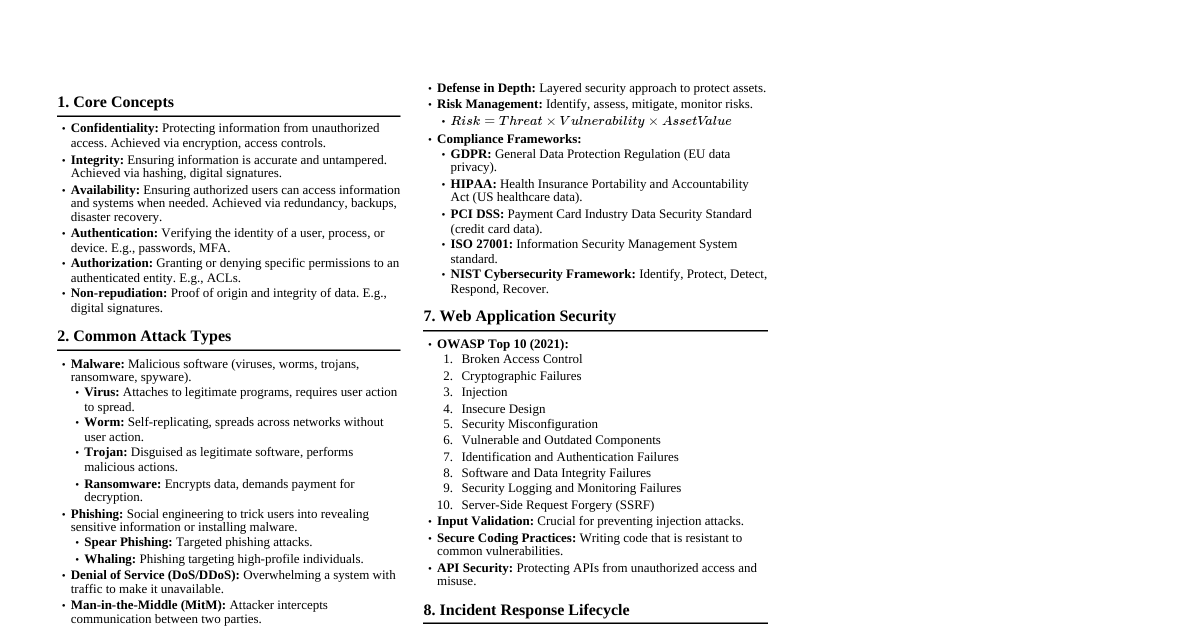
### Introduction to Claude Cowork Security Risks Claude Cowork, while a powerful AI assistant, introduces several security considerations when deployed in an enterprise environment. Understanding these risks is crucial for mitigating potential data breaches, compliance violations, and operational disruptions. This cheatsheet outlines key security risks and best practices for their management. ### Data Privacy and Confidentiality Risks Enterprise data often contains sensitive, proprietary, or regulated information. Using Claude Cowork requires careful consideration of how this data is handled. #### Input Data Leakage - **Risk:** Sensitive information (financial data, personal identifiable information (PII), intellectual property) entered into Claude Cowork could be inadvertently used for training models, exposed to unauthorized individuals, or stored insecurely. - **Mitigation:** - Implement strict data governance policies. - Anonymize or redact sensitive data before input. - Use enterprise-grade deployments with data isolation guarantees. - Ensure contractual agreements with Claude's provider explicitly state data usage and retention policies. #### Output Data Accuracy and Bias - **Risk:** Claude Cowork might generate inaccurate, biased, or hallucinated information that, if relied upon, could lead to poor business decisions, legal liabilities, or reputational damage. - **Mitigation:** - Human oversight and verification of critical outputs. - Implement fact-checking mechanisms. - Train users on critical evaluation of AI-generated content. ### Access Control and Authentication Managing who can access and interact with Claude Cowork, and under what permissions, is paramount. #### Unauthorized Access - **Risk:** Weak authentication mechanisms or improper access controls can allow unauthorized users to interact with Claude Cowork, potentially leading to data exfiltration or misuse. - **Mitigation:** - Integrate with enterprise Single Sign-On (SSO) and Multi-Factor Authentication (MFA). - Implement Role-Based Access Control (RBAC) to limit functionality based on user roles (e.g., read-only, limited input, full access). - Regularly audit access logs. #### API Key Management - **Risk:** If using API access, compromised API keys can grant full programmatic control to Claude Cowork, leading to widespread data breaches or service abuse. - **Mitigation:** - Rotate API keys regularly. - Store API keys securely (e.g., in a secrets manager). - Implement rate limiting and IP whitelisting for API access. - Monitor API usage for anomalies. ### Compliance and Legal Risks Enterprises operate under various regulatory frameworks that govern data handling. #### Regulatory Non-Compliance - **Risk:** Using Claude Cowork without adhering to regulations like GDPR, HIPAA, CCPA, or industry-specific standards can result in hefty fines and legal action. - **Mitigation:** - Conduct a thorough legal and compliance review before deployment. - Ensure data processing agreements (DPAs) with the AI provider meet regulatory requirements. - Understand data residency and sovereignty requirements. #### Intellectual Property (IP) Concerns - **Risk:** Inputting proprietary data could potentially expose IP, or outputs generated by Claude Cowork might infringe on third-party IP if the model was trained on infringing data. - **Mitigation:** - Clear policies on what IP can be shared with the AI. - Legal review of AI provider's IP indemnity clauses. - Implement strict internal guidelines for AI-generated content that might resemble existing IP. ### System Vulnerabilities and Attacks Like any software system, Claude Cowork and its integration points can be targets for cyberattacks. #### Prompt Injection Attacks - **Risk:** Malicious users or even legitimate users can craft prompts to manipulate Claude Cowork into revealing sensitive information, bypassing security filters, or executing unintended actions. - **Mitigation:** - Implement robust input validation and sanitization. - Use AI safety guardrails and content filters. - Continuously monitor for new prompt injection techniques. - Limit the scope of Claude Cowork's actions and access to systems. #### Denial of Service (DoS) / Resource Exhaustion - **Risk:** Malicious or poorly designed queries could overwhelm Claude Cowork's API or associated infrastructure, leading to service disruption or increased operational costs. - **Mitigation:** - Implement rate limiting on user requests. - Monitor resource usage and set alerts for unusual spikes. - Utilize cloud provider's DoS protection mechanisms. ### Shadow AI Use Unsanctioned use of AI tools by employees poses significant risks. #### Unsanctioned Data Sharing - **Risk:** Employees might use public versions of Claude Cowork or other AI tools to process company data, bypassing enterprise security controls and data governance policies. - **Mitigation:** - Establish clear Acceptable Use Policies (AUPs) for AI tools. - Provide sanctioned and secure AI alternatives. - Educate employees on the risks of shadow AI. - Implement network monitoring to detect unsanctioned AI tool usage. ### General Best Practices - **Security by Design:** Integrate security considerations from the initial planning phase of Claude Cowork deployment. - **Continuous Monitoring:** Regularly monitor logs, user activity, and AI outputs for anomalies or suspicious behavior. - **Regular Audits:** Conduct periodic security audits and penetration testing of the AI integration. - **Employee Training:** Educate all users on secure AI usage, data handling, and company policies. - **Incident Response Plan:** Develop a specific incident response plan for AI-related security incidents. - **Vendor Security Review:** Thoroughly vet the security practices, certifications, and compliance of the AI provider.