Class 11 Maths Formulas
Shared 2/24/2026•119 views
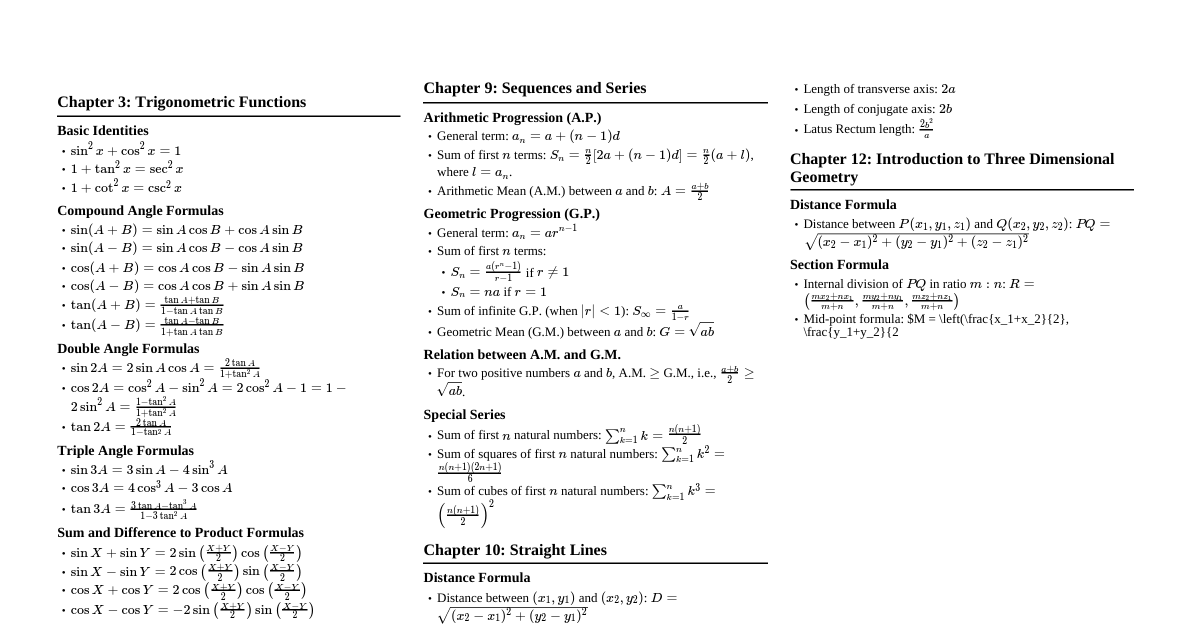
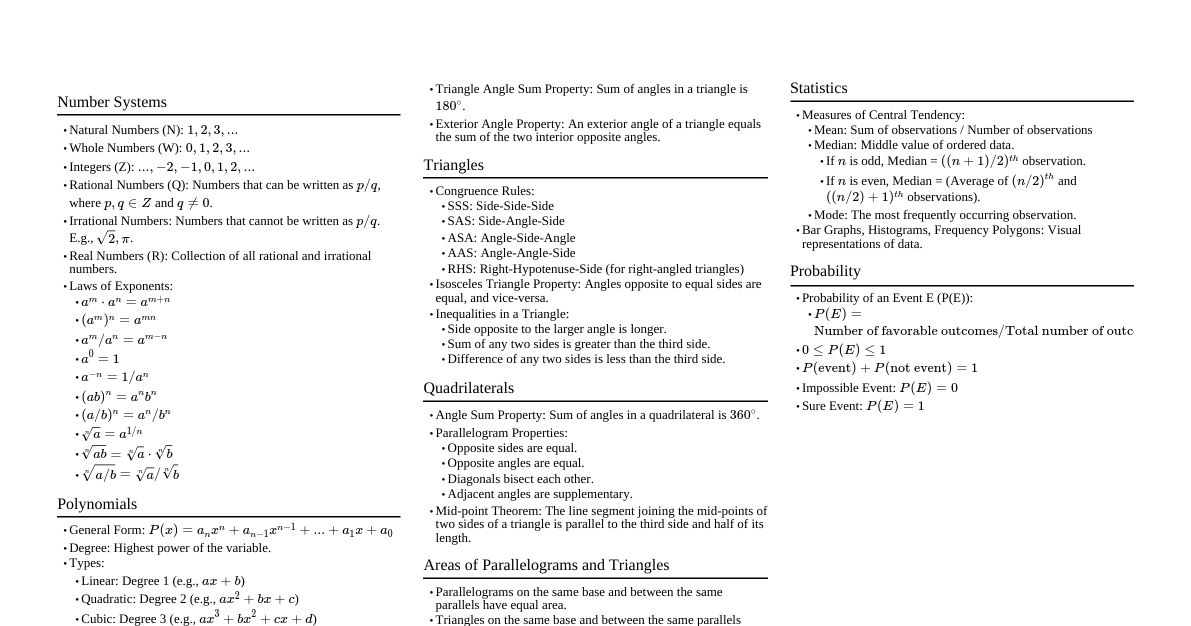
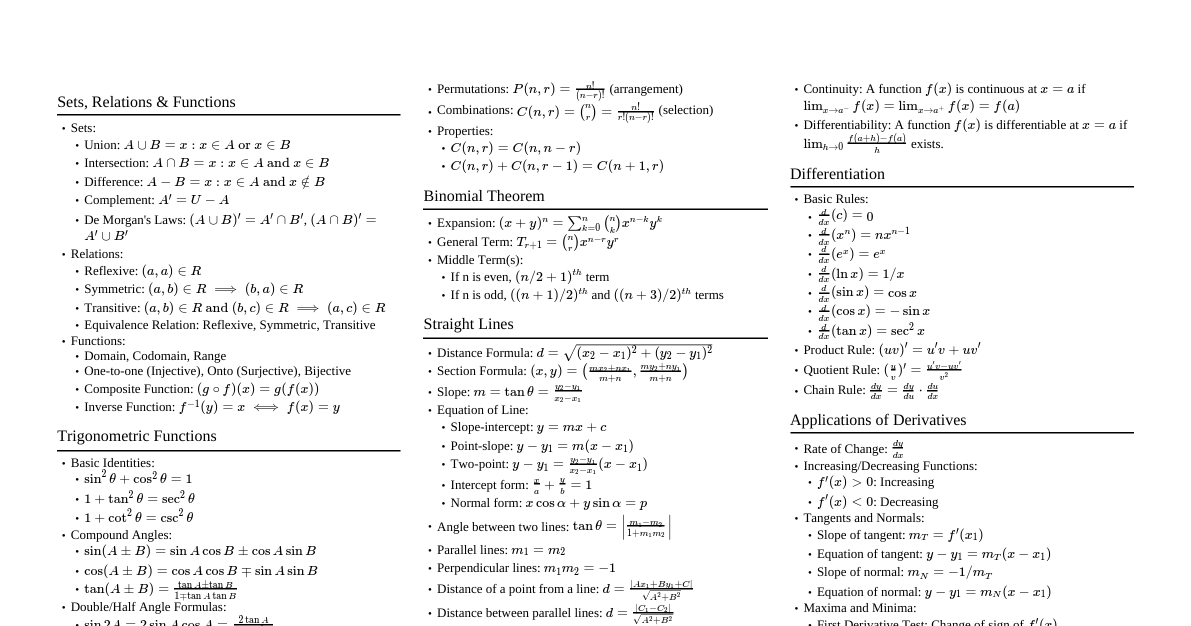
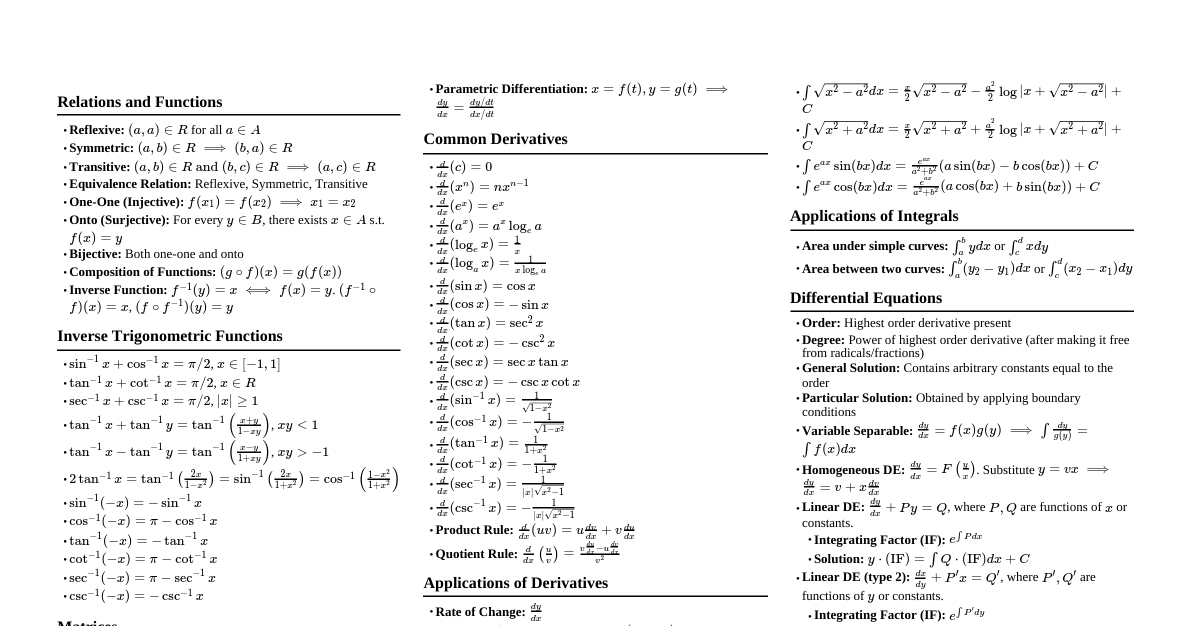
### Ch-1 Sets - **Definition:** A well-defined collection of objects. - **Representation:** - Roster form: $\{1, 2, 3, 4\}$ - Set-builder form: $\{x : x \text{ is a natural number and } x < 5\}$ - **Types of Sets:** - Empty set: $\emptyset$ or $\{\}$ - Finite set: Has a definite number of elements. - Infinite set: Has indefinite number of elements. - Singleton set: Contains only one element. - **Subset:** $A \subseteq B$ if every element of A is in B. - **Power Set:** $P(A)$ is the set of all subsets of A. If $|A|=n$, then $|P(A)|=2^n$. - **Universal Set:** $U$, the set containing all elements under consideration. - **Operations on Sets:** - **Union:** $A \cup B = \{x : x \in A \text{ or } x \in B\}$ - **Intersection:** $A \cap B = \{x : x \in A \text{ and } x \in B\}$ - **Difference:** $A - B = \{x : x \in A \text{ and } x \notin B\}$ - **Complement:** $A' = U - A = \{x : x \in U \text{ and } x \notin A\}$ - **Properties of Set Operations:** - Commutative Laws: $A \cup B = B \cup A$, $A \cap B = B \cap A$ - Associative Laws: $(A \cup B) \cup C = A \cup (B \cup C)$, $(A \cap B) \cap C = A \cap (B \cap C)$ - Distributive Laws: $A \cup (B \cap C) = (A \cup B) \cap (A \cup C)$, $A \cap (B \cup C) = (A \cap B) \cup (A \cap C)$ - De Morgan's Laws: $(A \cup B)' = A' \cap B'$, $(A \cap B)' = A' \cup B'$ - **Cardinality of Sets:** - $|A \cup B| = |A| + |B| - |A \cap B|$ - $|A \cup B \cup C| = |A| + |B| + |C| - |A \cap B| - |A \cap C| - |B \cap C| + |A \cap B \cap C|$ ### Ch-2 Relations & Functions - **Cartesian Product:** $A \times B = \{(a, b) : a \in A, b \in B\}$ - **Relation:** A subset of $A \times B$. - Domain: Set of all first elements of the ordered pairs in a relation. - Range: Set of all second elements of the ordered pairs in a relation. - **Function:** A special type of relation where every element of the domain has one and only one image in the codomain. - Domain, Codomain, Range. - **Types of Functions:** - Identity function: $f(x) = x$ - Constant function: $f(x) = c$ - Polynomial function: $f(x) = a_0 + a_1 x + ... + a_n x^n$ - Rational function: $f(x) = \frac{P(x)}{Q(x)}$, where $Q(x) \neq 0$ - Modulus function: $f(x) = |x| = \begin{cases} x & \text{if } x \ge 0 \\ -x & \text{if } x < 0 \end{cases}$ - Signum function: $f(x) = \text{sgn}(x) = \begin{cases} 1 & \text{if } x > 0 \\ 0 & \text{if } x = 0 \\ -1 & \text{if } x < 0 \end{cases}$ - Greatest Integer Function (Floor function): $f(x) = [x]$ (the greatest integer less than or equal to $x$). ### Ch-3 Trigonometric Functions - **Angle Measurement:** - $1 \text{ radian} = \frac{180^\circ}{\pi}$ - $1^\circ = \frac{\pi}{180} \text{ radian}$ - Arc length: $l = r\theta$ (where $\theta$ is in radians) - **Basic Identities:** - $\sin^2 x + \cos^2 x = 1$ - $1 + \tan^2 x = \sec^2 x$ - $1 + \cot^2 x = \csc^2 x$ - **Reciprocal Identities:** - $\csc x = \frac{1}{\sin x}$ - $\sec x = \frac{1}{\cos x}$ - $\cot x = \frac{1}{\tan x}$ - **Quotient Identities:** - $\tan x = \frac{\sin x}{\cos x}$ - $\cot x = \frac{\cos x}{\sin x}$ - **Signs of Trigonometric Functions (CAST Rule):** - Quadrant I (0 to $\pi/2$): All positive - Quadrant II ($\pi/2$ to $\pi$): Sin, Csc positive - Quadrant III ($\pi$ to $3\pi/2$): Tan, Cot positive - Quadrant IV ($3\pi/2$ to $2\pi$): Cos, Sec positive - **Trigonometric Functions of Allied Angles:** - $\sin(2n\pi + x) = \sin x$ - $\cos(2n\pi + x) = \cos x$ - $\sin(-x) = -\sin x$, $\cos(-x) = \cos x$, $\tan(-x) = -\tan x$ - $\sin(\pi/2 - x) = \cos x$, $\cos(\pi/2 - x) = \sin x$, $\tan(\pi/2 - x) = \cot x$ - $\sin(\pi/2 + x) = \cos x$, $\cos(\pi/2 + x) = -\sin x$, $\tan(\pi/2 + x) = -\cot x$ - $\sin(\pi - x) = \sin x$, $\cos(\pi - x) = -\cos x$, $\tan(\pi - x) = -\tan x$ - $\sin(\pi + x) = -\sin x$, $\cos(\pi + x) = -\cos x$, $\tan(\pi + x) = \tan x$ - **Compound Angle Formulas:** - $\sin(A \pm B) = \sin A \cos B \pm \cos A \sin B$ - $\cos(A \pm B) = \cos A \cos B \mp \sin A \sin B$ - $\tan(A \pm B) = \frac{\tan A \pm \tan B}{1 \mp \tan A \tan B}$ - $\cot(A \pm B) = \frac{\cot A \cot B \mp 1}{\cot B \pm \cot A}$ - **Double Angle Formulas:** - $\sin 2A = 2 \sin A \cos A = \frac{2 \tan A}{1 + \tan^2 A}$ - $\cos 2A = \cos^2 A - \sin^2 A = 2 \cos^2 A - 1 = 1 - 2 \sin^2 A = \frac{1 - \tan^2 A}{1 + \tan^2 A}$ - $\tan 2A = \frac{2 \tan A}{1 - \tan^2 A}$ - **Triple Angle Formulas:** - $\sin 3A = 3 \sin A - 4 \sin^3 A$ - $\cos 3A = 4 \cos^3 A - 3 \cos A$ - $\tan 3A = \frac{3 \tan A - \tan^3 A}{1 - 3 \tan^2 A}$ - **Half Angle Formulas:** - $\sin^2 A = \frac{1 - \cos 2A}{2}$ - $\cos^2 A = \frac{1 + \cos 2A}{2}$ - $\tan^2 A = \frac{1 - \cos 2A}{1 + \cos 2A}$ - **Product-to-Sum Formulas:** - $2 \sin A \cos B = \sin(A+B) + \sin(A-B)$ - $2 \cos A \sin B = \sin(A+B) - \sin(A-B)$ - $2 \cos A \cos B = \cos(A+B) + \cos(A-B)$ - $2 \sin A \sin B = \cos(A-B) - \cos(A+B)$ - **Sum-to-Product Formulas:** - $\sin C + \sin D = 2 \sin \left(\frac{C+D}{2}\right) \cos \left(\frac{C-D}{2}\right)$ - $\sin C - \sin D = 2 \cos \left(\frac{C+D}{2}\right) \sin \left(\frac{C-D}{2}\right)$ - $\cos C + \cos D = 2 \cos \left(\frac{C+D}{2}\right) \cos \left(\frac{C-D}{2}\right)$ - $\cos C - \cos D = -2 \sin \left(\frac{C+D}{2}\right) \sin \left(\frac{C-D}{2}\right)$ - **General Solutions of Trigonometric Equations:** - $\sin x = \sin y \implies x = n\pi + (-1)^n y$, where $n \in \mathbb{Z}$ - $\cos x = \cos y \implies x = 2n\pi \pm y$, where $n \in \mathbb{Z}$ - $\tan x = \tan y \implies x = n\pi + y$, where $n \in \mathbb{Z}$ - $\sin^2 x = \sin^2 y \implies x = n\pi \pm y$, where $n \in \mathbb{Z}$ - $\cos^2 x = \cos^2 y \implies x = n\pi \pm y$, where $n \in \mathbb{Z}$ - $\tan^2 x = \tan^2 y \implies x = n\pi \pm y$, where $n \in \mathbb{Z}$ ### Ch-4 Complex Numbers and Quadratic Equations - **Imaginary Unit:** $i = \sqrt{-1}$, so $i^2 = -1, i^3 = -i, i^4 = 1$ - **Complex Number:** $z = a + bi$, where $a, b \in \mathbb{R}$ and $i = \sqrt{-1}$. - $a$ is the real part ($\text{Re}(z)$), $b$ is the imaginary part ($\text{Im}(z)$). - **Conjugate of a Complex Number:** $\bar{z} = a - bi$ - **Modulus of a Complex Number:** $|z| = \sqrt{a^2 + b^2}$. - Properties: $|z_1 z_2| = |z_1| |z_2|$, $|\frac{z_1}{z_2}| = \frac{|z_1|}{|z_2|}$, $|z|^2 = z\bar{z}$ - **Polar Form of a Complex Number:** $z = r(\cos \theta + i \sin \theta)$, where $r = |z|$ and $\theta$ is the argument ($\text{arg}(z)$). - $\cos \theta = \frac{a}{r}$, $\sin \theta = \frac{b}{r}$ - Principal argument: $-\pi < \theta \le \pi$. - **Euler Form:** $z = re^{i\theta}$ - **Quadratic Equation:** $ax^2 + bx + c = 0$, where $a, b, c \in \mathbb{R}$ and $a \neq 0$. - **Quadratic Formula:** $x = \frac{-b \pm \sqrt{b^2 - 4ac}}{2a}$ - **Discriminant:** $D = b^2 - 4ac$ - If $D < 0$, roots are complex and distinct (conjugate pairs). ### Ch-5 Linear Inequalities - **Rules for solving inequalities:** - Adding or subtracting the same number on both sides does not change the inequality sign. - Multiplying or dividing by a positive number on both sides does not change the inequality sign. - Multiplying or dividing by a negative number on both sides *reverses* the inequality sign. - **Interval Notation:** - $(a, b)$: Open interval, $a < x < b$ - $[a, b]$: Closed interval, $a \le x \le b$ - $[a, b)$: Half-open interval, $a \le x < b$ - $(a, b]$: Half-open interval, $a < x \le b$ ### Ch-6 Permutations & Combinations - **Fundamental Principle of Counting:** - Multiplication Rule: If an event can occur in $m$ ways and another independent event can occur in $n$ ways, then both events can occur in $m \times n$ ways. - Addition Rule: If an event can occur in $m$ ways OR another independent event can occur in $n$ ways, then either event can occur in $m + n$ ways. - **Factorial Notation:** $n! = n \times (n-1) \times ... \times 2 \times 1$. By definition, $0! = 1$. - **Permutations (Arrangement):** Order matters. - Number of permutations of $n$ distinct objects taken $r$ at a time: $P(n, r) = {}^n P_r = \frac{n!}{(n-r)!}$ - Number of permutations of $n$ objects where $p_1$ are of one type, $p_2$ of another, etc.: $\frac{n!}{p_1! p_2! ... p_k!}$ - Number of circular permutations of $n$ distinct objects: $(n-1)!$ - **Combinations (Selection):** Order does not matter. - Number of combinations of $n$ distinct objects taken $r$ at a time: $C(n, r) = {}^n C_r = \binom{n}{r} = \frac{n!}{r!(n-r)!}$ - **Properties of Combinations:** - $\binom{n}{r} = \binom{n}{n-r}$ - $\binom{n}{r} + \binom{n}{r-1} = \binom{n+1}{r}$ - $\binom{n}{n} = 1$, $\binom{n}{0} = 1$ ### Ch-7 Binomial Theorem - **Binomial Theorem for Positive Integer Index:** - $(a+b)^n = \binom{n}{0}a^n b^0 + \binom{n}{1}a^{n-1}b^1 + ... + \binom{n}{r}a^{n-r}b^r + ... + \binom{n}{n}a^0 b^n$ - This can be written as $\sum_{r=0}^{n} \binom{n}{r} a^{n-r} b^r$ - **General Term:** $T_{r+1} = \binom{n}{r} a^{n-r} b^r$ - **Middle Term(s):** - If $n$ is even, there is one middle term: $T_{\frac{n}{2} + 1}$ - If $n$ is odd, there are two middle terms: $T_{\frac{n+1}{2}}$ and $T_{\frac{n+3}{2}}$ - **Term Independent of x (or any variable):** Find $r$ such that the power of the variable is 0 in the general term. - **Properties:** - Number of terms in the expansion of $(a+b)^n$ is $n+1$. - Sum of binomial coefficients: $\sum_{r=0}^{n} \binom{n}{r} = 2^n$ - Sum of alternating binomial coefficients: $\sum_{r=0}^{n} (-1)^r \binom{n}{r} = 0$ ### Ch-8 Sequence and Series - **Arithmetic Progression (AP):** - General term: $a_n = a + (n-1)d$ - Sum of first $n$ terms: $S_n = \frac{n}{2}[2a + (n-1)d] = \frac{n}{2}(a + a_n)$ - Arithmetic Mean (AM) between $a$ and $b$: $\frac{a+b}{2}$ - **Geometric Progression (GP):** - General term: $a_n = ar^{n-1}$ - Sum of first $n$ terms: $S_n = \frac{a(r^n - 1)}{r-1}$ for $r \neq 1$, $S_n = na$ for $r=1$ - Sum to infinity of a GP: $S_\infty = \frac{a}{1-r}$ for $|r| < 1$ - Geometric Mean (GM) between $a$ and $b$: $\sqrt{ab}$ - **Special Series:** - Sum of first $n$ natural numbers: $\sum_{k=1}^{n} k = \frac{n(n+1)}{2}$ - Sum of squares of first $n$ natural numbers: $\sum_{k=1}^{n} k^2 = \frac{n(n+1)(2n+1)}{6}$ - Sum of cubes of first $n$ natural numbers: $\sum_{k=1}^{n} k^3 = \left(\frac{n(n+1)}{2}\right)^2$ ### Ch-9 Straight Lines - **Distance Formula:** Distance between $(x_1, y_1)$ and $(x_2, y_2)$ is $\sqrt{(x_2-x_1)^2 + (y_2-y_1)^2}$ - **Section Formula:** - Internal division: $(x, y) = \left(\frac{m x_2 + n x_1}{m+n}, \frac{m y_2 + n y_1}{m+n}\right)$ - Mid-point: $\left(\frac{x_1+x_2}{2}, \frac{y_1+y_2}{2}\right)$ - **Area of a Triangle:** With vertices $(x_1, y_1), (x_2, y_2), (x_3, y_3)$ - Area $= \frac{1}{2} |x_1(y_2-y_3) + x_2(y_3-y_1) + x_3(y_1-y_2)|$ - **Slope of a Line (m):** - $m = \tan \theta$ (where $\theta$ is the angle with positive x-axis) - $m = \frac{y_2-y_1}{x_2-x_1}$ - **Parallel Lines:** $m_1 = m_2$ - **Perpendicular Lines:** $m_1 m_2 = -1$ (if slopes are defined) - **Angle between two lines:** $\tan \theta = \left|\frac{m_2 - m_1}{1 + m_1 m_2}\right|$ - **Equations of a Line:** - **Horizontal line:** $y = k$ - **Vertical line:** $x = k$ - **Point-slope form:** $y - y_1 = m(x - x_1)$ - **Two-point form:** $y - y_1 = \frac{y_2-y_1}{x_2-x_1}(x - x_1)$ - **Slope-intercept form:** $y = mx + c$ - **Intercept form:** $\frac{x}{a} + \frac{y}{b} = 1$ - **Normal form:** $x \cos \alpha + y \sin \alpha = p$ - **General form:** $Ax + By + C = 0$ - **Distance of a point from a line:** - Distance from $(x_1, y_1)$ to $Ax + By + C = 0$: $d = \frac{|Ax_1 + By_1 + C|}{\sqrt{A^2 + B^2}}$ - **Distance between two parallel lines:** - For $Ax + By + C_1 = 0$ and $Ax + By + C_2 = 0$: $d = \frac{|C_1 - C_2|}{\sqrt{A^2 + B^2}}$ ### Ch-10 Conic Sections - **General Equation of a Conic:** $Ax^2 + Bxy + Cy^2 + Dx + Ey + F = 0$ - **Circle:** Locus of a point equidistant from a fixed point (center). - **Equation:** $(x-h)^2 + (y-k)^2 = r^2$ (center $(h,k)$, radius $r$) - **General form:** $x^2 + y^2 + 2gx + 2fy + c = 0$ - Center: $(-g, -f)$, Radius: $\sqrt{g^2 + f^2 - c}$ - **Parabola:** Locus of a point that moves such that its distance from a fixed point (focus) is equal to its distance from a fixed line (directrix). - **Standard Equations:** - $y^2 = 4ax$: Focus $(a,0)$, Directrix $x = -a$, Axis $y=0$ - $y^2 = -4ax$: Focus $(-a,0)$, Directrix $x = a$, Axis $y=0$ - $x^2 = 4ay$: Focus $(0,a)$, Directrix $y = -a$, Axis $x=0$ - $x^2 = -4ay$: Focus $(0,-a)$, Directrix $y = a$, Axis $x=0$ - Latus Rectum: $4a$ - **Ellipse:** Locus of a point such that the sum of its distances from two fixed points (foci) is constant. - **Standard Equations:** - $\frac{x^2}{a^2} + \frac{y^2}{b^2} = 1$ (Major axis along x-axis, $a > b$) - Foci: $(\pm c, 0)$, where $c^2 = a^2 - b^2$ - Vertices: $(\pm a, 0)$ - Eccentricity: $e = \frac{c}{a} < 1$ - Latus Rectum: $\frac{2b^2}{a}$ - $\frac{x^2}{b^2} + \frac{y^2}{a^2} = 1$ (Major axis along y-axis, $a > b$) - Foci: $(0, \pm c)$, where $c^2 = a^2 - b^2$ - Vertices: $(0, \pm a)$ - Eccentricity: $e = \frac{c}{a} < 1$ - Latus Rectum: $\frac{2b^2}{a}$ - **Hyperbola:** Locus of a point such that the absolute difference of its distances from two fixed points (foci) is constant. - **Standard Equations:** - $\frac{x^2}{a^2} - \frac{y^2}{b^2} = 1$ (Transverse axis along x-axis) - Foci: $(\pm c, 0)$, where $c^2 = a^2 + b^2$ - Vertices: $(\pm a, 0)$ - Eccentricity: $e = \frac{c}{a} > 1$ - Latus Rectum: $\frac{2b^2}{a}$ - $\frac{y^2}{a^2} - \frac{x^2}{b^2} = 1$ (Transverse axis along y-axis) - Foci: $(0, \pm c)$, where $c^2 = a^2 + b^2$ - Vertices: $(0, \pm a)$ - Eccentricity: $e = \frac{c}{a} > 1$ - Latus Rectum: $\frac{2b^2}{a}$ ### Ch-11 Introduction to Three Dimensional Geometry - **Distance Formula:** Distance between $P(x_1, y_1, z_1)$ and $Q(x_2, y_2, z_2)$: - $PQ = \sqrt{(x_2-x_1)^2 + (y_2-y_1)^2 + (z_2-z_1)^2}$ - **Section Formula:** - Internal division: Point $R(x, y, z)$ dividing $PQ$ in ratio $m:n$: - $x = \frac{m x_2 + n x_1}{m+n}$, $y = \frac{m y_2 + n y_1}{m+n}$, $z = \frac{m z_2 + n z_1}{m+n}$ - Mid-point: $\left(\frac{x_1+x_2}{2}, \frac{y_1+y_2}{2}, \frac{z_1+z_2}{2}\right)$ - **Centroid of a Triangle:** Vertices $(x_1, y_1, z_1), (x_2, y_2, z_2), (x_3, y_3, z_3)$: - $\left(\frac{x_1+x_2+x_3}{3}, \frac{y_1+y_2+y_3}{3}, \frac{z_1+z_2+z_3}{3}\right)$ ### Ch-12 Limit and Derivatives - **Limits:** - $\lim_{x \to a} f(x) = L$ if $\lim_{x \to a^-} f(x) = \lim_{x \to a^+} f(x) = L$ - **Algebra of Limits:** - $\lim_{x \to a} [f(x) \pm g(x)] = \lim_{x \to a} f(x) \pm \lim_{x \to a} g(x)$ - $\lim_{x \to a} [f(x) \cdot g(x)] = \lim_{x \to a} f(x) \cdot \lim_{x \to a} g(x)$ - $\lim_{x \to a} \frac{f(x)}{g(x)} = \frac{\lim_{x \to a} f(x)}{\lim_{x \to a} g(x)}$, provided $\lim_{x \to a} g(x) \neq 0$ - **Standard Limits:** - $\lim_{x \to a} \frac{x^n - a^n}{x - a} = n a^{n-1}$ - $\lim_{x \to 0} \frac{\sin x}{x} = 1$ - $\lim_{x \to 0} \frac{\tan x}{x} = 1$ - $\lim_{x \to 0} \frac{1 - \cos x}{x} = 0$ - $\lim_{x \to 0} \frac{e^x - 1}{x} = 1$ - $\lim_{x \to 0} \frac{\log(1+x)}{x} = 1$ - **Derivatives (First Principles):** - $f'(x) = \lim_{h \to 0} \frac{f(x+h) - f(x)}{h}$ - **Derivatives of Standard Functions:** - $\frac{d}{dx}(c) = 0$ - $\frac{d}{dx}(x^n) = nx^{n-1}$ - $\frac{d}{dx}(\sin x) = \cos x$ - $\frac{d}{dx}(\cos x) = -\sin x$ - $\frac{d}{dx}(\tan x) = \sec^2 x$ - $\frac{d}{dx}(\cot x) = -\csc^2 x$ - $\frac{d}{dx}(\sec x) = \sec x \tan x$ - $\frac{d}{dx}(\csc x) = -\csc x \cot x$ - **Algebra of Derivatives:** - $(u \pm v)' = u' \pm v'$ - $(uv)' = u'v + uv'$ (Product Rule) - $\left(\frac{u}{v}\right)' = \frac{u'v - uv'}{v^2}$ (Quotient Rule) ### Ch-13 Statistics - **Measures of Central Tendency:** - **Mean (Arithmetic Mean):** - For ungrouped data: $\bar{x} = \frac{\sum x_i}{n}$ - For grouped data: $\bar{x} = \frac{\sum f_i x_i}{\sum f_i}$ - **Median:** Middle value of ordered data. - If $n$ is odd, Median = $\left(\frac{n+1}{2}\right)^{\text{th}}$ observation. - If $n$ is even, Median = Average of $\left(\frac{n}{2}\right)^{\text{th}}$ and $\left(\frac{n}{2}+1\right)^{\text{th}}$ observations. - **Mode:** Most frequent observation. - **Measures of Dispersion:** - **Range:** Maximum value - Minimum value - **Mean Deviation:** - About Mean: $MD(\bar{x}) = \frac{\sum |x_i - \bar{x}|}{n}$ (ungrouped) or $\frac{\sum f_i |x_i - \bar{x}|}{\sum f_i}$ (grouped) - About Median: $MD(M) = \frac{\sum |x_i - M|}{n}$ (ungrouped) or $\frac{\sum f_i |x_i - M|}{\sum f_i}$ (grouped) - **Variance:** $\sigma^2 = \frac{\sum (x_i - \bar{x})^2}{n}$ (ungrouped) or $\frac{\sum f_i (x_i - \bar{x})^2}{\sum f_i}$ (grouped) - Also $\sigma^2 = \frac{\sum x_i^2}{n} - (\bar{x})^2$ - **Standard Deviation:** $\sigma = \sqrt{\text{Variance}}$ - **Coefficient of Variation (CV):** $CV = \frac{\sigma}{\bar{x}} \times 100\%$ ### Ch-14 Probability - **Random Experiment:** An experiment whose outcome cannot be predicted with certainty. - **Sample Space (S):** Set of all possible outcomes of a random experiment. - **Event (E):** A subset of the sample space. - Impossible event: $\emptyset$ - Sure event: $S$ - **Probability of an Event:** $P(E) = \frac{\text{Number of outcomes favorable to E}}{\text{Total number of possible outcomes}} = \frac{n(E)}{n(S)}$ - **Axiomatic Approach to Probability:** - For any event $E$, $0 \le P(E) \le 1$. - $P(S) = 1$. - If $E$ and $F$ are mutually exclusive events, then $P(E \cup F) = P(E) + P(F)$. - **Complementary Event:** $P(E') = 1 - P(E)$ - **Addition Rule of Probability:** - For any two events $E$ and $F$: $P(E \cup F) = P(E) + P(F) - P(E \cap F)$ - If $E$ and $F$ are mutually exclusive: $P(E \cup F) = P(E) + P(F)$ - **Conditional Probability (Not strictly Class 11, but good to know for context):** - $P(E|F) = \frac{P(E \cap F)}{P(F)}$, provided $P(F) \neq 0$ - **Independent Events (Not strictly Class 11, but good to know for context):** - Two events $E$ and $F$ are independent if $P(E \cap F) = P(E)P(F)$.