NCERT Class 10 Maths Ch 1
Shared 5/3/2026•1 views
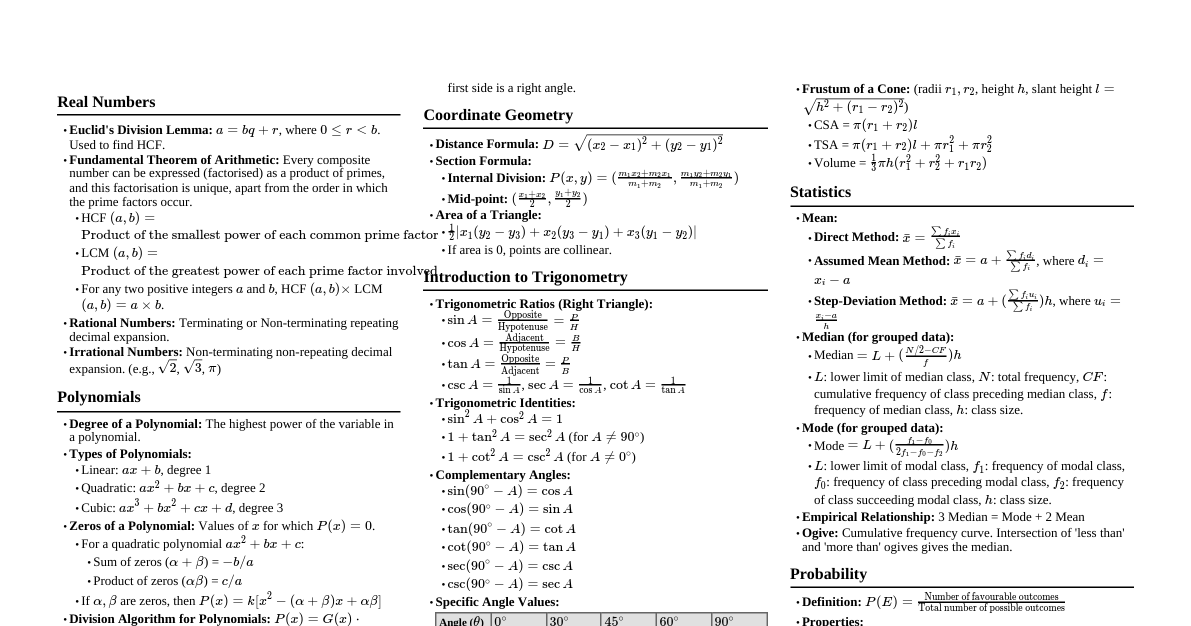
### Real Numbers: Introduction This worksheet covers key concepts and problems from Chapter 1, "Real Numbers," of the NCERT Class 10 Mathematics textbook. Ensure you understand the definitions and theorems before attempting the problems. ### Euclid's Division Lemma and Algorithm **Concept:** For any two positive integers $a$ and $b$, there exist unique integers $q$ and $r$ such that $a = bq + r$, where $0 \le r ### The Fundamental Theorem of Arithmetic **Concept:** Every composite number can be expressed (factorised) as a product of primes, and this factorisation is unique, apart from the order in which the prime factors occur. This theorem is used to find HCF and LCM of numbers. - **HCF (Highest Common Factor):** Product of the smallest power of each common prime factor. - **LCM (Least Common Multiple):** Product of the greatest power of each prime factor involved. **Questions:** 1. Express each number as a product of its prime factors: a) 140 b) 156 c) 3825 d) 5005 e) 7429 2. Find the LCM and HCF of the following pairs of integers and verify that LCM × HCF = product of the two numbers. a) 26 and 91 b) 510 and 92 c) 336 and 54 3. Find the LCM and HCF of the following integers by applying the prime factorisation method: a) 12, 15 and 21 b) 17, 23 and 29 c) 8, 9 and 25 4. Given that HCF(306, 657) = 9, find LCM(306, 657). 5. Check whether $6^n$ can end with the digit 0 for any natural number $n$. ### Revisiting Irrational Numbers **Concept:** A number is irrational if it cannot be expressed in the form $p/q$, where $p$ and $q$ are integers and $q \ne 0$. The proof of irrationality often involves proof by contradiction. **Questions:** 1. Prove that $\sqrt{5}$ is irrational. 2. Prove that $3 + 2\sqrt{5}$ is irrational. 3. Prove that the following are irrationals: a) $1/\sqrt{2}$ b) $7\sqrt{5}$ c) $6 + \sqrt{2}$ ### Revisiting Rational Numbers and Their Decimal Expansions **Concept:** A rational number $x = p/q$ (where $p$ and $q$ are coprime) has a terminating decimal expansion if the prime factorisation of $q$ is of the form $2^n 5^m$, where $n, m$ are non-negative integers. Otherwise, it has a non-terminating repeating decimal expansion. **Questions:** 1. Without actually performing the long division, state whether the following rational numbers will have a terminating decimal expansion or a non-terminating repeating decimal expansion: a) $13/3125$ b) $17/8$ c) $64/455$ d) $15/1600$ e) $29/343$ f) $23/(2^3 5^2)$ g) $129/(2^2 5^7 7^5)$ h) $6/15$ i) $35/50$ j) $77/210$ 2. Write down the decimal expansions of those rational numbers in Question 1 above which have terminating decimal expansions. 3. The following real numbers have decimal expansions as given below. In each case, decide whether they are rational or not. If they are rational, and of the form $p/q$, what can you say about the prime factors of $q$? a) $43.123456789$ b) $0.120120012000120000...$ c) $43.\overline{123456789}$ **Solutions for Question 3:** a) $43.123456789$ - This is a **rational number**. - It has a terminating decimal expansion. - Since it's rational and terminating, the prime factors of its denominator $q$ (when expressed in $p/q$ form) must be of the form $2^n 5^m$. b) $0.120120012000120000...$ - This is an **irrational number**. - The decimal expansion is non-terminating and non-repeating. There is no repeating block of digits. c) $43.\overline{123456789}$ - This is a **rational number**. - It has a non-terminating but repeating decimal expansion (the block '123456789' repeats). - Since it's rational and non-terminating repeating, the prime factors of its denominator $q$ (when expressed in $p/q$ form) will **not** be solely of the form $2^n 5^m$. It will have prime factors other than 2 or 5.