Mech Props Solids & Fluids
Cheatsheet Content
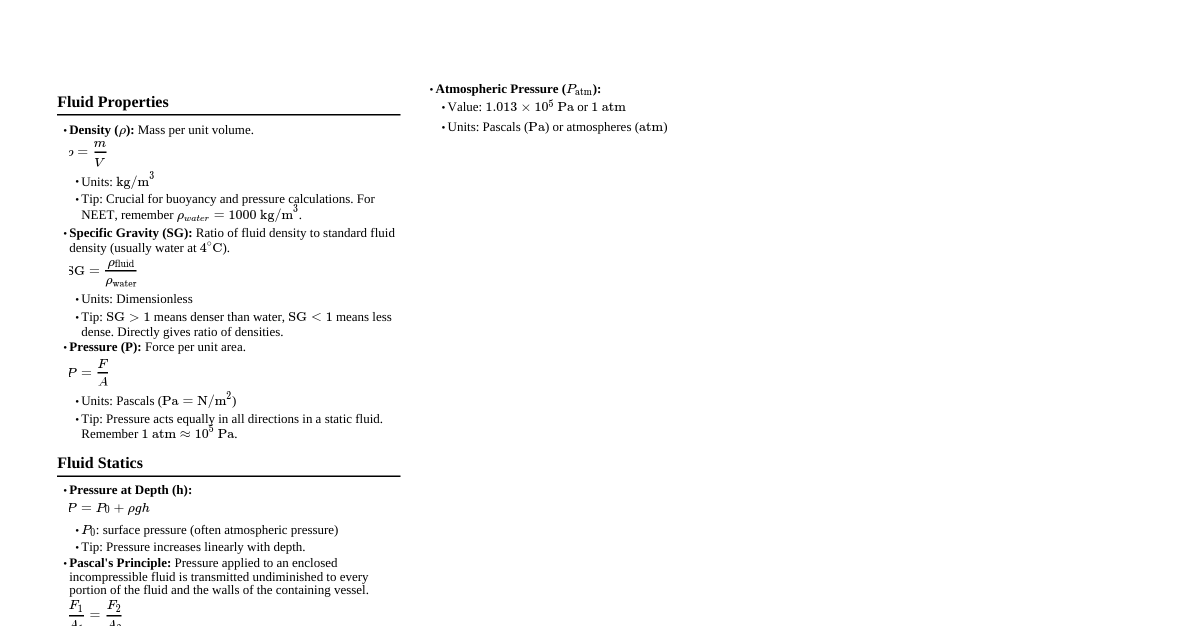
### Elasticity, Stress & Strain - **Deforming Force:** External force causing change in configuration. - **Restoring Force:** Internal force developed due to deformation, opposing deforming force. - **Elasticity:** Property of material to regain its original configuration after removal of deforming force. - **Plasticity:** Property of material to not regain its original configuration after removal of deforming force. - **Stress ($\sigma$):** Restoring force per unit area. - Formula: $\sigma = \frac{F_{restoring}}{A}$ - Unit: N/m$^2$ or Pascal (Pa) - Types: - **Normal Stress:** Perpendicular to surface. - Longitudinal Stress (tensile/compressive) - Bulk Stress (hydrostatic pressure) - **Tangential/Shearing Stress:** Parallel to surface. - **Strain ($\epsilon$):** Ratio of change in configuration to original configuration. - Formula: $\epsilon = \frac{\text{Change in configuration}}{\text{Original configuration}}$ - Unit: Dimensionless - Types: - **Longitudinal Strain:** $\epsilon_L = \frac{\Delta L}{L}$ - **Volumetric Strain:** $\epsilon_V = \frac{\Delta V}{V}$ - **Shearing Strain ($\phi$):** $\phi = \frac{\Delta x}{L} = \tan \theta \approx \theta$ (for small $\theta$) ### Hooke's Law & Moduli of Elasticity - **Hooke's Law:** Within elastic limit, stress is directly proportional to strain. - $\text{Stress} \propto \text{Strain} \implies \text{Stress} = E \times \text{Strain}$ - $E$ is modulus of elasticity. - **Young's Modulus (Y):** Ratio of normal stress to longitudinal strain. - $Y = \frac{\text{Normal Stress}}{\text{Longitudinal Strain}} = \frac{F/A}{\Delta L/L} = \frac{FL}{A\Delta L}$ - Unit: N/m$^2$ or Pa - **Bulk Modulus (B):** Ratio of normal stress to volumetric strain. - $B = \frac{\text{Normal Stress}}{\text{Volumetric Strain}} = \frac{-P}{\Delta V/V} = \frac{-PV}{\Delta V}$ - Unit: N/m$^2$ or Pa - **Compressibility (K):** $K = \frac{1}{B}$ - **Shear Modulus (G or $\eta$):** Ratio of tangential stress to shearing strain. - $G = \frac{\text{Tangential Stress}}{\text{Shearing Strain}} = \frac{F/A}{\phi} = \frac{F}{A\phi}$ - Unit: N/m$^2$ or Pa - **Poisson's Ratio ($\nu$ or $\sigma_p$):** Ratio of lateral strain to longitudinal strain. - $\nu = -\frac{\text{Lateral Strain}}{\text{Longitudinal Strain}} = -\frac{\Delta D/D}{\Delta L/L}$ - Unit: Dimensionless. Range: -1 to 0.5. For most materials: 0 to 0.5. - **Relation between Y, B, G, $\nu$:** - $Y = 3B(1-2\nu)$ - $Y = 2G(1+\nu)$ - $Y = \frac{9BG}{3B+G}$ ### Stress-Strain Curve - **Proportional Limit (P):** Stress and strain are proportional (Hooke's Law valid). - **Elastic Limit (E):** Max stress material can withstand without permanent deformation. - **Yield Point (Y):** Point beyond which material starts deforming plastically. - Upper Yield Point, Lower Yield Point. - **Ultimate Tensile Strength (UTS):** Maximum stress material can withstand before necking begins. - **Fracture Point (F):** Point where material breaks. - **Ductile Materials:** Large plastic region (e.g., steel, copper). - **Brittle Materials:** Small or no plastic region (e.g., glass, cast iron). - **Elastomers:** Materials that can be stretched to large strains (e.g., rubber). ### Elastic Potential Energy - **Energy Stored in a Stretched Wire:** - $U = \frac{1}{2} \times \text{Stress} \times \text{Strain} \times \text{Volume}$ - $U = \frac{1}{2} Y (\text{Strain})^2 \times \text{Volume}$ - $U = \frac{1}{2} \frac{(\text{Stress})^2}{Y} \times \text{Volume}$ - **Energy per unit volume (Energy Density):** - $u = \frac{1}{2} \times \text{Stress} \times \text{Strain}$ ### Fluid Pressure - **Fluid:** Substance that can flow (liquids and gases). - **Pressure (P):** Normal force per unit area. - $P = \frac{F}{A}$ - Unit: N/m$^2$ or Pascal (Pa) - Scalar quantity. - **Density ($\rho$):** Mass per unit volume. - $\rho = \frac{m}{V}$ - Unit: kg/m$^3$ - **Specific Gravity (Relative Density):** $\frac{\text{Density of substance}}{\text{Density of water at } 4^\circ C}$ (dimensionless). - **Pressure at Depth (h):** $P = P_0 + \rho gh$ (where $P_0$ is atmospheric pressure). - **Pascal's Law:** Pressure applied to an enclosed fluid is transmitted undiminished to every portion of the fluid and the walls of the containing vessel. - Applications: Hydraulic lift, hydraulic brakes. - Hydraulic Lift: $\frac{F_1}{A_1} = \frac{F_2}{A_2} \implies F_2 = F_1 \frac{A_2}{A_1}$ - **Atmospheric Pressure ($P_{atm}$):** Pressure exerted by the atmosphere. - $P_{atm} \approx 1.013 \times 10^5$ Pa or 1 atm. - Measured by barometer. - **Gauge Pressure ($P_g$):** $P_g = P_{abs} - P_{atm}$ - **Absolute Pressure ($P_{abs}$):** $P_{abs} = P_{atm} + P_g$ ### Archimedes' Principle & Buoyancy - **Buoyant Force ($F_B$):** Upward force exerted by a fluid on a submerged or partially submerged object. - **Archimedes' Principle:** When an object is wholly or partially immersed in a fluid, it experiences an upward buoyant force equal to the weight of the fluid displaced by it. - $F_B = V_{displaced} \rho_{fluid} g$ - **Apparent Weight:** $W_{apparent} = W_{actual} - F_B$ - **Flotation:** - If $\rho_{object} < \rho_{fluid}$, object floats. - If $\rho_{object} = \rho_{fluid}$, object remains suspended. - If $\rho_{object} > \rho_{fluid}$, object sinks. - **Fraction of volume submerged:** $\frac{V_{submerged}}{V_{total}} = \frac{\rho_{object}}{\rho_{fluid}}$ ### Fluid Dynamics & Continuity - **Ideal Fluid:** Incompressible (constant density), non-viscous (no internal friction), irrotational (no angular momentum), steady flow. - **Types of Flow:** - **Streamline/Laminar Flow:** Fluid particles follow smooth paths, no mixing. Velocity at any point is constant over time. - **Turbulent Flow:** Irregular, chaotic motion of fluid particles. Velocity at any point changes rapidly. - **Equation of Continuity:** For an incompressible, non-viscous fluid in steady flow, the mass flow rate is constant. - $A_1 v_1 = A_2 v_2 = \text{constant}$ (where $A$ is cross-sectional area, $v$ is fluid velocity). - This means: $v \propto \frac{1}{A}$. Fluid speed is higher where the tube is narrower. ### Bernoulli's Theorem - **Statement:** For a steady, incompressible, non-viscous flow of fluid, the sum of pressure energy, kinetic energy, and potential energy per unit volume (or per unit mass) remains constant at all points along a streamline. - $\text{Pressure Energy} + \text{Kinetic Energy} + \text{Potential Energy} = \text{Constant}$ - **Per unit volume:** $P + \frac{1}{2}\rho v^2 + \rho gh = \text{Constant}$ - **Per unit mass:** $\frac{P}{\rho} + \frac{1}{2}v^2 + gh = \text{Constant}$ - **Per unit weight (Bernoulli's Head):** $\frac{P}{\rho g} + \frac{v^2}{2g} + h = \text{Constant}$ - **Applications:** - **Venturimeter:** Measures flow speed. - **Torricelli's Law (Efflux velocity):** $v = \sqrt{2gh}$ (velocity of efflux from an orifice at depth $h$). - **Aerofoil lift, Magnus effect, atomizer, carburetor.** ### Viscosity - **Definition:** Internal frictional force between different layers of a fluid in relative motion. It opposes relative motion. - **Viscous Force ($F_v$):** $F_v = -\eta A \frac{dv}{dz}$ (Newton's Law of Viscosity) - $\eta$ (eta) = Coefficient of Viscosity - $A$ = Area of layers - $\frac{dv}{dz}$ = Velocity gradient - **Coefficient of Viscosity ($\eta$):** - Unit: N s/m$^2$ or Poiseuille (Pl) or Poise (1 Pl = 10 Poise). - Depends on temperature (decreases for liquids, increases for gases). - **Stokes' Law:** For a small spherical body falling through a viscous medium. - $F_v = 6\pi\eta r v$ (where $r$ is radius, $v$ is terminal velocity). - **Terminal Velocity ($v_T$):** Constant velocity attained by a body falling through a viscous fluid when viscous drag equals buoyant force plus gravitational force. - $v_T = \frac{2r^2(\rho_{object} - \rho_{fluid})g}{9\eta}$ ### Reynolds Number (Re) - **Definition:** Dimensionless number that predicts the nature of fluid flow (laminar or turbulent). - $Re = \frac{\rho v D}{\eta}$ (where $\rho$ is density, $v$ is flow speed, $D$ is characteristic length/diameter, $\eta$ is viscosity). - **Flow Regimes:** - $Re < 1000$ (or 2000): Laminar flow - $Re > 2000$ (or 3000): Turbulent flow - $1000 < Re < 2000$ (or 2000-3000): Unstable/Transition flow ### Surface Tension - **Definition:** Property of liquid surface to behave like a stretched elastic membrane, tending to minimize its surface area. - **Surface Tension (T or S):** Force per unit length acting tangentially to the surface. - $T = \frac{F}{L}$ - Unit: N/m - **Surface Energy (E_S):** Work done to increase the surface area by one unit. - $E_S = T \Delta A$ - Unit: J/m$^2$ or N/m (dimensionally same as T). - **Excess Pressure inside a liquid drop/bubble:** - Liquid drop: $\Delta P = \frac{2T}{R}$ - Soap bubble: $\Delta P = \frac{4T}{R}$ - Air bubble in liquid: $\Delta P = \frac{2T}{R}$ - **Angle of Contact ($\theta_C$):** Angle between the tangent to the liquid surface at the point of contact and the solid surface inside the liquid. - $\theta_C < 90^\circ$: Liquid wets the surface (e.g., water on glass). Concave meniscus. - $\theta_C > 90^\circ$: Liquid does not wet the surface (e.g., mercury on glass). Convex meniscus. - $\theta_C = 90^\circ$: Horizontal meniscus. - **Capillarity (Capillary Action):** Rise or fall of a liquid in a narrow tube (capillary). - **Capillary Rise/Fall (h):** $h = \frac{2T \cos \theta_C}{\rho r g}$ - If $\theta_C < 90^\circ$, $\cos \theta_C$ is positive, $h$ is positive (rise). - If $\theta_C > 90^\circ$, $\cos \theta_C$ is negative, $h$ is negative (fall). ### Key Formulas - Solids - **Stress:** $\sigma = F/A$ - **Strain:** $\epsilon = \Delta L/L$, $\Delta V/V$, $\phi = \Delta x/L$ - **Young's Modulus:** $Y = \frac{FL}{A\Delta L}$ - **Bulk Modulus:** $B = \frac{-PV}{\Delta V}$ - **Shear Modulus:** $G = \frac{F}{A\phi}$ - **Poisson's Ratio:** $\nu = -\frac{\Delta D/D}{\Delta L/L}$ - **Elastic Potential Energy:** $U = \frac{1}{2} \text{Stress} \times \text{Strain} \times \text{Volume}$ - **Energy Density:** $u = \frac{1}{2} \text{Stress} \times \text{Strain}$ ### Key Formulas - Fluids - **Pressure:** $P = F/A$ - **Pressure at depth h:** $P = P_0 + \rho gh$ - **Buoyant Force:** $F_B = V_{displaced} \rho_{fluid} g$ - **Equation of Continuity:** $A_1 v_1 = A_2 v_2$ - **Bernoulli's Equation:** $P + \frac{1}{2}\rho v^2 + \rho gh = \text{Constant}$ - **Viscous Force:** $F_v = -\eta A \frac{dv}{dz}$ - **Stokes' Law:** $F_v = 6\pi\eta r v$ - **Terminal Velocity:** $v_T = \frac{2r^2(\rho_{object} - \rho_{fluid})g}{9\eta}$ - **Reynolds Number:** $Re = \frac{\rho v D}{\eta}$ - **Surface Tension:** $T = F/L$ - **Excess Pressure (drop):** $\Delta P = \frac{2T}{R}$ - **Excess Pressure (bubble):** $\Delta P = \frac{4T}{R}$ - **Capillary Rise/Fall:** $h = \frac{2T \cos \theta_C}{\rho r g}$