Developmental Biology Basics
Cheatsheet Content
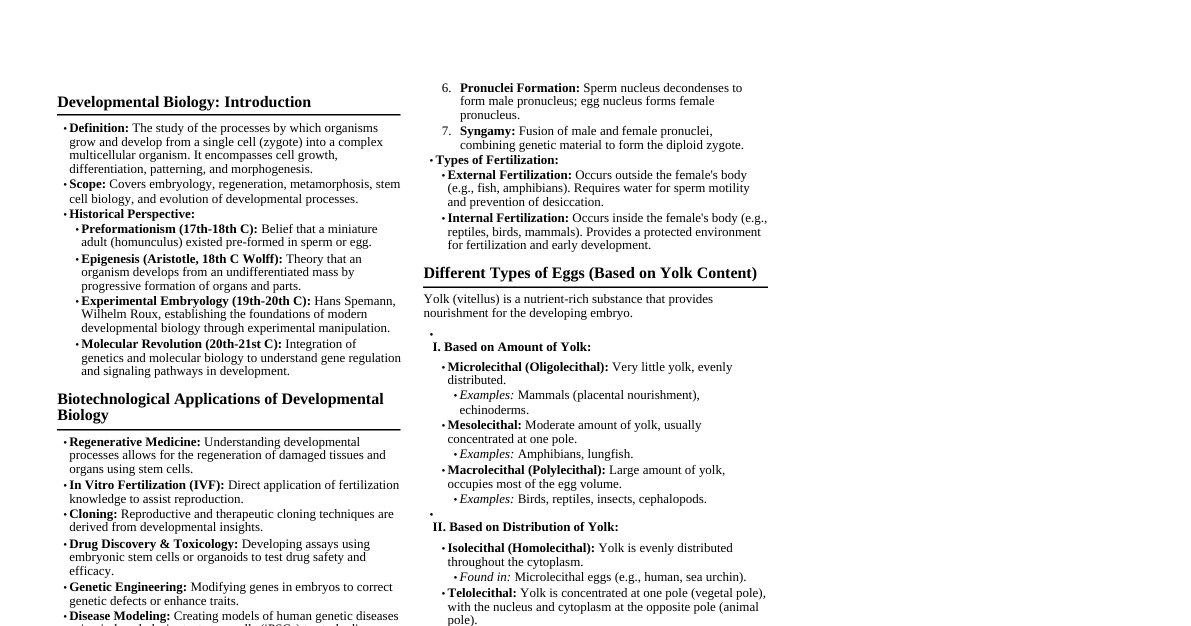
### Developmental Biology: Introduction - **Definition:** The study of the processes by which organisms grow and develop from a single cell (zygote) to a multicellular organism. It encompasses growth, cell differentiation, and morphogenesis. - **Scope:** - **Understanding Life:** Explains how complex organisms arise from simple beginnings. - **Evolutionary Biology:** Provides insights into evolutionary changes and conserved developmental pathways. - **Medicine:** Crucial for understanding congenital diseases, regenerative medicine, stem cell research, and cancer. - **Biotechnology:** Applications in agriculture (crop improvement), animal breeding, cloning, and tissue engineering. - **Historical Perspective:** - **Preformationism (17th-18th C.):** Belief that organisms develop from miniature versions of themselves present in sperm or egg. - **Epigenesis (Aristotle, 18th C. Wolff):** Idea that structures arise de novo from undifferentiated material. - **Experimental Embryology (19th C. Driesch, Spemann):** Pioneers used experimental manipulation to understand developmental mechanisms. - **Molecular Revolution (20th C. onwards):** Integration of genetics and molecular biology to understand gene regulation and signaling pathways in development. ### Biotechnological Applications of Developmental Biology - **Regenerative Medicine:** Using stem cells (embryonic, induced pluripotent) to repair or replace damaged tissues and organs. - **Tissue Engineering:** Creating artificial tissues and organs for transplantation or drug testing. - **Cloning:** Reproductive cloning (creating a genetically identical organism) and therapeutic cloning (creating embryonic stem cells for research/therapy). - **Assisted Reproductive Technologies (ART):** In vitro fertilization (IVF), intracytoplasmic sperm injection (ICSI) to overcome infertility. - **Gene Therapy:** Correcting genetic defects in early embryos or somatic cells to prevent developmental disorders. - **Agricultural Biotechnology:** Improving livestock (e.g., disease resistance, growth rates) and crop yields through genetic manipulation and developmental control. - **Drug Discovery & Toxicology:** Using developmental models (e.g., zebrafish embryos) to screen for developmental toxicity and identify drug candidates. ### Gametogenesis - **Definition:** The process of formation of gametes (sperm and egg) from germline stem cells in sexually reproducing organisms. It involves meiosis, which reduces the chromosome number by half. - **Scope:** Essential for sexual reproduction and maintaining the diploid chromosome number across generations. - **Types:** - **Spermatogenesis:** Formation of sperm in males. - **Oogenesis:** Formation of ova (eggs) in females. #### Spermatogenesis - **Location:** Seminiferous tubules of the testes. - **Stages:** 1. **Multiplication Phase:** Primordial germ cells (spermatogonia) undergo mitotic divisions to increase in number. 2. **Growth Phase:** Spermatogonia grow into primary spermatocytes. 3. **Maturation Phase:** - Primary spermatocytes undergo Meiosis I to form two haploid secondary spermatocytes. - Secondary spermatocytes undergo Meiosis II to form four haploid spermatids. 4. **Spermiogenesis:** Spermatids differentiate into mature spermatozoa (sperm) by developing a head, midpiece, and tail, and shedding excess cytoplasm. - **Duration:** Continuous process from puberty throughout life in males. #### Oogenesis - **Location:** Ovaries. - **Stages:** 1. **Multiplication Phase (Fetal Life):** Primordial germ cells (oogonia) undergo mitotic divisions. 2. **Growth Phase (Fetal Life):** Oogonia grow into primary oocytes, which then enter Meiosis I but arrest at Prophase I. 3. **Maturation Phase (Puberty onwards):** - At puberty, one primary oocyte per menstrual cycle completes Meiosis I, forming a large secondary oocyte and a small first polar body. - The secondary oocyte arrests at Metaphase II and is ovulated. - If fertilized, the secondary oocyte completes Meiosis II, forming a large ovum (egg) and a small second polar body. - **Duration:** Initiated during fetal development, pauses until puberty, and ceases at menopause. Typically one egg matures per month. ### Fertilization - **Definition:** The fusion of male and female gametes (sperm and egg) to form a zygote. - **Mechanism:** 1. **Sperm Capacitation:** Physiological changes in sperm that enable it to fertilize an egg (e.g., changes in motility, membrane properties). 2. **Sperm-Egg Recognition & Binding:** Sperm binds to species-specific receptors on the egg's outer layer (zona pellucida in mammals). 3. **Acrosome Reaction:** Release of enzymes from the sperm's acrosome that digest a path through the egg's outer layers. 4. **Penetration:** Sperm penetrates the egg's protective layers (e.g., corona radiata, zona pellucida). 5. **Fusion of Gamete Membranes:** Sperm and egg plasma membranes fuse, and the sperm nucleus enters the egg cytoplasm. 6. **Cortical Reaction (Block to Polyspermy):** Release of cortical granules from the egg, modifying the egg's outer layers to prevent entry of additional sperm. 7. **Meiosis II Completion:** The egg completes Meiosis II, forming the ovum and second polar body. 8. **Pronuclei Formation & Fusion:** Male and female pronuclei (haploid nuclei) form, replicate DNA, and then fuse to form a diploid zygote nucleus. - **Types of Fertilization:** - **External Fertilization:** Gametes are released into the environment (e.g., water) where fertilization occurs (e.g., many fish, amphibians). - **Internal Fertilization:** Gametes fuse inside the female reproductive tract (e.g., mammals, birds, reptiles). #### Types of Eggs Based on Yolk Content Yolk provides nutrients for the developing embryo. - **Isolecithal (Oligolecithal):** - **Description:** Very little yolk, evenly distributed throughout the cytoplasm. - **Examples:** Mammals (human), echinoderms, amphioxus. - **Mesolecithal:** - **Description:** Moderate amount of yolk, concentrated in the vegetal pole (one hemisphere). - **Examples:** Amphibians, lungfish. - **Telolecithal:** - **Description:** Large amount of yolk, concentrated at one end (vegetal pole), with the nucleus and cytoplasm pushed to the animal pole. - **Examples:** Birds, reptiles, fish (except lungfish), cephalopods. - **Centrolecithal:** - **Description:** Yolk concentrated in the center of the egg, with the cytoplasm forming a thin layer around the periphery and enclosing the central yolk. - **Examples:** Insects.