Fluid Mechanics Derivations
Shared 5/15/2026•21 views
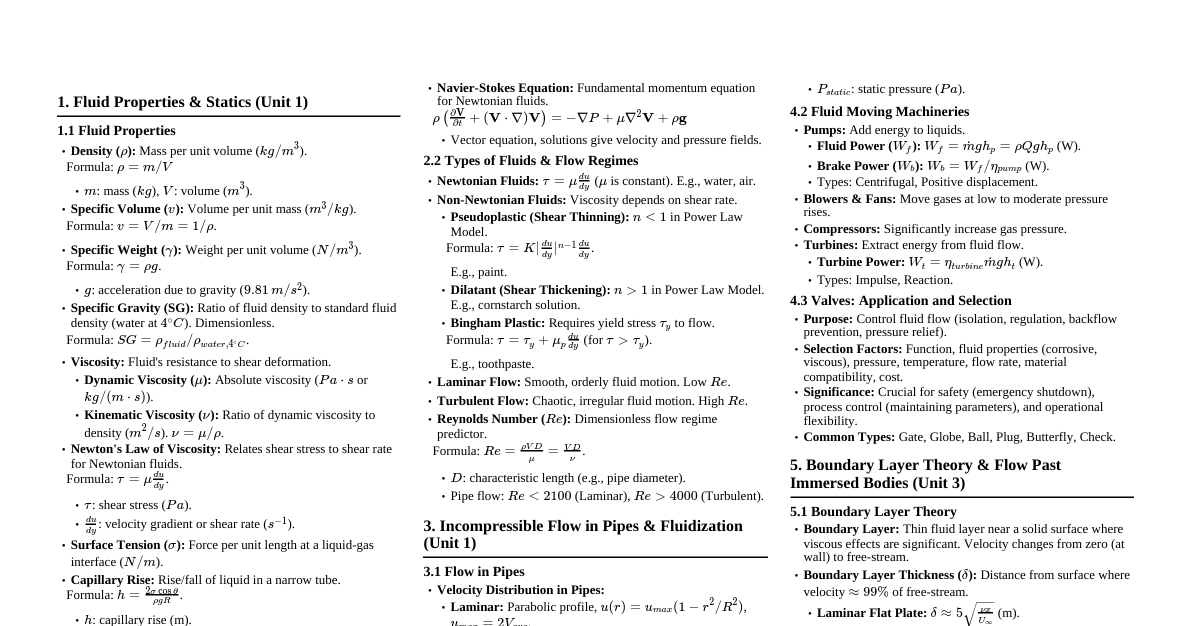
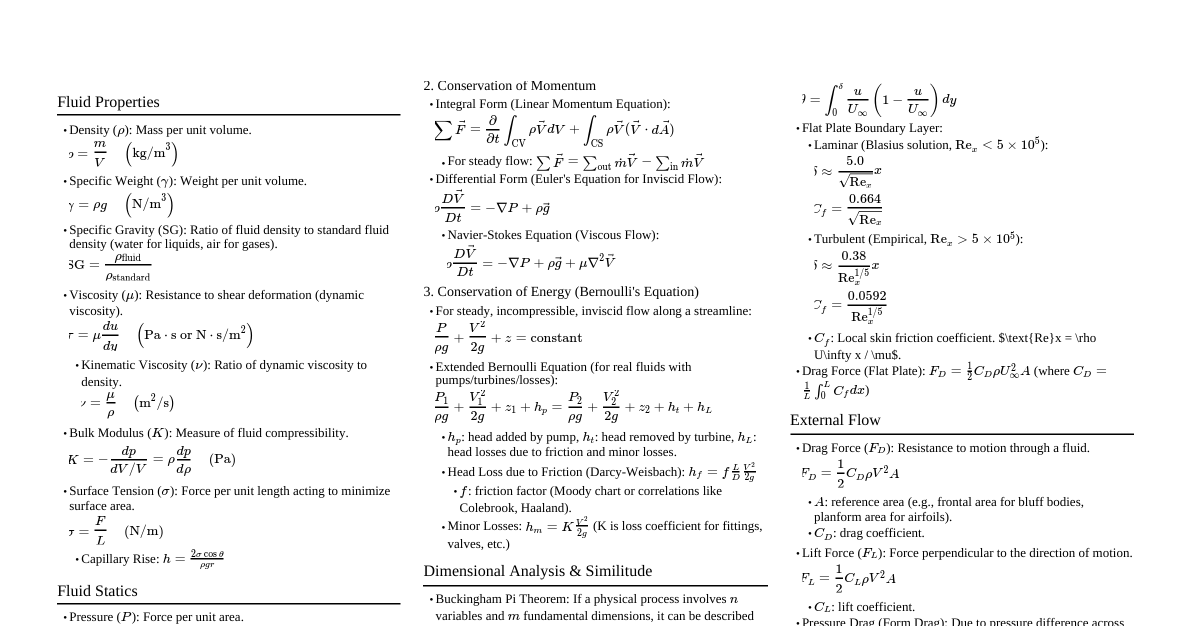
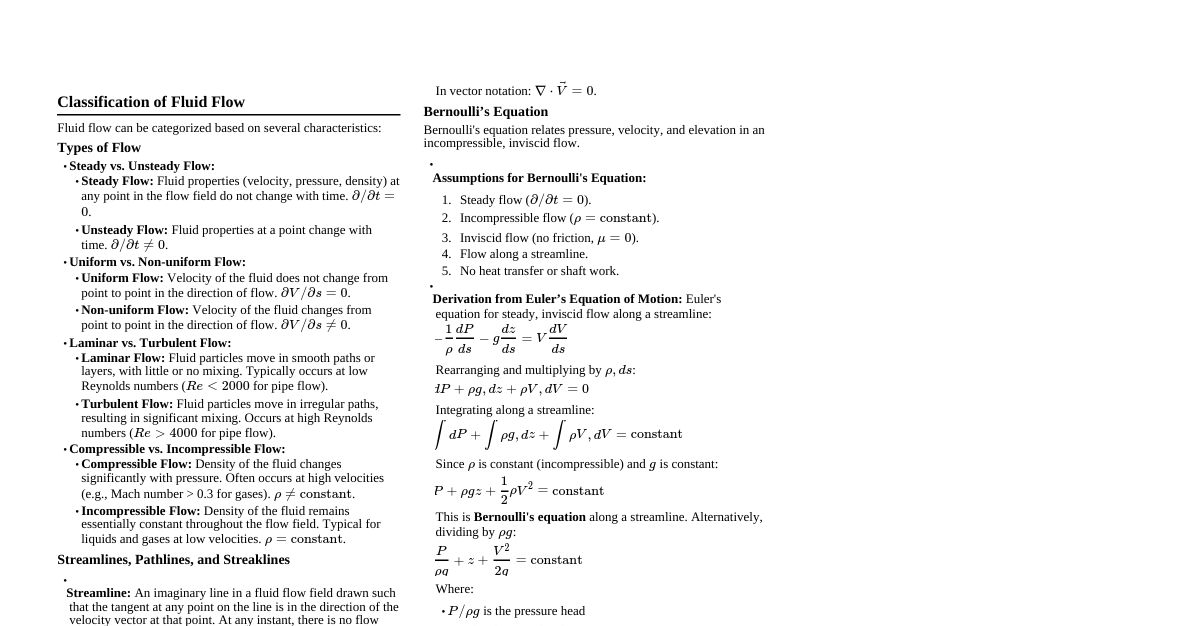
### Fundamentals of Fluid Mechanics #### Properties of Fluid - **Density ($\rho$):** Mass per unit volume. $$\rho = \frac{m}{V}$$ - **Specific Gravity (SG):** Ratio of fluid density to standard fluid density (water for liquids, air for gases). $$SG = \frac{\rho_{fluid}}{\rho_{standard}}$$ - **Viscosity ($\mu$):** Resistance to shear deformation. Newton's Law of Viscosity: $$\tau = \mu \frac{du}{dy}$$ Where $\tau$ is shear stress, $u$ is velocity, $y$ is distance normal to flow. - **Bulk Modulus (K):** Measure of fluid's resistance to compression. $$K = -V \frac{dP}{dV}$$ Where $P$ is pressure, $V$ is volume. - **Surface Tension ($\sigma$):** Force per unit length acting perpendicular to a line in the surface. $$F = \sigma L$$ For a droplet: $$\Delta P = \frac{4\sigma}{d}$$ For a bubble: $$\Delta P = \frac{8\sigma}{d}$$ #### Pressure Measurement - **Pascal's Law:** Pressure at a point in a static fluid is equal in all directions. - **Manometers:** Pressure difference calculation. $$\Delta P = P_1 - P_2 = (\rho_m - \rho_f) g h$$ Where $\rho_m$ is manometer fluid density, $\rho_f$ is fluid density, $h$ is height difference. #### Hydrostatic Forces - **Total Pressure Force (F) on a submerged plane surface:** $$F = \rho g \bar{h} A$$ Where $\bar{h}$ is depth of centroid, $A$ is area. - **Centre of Pressure ($y_p$):** Location where the total pressure force acts. $$y_p = \bar{y} + \frac{I_{xx}}{\bar{y} A}$$ Where $I_{xx}$ is moment of inertia about the centroidal axis parallel to the free surface. #### Buoyancy - **Archimedes' Principle:** Buoyant force ($F_B$) equals the weight of the fluid displaced. $$F_B = \rho_f g V_{submerged}$$ - **Metacentric Height (GM):** Stability of floating bodies. $$GM = BM - BG$$ Where $BM = \frac{I}{V_{submerged}}$, $I$ is moment of inertia of waterplane area, $BG$ is distance between center of buoyancy and center of gravity. ### Fluid Kinematics and Dynamics #### Fluid Kinematics - **Continuity Equation (incompressible flow):** - **Cartesian:** $$\frac{\partial u}{\partial x} + \frac{\partial v}{\partial y} + \frac{\partial w}{\partial z} = 0$$ - **Cylindrical:** $$\frac{1}{r}\frac{\partial}{\partial r}(r v_r) + \frac{1}{r}\frac{\partial v_\theta}{\partial \theta} + \frac{\partial v_z}{\partial z} = 0$$ - **Stream Function ($\psi$) for 2D incompressible flow:** $$u = \frac{\partial \psi}{\partial y}, \quad v = -\frac{\partial \psi}{\partial x}$$ - **Velocity Potential ($\phi$) for irrotational flow:** $$u = \frac{\partial \phi}{\partial x}, \quad v = \frac{\partial \phi}{\partial y}$$ #### Fluid Dynamics - **Euler's Equation (for inviscid flow):** $$\rho \frac{D\vec{V}}{Dt} = -\nabla P + \rho \vec{g}$$ In 1D steady flow along a streamline: $$\frac{dP}{\rho} + V dV + g dz = 0$$ - **Bernoulli's Equation (derived from Euler's for steady, incompressible, inviscid flow along a streamline):** $$\frac{P}{\rho g} + \frac{V^2}{2g} + z = \text{constant}$$ This is the energy per unit weight of fluid. - **Venturimeter:** Used to measure flow rate. $$Q = C_d A_1 \frac{A_2}{\sqrt{A_1^2 - A_2^2}} \sqrt{2gh}$$ Where $C_d$ is coefficient of discharge, $A_1, A_2$ are areas, $h$ is differential head. - **Orifice Meter:** Similar to Venturimeter. $$Q = C_d A_o \frac{A_1}{\sqrt{A_1^2 - A_o^2}} \sqrt{2gh}$$ Where $A_o$ is orifice area. - **Momentum Equation (Integral form for control volume):** $$\sum \vec{F} = \frac{\partial}{\partial t} \int_{CV} \vec{V} \rho dV + \int_{CS} \vec{V} \rho (\vec{V} \cdot d\vec{A})$$ For steady flow: $$\sum F_x = \dot{m}(V_{out,x} - V_{in,x})$$ ### Viscous and Turbulent Flow #### Viscous Flow - **Hagen-Poiseuille Equation (for laminar flow in circular pipe):** $$Q = \frac{\pi D^4 \Delta P}{128 \mu L}$$ Where $Q$ is flow rate, $D$ is pipe diameter, $\Delta P$ is pressure drop, $L$ is pipe length. - **Head Loss due to Viscous Flow (Laminar):** $$h_f = \frac{32 \mu \bar{V} L}{\rho g D^2}$$ Where $\bar{V}$ is average velocity. - **Coefficient of Viscosity ($\mu$):** (See Properties of Fluid) #### Turbulent Flow - **Reynolds Number (Re):** Dimensionless number predicting flow regime. $$Re = \frac{\rho V D}{\mu} = \frac{VD}{\nu}$$ Where $\nu$ is kinematic viscosity. - **Friction Factor (f) for turbulent flow:** - **Darcy-Weisbach Equation:** $$h_f = f \frac{L}{D} \frac{V^2}{2g}$$ - **Colebrook Equation (implicit for rough pipes):** $$\frac{1}{\sqrt{f}} = -2.0 \log_{10} \left( \frac{\epsilon/D}{3.7} + \frac{2.51}{Re\sqrt{f}} \right)$$ Where $\epsilon$ is absolute roughness. - **Blasius Equation (for smooth pipes, $Re ### Pipe Flow #### Energy Loss due to Friction - **Darcy-Weisbach Equation:** (See Turbulent Flow) #### Minor Energy Losses - **Sudden Expansion:** $$h_L = \frac{(V_1 - V_2)^2}{2g} = K \frac{V_1^2}{2g}$$ Where $K = \left(1 - \frac{A_1}{A_2}\right)^2$. - **Sudden Contraction:** $$h_L = K \frac{V_2^2}{2g}$$ Where $K$ depends on $A_2/A_1$. Often $K \approx 0.5$ for sharp-edged. - **Entrance Loss:** $$h_L = K_{ent} \frac{V^2}{2g}$$ Where $K_{ent}$ is typically 0.5 for sharp-edged. - **Exit Loss:** $$h_L = K_{exit} \frac{V^2}{2g}$$ Where $K_{exit} \approx 1.0$. - **Bends and Fittings:** $$h_L = K_{fitting} \frac{V^2}{2g}$$ #### Hydraulic Grade Line (HGL) and Energy Grade Line (EGL) - **HGL:** Represents the sum of pressure head and elevation head ($\frac{P}{\rho g} + z$). - **EGL:** Represents the sum of pressure head, velocity head, and elevation head ($\frac{P}{\rho g} + \frac{V^2}{2g} + z$). The EGL is always above the HGL by the velocity head. #### Flow Through Pipes - **Series Pipes:** Total head loss is sum of individual head losses. $$h_{f,total} = h_{f1} + h_{f2} + ...$$ Flow rate is constant through all pipes: $Q = Q_1 = Q_2 = ...$ - **Parallel Pipes:** Head loss across each parallel pipe is the same. $$h_{f1} = h_{f2} = ...$$ Total flow rate is the sum of flow rates in individual pipes: $Q = Q_1 + Q_2 + ...$ - **Pipe Network Analysis (Hardy Cross Method):** Iterative method for balancing heads in closed loops and flows at junctions.