Physical Review Letters 2026: Impact Factor 9.4, h-index 723, and the Broad-Significance Test Behind PRL's 35% Desk Rejection Rate
Jun 26, 2026Key Points
Physical Review Letters (PRL) holds an h-index of 723 and CiteScore of 16.8 — metrics that better reflect its standing in the physics community than the JCR impact factor alone.
The journal's 35% desk rejection rate is not primarily a quality filter. It is a significance filter: the result must matter to physicists outside your immediate subfield, not just to specialists.
PRL allows up to 2 pages of "End Matter" (appendices, supplemental derivations) beyond the 4-page core limit — a practical rule many authors miss, and one that frequently affects whether a paper fits the format.
Physical Review Letters (PRL) is the flagship journal of the American Physical Society and the most recognized short-communication venue in physics. Published since 1958, it covers all of physics in a single journal — condensed matter, quantum information, particle physics, gravitational waves, biophysics, optics, statistical mechanics — and holds every submission to the same standard: does this result matter to physicists across subfields, not just within one?
Understanding what that standard actually means in practice — how it is applied at the desk, how it shapes the format requirements, and how it differs from what competing journals demand — is the practical knowledge that separates successful PRL submissions from the ~35% that never reach peer review.
Physical Review Letters at a Glance: Journal Profile (2026)
Attribute | Detail |
|---|---|
Full Name | Physical Review Letters |
Abbreviation | PRL |
Publisher | American Physical Society (APS) |
Website | |
ISSN | 0031-9007 (Print) / 1079-7114 (Online) |
Access Model | Subscription (Open Access option via APS hybrid program) |
Founded | 1958 |
Impact Factor (JCR 2025) | 9.4 |
5-Year Impact Factor | 8.3 |
CiteScore (Scopus 2025) | 16.8 |
h-index | 723 |
SJR | 2.856 |
SNIP | 2.29 |
JCR Ranking | Q1 — 9th out of 114 (Physics, Multidisciplinary) |
Articles Published (2025) | ~1,291 |
Acceptance Rate | ~25–30% of reviewed papers (~65% overall including desk rejections) |
Desk Rejection Rate | ~35% |
Time to Desk Decision | 1–2 weeks |
Time to First Decision (with review) | 6–10 weeks |
Indexing | SCIE (Web of Science), Scopus, PubMed, ADS |
On the h-index vs. impact factor: PRL's h-index of 723 reflects over six decades of landmark physics — from the first BCS papers to LIGO's gravitational wave discoveries. The JCR impact factor (9.4) measures recent citation velocity and is lower than some specialized journals. For career evaluation purposes in physics, a PRL publication carries more weight than the impact factor alone implies.
What PRL Actually Publishes: Subfield Distribution (2025–2026)
PRL covers all of physics in a single journal — the broadest scope of any Letters-format publication in the field. Based on APS editorial scope data and the 2025 article distribution (~1,291 papers), publications cluster into the following research areas:
Subfield Distribution: PRL 2025–2026
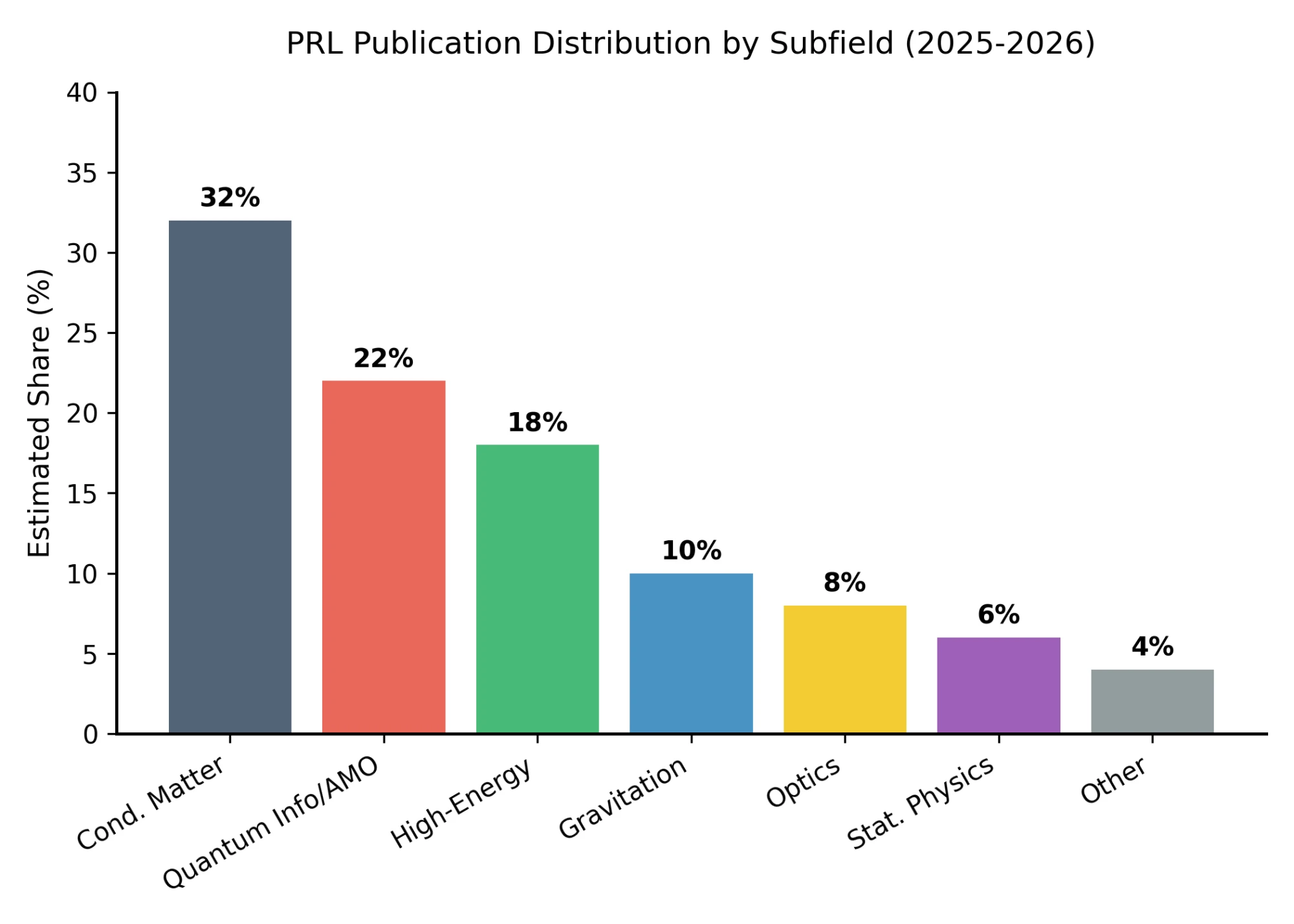
Figure 1. PRL subfield distribution (2025–2026). Condensed matter and quantum information together account for ~54% of publications — the same areas where most desk rejections occur when cross-field significance is not established.
Research Area | Estimated Share | Representative Topics |
|---|---|---|
Condensed Matter & Quantum Materials | ~32% | Topological phases, non-Hermitian systems, quantum spin liquids, Kitaev models, Mott transitions, 2D materials |
Quantum Information & AMO Physics | ~22% | Entanglement, quantum error correction, ion trap experiments, Bose-Einstein condensates, quantum computing hardware |
High-Energy & Particle Physics | ~18% | Beyond Standard Model, lattice QCD, collider phenomenology, dark matter candidates |
Gravitation & Cosmology | ~10% | Gravitational wave physics (LIGO/Virgo), black hole thermodynamics, cosmological perturbations |
Optics & Photonics | ~8% | Nonlinear optics, cavity QED, ultrafast lasers, topological photonics |
Statistical & Nonlinear Physics | ~6% | Complex networks, active matter, stochastic thermodynamics, turbulence |
Other (Biophysics, Fluids, etc.) | ~4% | Biological mechanics, fluid instabilities, plasma physics |
What this distribution means for submissions: PRL's condensed matter and quantum information sections (~54% combined) are the highest-volume areas, but also where most desk rejections occur — because subfield-level significance in condensed matter or quantum optics is not the same as the cross-field significance PRL requires. A topological insulator paper that matters to condensed matter specialists but not to particle physicists or gravitational wave researchers faces the desk rejection risk directly.
The Broad-Significance Test: How PRL Editors Actually Screen Papers
The most important thing to understand about PRL's desk rejection process is what it is not: it is not primarily a quality filter. Papers that are desk-rejected from PRL are not necessarily weak — most of them publish successfully in Physical Review B, Physical Review A, Physical Review Applied, or Physical Review D. They are rejected because they fail a specific test that PRL applies to every submission:
Would a physicist working in a different subfield recognize this result as significant?
APS editorial guidance frames this explicitly. The test that matters at desk review is: if you are submitting a condensed matter paper, could a particle physicist read the abstract and identify why the result matters? If you are submitting a gravitational wave paper, would a quantum information researcher understand why this result advances physics broadly?
The Three Questions PRL Editors Apply at Desk Review
Question | What a "Pass" Looks Like | What a "Fail" Looks Like |
|---|---|---|
Is the result broadly significant? | The abstract explains the significance in terms any physicist can recognize — a new phase, a resolved fundamental tension, a first observation | Significance is framed entirely in subfield language; the importance is visible only to specialists |
Does it fit the Letters format? | Core argument is complete in 4 pages; End Matter appendices are genuinely supplemental | Paper needs 8+ pages to establish the result; figures or derivations essential to the argument are cut |
Is this a first important step? | Novel discovery, first experimental observation, theoretical prediction of a testable new effect | Third paper establishing a known result with improved precision; incremental advance within a known framework |
Writing for the Broad-Significance Test
The practical consequence is that PRL submissions require a different abstract structure than other journals. The first two sentences of the abstract must make the case for broad significance to a non-specialist — before any technical language appears.
Standard physics abstract opening (fails PRL's test):
"We investigate the topological properties of a Kitaev honeycomb model with fractionalized quantum critical points using numerical renormalization group techniques..."
PRL abstract opening (passes):
"We demonstrate that quantum criticality in a frustrated magnet generates emergent spacetime supersymmetry — a symmetry connecting bosons and fermions not imposed by the Hamiltonian but arising spontaneously at the critical point. This provides the first experimental prediction for SUSY signatures in a condensed matter system..."
The second version states the cross-field significance (emergent SUSY, testable predictions) before naming the model. This is what PRL's first-paragraph screen looks for.
PRL's Format Rules: The 4-Page Core and the End Matter Provision
PRL papers are Letters — short by structural requirement, not editorial preference. The format rules are stricter than most journals and include a provision many authors miss:
PRL Format Standards (2026)
Element | Limit | Notes |
|---|---|---|
Core text | 4 journal pages | REVTeX two-column format; ~3,000–3,500 words before figures consume space |
End Matter | Up to 2 additional pages | Appendices, supplemental derivations, extended datasets — for specialists; does NOT count toward the 4-page core |
Abstract | ~200 words | Structured for broad readership; must stand alone |
Figures | Counted against core page limit | Each figure typically costs ~0.5–1 page; complex multi-panel figures require planning |
References | No hard limit | Typically 20–40 in a Letter; exhaustive reviews are not appropriate |
Supplemental Material | No explicit limit | Hosted separately; linked but not paginated in the journal |
The End Matter rule in practice: Authors who need 6 pages for their argument often assume they cannot publish in PRL. The End Matter provision means that 2 pages of derivations, data tables, or extended proofs can be placed there rather than in the core — keeping the physics argument within 4 pages while making the paper complete. Editors do not count End Matter against the page limit, but they do check that it is genuinely supplemental rather than essential to the core result.
Statistical and Mathematical Reporting Standards in PRL
PRL's editorial expectations for quantitative rigor vary by subfield, but two standards cut across all areas of experimental and observational physics.
Significance Thresholds: The 5σ Standard
In particle physics and observational cosmology — two of PRL's core areas — statistical reporting follows a convention that differs substantially from the p < 0.05 standard common in other sciences:
Claim Level | Required Significance | p-value Equivalent | Typical Application |
|---|---|---|---|
Discovery | 5σ | p ≈ 3 × 10⁻⁷ | New particle, new phase, first detection of a phenomenon |
Evidence | 3σ | p ≈ 0.0027 | Suggestive result requiring follow-up confirmation |
Hint / Excess | < 3σ | p > 0.003 | Reported but not claimed; typically insufficient for PRL alone |
The 5σ threshold originates from the need to account for the "look-elsewhere effect" — when scanning for signals across many bins or parameters, the probability of a spurious local excess is much higher than the local p-value suggests. PRL's particle physics and gravitational wave papers apply this standard explicitly; papers that report a 2.5σ excess as a "potential discovery" without appropriate caveats are flagged in review.
For condensed matter and AMO papers, standard statistical reporting (confidence intervals, error bars, χ² fits) applies, but the 5σ convention is not required unless the claim is an unambiguous discovery of a new phenomenon.
What Goes in End Matter vs. Core: A Practical Boundary
The 4-page core should contain the physical argument and its significance. The 2-page End Matter is for mathematical content specialists need but general readers do not:
Core (4 pages) | End Matter (2 pages) |
|---|---|
Hamiltonian and key result | Full diagonalization procedure |
Experimental setup schematic | Extended calibration data |
Main figures with results | Additional parameter sweeps |
Physical interpretation | Higher-order perturbation terms, e.g.: |
Desk Rejection Patterns: Why Papers Get Returned in 1–2 Weeks
Based on APS editorial guidance and community submission experience, PRL's ~35% desk rejection rate concentrates around three patterns:
1. Subfield-level significance framed as field-level. The most common cause. The paper may be excellent and novel within condensed matter, optics, or high-energy theory. But if the abstract and introduction frame the significance entirely in subfield language — without a sentence that tells a non-specialist why this matters — the editor cannot make the case to send it to referees. Typical outcome: redirect to Physical Review B, Physical Review D, or Physical Review A.
2. Letter format not matched. Papers submitted with 8–10 pages of content that cannot be separated into a 4-page core + End Matter. If the derivations and data are structurally essential to the argument at every page, the paper belongs in Physical Review X or the appropriate full-article Physical Review journal. Compressing the text mechanically without restructuring the argument does not solve this problem.
3. Incremental advance in a moving field. PRL publishes first important steps — not the third paper confirming a known effect with improved precision. A 15% improvement in a well-established measurement, or the n-th topological phase characterized in a new material system, may represent real scientific progress while falling short of PRL's threshold. This is the subtlest rejection cause because the paper is good; it just isn't PRL-level good.
Submission Workflow: From Submission to Publication
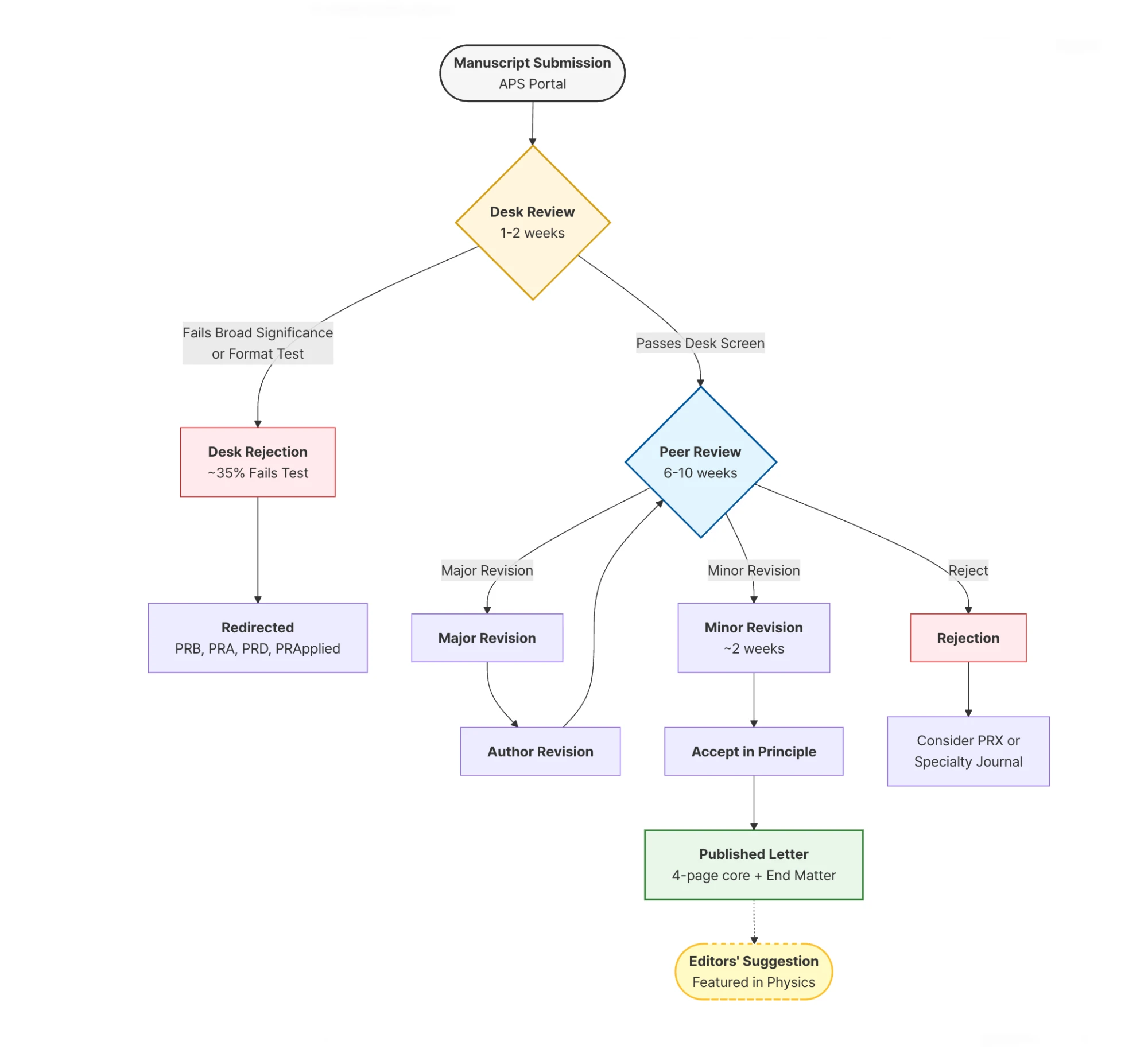
Editors' Suggestion: A small fraction of published PRL papers (~15–20%) are designated as "Editors' Suggestions" — letters that editors judge to be particularly important, innovative, or likely to become highly cited. Selection requires recommendation from at least two referees and editorial agreement. Editors' Suggestions receive additional exposure through the APS Physics magazine ("Featured in Physics" synopses written for a general physics audience) and are freely accessible regardless of subscription status. For authors, an Editors' Suggestion designation meaningfully increases readership and citation rate.
PRL vs. Competing Physics Journals: How to Choose
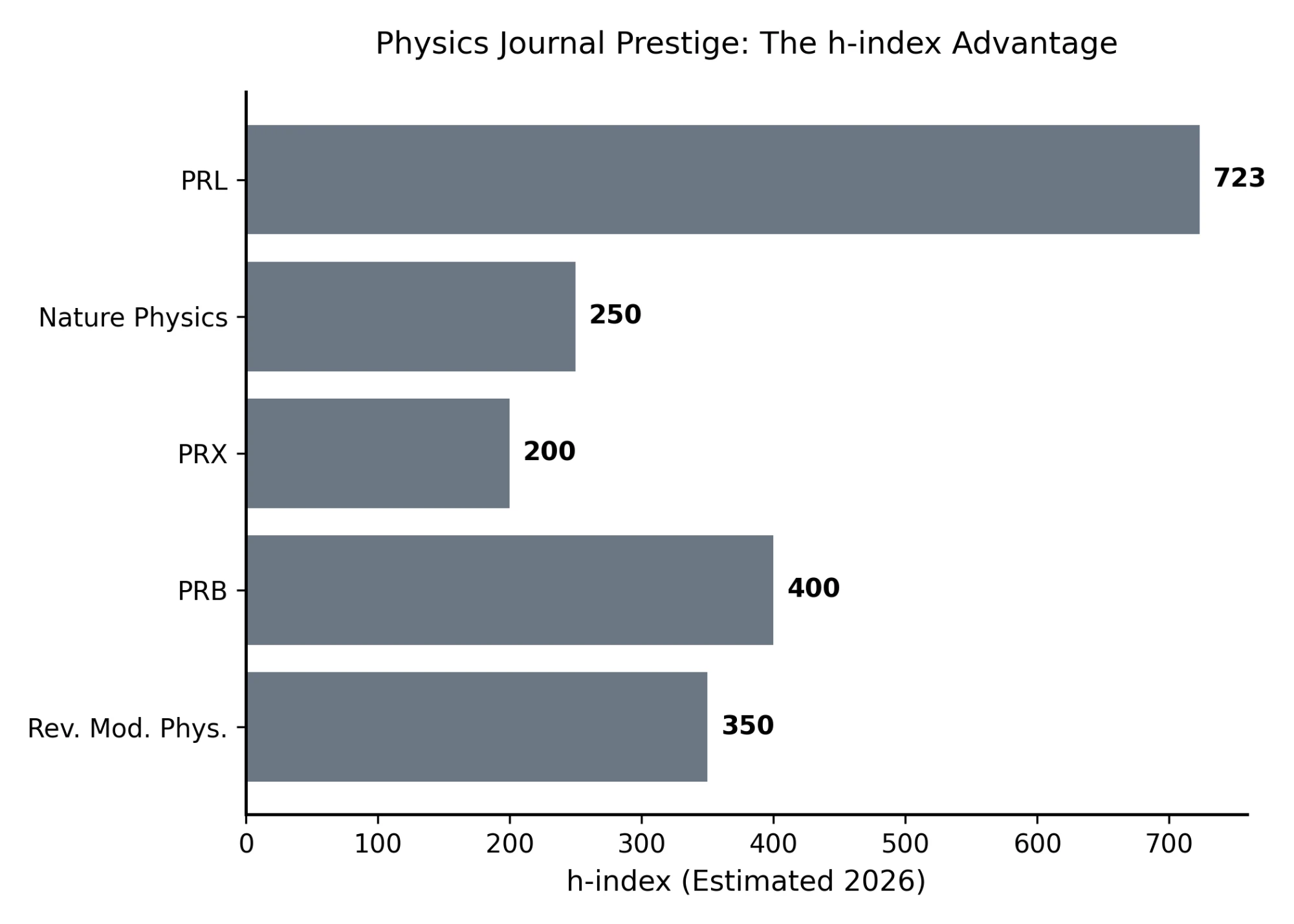
Figure 2. h-index comparison across major physics journals (estimated 2026). PRL's h-index of 723 is nearly 3× that of Physical Review B (400) and almost triple Nature Physics (250), reflecting its 65-year history of landmark publications across all of physics.
Journal | IF (JCR 2025) | h-index | Format | Acceptance Rate | Strategic Tip |
|---|---|---|---|---|---|
9.4 | 723 | Letters (4 pp core + 2 pp End Matter) | ~25-30% (reviewed) | Submit if the significance crosses subfield lines and the argument fits the Letters format; use the End Matter provision for supplemental derivations | |
16.8 | ~200 | Full article (no length limit) | ~25% | The natural alternative when the result is high-impact but needs more than 6 pages; higher IF than PRL, fully OA, no Letters constraint | |
~18 | ~250 | Article + Letters | ~7% | Highest prestige in physics; prioritizes experimental breakthroughs with broad narrative; harder on theory-heavy papers without experimental grounding | |
3.9 | ~400 | Full article | ~65-70% | The correct venue for excellent condensed matter and materials physics that doesn't clear PRL's cross-field significance bar; high-volume, field-defining | |
~5.4 | ~80 | Full article | ~30% | Nature-family OA journal for high-quality physics that falls below Nature Physics threshold; good visibility, no Letters format constraint | |
~2.8 | ~120 | Full article | ~60% | OA, broad physics scope, lower selectivity; suitable for rigorous work that doesn't clear PRL or PRX significance bar |
How Researchers Use AI to Navigate PRL-Level Physics
PRL papers are among the most technically compressed documents in science. A 4-page Letter routinely contains a theoretical framework, experimental data, statistical analysis, and the physical interpretation of results — with derivations relegated to End Matter that is not always easy to follow without domain expertise in the specific subfield.
This density creates a specific challenge: a gravitational wave researcher reading a condensed matter Letter, or a quantum information theorist reading a high-energy theory paper, often encounters technical frameworks outside their training. The journal's cross-field scope is precisely what makes this problem common.
Researchers working with PRL papers increasingly use GPAI to work through this gap:
Deep Explain mode unpacks the theoretical frameworks embedded in PRL Letters — walking through a renormalization group argument, explaining what a Bogoliubov transformation achieves, or clarifying the physical interpretation of a topological invariant for a reader from outside condensed matter.
GPAI Solver handles the underlying mathematics — verifying a Hamiltonian diagonalization, working through perturbation theory steps in End Matter, or checking whether a scaling exponent is consistent with the universality class claimed in the text.
Cross-model verification (GPT, Claude, Gemini simultaneously) is particularly useful for the theoretical physics interpretations PRL papers often compress into a single sentence — where a short statement about gauge symmetry, topological charge, or quantum criticality requires unpacking that benefits from multiple independent reasoning chains.
For researchers preparing PRL submissions, GPAI's Deep Explain mode also helps evaluate whether the paper's introduction makes the cross-field significance case — the most common desk rejection trigger — before the manuscript reaches the editor.
Frequently Asked Questions
What is Physical Review Letters' impact factor in 2026?
Physical Review Letters has a JCR impact factor of 9.4, as reported in the Journal Citation Reports 2025 (released June 2026). The 5-year impact factor is 8.3. The journal is ranked Q1 in Physics, Multidisciplinary, placing 9th out of 114 journals in that category. For a more complete bibliometric picture, PRL's CiteScore is 16.8 (Scopus 2025) and its h-index is 723, reflecting its decades-long position as the primary short-communication venue in physics.
What is Physical Review Letters' h-index in 2026?
PRL's h-index is 723 — one of the highest h-indices of any physics journal. This reflects the journal's history of publishing landmark results: BCS superconductivity, CP violation in kaon decay, LIGO's detection of gravitational waves, the first topological insulator experiments. The h-index measures sustained citation depth in a way the annual impact factor does not capture.
Why does PRL desk reject so many papers?
PRL desk rejects approximately 35% of submissions, but the cause is usually scope mismatch rather than quality failure. The journal publishes results of broad interest to all of physics, not results that are important within a specific subfield. A technically excellent condensed matter or optics paper that does not make a clear case for cross-field significance will be redirected — typically to Physical Review B, Physical Review A, or Physical Review Applied — within 1–2 weeks. The desk rejection is not a judgment on the physics; it is a signal about venue fit.
What is the "broad significance test" in Physical Review Letters?
The broad significance test is the editorial screen PRL applies at every submission: would a physicist outside your immediate subfield recognize this result as important? APS guidance explicitly states that PRL exists to "inform a broad readership of physicists" and publishes results of "broad interest." In practice, editors ask whether the abstract and introduction make the cross-field significance case in language a non-specialist can follow. Papers that frame their importance entirely in subfield-specific language — even if the physics is novel — typically fail this test at desk review.
What is the End Matter provision in Physical Review Letters?
PRL's core text is limited to 4 journal pages (REVTeX two-column format). However, authors may add up to 2 additional pages of End Matter — appendices, supplemental derivations, extended datasets, or proofs intended for specialists — that do not count against the 4-page core limit. This is separate from Supplemental Material, which is hosted online with no page limit. Many authors submit to PRL assuming the 4-page limit makes their work unsubmittable; the End Matter provision often resolves this.
What is the difference between Physical Review Letters and Physical Review X?
Both are APS journals targeting high-impact physics. PRL publishes short Letters (4-page core) requiring demonstrated cross-field significance; it is not open access by default. PRX publishes longer full articles (no page limit), is fully open access, and accepts high-impact work within specific fields without the same cross-subfield significance requirement. PRX has a higher JCR impact factor (16.8 vs. 9.4) because it covers fewer, higher-impact papers. The practical decision: if your result crosses subfield lines and fits 4 pages, PRL. If it is high-impact within a field and needs full-length presentation, PRX.
How do I write a Physical Review Letters abstract?
A PRL abstract should open with the broad physical significance of the result — what it reveals about nature, not which system or model you studied. The first two sentences should be intelligible to a physicist outside your subfield; technical language, model names, and experimental specifics come after. The abstract must stand alone (no citations) and should state the result, the method in a phrase, and the broader implication. Approximately 200 words is standard. The most common failure: opening with system description ("We study a Kitaev model with...") rather than result significance ("We show that quantum criticality in a frustrated magnet generates...").
How long does PRL review take?
PRL editors make a desk decision in 1–2 weeks. If the paper passes to peer review, the first decision typically comes in 6–10 weeks. Total time from submission to acceptance, including revision rounds, typically runs 3–6 months. APS does not guarantee review timelines, and papers that require multiple revision rounds can take longer. For papers redirected to specialty Physical Review journals, the desk decision is usually the end point, with resubmission to the new journal starting a separate timeline.
GPAI is an all-in-one STEM workspace for researchers, graduate students, and educators — Solver, Visualizer, and Deep Explain in one subscription. Use GPAI to work through the compressed theoretical frameworks in Physical Review Letters papers, verify calculations in End Matter appendices, and evaluate whether your submission makes the cross-field significance case before it reaches the editor.