JACS Impact Factor 2026, DFT Requirements, and Desk Rejection: A Submission Guide for the Journal of the American Chemical Society
Jun 24, 2026Key Points
JACS's 2026 impact factor is 16.6 (JCR 2025) — up from 15.6 in JCR 2024. h-index 734, CiteScore 22.5, ranked Q1 top-20 in chemistry.
40–50% of submissions are desk-rejected before peer review. The most common reasons: insufficient broad significance and incomplete DFT reporting in computational sections.
As of 2025–2026, over 70% of JACS papers include DFT data. The journal now expects D3/D4 dispersion correction, SMD/CPCM solvation, and functional benchmarking as baseline — not optional extras.
Founded in 1879, the Journal of the American Chemical Society (JACS) is the flagship publication of the American Chemical Society and the most widely cited general chemistry journal in the world. Its 2026 impact factor of 16.6 (JCR 2025) is the most current figure available — a meaningful jump from the 15.6 figure still cited by many sources using older JCR data.
The acceptance rate of ~25% sounds competitive, but the harder number is 40–50%: the share of submissions that never reach a reviewer. And as DFT has become embedded in over 70% of JACS papers, incomplete computational reporting has become one of the most common triggers for both desk rejection and reviewer pushback.
This guide covers the latest JACS metrics, what the journal's DFT and computational reporting standards actually require, how to navigate desk rejection, and what the 2025–2026 research landscape looks like.
JACS at a Glance: Journal Profile (2026)
Attribute | Detail |
|---|---|
Full Name | Journal of the American Chemical Society |
Abbreviation | JACS |
Publisher | American Chemical Society (ACS) |
Website | |
ISSN | 0002-7863 (Print) / 1520-5126 (Online) |
Access Model | Subscription + ACS Open Access option |
Founded | 1879 |
Publication Frequency | Weekly |
Impact Factor (2026) | 16.6 (JCR 2025) |
CiteScore | 22.5 |
h-index | 734 |
SJR | 5.554 |
Quartile / Ranking | Q1 — Rank 19/250 in Chemistry |
Median Time to First Decision | 29.2 days |
Median Time to Acceptance | 70.8 days |
Acceptance Rate | ~25% (source) |
Desk Rejection Rate | ~40–50% |
Peer Review Type | Single-anonymous |
Indexing |
JACS at a Glance: Journal Profile (2026)
Jump to: Acceptance Rate & Desk Rejection · Research Trends · JACS vs Angewandte Chemie
What JACS Publishes: Research Scope and Article Types
JACS is devoted to fundamental research across all areas of chemistry — but in practice, its editorial priorities in 2025–2026 reflect a field undergoing two simultaneous transformations: the integration of AI and computation into experimental chemistry, and the shift toward sustainability-driven synthesis.
Article Types Accepted
Article Type | Description | Typical Length |
|---|---|---|
Articles | Full research papers with complete experimental data | 6,000–10,000 words |
Communications | Urgent, concise reports of significant new findings | 2,500–4,000 words |
Perspectives | Forward-looking reviews of an emerging research direction | 4,000–8,000 words |
Spotlights | Brief highlights of particularly notable recent papers | 800–1,200 words |
For complete submission requirements, see the JACS Author Guidelines and ACS Submission Portal.
2025–2026 Research Trends: What JACS Is Publishing Now
Chemistry's research landscape has shifted considerably since 2022. JACS's current publication mix reflects five dominant clusters, each with distinct methodological requirements.
Thematic Distribution: 2025–2026 JACS Output
Research Cluster | Share (est.) | Core Research Focus | Dominant Methods |
|---|---|---|---|
Catalysis (Photo, Electro, Organo) | ~28% | Photoredox catalysis, C–H functionalization, asymmetric synthesis | Mechanistic kinetics, DFT, transient absorption spectroscopy |
Materials & Nanochemistry | ~22% | Battery materials, MOFs, 2D materials, quantum dots | XRD, TEM/SEM, electrochemical impedance, BET |
Organic Synthesis & Total Synthesis | ~18% | Natural product synthesis, novel synthetic methodologies | Retrosynthetic analysis, NMR, HPLC, X-ray crystallography |
Chemical Biology & Medicinal Chemistry | ~16% | Drug discovery, protein–ligand interaction, bioorthogonal chemistry | SPR, cryo-EM, MD simulation, cell viability assays |
Computational & AI-Assisted Chemistry | ~10% | ML-guided molecular design, reaction prediction, de novo drug design | Neural networks, Bayesian optimization, DFT, SMILES-based models |
Sustainable & Green Chemistry | ~6% | Earth-abundant metal catalysts, CO₂ capture, waste reduction | Atom economy metrics, lifecycle analysis, TON/TOF reporting |
The AI shift in JACS: The share of papers incorporating machine learning or computational prediction has roughly doubled since 2022. AI is no longer a separate subfield — it is embedded in catalysis, drug design, and materials characterization papers across all clusters. A JACS reviewer in 2026 expects computational validation alongside experimental results in most synthetic chemistry submissions.
What It Takes to Publish in JACS: Editorial Standards
JACS's ~25% acceptance rate and 40–50% desk rejection rate make pre-submission self-assessment critical. The editorial team filters primarily on two criteria: conceptual novelty and broad chemical significance. Incremental advances within a narrow subfield — even well-executed ones — are typically desk-rejected.
Quick check before submitting: Ask yourself — "Would a materials chemist, a chemical biologist, and an organic chemist all find this paper interesting?" If the answer is no for any of the three, reconsider the target journal.
JACS Minimum Reporting Standards by Research Type
Research Type | Required Methodology | Common Rejection Reason |
|---|---|---|
Synthetic Chemistry | Full characterization (NMR, HRMS, X-ray where applicable), yield optimization, substrate scope | Insufficient scope; missing mechanistic rationale |
Catalysis | TON/TOF data, control experiments, mechanistic studies (KIE, radical trapping) | No mechanistic insight; narrow substrate scope |
Computational Chemistry | Benchmarked DFT functional, dispersion correction, solvation model, energy profiles | Unvalidated method; missing experimental correlation |
Materials Science | Structural characterization (XRD, TEM), performance benchmarking vs. literature, stability data | No comparison to state-of-the-art; missing stability |
Chemical Biology | In vitro + cell-based validation, selectivity profiling, dose-response curves | Activity without selectivity data; single assay type |
AI/ML Chemistry | Training/test split reporting, uncertainty quantification, experimental validation of predictions | No experimental validation; data leakage risk |
JACS DFT and Computational Chemistry Requirements (2026)
Unlike journals where statistical analysis is peripheral, JACS submissions in 2025–2026 increasingly require rigorous computational and statistical reporting — particularly in the catalysis, materials, and AI-chemistry clusters.
As of 2025–2026, DFT calculations appear in over 70% of JACS submissions across all chemistry subfields — not just computational chemistry papers. A catalysis paper without a transition state calculation, or a materials paper without band structure analysis, now stands out for the wrong reason. The bar has shifted from "nice to have" to "expected."
JACS Computational Reporting Checklist (2026)
Framework | Application | What JACS Expects |
|---|---|---|
DFT (Density Functional Theory) | Reaction mechanism elucidation, transition state geometry | Functional benchmarked against experimental data; basis set specified; D3/D4 dispersion correction included; solvation via SMD or CPCM; all energies in kcal/mol with ZPE correction |
Kinetic Isotope Effects (KIE) | Identifying rate-determining steps in catalytic cycles | Both primary and secondary KIE (k_H/k_D); comparison to DFT-computed values; Eyring analysis (ΔH‡, ΔS‡) for full transition state characterization |
Electrochemical Impedance Spectroscopy (EIS) | Charge transfer in battery/electrocatalysis papers | Equivalent circuit model with Nyquist plot, fitted parameters reported |
Bayesian Optimization | High-throughput reaction condition screening | Acquisition function specified; comparison to random baseline |
Molecular Dynamics (MD) | Protein–ligand binding, membrane permeability | Force field specified, convergence verified, RMSD/RMSF reported |
ANOVA / Regression | Multi-variable optimization (temperature, solvent, loading) | p-values, confidence intervals, R² reported |
DFT note: As of 2025–2026, over 70% of JACS papers include computational data. Submissions using DFT without benchmarking the chosen functional against experimental reference values — or without dispersion correction for non-covalent interactions — are increasingly flagged by reviewers.
JACS vs Angewandte Chemie vs Nature Chemistry: How to Choose
Journal | Impact Factor | h-index | CiteScore | Access | Acceptance Rate |
|---|---|---|---|---|---|
Journal | Impact Factor | h-index | CiteScore | Access | Acceptance Rate |
--- | --- | --- | --- | --- | --- |
16.6 | 734 | 22.5 | Subscription/OA | ~25% | |
~25.1 | ~260 | ~32 | Subscription/OA | ~8% | |
~16.1 | ~560 | ~22 | Subscription/OA | ~15% | |
~12.7 | ~120 | ~18 | Full Open Access | ~10% | |
~8.4 | ~180 | ~14 | Full Open Access | ~30% | |
~5.6 | ~290 | ~9 | Subscription/OA | ~35% |
Where JACS sits: JACS occupies the intersection of prestige and breadth that makes it the default target for high-impact work across all chemistry subfields. Nature Chemistry has a higher impact factor but a ~8% acceptance rate and narrower scope. Angewandte Chemie is the closest European equivalent, with comparable metrics. For researchers who want maximum visibility without the extreme selectivity of Nature journals, JACS is the standard choice.
How to Avoid Desk Rejection at JACS
JACS desk-rejects 40–50% of all submissions — before a single external reviewer ever sees the manuscript. Understanding what triggers a desk rejection is more valuable than any other single piece of submission advice.
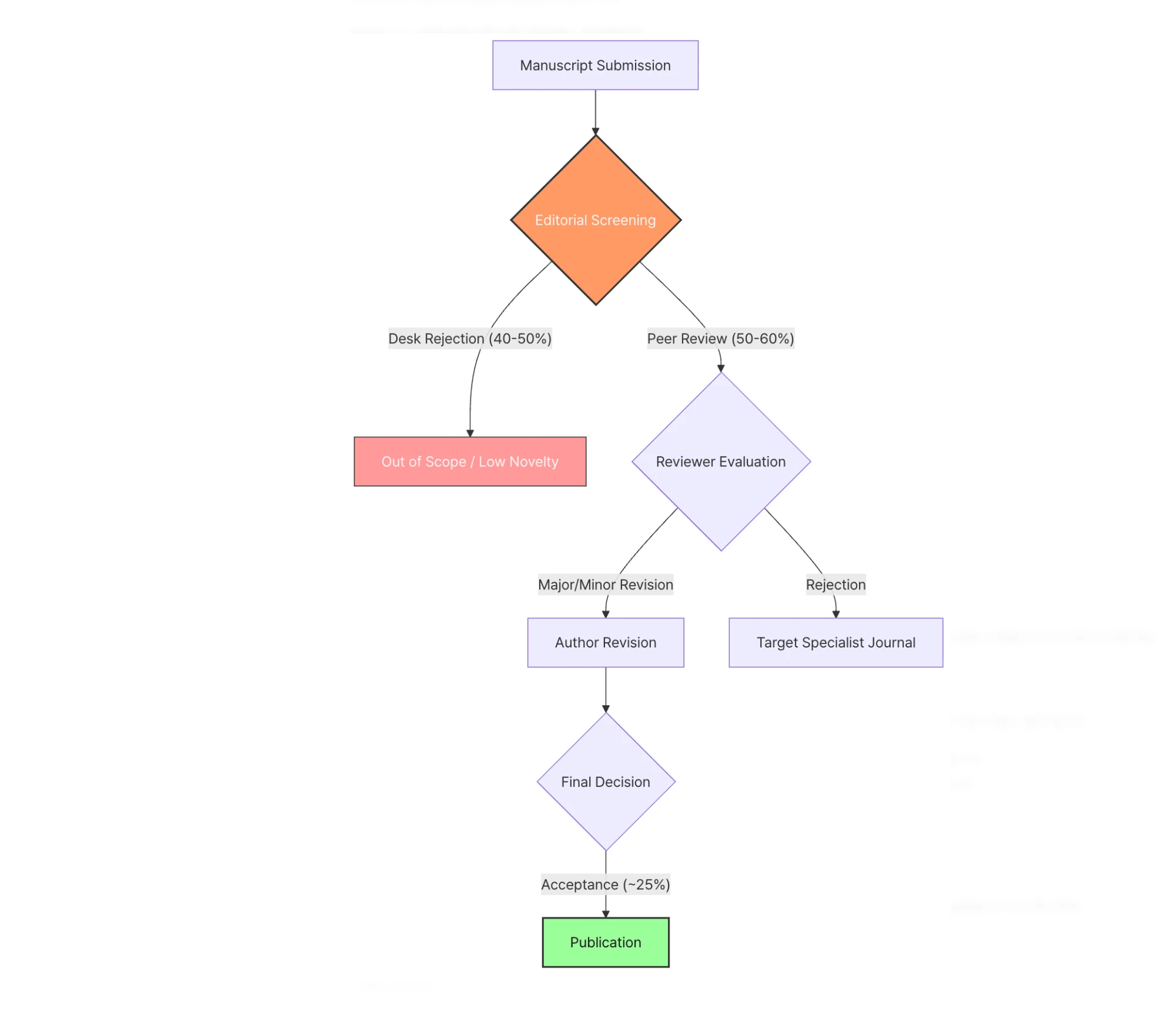
Three Things That Determine Whether Your Paper Passes Desk Review
1. Broad Chemical Significance The key editorial question is: "Is this finding interesting to a materials chemist, a chemical biologist, and an organic chemist — not just specialists in this exact subfield?" A highly optimized catalyst for one substrate class with no generalizability is a desk rejection. The same chemistry framed around a mechanistic principle that explains a broader class of transformations is not.
2. Supporting Information Completeness JACS editors and reviewers read SI. Incomplete NMR spectra, missing HRMS data, poorly documented crystallographic data, or HPLC traces without baseline integration are treated as signals of insufficient rigor — not minor oversights. The SI should be as carefully prepared as the main manuscript.
3. Graphical Abstract Quality The graphical abstract is the first thing an editor sees after the title. A clear, publication-quality visual that communicates the core finding in one glance — without requiring the editor to read the abstract — significantly improves the chances of passing desk review. A cluttered or generic graphic works against the paper regardless of the chemistry inside.
How Researchers Use AI to Work With JACS Papers
JACS papers are among the most technically demanding in chemistry. A single catalysis paper might embed DFT energy profiles, kinetic modeling, Eyring plots, substrate scope tables, and mechanistic proposals across 40+ pages of supporting information. Working through this material — especially across subfields — requires fluency in methods that even experienced chemists encounter infrequently.
Researchers increasingly use GPAI to interpret and verify JACS content:
Deep Explain mode walks through mechanistic proposals and computational results — what a transition state energy profile actually shows, how to read a Nyquist plot from an EIS experiment, or what a KIE value of 6.2 implies about the rate-determining step in a catalytic cycle.
GPAI Solver handles the underlying chemistry calculations — verifying DFT energy differences, working through reaction coordinate diagrams, or checking whether reported TON values are consistent with the experimental conditions described.
Cross-model verification (GPT, Claude, Gemini simultaneously) is particularly useful when interpreting novel mechanistic proposals in JACS, where a single model's confident but incorrect interpretation of a complex mechanism can compound across an entire reading session.
Frequently Asked Questions
What is the JACS acceptance rate in 2026?
JACS has an overall acceptance rate of approximately 25%. However, 40–50% of all submissions are desk-rejected before reaching peer review — making the effective acceptance rate among peer-reviewed manuscripts meaningfully higher. The most common reasons for desk rejection are insufficient conceptual novelty, limited broad chemical significance, and (increasingly) incomplete DFT or computational reporting in papers where calculations are included.
What is the JACS impact factor in 2026?
The Journal of the American Chemical Society has an impact factor of 16.6 (JCR 2025) — the most current official figure as of mid-2026. Many sources still cite 15.6, which reflects JCR 2024 data. CiteScore 22.5, h-index 734, ranked Q1 top-20 in chemistry.
What is the acceptance rate for JACS?
JACS has an overall acceptance rate of approximately 25%. However, the journal desk-rejects approximately 40–50% of submissions before they reach peer review — meaning the effective acceptance rate among peer-reviewed manuscripts is higher. The primary reasons for desk rejection are insufficient conceptual novelty and limited broad chemical significance.
How long does peer review take at JACS?
The median time to first peer-review decision is 29.2 days. The median time from submission to acceptance is 70.8 days. JACS publishes weekly, so accepted papers typically appear online within weeks of acceptance.
Is JACS open access?
JACS is primarily a subscription journal, but authors can pay an Article Processing Charge (APC) to make individual papers open access under the ACS AuthorChoice or ACS Editors' Choice programs. ACS also offers transformative agreements with many institutions. For researchers who want a fully open-access ACS general chemistry journal, ACS Central Science is the alternative — though its acceptance rate (~10%) is similarly competitive.
What is the difference between JACS and Angewandte Chemie?
Both are top-tier general chemistry journals with comparable impact factors (~16.6 vs. ~16.1). JACS is published by the American Chemical Society and tends to have stronger representation of organic synthesis, chemical biology, and US-based research. Angewandte Chemie (Wiley/GDCh) has deeper roots in European and Asian research communities and is slightly faster (median first decision ~21 days vs. 29 days for JACS). Most chemists submit to both over their careers; the choice often comes down to fit with the editorial board's current focus areas and geographic network.
What types of chemistry does JACS publish?
JACS publishes fundamental research across all chemistry disciplines: organic synthesis, inorganic chemistry, physical chemistry, analytical chemistry, chemical biology, materials chemistry, computational chemistry, and increasingly AI-assisted molecular design. It does not publish applied or engineering-focused work — papers must demonstrate fundamental chemical significance, not just application utility.
How should I decide between JACS and a specialist journal?
JACS requires that your work be of broad significance to the entire chemistry community, not just specialists in your subfield. If your paper's significance is primarily within a narrow field (e.g., a specific class of organocatalysts with limited generalizability), a specialist journal like ACS Catalysis, Organic Letters, or JACS Au is likely a better fit and will reach the most relevant audience. JACS is appropriate when the chemistry is genuinely novel and the implications cross subfield boundaries.
GPAI is an all-in-one STEM workspace for researchers, graduate students, and educators — Solver, Visualizer, and Chat in one subscription. Use GPAI's Deep Explain mode to work through the mechanistic proposals, DFT results, and statistical frameworks embedded in JACS papers.