Class 11 Physics Vectors
Shared 5/13/2026•0 views
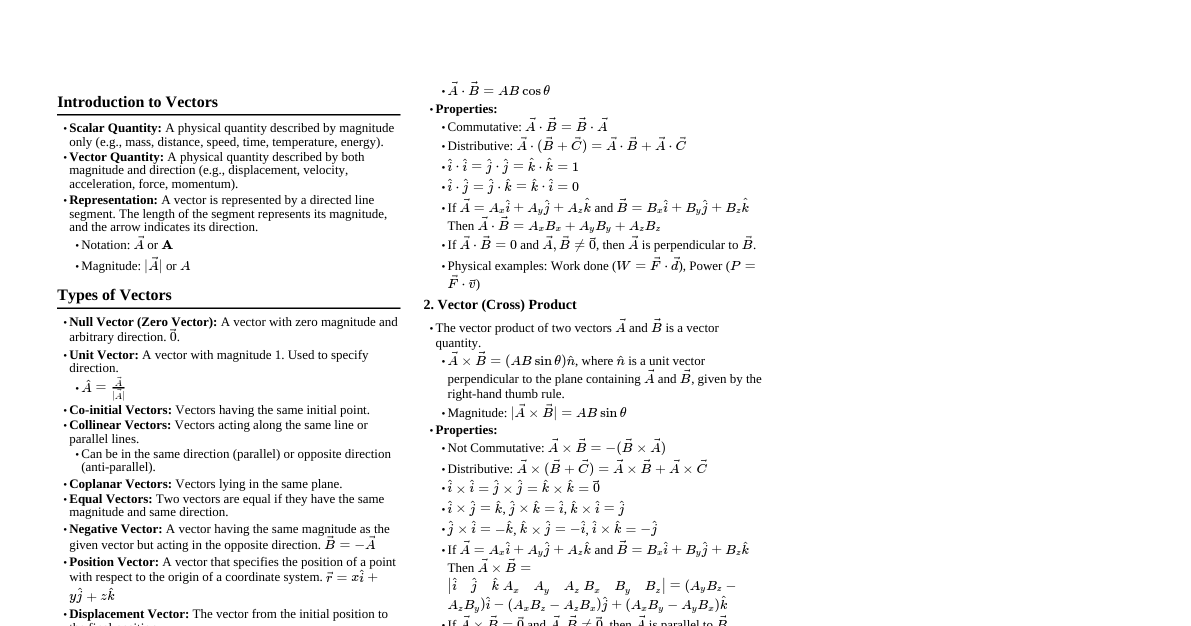
### Introduction to Vectors - **Scalar Quantities:** Quantities described by magnitude only (e.g., mass, speed, distance, time, temperature, energy). - **Vector Quantities:** Quantities described by both magnitude and direction (e.g., displacement, velocity, acceleration, force, momentum, electric field). - **Representation:** A vector is represented by an arrow. The length of the arrow represents its magnitude, and the arrowhead indicates its direction. - Notation: $\vec{A}$ or $\mathbf{A}$ - Magnitude: $|\vec{A}|$ or $A$ ### Types of Vectors - **Zero Vector (Null Vector):** A vector with zero magnitude and arbitrary direction. $\vec{0}$. - **Unit Vector:** A vector with magnitude 1. Used to specify direction. - $\hat{A} = \frac{\vec{A}}{|\vec{A}|}$ - Unit vectors along x, y, z axes are $\hat{i}$, $\hat{j}$, $\hat{k}$ respectively. - **Co-initial Vectors:** Vectors having the same starting point. - **Collinear Vectors:** Vectors acting along the same line (parallel or anti-parallel). - **Coplanar Vectors:** Vectors lying in the same plane. - **Equal Vectors:** Vectors having the same magnitude and direction. - **Negative Vector:** A vector having the same magnitude but opposite direction to a given vector. If $\vec{A}$ is a vector, then $-\vec{A}$ is its negative vector. ### Vector Addition - **Triangle Law of Vector Addition:** If two vectors are represented by two sides of a triangle taken in order, then their resultant is represented by the third side taken in opposite order. - If $\vec{A}$ and $\vec{B}$ are two vectors, then $\vec{R} = \vec{A} + \vec{B}$. - Magnitude of resultant: $|\vec{R}| = \sqrt{A^2 + B^2 + 2AB\cos\theta}$, where $\theta$ is the angle between $\vec{A}$ and $\vec{B}$. - Direction of resultant: $\tan\alpha = \frac{B\sin\theta}{A + B\cos\theta}$, where $\alpha$ is the angle $\vec{R}$ makes with $\vec{A}$. - **Parallelogram Law of Vector Addition:** If two vectors are represented by the two adjacent sides of a parallelogram drawn from a common point, then their resultant is represented by the diagonal of the parallelogram starting from the same common point. - Formulae for magnitude and direction are the same as for the Triangle Law. - **Polygon Law of Vector Addition:** If a number of vectors are represented by the sides of an open polygon taken in order, then their resultant is represented by the closing side of the polygon taken in opposite order. - $\vec{R} = \vec{A} + \vec{B} + \vec{C} + ...$ - **Properties of Vector Addition:** - **Commutative:** $\vec{A} + \vec{B} = \vec{B} + \vec{A}$ - **Associative:** $(\vec{A} + \vec{B}) + \vec{C} = \vec{A} + (\vec{B} + \vec{C})$ ### Vector Subtraction - Subtraction of vectors is equivalent to adding the negative of the vector. - $\vec{A} - \vec{B} = \vec{A} + (-\vec{B})$ - Magnitude of resultant: $|\vec{R}| = \sqrt{A^2 + B^2 - 2AB\cos\theta}$ - Direction of resultant: $\tan\alpha = \frac{B\sin\theta}{A - B\cos\theta}$ ### Resolution of Vectors - The process of splitting a vector into two or more components is called resolution of vectors. - **Rectangular Components (2D):** A vector $\vec{A}$ in a plane can be resolved into two perpendicular components along x and y axes. - $\vec{A} = A_x\hat{i} + A_y\hat{j}$ - $A_x = A\cos\theta$ (component along x-axis) - $A_y = A\sin\theta$ (component along y-axis) - Magnitude: $A = \sqrt{A_x^2 + A_y^2}$ - Direction: $\tan\theta = \frac{A_y}{A_x}$ - **Rectangular Components (3D):** A vector $\vec{A}$ in space can be resolved into three perpendicular components along x, y, and z axes. - $\vec{A} = A_x\hat{i} + A_y\hat{j} + A_z\hat{k}$ - Magnitude: $A = \sqrt{A_x^2 + A_y^2 + A_z^2}$ - Direction Cosines: - $\cos\alpha = \frac{A_x}{A}$ - $\cos\beta = \frac{A_y}{A}$ - $\cos\gamma = \frac{A_z}{A}$ - $\cos^2\alpha + \cos^2\beta + \cos^2\gamma = 1$ ### Multiplication of Vectors #### 1. Scalar Product (Dot Product) - The dot product of two vectors results in a scalar quantity. - $\vec{A} \cdot \vec{B} = |\vec{A}||\vec{B}|\cos\theta = AB\cos\theta$ - If $\vec{A} = A_x\hat{i} + A_y\hat{j} + A_z\hat{k}$ and $\vec{B} = B_x\hat{i} + B_y\hat{j} + B_z\hat{k}$ - $\vec{A} \cdot \vec{B} = A_xB_x + A_yB_y + A_zB_z$ - **Properties:** - Commutative: $\vec{A} \cdot \vec{B} = \vec{B} \cdot \vec{A}$ - Distributive: $\vec{A} \cdot (\vec{B} + \vec{C}) = \vec{A} \cdot \vec{B} + \vec{A} \cdot \vec{C}$ - $\hat{i} \cdot \hat{i} = \hat{j} \cdot \hat{j} = \hat{k} \cdot \hat{k} = 1$ - $\hat{i} \cdot \hat{j} = \hat{j} \cdot \hat{k} = \hat{k} \cdot \hat{i} = 0$ - If $\vec{A} \cdot \vec{B} = 0$ and $\vec{A}, \vec{B} \neq \vec{0}$, then $\vec{A}$ is perpendicular to $\vec{B}$ ($\theta = 90^\circ$). - $\vec{A} \cdot \vec{A} = |\vec{A}|^2 = A^2$ #### 2. Vector Product (Cross Product) - The cross product of two vectors results in a vector quantity. - $\vec{A} \times \vec{B} = (|\vec{A}||\vec{B}|\sin\theta)\hat{n}$ - $\hat{n}$ is a unit vector perpendicular to the plane containing $\vec{A}$ and $\vec{B}$, determined by the right-hand thumb rule. - Magnitude: $|\vec{A} \times \vec{B}| = AB\sin\theta$ - If $\vec{A} = A_x\hat{i} + A_y\hat{j} + A_z\hat{k}$ and $\vec{B} = B_x\hat{i} + B_y\hat{j} + B_z\hat{k}$ - $\vec{A} \times \vec{B} = \begin{vmatrix} \hat{i} & \hat{j} & \hat{k} \\ A_x & A_y & A_z \\ B_x & B_y & B_z \end{vmatrix} = (A_yB_z - A_zB_y)\hat{i} - (A_xB_z - A_zB_x)\hat{j} + (A_xB_y - A_yB_x)\hat{k}$ - **Properties:** - Not Commutative: $\vec{A} \times \vec{B} = -(\vec{B} \times \vec{A})$ - Distributive: $\vec{A} \times (\vec{B} + \vec{C}) = \vec{A} \times \vec{B} + \vec{A} \times \vec{C}$ - $\hat{i} \times \hat{i} = \hat{j} \times \hat{j} = \hat{k} \times \hat{k} = \vec{0}$ - $\hat{i} \times \hat{j} = \hat{k}$, $\hat{j} \times \hat{k} = \hat{i}$, $\hat{k} \times \hat{i} = \hat{j}$ - If $\vec{A} \times \vec{B} = \vec{0}$ and $\vec{A}, \vec{B} \neq \vec{0}$, then $\vec{A}$ is parallel to $\vec{B}$ ($\theta = 0^\circ$ or $180^\circ$). - Area of parallelogram with sides $\vec{A}$ and $\vec{B}$: $|\vec{A} \times \vec{B}|$ - Area of triangle with sides $\vec{A}$ and $\vec{B}$: $\frac{1}{2}|\vec{A} \times \vec{B}|$