Hibbeler
Cheatsheet Content
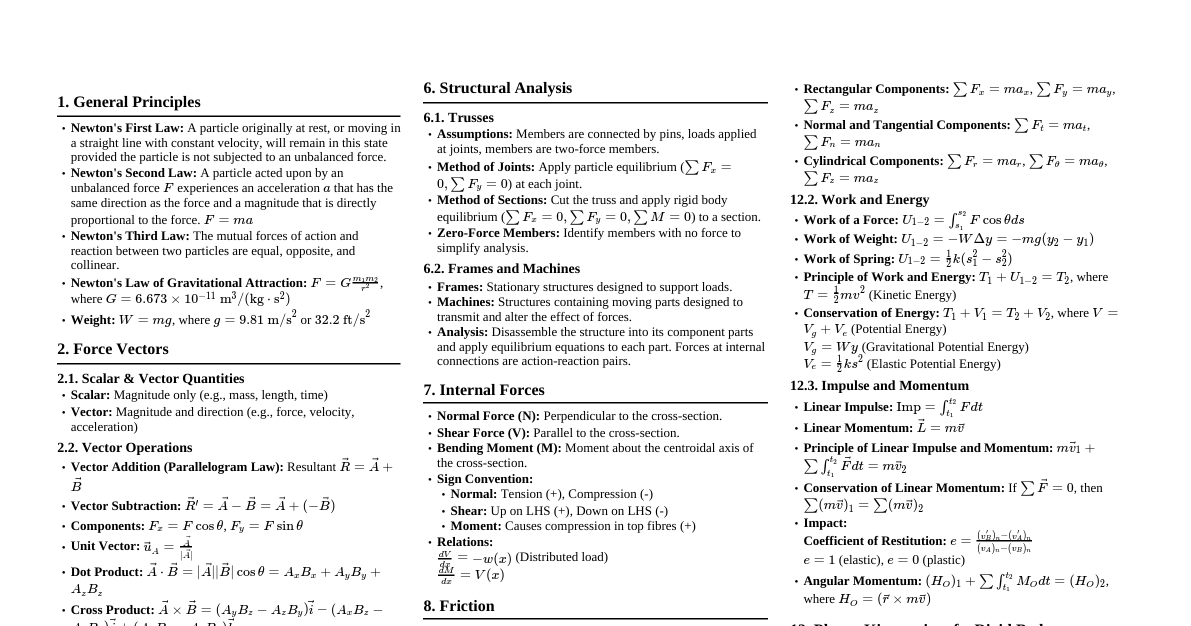
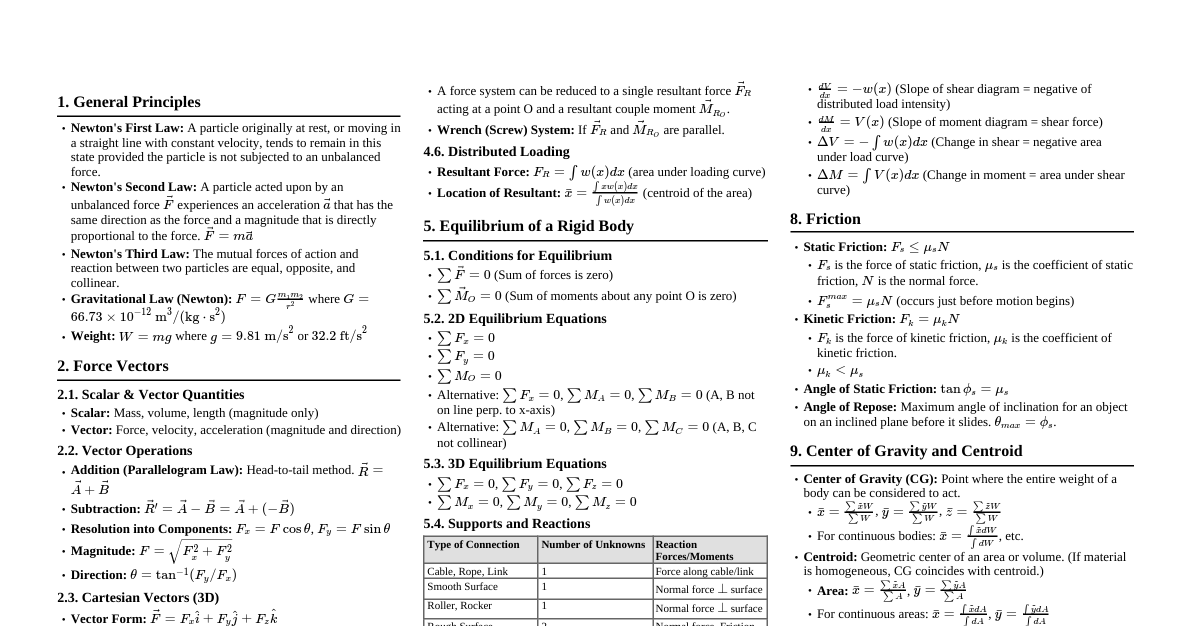
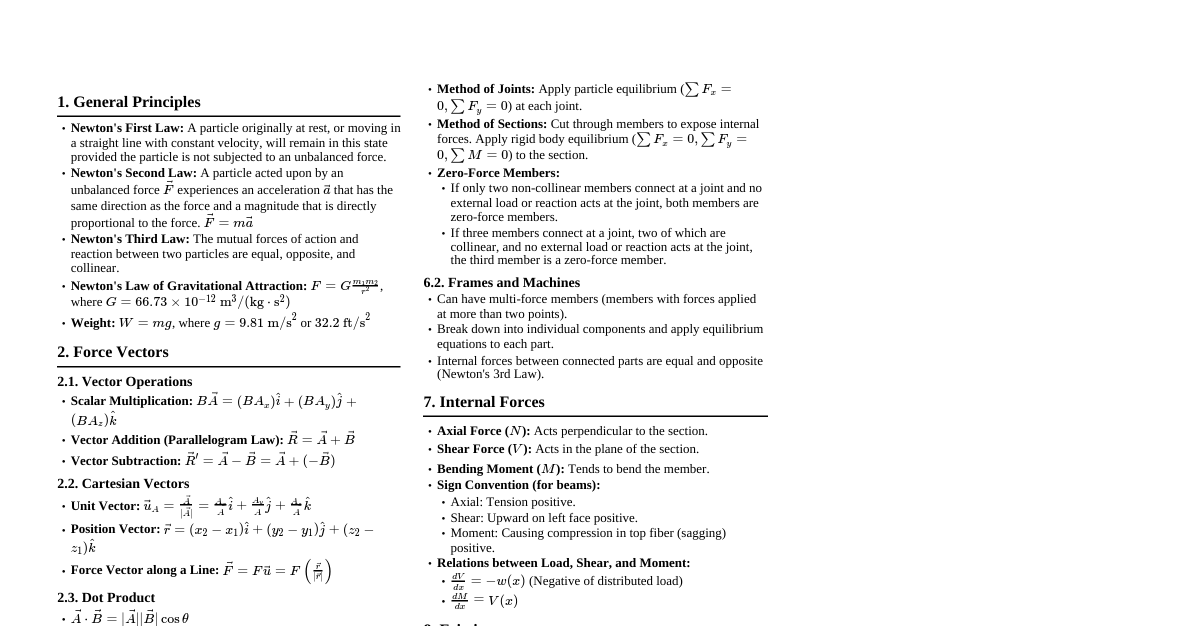
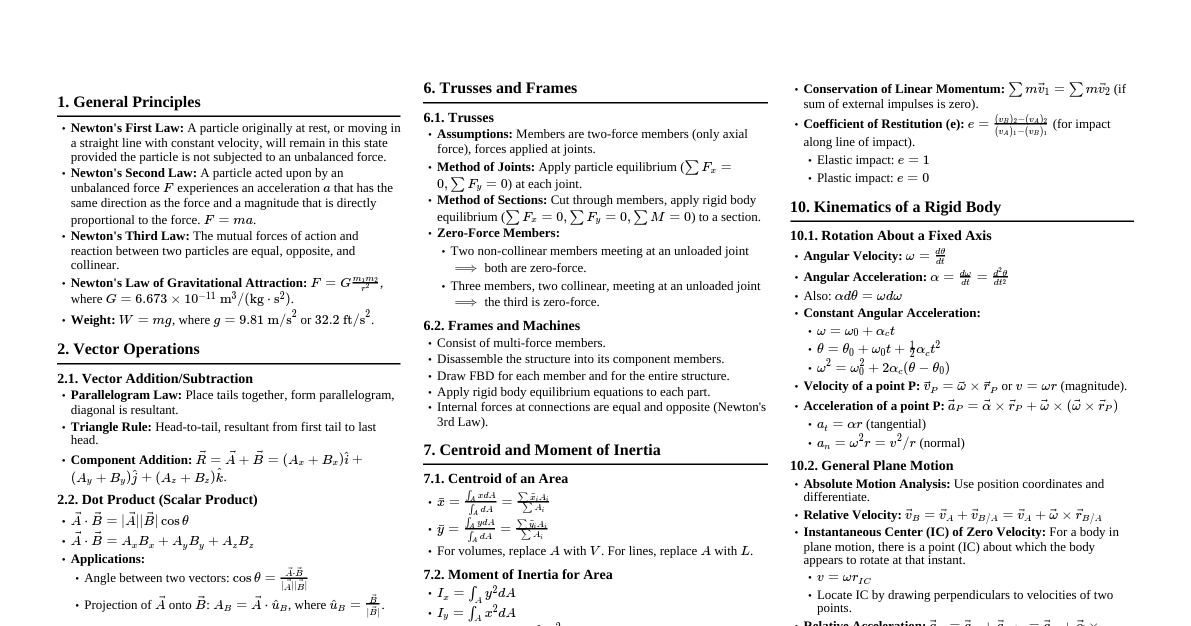
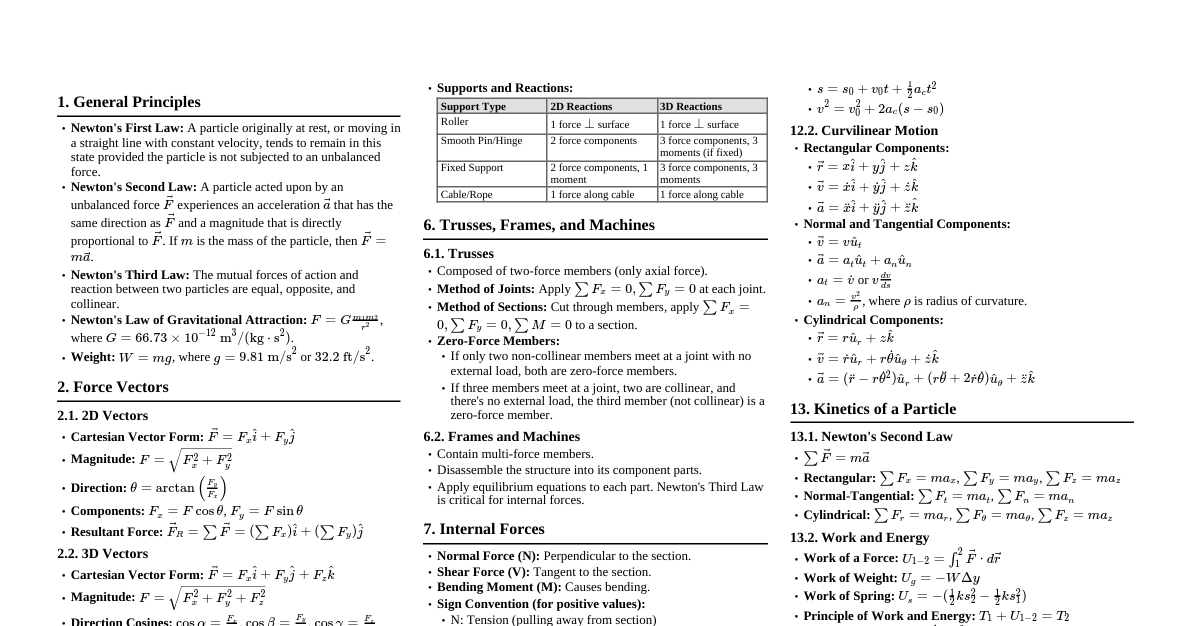
1. General Principles Newton's First Law: A particle originally at rest, or moving in a straight line with constant velocity, will remain in this state provided the particle is not subjected to an unbalanced force. Newton's Second Law: A particle acted upon by an unbalanced force $\vec{F}$ experiences an acceleration $\vec{a}$ that has the same direction as the force and a magnitude that is directly proportional to the force. $ \vec{F} = m\vec{a} $ Newton's Third Law: The mutual forces of action and reaction between two particles are equal, opposite, and collinear. Units: SI: Length (m), Mass (kg), Time (s), Force (N) US Customary: Length (ft), Force (lb), Time (s), Mass (slug) Gravitational Acceleration: $g = 9.81 \text{ m/s}^2$ or $32.2 \text{ ft/s}^2$ 2. Force Vectors 2.1. Scalar & Vector Quantities Scalar: Magnitude only (e.g., mass, time, temperature). Vector: Magnitude and direction (e.g., force, velocity, acceleration). 2.2. Vector Operations Addition (Parallelogram Law): Resultant $\vec{R} = \vec{A} + \vec{B}$. Tail-to-tip method. Subtraction: $\vec{R}' = \vec{A} - \vec{B} = \vec{A} + (-\vec{B})$ Components: $\vec{F} = F_x\hat{i} + F_y\hat{j} + F_z\hat{k}$ Magnitude: $|\vec{F}| = \sqrt{F_x^2 + F_y^2 + F_z^2}$ Unit Vector: $\hat{u}_F = \frac{\vec{F}}{|\vec{F}|} = \cos\alpha\hat{i} + \cos\beta\hat{j} + \cos\gamma\hat{k}$ Dot Product: $\vec{A} \cdot \vec{B} = |\vec{A}||\vec{B}|\cos\theta = A_xB_x + A_yB_y + A_zB_z$ Used to find angle between vectors or project a vector onto another. Cross Product: $\vec{C} = \vec{A} \times \vec{B} = (A_yB_z - A_zB_y)\hat{i} + (A_zB_x - A_xB_z)\hat{j} + (A_xB_y - A_yB_x)\hat{k}$ Magnitude: $|\vec{A}||\vec{B}|\sin\theta$. Direction by right-hand rule. Used to find moment of a force. 3. Equilibrium of a Particle Free-Body Diagram (FBD): Essential for problem-solving. Shows all external forces acting on the particle. Equations of Equilibrium: 2D: $\sum F_x = 0$, $\sum F_y = 0$ 3D: $\sum F_x = 0$, $\sum F_y = 0$, $\sum F_z = 0$ Spring Force: $F = ks$, where $k$ is spring constant and $s$ is deformation. 4. Force System Resultants 4.1. Moment of a Force Scalar Formulation (2D): $M_O = Fd$, where $d$ is perpendicular distance from $O$ to line of action of $F$. Vector Formulation (3D): $\vec{M}_O = \vec{r} \times \vec{F}$, where $\vec{r}$ is position vector from $O$ to any point on line of action of $F$. Varignon's Theorem: The moment of a force about a point is equal to the sum of the moments of its components about the same point. 4.2. Moment of a Couple A couple consists of two parallel forces of equal magnitude and opposite direction, separated by a perpendicular distance $d$. Magnitude: $M = Fd$. Direction is perpendicular to the plane containing the forces. A couple is a free vector (its effect is independent of its location). 4.3. Resultant of a Force System Resultant Force: $\vec{F}_R = \sum \vec{F}$ Resultant Moment: $\vec{M}_{R_O} = \sum \vec{M}_O + \sum \vec{M}_{couples}$ A force system can be reduced to a single resultant force $\vec{F}_R$ and a resultant couple moment $\vec{M}_{R_O}$ at any arbitrary point $O$. 5. Equilibrium of a Rigid Body Free-Body Diagram: Show all external forces and moments. Reactions at supports. Equations of Equilibrium: 2D: $\sum F_x = 0$, $\sum F_y = 0$, $\sum M_O = 0$ 3D: $\sum F_x = 0$, $\sum F_y = 0$, $\sum F_z = 0$, $\sum M_x = 0$, $\sum M_y = 0$, $\sum M_z = 0$ Types of Supports (2D): Roller/Rocker: 1 unknown (normal force $\perp$ surface) Pin/Hinge: 2 unknowns (force components $F_x, F_y$) Fixed Support: 3 unknowns (force components $F_x, F_y$ and couple moment $M$) Two-Force Member: A member subjected to forces at only two points. The forces must be equal, opposite, and collinear along the member's axis. Three-Force Member: A member subjected to forces at three points. The forces must be concurrent or parallel. 6. Trusses, Frames, and Machines 6.1. Trusses Made of slender members connected at their ends by pins. Assume members are two-force members. Method of Joints: Apply particle equilibrium ($\sum F_x = 0, \sum F_y = 0$) at each pin. Method of Sections: Cut the truss into two sections, exposing up to 3 unknown member forces. Apply rigid body equilibrium ($\sum F_x = 0, \sum F_y = 0, \sum M = 0$) to one section. Zero-Force Members: If only two non-collinear members connect at an unloaded joint, both are zero-force members. If three members connect at an unloaded joint, and two are collinear, the third is a zero-force member. 6.2. Frames and Machines Contain at least one multi-force member. Forces are not necessarily along the member's axis. Disassemble the structure into its component parts. Draw an FBD for each part. Action-reaction forces between connected members are equal and opposite. 7. Internal Forces Axial Force ($N$): Normal to the cross-section. Tension (+), Compression (-). Shear Force ($V$): Parallel to the cross-section. Bending Moment ($M$): Tends to bend the member. Sign Convention: Axial: Outward from section is positive. Shear: Up on right face, down on left face is positive. Moment: Causing compression in top fibers, tension in bottom fibers (smiley face) is positive. 8. Friction Dry Friction: Occurs between two non-lubricated surfaces. Static Friction ($F_s$): Opposes impending motion. $F_s \le \mu_s N$, where $\mu_s$ is coefficient of static friction. Kinetic Friction ($F_k$): Opposes actual motion. $F_k = \mu_k N$, where $\mu_k$ is coefficient of kinetic friction. $\mu_k Angle of Static Friction: $\phi_s = \tan^{-1}(\mu_s)$ Wedges: Used to create small movements or apply large forces. Analyze by drawing FBDs for each component. Belts: $T_2 = T_1 e^{\mu_s \beta}$, where $T_2 > T_1$, $\mu_s$ is coefficient of static friction, and $\beta$ is angle of contact in radians. 9. Centroids and Moments of Inertia 9.1. Centroid of an Area Centroid Coordinates: $\bar{x} = \frac{\sum \tilde{x}A}{\sum A}$, $\bar{y} = \frac{\sum \tilde{y}A}{\sum A}$ (for composite areas) For Integration: $\bar{x} = \frac{\int \tilde{x}dA}{\int dA}$, $\bar{y} = \frac{\int \tilde{y}dA}{\int dA}$ Symmetry: If an area has an axis of symmetry, its centroid lies on that axis. 9.2. Moment of Inertia of an Area Definition: $I_x = \int y^2 dA$, $I_y = \int x^2 dA$ Polar Moment of Inertia: $J_O = \int r^2 dA = I_x + I_y$ Parallel-Axis Theorem: $I = \bar{I} + Ad^2$, where $\bar{I}$ is moment of inertia about centroidal axis, $A$ is area, $d$ is perpendicular distance between parallel axes. Radius of Gyration: $k = \sqrt{I/A}$ 10. Kinematics of a Particle 10.1. Rectilinear Motion Velocity: $v = \frac{ds}{dt}$ Acceleration: $a = \frac{dv}{dt} = \frac{d^2s}{dt^2}$ Differential Relation: $a ds = v dv$ Constant Acceleration: $v = v_0 + a_c t$ $s = s_0 + v_0 t + \frac{1}{2} a_c t^2$ $v^2 = v_0^2 + 2 a_c (s - s_0)$ 10.2. Curvilinear Motion Position Vector: $\vec{r}(t) = x(t)\hat{i} + y(t)\hat{j} + z(t)\hat{k}$ Velocity: $\vec{v} = \frac{d\vec{r}}{dt} = v_x\hat{i} + v_y\hat{j} + v_z\hat{k}$ Acceleration: $\vec{a} = \frac{d\vec{v}}{dt} = a_x\hat{i} + a_y\hat{j} + a_z\hat{k}$ Projectile Motion: Constant $a_y = -g$, $a_x = 0$. Normal and Tangential Components: $v = \dot{s}$ $a_t = \dot{v} = \frac{dv}{dt}$ (tangential acceleration) $a_n = \frac{v^2}{\rho}$ (normal acceleration, always towards center of curvature) $a = \sqrt{a_t^2 + a_n^2}$ Cylindrical Components: $\vec{r} = r\hat{u}_r$ $\vec{v} = \dot{r}\hat{u}_r + r\dot{\theta}\hat{u}_\theta$ $\vec{a} = (\ddot{r} - r\dot{\theta}^2)\hat{u}_r + (r\ddot{\theta} + 2\dot{r}\dot{\theta})\hat{u}_\theta$ 11. Kinetics of a Particle (Newton's Second Law) Equation of Motion: $\sum \vec{F} = m\vec{a}$ Rectangular Coordinates: $\sum F_x = ma_x$, $\sum F_y = ma_y$, $\sum F_z = ma_z$ Normal and Tangential Coordinates: $\sum F_t = ma_t$, $\sum F_n = ma_n = m\frac{v^2}{\rho}$ Cylindrical Coordinates: $\sum F_r = m(\ddot{r} - r\dot{\theta}^2)$, $\sum F_\theta = m(r\ddot{\theta} + 2\dot{r}\dot{\theta})$ 12. Work and Energy Work of a Force: $U_{1-2} = \int_{s_1}^{s_2} \vec{F} \cdot d\vec{r}$ Constant Force: $U_{1-2} = (F\cos\theta)\Delta s$ Spring Force: $U_{1-2} = \frac{1}{2}k(s_1^2 - s_2^2)$ Weight: $U_{1-2} = -W\Delta y$ Principle of Work and Energy: $T_1 + U_{1-2} = T_2$ Kinetic Energy: $T = \frac{1}{2}mv^2$ Conservative Forces: Work is path-independent (weight, spring force). Potential Energy: $V_g = Wy$ (gravitational), $V_e = \frac{1}{2}ks^2$ (elastic) Conservation of Energy: $T_1 + V_1 = T_2 + V_2$ (if only conservative forces do work) Power: $P = \frac{dU}{dt} = \vec{F} \cdot \vec{v}$ Efficiency: $\epsilon = \frac{\text{Power Output}}{\text{Power Input}}$ 13. Impulse and Momentum Linear Momentum: $\vec{L} = m\vec{v}$ Linear Impulse: $\text{Imp}_{1-2} = \int_{t_1}^{t_2} \vec{F} dt$ Principle of Linear Impulse and Momentum: $m\vec{v}_1 + \sum \int_{t_1}^{t_2} \vec{F} dt = m\vec{v}_2$ Conservation of Linear Momentum: If $\sum \vec{F}_{ext} = 0$, then $\sum m\vec{v}_1 = \sum m\vec{v}_2$. Impact: Coefficient of Restitution ($e$): $e = \frac{(v_B)_2 - (v_A)_2}{(v_A)_1 - (v_B)_1}$ (for central impact along line of impact) $e=1$ (elastic impact), $e=0$ (plastic impact)