Units & Measurement
Cheatsheet Content
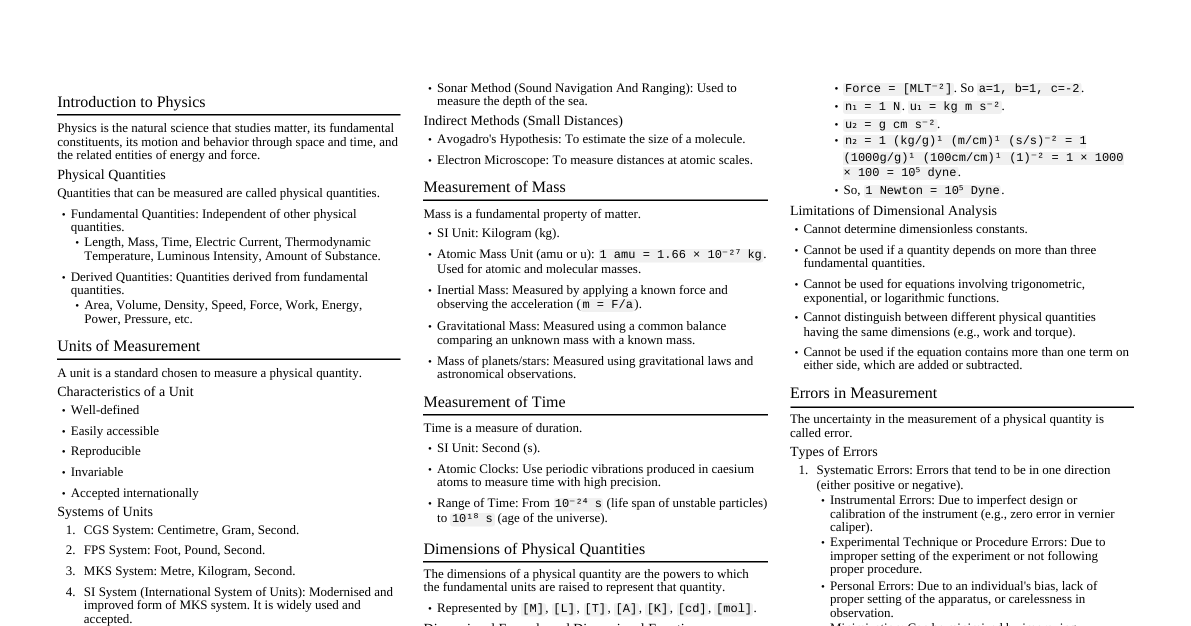
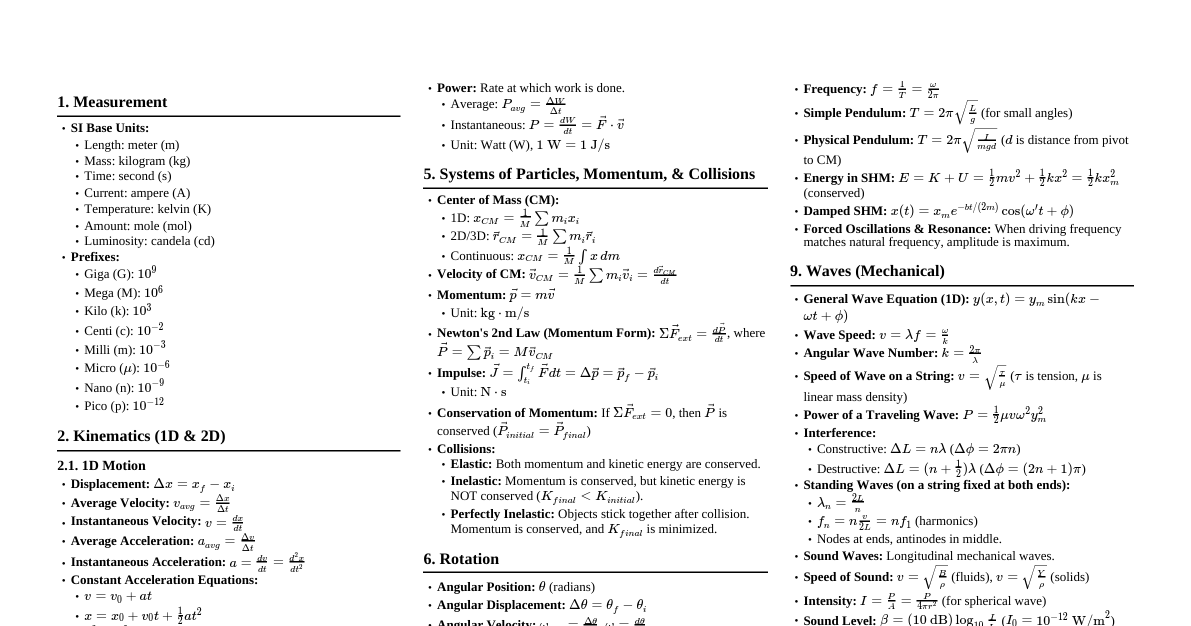
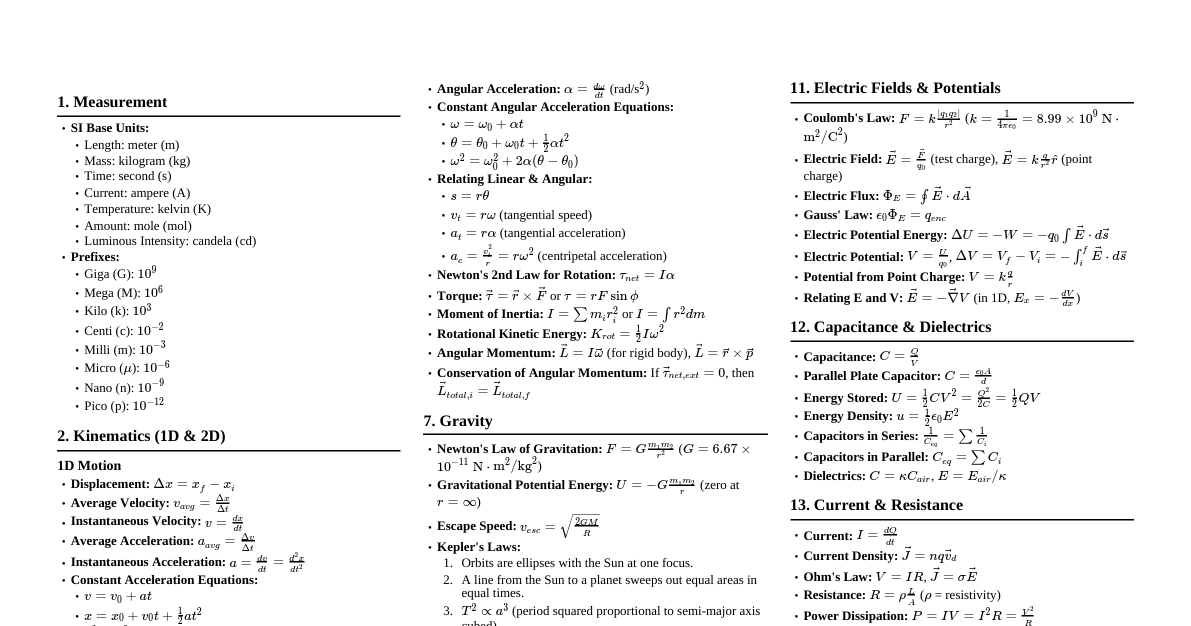
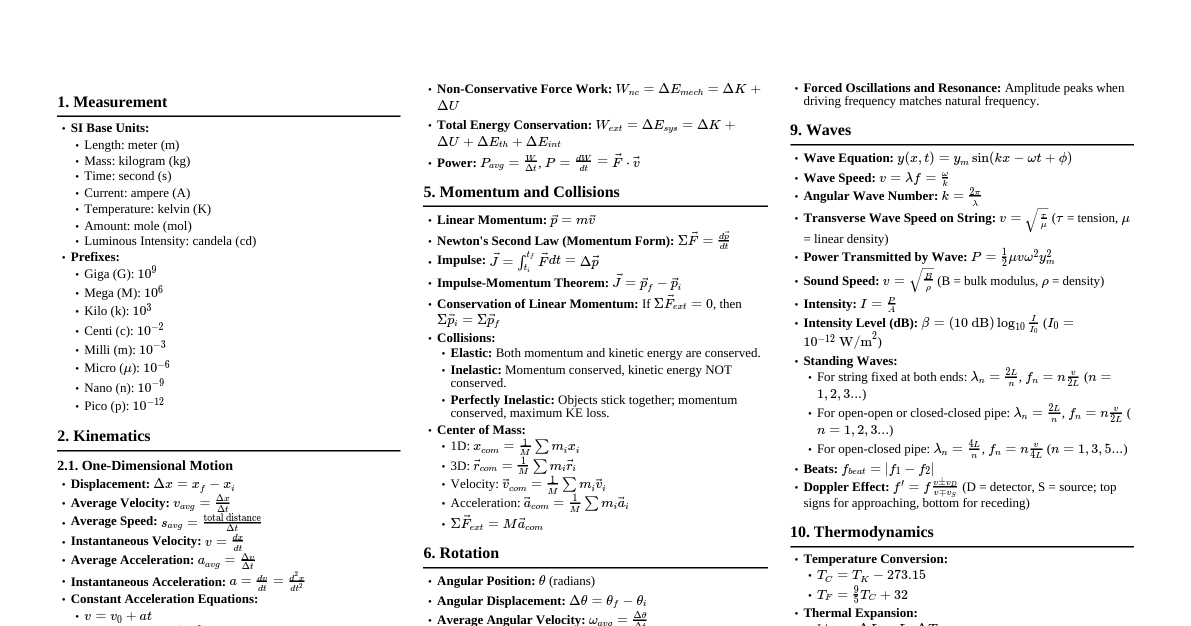
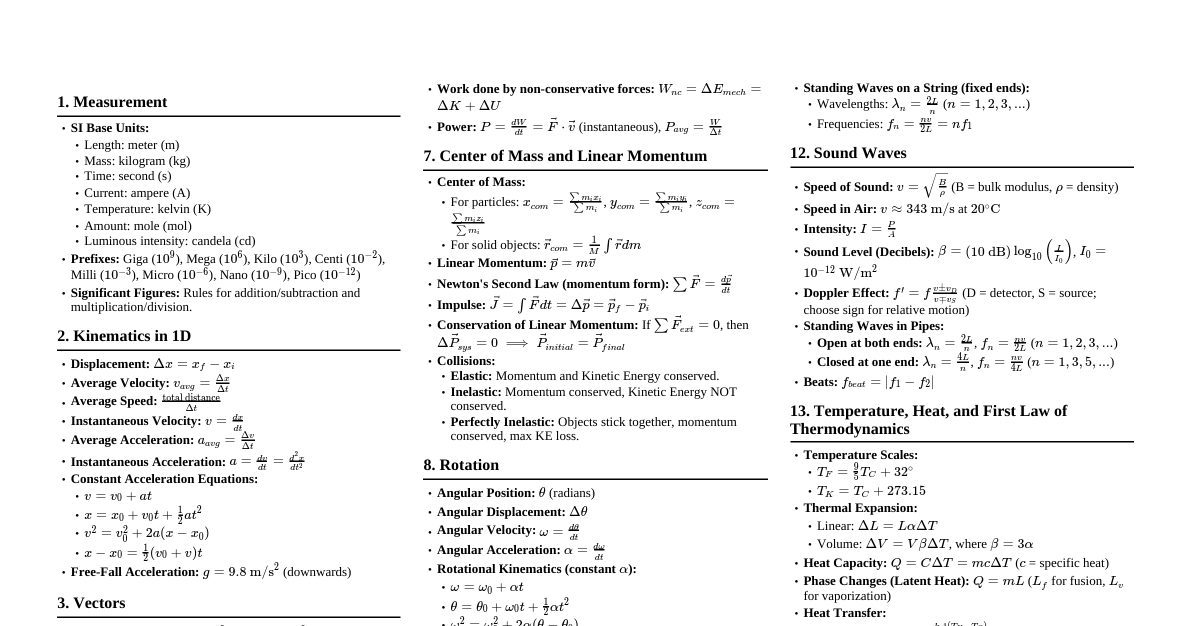
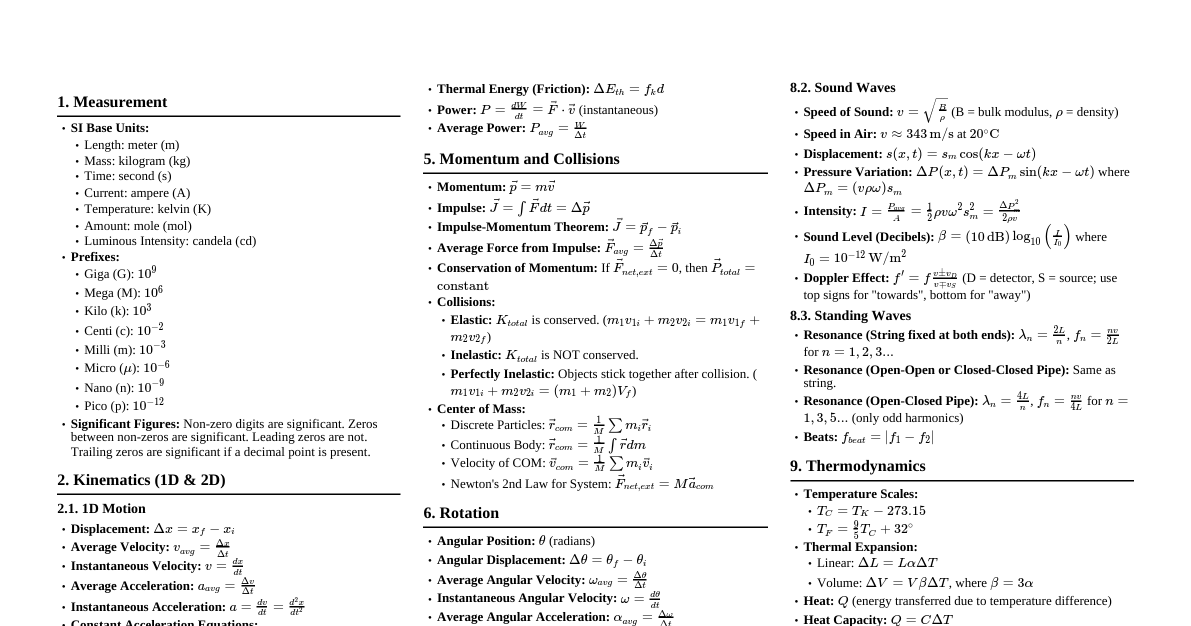
### SI Base Units The International System of Units (SI) defines seven base units: - **Length:** Meter (m) - **Mass:** Kilogram (kg) - **Time:** Second (s) - **Electric Current:** Ampere (A) - **Thermodynamic Temperature:** Kelvin (K) - **Amount of Substance:** Mole (mol) - **Luminous Intensity:** Candela (cd) ### SI Derived Units Units derived from the base units. - **Area:** square meter ($m^2$) - **Volume:** cubic meter ($m^3$) - **Velocity:** meter per second ($m/s$) - **Acceleration:** meter per second squared ($m/s^2$) - **Force:** Newton (N) = $kg \cdot m/s^2$ - **Pressure:** Pascal (Pa) = $N/m^2$ - **Energy/Work:** Joule (J) = $N \cdot m$ - **Power:** Watt (W) = $J/s$ - **Frequency:** Hertz (Hz) = $s^{-1}$ - **Electric Charge:** Coulomb (C) = $A \cdot s$ - **Electric Potential:** Volt (V) = $J/C$ ### SI Prefixes Prefixes used to denote multiples or submultiples of units. | Prefix | Symbol | Factor | |--------|--------|--------------| | Tera | T | $10^{12}$ | | Giga | G | $10^9$ | | Mega | M | $10^6$ | | Kilo | k | $10^3$ | | Hecto | h | $10^2$ | | Deca | da | $10^1$ | | Deci | d | $10^{-1}$ | | Centi | c | $10^{-2}$ | | Milli | m | $10^{-3}$ | | Micro | $\mu$ | $10^{-6}$ | | Nano | n | $10^{-9}$ | | Pico | p | $10^{-12}$ | ### Unit Conversion To convert units, multiply by a conversion factor (a ratio equal to 1). **Example 1:** Convert 5 km to meters. $$5 \text{ km} \times \frac{1000 \text{ m}}{1 \text{ km}} = 5000 \text{ m}$$ **Example 2:** Convert 72 km/h to m/s. $$72 \frac{\text{km}}{\text{h}} \times \frac{1000 \text{ m}}{1 \text{ km}} \times \frac{1 \text{ h}}{3600 \text{ s}} = 20 \text{ m/s}$$ ### Significant Figures Rules for determining the precision of a measurement. - **Non-zero digits:** Always significant (e.g., 23.45 has 4 sig figs). - **Zeros between non-zero digits:** Always significant (e.g., 20.005 has 5 sig figs). - **Leading zeros:** Never significant (e.g., 0.0023 has 2 sig figs). - **Trailing zeros (with decimal point):** Always significant (e.g., 2.000 has 4 sig figs, 20. has 2 sig figs). - **Trailing zeros (without decimal point):** Ambiguous, often non-significant (e.g., 200 could have 1, 2, or 3 sig figs). Use scientific notation to clarify ($2.00 \times 10^2$ for 3 sig figs). #### Operations with Significant Figures - **Multiplication/Division:** Result has same number of sig figs as the measurement with the fewest sig figs. - Example: $2.3 \times 4.56 = 10.488 \rightarrow 10.$ (2 sig figs) - **Addition/Subtraction:** Result has the same number of decimal places as the measurement with the fewest decimal places. - Example: $12.34 + 5.6 = 17.94 \rightarrow 17.9$ (1 decimal place) ### Dimensional Analysis A method to check the consistency of equations using dimensions. - Every physical quantity has a dimension (e.g., [L] for length, [M] for mass, [T] for time). - Both sides of an equation must have the same dimensions. - Dimensions multiply and divide like algebraic quantities. **Example:** Check the equation for distance $d = v_0 t + \frac{1}{2}at^2$. - Dimension of $d$: [L] - Dimension of $v_0 t$: $[L/T] \cdot [T] = [L]$ - Dimension of $\frac{1}{2}at^2$: constant has no dimension, $[L/T^2] \cdot [T^2] = [L]$ - Since $[L] = [L] + [L]$, the equation is dimensionally consistent.