History Cheatsheet
Cheatsheet Content
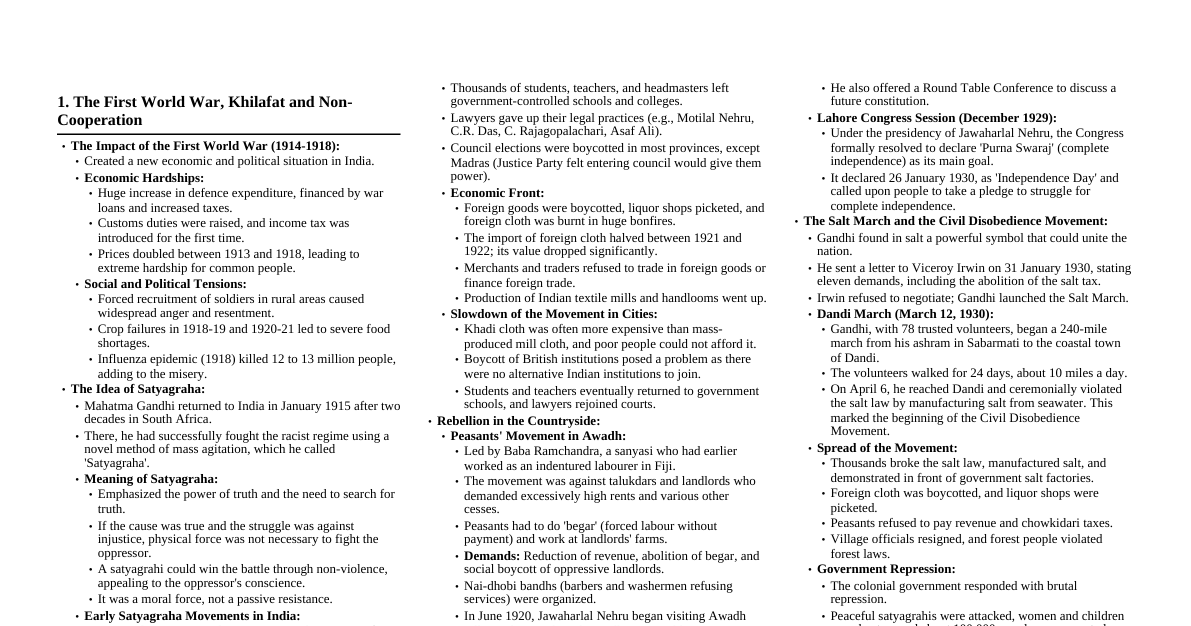
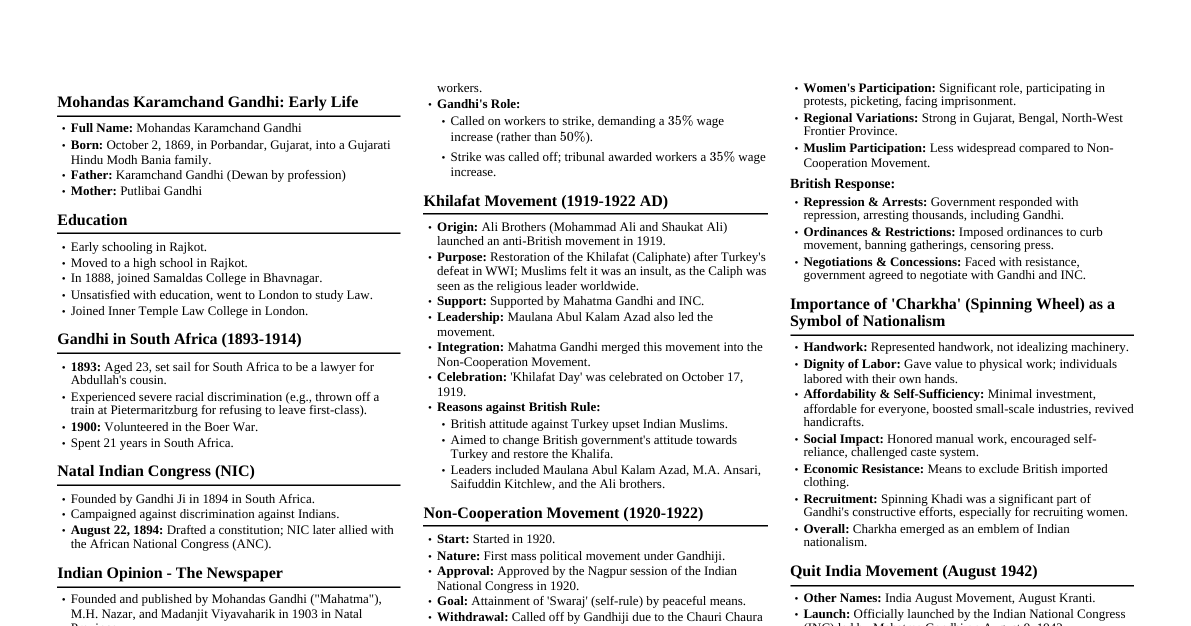
Nationalism in India 6A. The Idea of Satyagraha Introduced by Mahatma Gandhi. Emphasizes the power of truth and the need to search for truth. If the cause is true, and the struggle is against injustice, physical force is not necessary. A satyagrahi can win the battle through non-violence, appealing to the oppressor's conscience. This philosophy united people against British rule. Key Satyagraha Movements: Champaran (1917): Supported peasants against oppressive indigo plantation system. Kheda (1918): Campaign for revenue reduction for peasants affected by crop failure and plague. Ahmedabad (1918): Supported cotton mill workers' demand for better wages. 6B. Salt as a Tool of Resistance (Civil Disobedience Movement) Salt was consumed by all, rich and poor, making it a powerful symbol. Gandhi's letter to Viceroy Irwin demanded the abolition of the salt tax and other concessions. Irwin's refusal led to the historic Salt March (Dandi March) in 1930. Gandhi and 78 followers marched over 240 miles from Sabarmati Ashram to Dandi. Upon reaching Dandi, Gandhi ceremonially broke the salt law by making salt from seawater. This act sparked widespread civil disobedience: People began manufacturing salt and demonstrating in front of government salt factories. Boycott of foreign cloth and liquor shops. Peasants refused to pay revenue and chaukidari taxes. Village officials resigned their posts. Forest people violated forest laws by going into Reserved Forests to collect wood and graze cattle. The movement led to mass arrests, including Gandhi and other leaders. 6C. Non-Cooperation Movement (1920-1922) Launched by Gandhi in response to the Rowlatt Act and Jallianwala Bagh Massacre. Proposed in stages: Surrender of titles and honorary posts. Boycott of civil services, army, police, courts, legislative councils, schools, and foreign goods. Participation: Towns: Middle-class participation, students left schools, teachers resigned, lawyers gave up practice. Foreign goods boycotted, liquor shops picketed. Countryside (Awadh): Peasants led by Baba Ramchandra against landlords for high rents and begar. Demanded reduction of revenue, abolition of begar, social boycott of oppressive landlords. Gudem Hills (Andhra Pradesh): Tribal peasants led by Alluri Sitaram Raju against colonial forest laws. Advocated for non-cooperation but used guerilla warfare. Plantations (Assam): Workers demanded right to move freely in and out of tea gardens, believing Gandhi Raj was coming. Withdrawal: Called off by Gandhi in 1922 after the Chauri Chaura incident (violent clash). 5. Re-interpretation of Indian History & Culture During the colonial period, the British often portrayed Indians as backward and primitive, incapable of self-governance. In response, Indian nationalists sought to rediscover a glorious past. They highlighted India's ancient achievements in: Art and Architecture: Magnificent temples, sculptures, and historical monuments. Science and Mathematics: Innovations like the decimal system, zero, Ayurveda. Religion and Philosophy: Rich spiritual traditions, diverse philosophical schools. Law and Governance: Sophisticated legal codes and administrative systems. This re-interpretation instilled a sense of pride and self-confidence among Indians. It challenged the colonial narrative and provided a strong foundation for nationalist aspirations, demonstrating India's capacity for progress and self-rule. Figures like Bankim Chandra Chattopadhyay (with 'Vande Mataram') and Rabindranath Tagore (with 'Bharat Mata' imagery) contributed significantly to this cultural revival. The Making of Britain & Europe 7A. Formation of the British Nation-State (The "United Kingdom") Unlike other nations, Britain's formation was not the result of a sudden revolution but a long and gradual process. The primary identities of the people inhabiting the British Isles were ethnic: English, Welsh, Scot, and Irish. Each had its own distinct culture and political traditions. Growth of English Power: The English nation steadily grew in wealth, importance, and power, enabling it to extend its influence over the other nations of the islands. The Act of Union (1707): Between England and Scotland, resulting in the formation of the 'United Kingdom of Great Britain'. This meant that England could impose its influence on Scotland. The British Parliament was henceforth dominated by its English members. Suppression of Scotland: The distinctive culture and political institutions of Scotland were systematically suppressed. Catholic Highlanders were forbidden to speak their Gaelic language or wear their national dress (the kilt). Large numbers were forcibly driven out of their homeland. Ireland's Incorporation: Ireland suffered a similar fate. It was a country deeply divided between Catholics and Protestants. The English helped the Protestants of Ireland to establish their dominance over a largely Catholic country. Catholic revolts against British dominance were brutally suppressed. After a failed revolt led by Wolfe Tone and his United Irishmen (1798), Ireland was forcibly incorporated into the United Kingdom in 1801. New British Identity: A new 'British nation' was forged through the propagation of a dominant English culture. Symbols of the New Britain: The British flag (Union Jack). The national anthem ('God Save Our Noble King'). The English language. The older nations survived only as subordinate partners in this Union. 7B. The Congress of Vienna (1815) Host: Austrian Chancellor Duke Metternich. Participants: Representatives of European powers like Britain, Russia, Prussia, and Austria. Main Objectives: To undo most of the changes that had come about in Europe during the Napoleonic wars. To restore the monarchies that had been overthrown by Napoleon. To create a new conservative order in Europe. Key Provisions/Outcomes: The Bourbon dynasty, which had been deposed during the French Revolution, was restored to power in France. France lost the territories it had annexed under Napoleon. A series of states were set up on the boundaries of France to prevent future French expansion: The Kingdom of the Netherlands (including Belgium) was set up in the north. Genoa was added to Piedmont in the south. Prussia was given important new territories on its western frontiers. Austria was given control of northern Italy. The German confederation of 39 states, which had been set up by Napoleon, was left untouched. Russia was given part of Poland. Prussia was given a portion of Saxony. Impact: The Congress of Vienna established a conservative regime across Europe, aiming to suppress liberal and nationalist movements for decades. 7C. Unification of Germany (1866-1871) Background: Nationalist feelings were widespread among middle-class Germans. In 1848, they tried to unite the German states into a nation-state governed by an elected parliament, but this was suppressed by the monarchy and military. Role of Prussia: Prussia took on the leadership of the movement for national unification. Its Chief Minister, Otto von Bismarck, was the architect of this process, carried out with the help of the Prussian army and bureaucracy. Three Wars: Over seven years, Prussia fought three wars with Austria, Denmark, and France. These wars ended in Prussian victory. Proclamation of the German Empire: In January 1871, the Prussian King, William I, was proclaimed German Emperor at a ceremony held in the Palace of Versailles. The new German Empire prioritized modernizing the currency, banking, legal, and judicial systems. 7D. Unification of Italy (1859-1870) Fragmented State: Italy was politically fragmented into seven states, only one of which (Sardinia-Piedmont) was ruled by an Italian princely house. Giuseppe Mazzini: During the 1830s, Mazzini formed 'Young Italy' for the unification of Italy, but his revolts failed. Role of Sardinia-Piedmont: King Victor Emmanuel II of Sardinia-Piedmont took the initiative to unify the Italian states. Chief Minister Cavour led the movement, not a revolutionary but a shrewd diplomat. Cavour engineered a careful alliance with France (1859) to defeat Austrian forces, liberating northern Italy (except Venetia). Giuseppe Garibaldi: In 1860, Garibaldi and his armed volunteers (Red Shirts) marched into South Italy and the Kingdom of the Two Sicilies. They drove out the Bourbon kings and won the support of local peasants to expel the Spanish rulers. Completion of Unification: In 1861, Victor Emmanuel II was proclaimed King of United Italy. Venetia was incorporated in 1866 (after Austro-Prussian War). The Papal States (Rome) were finally joined in 1870 (after Franco-Prussian War), completing the unification. Media and Society (19th Century) 8.1 Krishnaji's Aim for Publishing Krishnaji Ranzuji, a prominent figure, aimed to use publishing as a means to disseminate crucial information. His primary goal was to inform the public about significant developments in various spheres of life. This included political events, scientific discoveries, social reforms, and cultural changes. He believed that an informed citizenry was essential for societal progress and for fostering critical thinking. By making this information accessible, he sought to raise public awareness and encourage participation in national discourse. 8.2 Role of Media as an Opposition In the 19th century, particularly under colonial rule, newspapers and journals played a vital role beyond mere information dissemination. Local newspapers, often run by Indian nationalists or social reformers, became platforms for criticizing and analyzing government policies. They meticulously scrutinized administrative decisions, highlighting injustices, economic exploitation, and shortcomings of the colonial regime. Political organizations and intellectuals used these publications to articulate their grievances and propose alternative visions for society. This critical function effectively positioned the media as a de facto opposition to the government, especially in the absence of a strong, representative elected body. Through editorials, articles, and public debates, they challenged authority and mobilized public opinion against oppressive laws and practices. 8.3 Popularity and Impact of Newspapers The burgeoning political developments and nationalist movements of the 19th century greatly engaged a large segment of society. Newspapers skillfully captured and presented these political narratives, making complex issues understandable to a wider audience. They were not just news carriers but also educators, informing people about their rights, the nature of colonial exploitation, and the ideals of self-rule. Beyond politics, newspapers served as crucial sources for advancements in social, cultural, and scientific spheres. They published: Discussions on social reforms (e.g., women's rights, caste system). Literary works, poems, and cultural commentaries. Reports on scientific discoveries and technological innovations. This comprehensive coverage made newspapers indispensable, fostering a sense of shared identity and collective consciousness among diverse populations. Their accessibility and reach contributed significantly to the spread of nationalist ideas and the awakening of a political consciousness among the masses. The Rise of Nationalism in Europe 9A. French Revolution (1789) and the Idea of the Nation Marked the first clear expression of nationalism. Transferred sovereignty from the monarchy to the body of French citizens. Measures taken by revolutionaries: Ideas of la patrie (the fatherland) and le citoyen (the citizen) emphasized a united community with equal rights. A new French flag (tricolour) replaced the royal standard. The Estates General was elected by active citizens and renamed the National Assembly. New hymns, oaths, and martyrs commemorated in the name of the nation. A centralized administrative system with uniform laws for all citizens. Internal customs duties and dues abolished, and a uniform system of weights and measures adopted. French became the common language of the nation, overriding regional dialects. Impact: French armies carried the idea of nationalism abroad, promising to liberate people from despotism. 9B. The Napoleonic Code (1804) Also known as the Civil Code. Did away with all privileges based on birth. Established equality before the law. Secured the right to property. Simplified administrative divisions. Abolished the feudal system and freed peasants from serfdom and manorial dues. In towns, guild restrictions were removed. Transport and communication systems were improved. Initially, people welcomed French armies as harbingers of liberty, but this soon turned to hostility due to increased taxation, censorship, and forced conscription. 9C. The Aristocracy and the New Middle Class Aristocracy: Dominant social and political class in Europe. Owned vast estates, spoke French for diplomacy. Families often connected by marriage. A numerically small group. Peasantry: Majority of the population. Mostly tenants and small landowners. New Middle Class: Emergence due to industrialization in Western and Central Europe. Composed of industrialists, businessmen, professionals. Educated, liberal-minded, and advocated for national unity and abolition of aristocratic privileges. Their ideas of national unity gained popularity after the abolition of aristocratic privileges. 9D. Liberal Nationalism Political Aspects: Government by consent. End of autocracy and clerical privileges. A constitution and representative government through parliament. Inviolability of private property. Equality before the law (though initially this often meant only property-owning men had suffrage). Economic Aspects: Freedom of markets. Abolition of state-imposed restrictions on the movement of goods and capital. Creation of a unified economic territory. Zollverein (1834): A customs union initiated by Prussia, joined by most German states. Abolished tariff barriers. Reduced the number of currencies from over thirty to two. Facilitated economic nationalism and the unification process. Nationalism in Europe: Visualizing the Nation 10A. Allegories and Personifications In the 18th and 19th centuries, artists personified nations as female figures. This was an abstract idea made concrete, giving the abstract concept of the nation a visual form. France: Marianne Characteristics: Red Cap, Tricolour, Cockade (symbols of Liberty and the Republic). Statues erected in public places to remind the public of the national symbol of unity. Germany: Germania Characteristics: Crown of oak leaves (heroism), breastplate with eagle (strength), sword (readiness to fight), olive branch around sword (willingness to make peace), black, red, and gold tricolour (flag of liberal nationalists), rays of the rising sun (beginning of a new era). Often depicted holding a banner or flag. These allegories helped to foster a sense of collective identity and national pride. 10B. Romanticism and National Feeling Romanticism: A cultural movement that sought to develop a particular form of nationalist sentiment. Romantic artists and poets generally criticized the glorification of reason and science. Instead, they focused on emotions, intuition, and mystical feelings. Their effort was to create a sense of a shared collective heritage, a common cultural past, as the basis of a nation. Johann Gottfried Herder (German Romantic Philosopher): Claimed that true German culture was to be discovered among the common people ( das Volk ). Through folk songs, folk poetry, and folk dances, the true spirit of the nation ( Volksgeist ) was popularized. Language as a unifying force: The emphasis on vernacular languages and the collection of local folklore was not just about recovering an ancient national spirit but also about carrying the modern nationalist message to large audiences who were mostly illiterate. Example: In Poland, despite Russian occupation, the Polish language was used for church gatherings and religious instruction, becoming a symbol of resistance. 10C. Hunger, Hardship, and Popular Revolt (1830s-1848) The 1830s: Years of great economic hardship in Europe. Rapid population growth across Europe. More job seekers than employment. Rural populations migrated to cities, leading to overcrowded slums. Small producers in towns faced stiff competition from cheap machine-made goods from England. Feudal dues and obligations in parts of Europe. Bad harvests and rising food prices led to widespread pauperism in town and country. 1848: The Year of Revolutions Food shortages and widespread unemployment led to popular revolts. France: Parisian workers revolted, forcing Louis Philippe to flee. A National Assembly proclaimed a Republic, granted suffrage to all adult males over 21, and guaranteed the right to work. National workshops were set up to provide employment. Silesia (1845): Weavers revolted against contractors who drastically reduced payments for finished textiles.