Nationalism in India (Class 10)
Cheatsheet Content
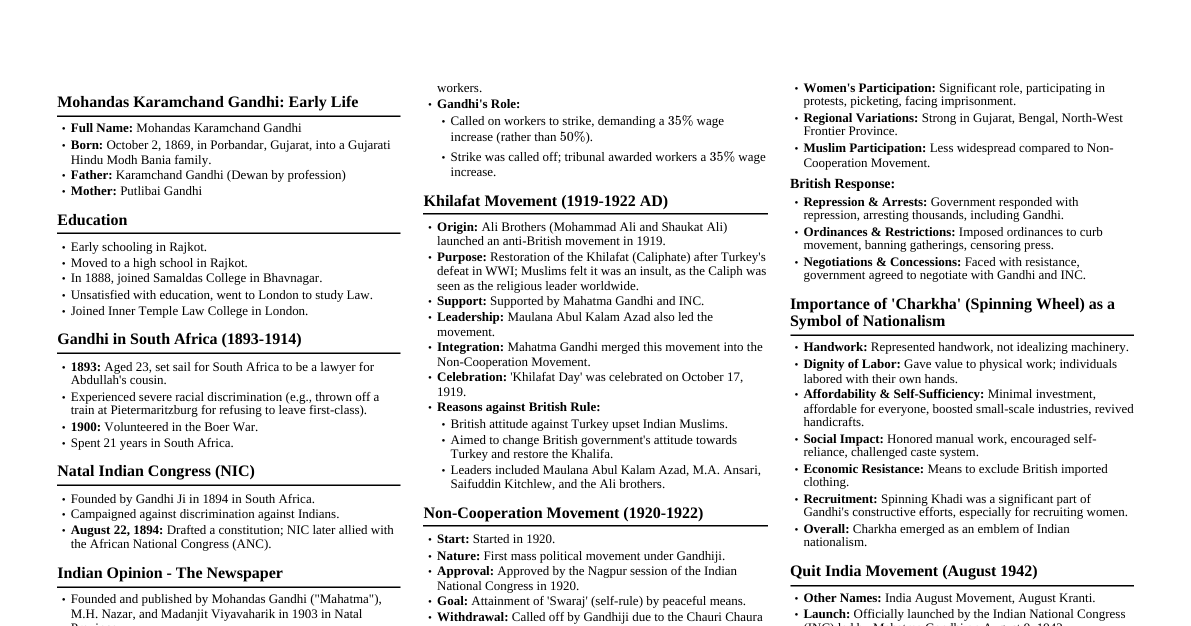
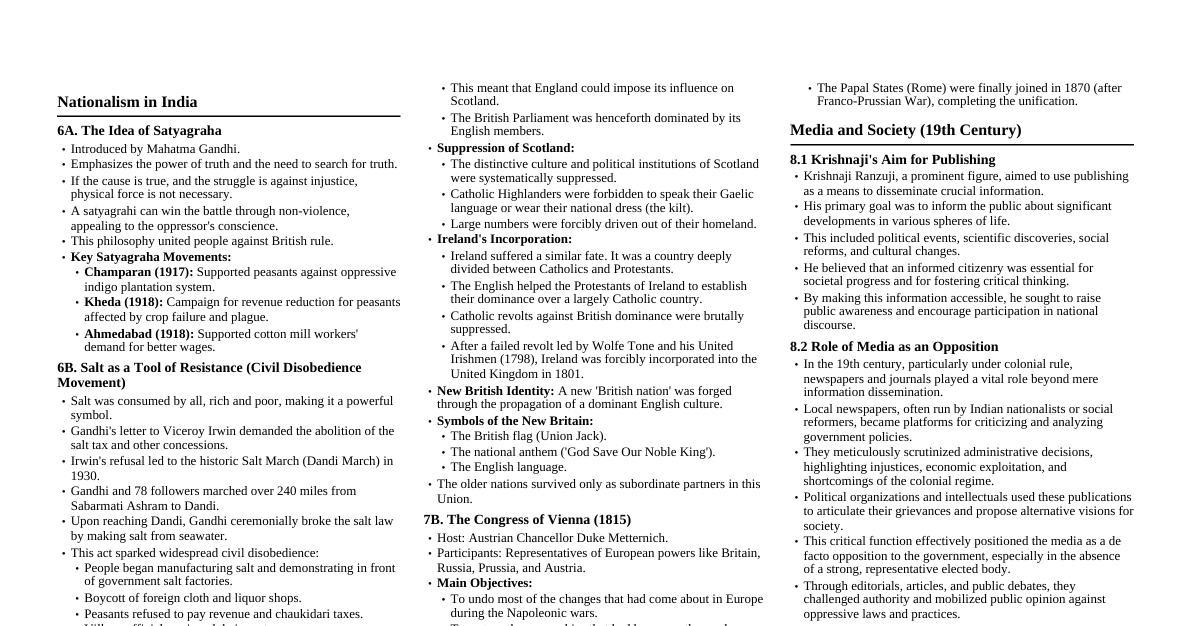
1. The First World War, Khilafat and Non-Cooperation The Impact of the First World War (1914-1918): Created a new economic and political situation in India. Economic Hardships: Huge increase in defence expenditure, financed by war loans and increased taxes. Customs duties were raised, and income tax was introduced for the first time. Prices doubled between 1913 and 1918, leading to extreme hardship for common people. Social and Political Tensions: Forced recruitment of soldiers in rural areas caused widespread anger and resentment. Crop failures in 1918-19 and 1920-21 led to severe food shortages. Influenza epidemic (1918) killed 12 to 13 million people, adding to the misery. The Idea of Satyagraha: Mahatma Gandhi returned to India in January 1915 after two decades in South Africa. There, he had successfully fought the racist regime using a novel method of mass agitation, which he called 'Satyagraha'. Meaning of Satyagraha: Emphasized the power of truth and the need to search for truth. If the cause was true and the struggle was against injustice, physical force was not necessary to fight the oppressor. A satyagrahi could win the battle through non-violence, appealing to the oppressor's conscience. It was a moral force, not a passive resistance. Early Satyagraha Movements in India: 1917: Champaran (Bihar) – Organized movement for indigo planters to struggle against the oppressive plantation system. 1917: Kheda (Gujarat) – Supported peasants who were affected by crop failure and a plague epidemic, demanding relaxation in revenue collection. 1918: Ahmedabad (Gujarat) – Organized a satyagraha movement amongst cotton mill workers for better wages and working conditions. The Rowlatt Act (1919): Passed by the Imperial Legislative Council in 1919 despite the united opposition of the Indian members. Gave the government enormous powers to repress political activities. Allowed detention of political prisoners without trial for up to two years. Gandhi called for a nationwide Satyagraha against this unjust law. Response: Rallies were organized, workers went on strike, and shops closed down. British administration responded by clamping down on nationalists, local leaders were picked up, and Gandhi was barred from entering Delhi. Jallianwala Bagh Massacre (13 April 1919): On Baisakhi day, a large crowd gathered in the enclosed ground of Jallianwala Bagh in Amritsar. Some came to protest against the government's new repressive measures, while others had come to attend the annual Baisakhi fair. General Dyer entered the area, blocked the exit points, and opened fire on the unarmed crowd, killing hundreds. Aftermath: The massacre led to widespread strikes, clashes with the police, and attacks on government buildings. The government responded with brutal repression, humiliating and terrorizing people. Gandhi called off the Rowlatt Satyagraha movement as it was turning violent. The Khilafat Movement: The defeat of Ottoman Turkey in World War I led to fears of a harsh peace treaty being imposed on the Ottoman Emperor (the spiritual head of the Islamic world, the Khalifa). To defend the Khalifa's temporal powers, a Khilafat Committee was formed in Bombay in March 1919 by Muslim leaders like Muhammad Ali and Shaukat Ali. Gandhi saw this as an opportunity to unite Hindus and Muslims under one umbrella. At the Calcutta Session of the Congress in September 1920, Gandhi convinced other leaders to launch a Non-Cooperation Movement in support of the Khilafat issue and for Swaraj. The Non-Cooperation Movement (1920-1922): Gandhi's book 'Hind Swaraj' (1909) stated that British rule in India survived only because of Indian cooperation. If Indians refused to cooperate, British rule would collapse. Proposed Phases: Surrender of government titles and honorary posts. Boycott of civil services, army, police, courts, and legislative councils. Boycott of foreign goods. If the government used repression, a full civil disobedience campaign would be launched. Launched in January 1921. 2. Differing Strands within the Movement Movement in the Towns: Middle-class participation was enthusiastic in cities. Thousands of students, teachers, and headmasters left government-controlled schools and colleges. Lawyers gave up their legal practices (e.g., Motilal Nehru, C.R. Das, C. Rajagopalachari, Asaf Ali). Council elections were boycotted in most provinces, except Madras (Justice Party felt entering council would give them power). Economic Front: Foreign goods were boycotted, liquor shops picketed, and foreign cloth was burnt in huge bonfires. The import of foreign cloth halved between 1921 and 1922; its value dropped significantly. Merchants and traders refused to trade in foreign goods or finance foreign trade. Production of Indian textile mills and handlooms went up. Slowdown of the Movement in Cities: Khadi cloth was often more expensive than mass-produced mill cloth, and poor people could not afford it. Boycott of British institutions posed a problem as there were no alternative Indian institutions to join. Students and teachers eventually returned to government schools, and lawyers rejoined courts. Rebellion in the Countryside: Peasants' Movement in Awadh: Led by Baba Ramchandra, a sanyasi who had earlier worked as an indentured labourer in Fiji. The movement was against talukdars and landlords who demanded excessively high rents and various other cesses. Peasants had to do 'begar' (forced labour without payment) and work at landlords' farms. Demands: Reduction of revenue, abolition of begar, and social boycott of oppressive landlords. Nai-dhobi bandhs (barbers and washermen refusing services) were organized. In June 1920, Jawaharlal Nehru began visiting Awadh villages; by October, the Oudh Kisan Sabha was set up. Peasant movement often turned violent, attacking markets, looting grain hoards, and taking over local officials. Tribal Peasants (Andhra Pradesh): A militant guerrilla movement spread in the Gudem Hills of Andhra Pradesh. Colonial government had closed large forest areas, preventing tribal people from grazing cattle, collecting fuelwood and fruits, which affected their livelihoods. Led by Alluri Sitaram Raju, who claimed to have special powers and was believed to be an incarnation of God. Raju was inspired by Gandhi's Non-Cooperation but believed India could be liberated only by the use of force. Gudem rebels attacked police stations, attempted to kill British officials, and carried on guerrilla warfare for Swaraj. Raju was captured and executed in 1924, becoming a folk hero. Swaraj in the Plantations: For plantation workers in Assam, freedom meant the right to move freely in and out of the confined space in which they were enclosed. Under the Inland Emigration Act of 1859, plantation workers were not permitted to leave the tea gardens without permission. When they heard of the Non-Cooperation Movement, thousands of workers defied authorities, left the plantations, and headed home. They believed that Gandhi Raj was coming and everyone would be given land in their own villages. They were caught by the police and brutally beaten. 3. Towards Civil Disobedience Withdrawal of Non-Cooperation: In February 1922, Mahatma Gandhi decided to withdraw the Non-Cooperation Movement. He felt the movement was turning violent in many places, particularly after the Chauri Chaura incident (Uttar Pradesh) where protestors clashed with police, setting a police station on fire and killing policemen. Gandhi felt the satyagrahis needed to be properly trained before mass struggles. Within the Congress: Some leaders, like C.R. Das and Motilal Nehru, felt tired of mass struggles and wanted to participate in council elections. They formed the Swaraj Party (1923) within the Congress to argue for a return to council politics and to oppose British policies from within the councils. Younger leaders like Jawaharlal Nehru and Subhas Chandra Bose pressed for more radical mass agitation and for full independence (Purna Swaraj). Factors leading to Civil Disobedience: Economic Depression: Agricultural prices began to fall from 1926 and collapsed after 1930, causing widespread distress among peasants. Simon Commission (1928): The British government set up a Statutory Commission under Sir John Simon to look into the functioning of the constitutional system in India and suggest changes. The Commission had no Indian members; all were British. It was met with the slogan "Go back Simon" and nationwide protests. Lord Irwin's Offer (1929): Viceroy Lord Irwin announced a vague offer of 'Dominion Status' for India in an unspecified future. He also offered a Round Table Conference to discuss a future constitution. Lahore Congress Session (December 1929): Under the presidency of Jawaharlal Nehru, the Congress formally resolved to declare 'Purna Swaraj' (complete independence) as its main goal. It declared 26 January 1930, as 'Independence Day' and called upon people to take a pledge to struggle for complete independence. The Salt March and the Civil Disobedience Movement: Gandhi found in salt a powerful symbol that could unite the nation. He sent a letter to Viceroy Irwin on 31 January 1930, stating eleven demands, including the abolition of the salt tax. Irwin refused to negotiate; Gandhi launched the Salt March. Dandi March (March 12, 1930): Gandhi, with 78 trusted volunteers, began a 240-mile march from his ashram in Sabarmati to the coastal town of Dandi. The volunteers walked for 24 days, about 10 miles a day. On April 6, he reached Dandi and ceremonially violated the salt law by manufacturing salt from seawater. This marked the beginning of the Civil Disobedience Movement. Spread of the Movement: Thousands broke the salt law, manufactured salt, and demonstrated in front of government salt factories. Foreign cloth was boycotted, and liquor shops were picketed. Peasants refused to pay revenue and chowkidari taxes. Village officials resigned, and forest people violated forest laws. Government Repression: The colonial government responded with brutal repression. Peaceful satyagrahis were attacked, women and children were beaten, and about 100,000 people were arrested. Leaders like Abdul Ghaffar Khan and Mahatma Gandhi were arrested. Gandhi-Irwin Pact (March 1931): Gandhi called off the movement and agreed to participate in the Second Round Table Conference in London. Lord Irwin agreed to release the political prisoners. Gandhi went to London but the negotiations broke down, and he returned disappointed. Relaunch of Civil Disobedience: On returning to India, Gandhi found the government had started a new cycle of repression. The Congress was declared an illegal organization, and many leaders were arrested. Gandhi relaunched the Civil Disobedience Movement. It lost its momentum by 1934. 4. How Participants Saw the Movement Rich Peasants (e.g., Patidars of Gujarat, Jats of Uttar Pradesh): Were active supporters of the Civil Disobedience Movement. They were hard hit by the trade depression and falling agricultural prices, and their cash income disappeared. For them, the fight for Swaraj was a struggle against high revenues. They were deeply disappointed when the movement was called off in 1931 without the revenue rates being revised. Poor Peasants: Unlike the rich peasants, their main concern was the reduction of their unpaid rent to landlords. They often joined radical movements led by Socialists and Communists, demanding 'no rent' campaigns. The Congress was often unwilling to support 'no rent' campaigns because it feared upsetting the rich peasants and landlords. Business Classes: During WWI, Indian merchants and industrialists had made huge profits. They now reacted against colonial policies that restricted their business activities. They wanted protection against imports and a rupee-sterling foreign exchange ratio that would discourage imports. They formed organizations like the Indian Industrial and Commercial Congress (1920) and the Federation of the Indian Chamber of Commerce and Industries (FICCI, 1927), led by prominent industrialists like Purshottamdas Thakurdas and G.D. Birla. They supported the Civil Disobedience Movement, giving financial assistance and refusing to buy or sell imported goods. However, after the failure of the Round Table Conference and the spread of militant activities, they became apprehensive. Industrial Working Classes: Did not participate in the Civil Disobedience Movement in large numbers, except in the Nagpur region. Some workers adopted Gandhian ideas, like the boycott of foreign goods. There were strikes by railway workers (1930) and dockworkers (1932). The Congress was reluctant to include workers' demands as part of its programme of struggle, fearing it would alienate industrialists. Women: In urban areas, women from high-caste families participated; in rural areas, women from rich peasant households joined. They participated in protest marches, manufactured salt, and picketed foreign cloth and liquor shops. Many went to jail. Gandhi was convinced that it was the duty of women to look after home and hearth, be good mothers and good wives. For a long time, the Congress was reluctant to allow women to hold any position of authority within the organization. 5. The Limits of Civil Disobedience Dalits (Depressed Classes): For a long time, the Congress had ignored the Dalits (untouchables) for fear of offending the conservative high-caste Hindus. Dalit leaders began organizing themselves, demanding reserved seats in educational institutions and separate electorates. Dr. B.R. Ambedkar organized the Dalits into the Depressed Classes Association in 1930. He clashed with Mahatma Gandhi at the Second Round Table Conference by demanding separate electorates for Dalits. Poona Pact (September 1932): Gandhi believed separate electorates would slow down the process of their integration into society. The Poona Pact was signed between Ambedkar and Gandhi. It gave the Depressed Classes reserved seats in provincial and central legislative councils, but they were to be voted in by the general electorate. Muslim Political Organisations: Some Muslim political organizations also did not respond to the call for Civil Disobedience. After the decline of the Non-Cooperation-Khilafat Movement, a large section of Muslims felt alienated from the Congress. Hindu-Muslim relations worsened, with Hindu Mahasabha becoming more active. Muhammad Ali Jinnah, a leader of the Muslim League, was willing to give up the demand for separate electorates if Muslims were assured reserved seats in the Central Assembly and representation in proportion to population in the Muslim-dominated provinces. Negotiations over the issue of representation failed, leading to a sense of alienation among many Muslims. 6. The Sense of Collective Belonging United Struggles: Nationalism spread when people began to believe that they were all part of the same nation, discovering some unity that bound them together. The experience of united struggles was crucial. Cultural Processes: A variety of cultural processes also played an important role in creating the idea of a nation. Symbol of Bharat Mata: The image of Bharat Mata was first created by Bankim Chandra Chattopadhyay in the 1870s. He wrote 'Vande Mataram' as a hymn to the motherland. Abanindranath Tagore painted his famous image of Bharat Mata in 1905, depicting her as an ascetic figure, calm, composed, divine, and spiritual. The image acquired different forms as it was circulated in popular prints, and devotion to this mother figure became a proof of one's nationalism. Folklore, Songs, and Popular Prints: Nationalists gathered folk tales, folk songs, and legends to promote a sense of national identity. Rabindranath Tagore began collecting ballads, nursery rhymes, and myths. Natesa Sastri published a massive four-volume collection of Tamil folk tales, 'The Folklore of Southern India', believing that folklore was national literature. Icons and Symbols: During the Swadeshi movement in Bengal, a tricolour flag (red, green, and yellow) was designed. It had eight lotuses representing eight provinces of British India and a crescent moon representing Hindus and Muslims. By 1921, Gandhi designed the Swaraj Flag (red, green, and white) with a spinning wheel in the centre, representing the Gandhian ideal of self-help. Reinterpretation of History: The British often portrayed Indians as backward, primitive, and incapable of governing themselves. Indian historians and nationalists wrote about the glorious past of India, highlighting its great achievements in ancient times in art, architecture, science, mathematics, religion, culture, law, philosophy, crafts, and trade. This glorious past helped instill pride in Indians and urged them to fight for their nation.