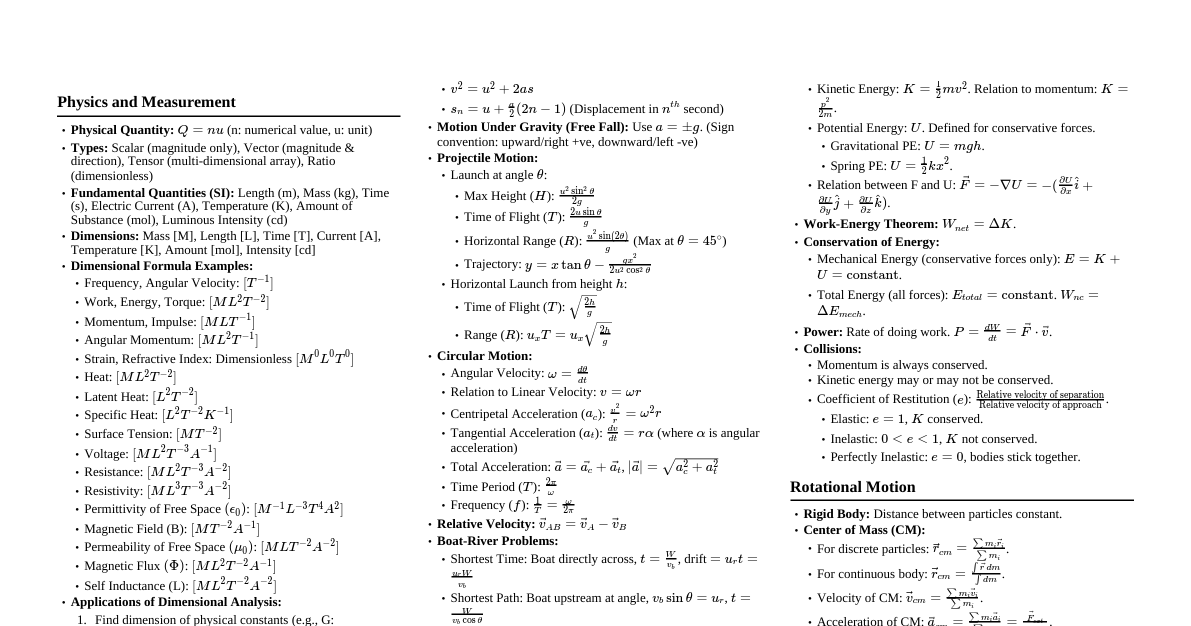
Gravitation (NEET Adv)
Cheatsheet Content
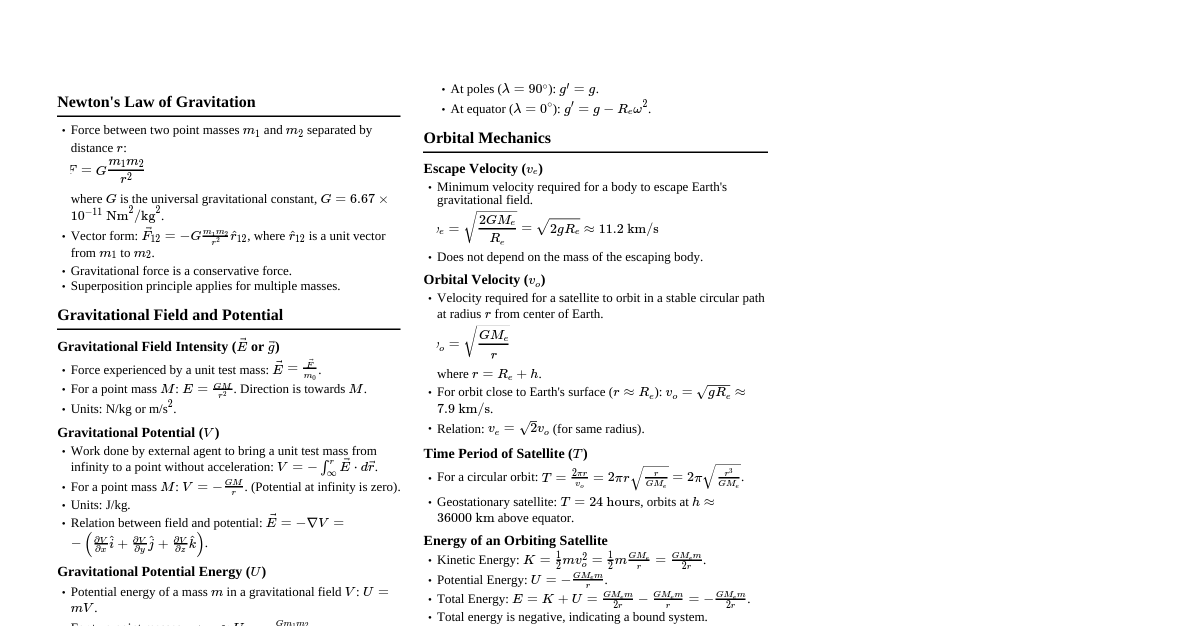
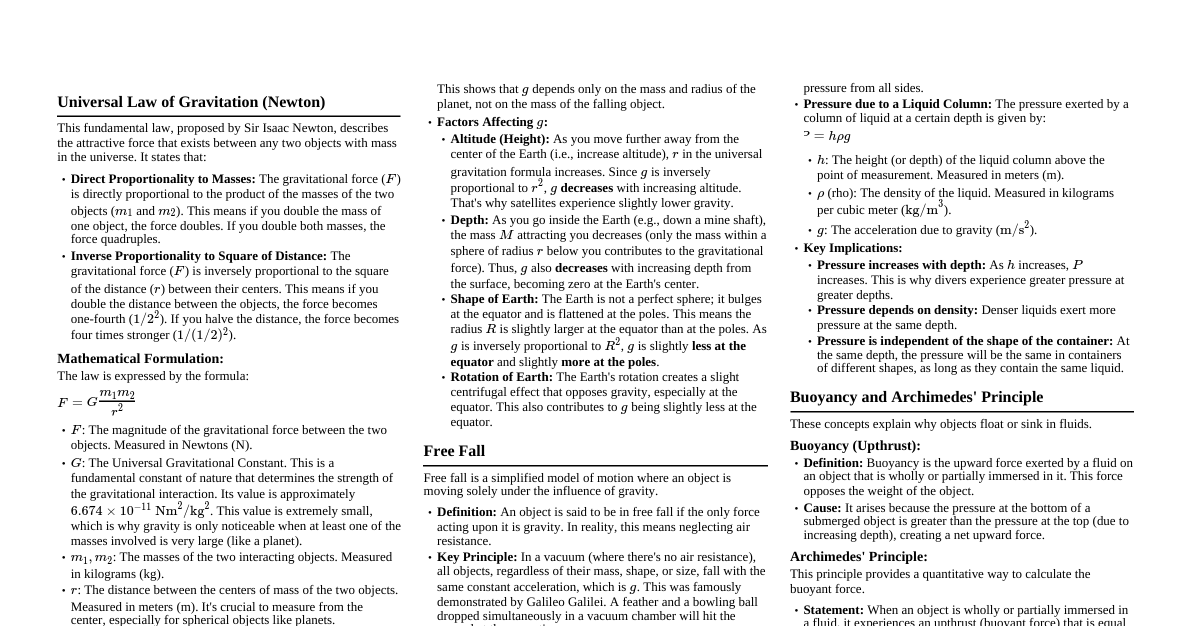
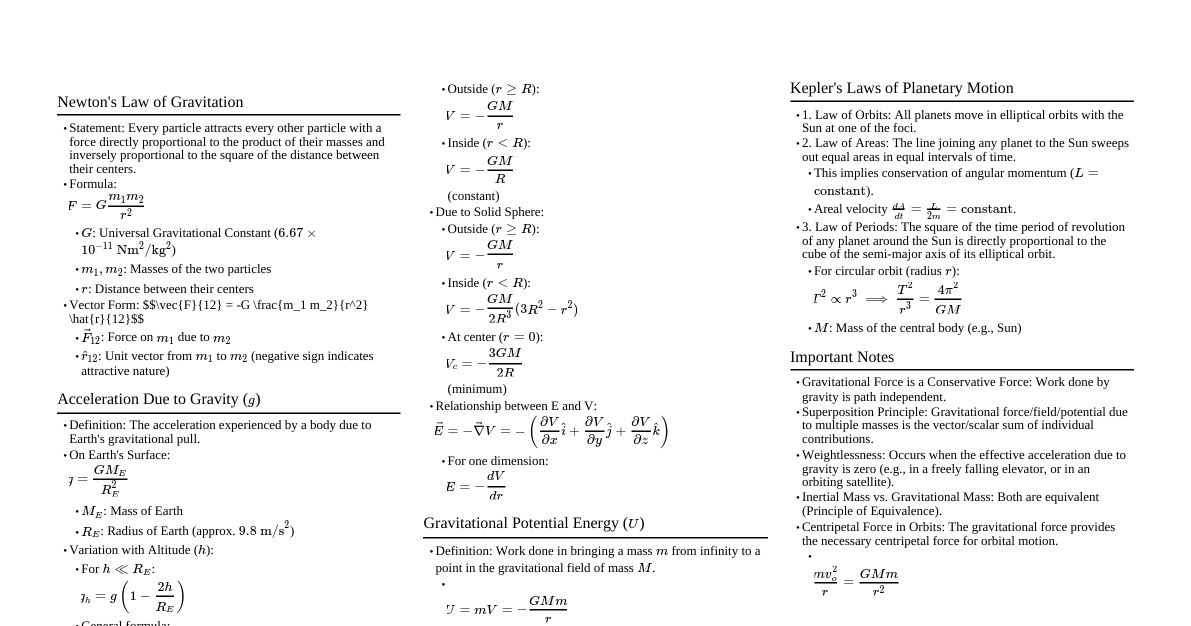
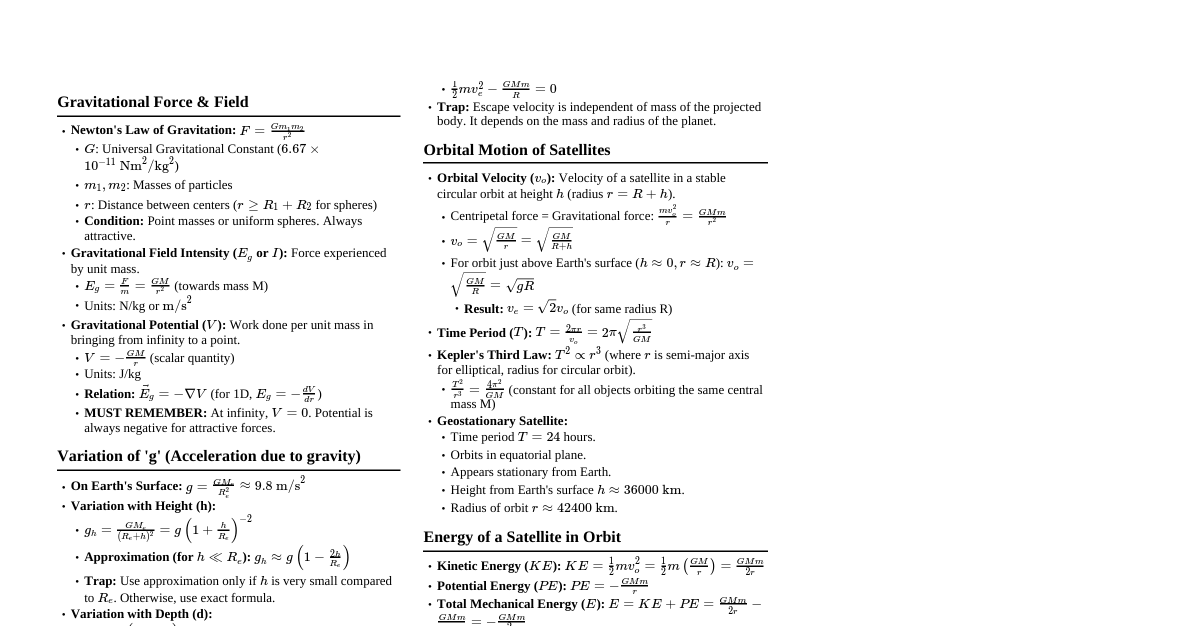
1. Newton's Law of Gravitation Definition: Every body attracts every other body with a force directly proportional to the product of their masses and inversely proportional to the square of the distance between their centers. The direction of the force is along the line joining the particles. Formula: $F = G \frac{m_1 m_2}{r^2}$ $G$: Universal Gravitational Constant ($6.67 \times 10^{-11} \text{ N m}^2 \text{ kg}^{-2}$) $F$: Gravitational force $m_1, m_2$: Masses of the two bodies $r$: Distance between their centers Vector Form: $\vec{F}_{12} = -G \frac{m_1 m_2}{r^3} \vec{r}_{21}$ (where $\vec{r}_{21}$ is the position vector from $m_2$ to $m_1$) Important Points about G: Value first determined by Cavendish using torsional balance. Dimensional formula: $[M^{-1} L^3 T^{-2}]$ Independent of nature, size of bodies, and medium between bodies. Gravitational forces are very small unless masses are huge. 2. Properties of Gravitational Force Always attractive. Independent of the medium. Central force (acts along the line joining centers). Two-body interaction (independent of other particles; superposition principle applies). Weakest force in nature ($F_{\text{nuclear}} > F_{\text{electromagnetic}} > F_{\text{gravitational}}$). Conservative force (work done is path independent, zero in closed path). Action-reaction pair (Newton's third law). 3. Acceleration Due to Gravity ($g$) Definition: Acceleration produced in a body due to Earth's gravitational pull. Formula on Earth's surface: $g = \frac{GM}{R^2}$ $M$: Mass of Earth, $R$: Radius of Earth In terms of density: $g = \frac{4}{3} \pi \rho G R$ Important Points: Independent of mass, shape, and density of the body. Vector quantity, directed towards Earth's center. Dimension: $[L T^{-2}]$ Average value: $9.8 \text{ m/s}^2$ Varies with: shape of Earth, height, depth, and axial rotation. 4. Variation in $g$ 4.1. Due to Shape of Earth Earth is elliptical (flattened at poles, bulged at equator). $R_{\text{equator}} > R_{\text{pole}}$ $g_{\text{pole}} > g_{\text{equator}}$ (Weight increases from equator to pole). 4.2. Due to Height ($h$) $g' = g \left(\frac{R}{R+h}\right)^2$ At infinite distance ($h \to \infty$), $g' = 0$. If $h \ll R$: $g' \approx g \left(1 - \frac{2h}{R}\right)$ Percentage decrease: $\frac{\Delta g}{g} \times 100\% = \frac{2h}{R} \times 100\%$ 4.3. Due to Depth ($d$) $g' = g \left(1 - \frac{d}{R}\right)$ At Earth's center ($d=R$), $g' = 0$. Rate of decrease of gravity outside Earth ($h \ll R$) is double that inside Earth. 4.4. Due to Rotation of Earth Apparent weight decreases due to centrifugal force. At latitude $\lambda$: $g' = g - \omega^2 R \cos^2 \lambda$ At poles ($\lambda = 90^\circ$), $g' = g$ (no effect of rotation). At equator ($\lambda = 0^\circ$), $g' = g - \omega^2 R$ (maximum effect). Condition for weightlessness at equator: $\omega = \sqrt{\frac{g}{R}}$ (new time period $T = 2\pi \sqrt{\frac{R}{g}} \approx 1.4 \text{ hr}$). 5. Mass and Density of Earth Mass of Earth: $M = \frac{gR^2}{G}$ (approx. $5.98 \times 10^{24} \text{ kg}$) Density of Earth: $\rho = \frac{3g}{4\pi GR}$ (approx. $5478.4 \text{ kg/m}^3$) 6. Inertial and Gravitational Masses Feature Inertial Mass ($m_i$) Gravitational Mass ($m_g$) Definition Measures inertia ($F=m_i a$) Determines gravitational pull ($F=G \frac{M m_g}{R^2}$) Effect of Gravity No effect Directly related Measurement Newton's 2nd Law (inertial balance) Newton's Law of Gravitation (spring balance) Relation Experimentally found $m_i = m_g$ 7. Gravitational Field Definition: Space around a body where its gravitational attraction can be experienced. Gravitational Field Intensity ($\vec{I}$): Force experienced by a unit test mass. $\vec{I} = \frac{\vec{F}}{m_{\text{test}}}$ For point mass $M$: $I = \frac{GM}{r^2}$ (directed towards $M$). $I = g$ (acceleration due to gravity). Unit: N/kg or m/s$^2$. Dimension: $[M^0 L T^{-2}]$. $I=0$ at $r = \infty$. Superposition principle applies: $\vec{I}_{\text{net}} = \vec{I}_1 + \vec{I}_2 + \dots$ 8. Gravitational Field Intensity for Different Bodies Body Outside ($r > R$) On Surface ($r=R$) Inside ($r Uniform Solid Sphere (Mass M, Radius R) $I = \frac{GM}{r^2}$ $I = \frac{GM}{R^2}$ $I = \frac{GMr}{R^3}$ Spherical Shell (Mass M, Radius R) $I = \frac{GM}{r^2}$ $I = \frac{GM}{R^2}$ $I = 0$ 9. Gravitational Potential ($V$) Definition: Negative of work done per unit mass in bringing a test mass from infinity to a point. Formula: $V = -\frac{GM}{r}$ (Scalar quantity) Unit: Joule/kg or m$^2$/s$^2$. Dimension: $[M^0 L^2 T^{-2}]$. $V=0$ at $r=\infty$. Potential is always negative. Relation with intensity: $I = -\frac{dV}{dr}$ (Negative gradient). Superposition principle applies: $V_{\text{net}} = V_1 + V_2 + \dots$ 10. Gravitational Potential for Different Bodies Body Outside ($r > R$) On Surface ($r=R$) Inside ($r Uniform Solid Sphere (Mass M, Radius R) $V = -\frac{GM}{r}$ $V = -\frac{GM}{R}$ $V = -\frac{GM}{2R^3}(3R^2 - r^2)$ Spherical Shell (Mass M, Radius R) $V = -\frac{GM}{r}$ $V = -\frac{GM}{R}$ $V = -\frac{GM}{R}$ (constant) 11. Gravitational Potential Energy ($U$) Definition: Amount of work done in bringing a body from infinity to a point. Formula: $U = -\frac{GMm}{r}$ (Scalar quantity) Unit: Joule. Dimension: $[M L^2 T^{-2}]$. Always negative. $U=0$ at $r=\infty$. Relation with potential: $U = mV$. Change in potential energy: $\Delta U = GMm \left(\frac{1}{r_1} - \frac{1}{r_2}\right)$ (Work done against gravity). For discrete mass distribution: $U = \sum_{i 12. Escape Velocity ($v_e$) Definition: Minimum velocity required to project a body so it escapes Earth's gravitational pull. Formula: $v_e = \sqrt{\frac{2GM}{R}} = \sqrt{2gR}$ For Earth: $v_e \approx 11.2 \text{ km/s}$. Independent of mass and direction of projection of the body. Depends on the reference body's mass and radius. Planet has atmosphere if $v_{\text{rms}} 13. Kepler's Laws of Planetary Motion 1. Law of Orbits: Planets move in elliptical orbits with the Sun at one focus. 2. Law of Areas: The line joining the Sun to a planet sweeps out equal areas in equal intervals of time (Areal velocity $\frac{dA}{dt}$ is constant). This implies angular momentum is conserved. 3. Law of Periods: The square of the orbital period ($T$) is proportional to the cube of the semi-major axis ($a$) of the orbit. $T^2 \propto a^3$. For circular orbits: $T^2 = \frac{4\pi^2}{GM} r^3$. 14. Orbital Velocity of Satellite ($v_o$) Definition: Velocity required to put a satellite into orbit. Formula: $v_o = \sqrt{\frac{GM}{r}}$ where $r$ is orbital radius. For satellite orbiting close to Earth's surface ($r \approx R$): $v_o = \sqrt{\frac{GM}{R}} = \sqrt{gR}$. For Earth (near surface): $v_o \approx 7.9 \text{ km/s} \approx 8 \text{ km/s}$. Relation with escape velocity: $v_e = \sqrt{2} v_o$. Independent of satellite's mass. 15. Time Period of Satellite ($T$) Definition: Time taken for one complete revolution. Formula: $T = \frac{2\pi r}{v_o} = 2\pi \sqrt{\frac{r^3}{GM}}$ For satellite orbiting close to Earth's surface ($r \approx R$): $T = 2\pi \sqrt{\frac{R^3}{GM}} = 2\pi \sqrt{\frac{R}{g}}$. For Earth (near surface): $T \approx 84.6 \text{ minutes} \approx 1.4 \text{ hours}$. Geostationary Satellite: Period: $T = 24 \text{ hours}$. Height from surface: $h \approx 36000 \text{ km}$. Orbital radius: $r \approx 42000 \text{ km}$. Orbital velocity: $v_o \approx 3.08 \text{ km/s}$. 16. Energy of Satellite Potential Energy: $U = -\frac{GMm}{r}$ Kinetic Energy: $K = \frac{1}{2} m v_o^2 = \frac{GMm}{2r}$ Total Mechanical Energy: $E = K + U = -\frac{GMm}{2r}$ Binding Energy: $B.E. = -E = \frac{GMm}{2r}$ (Energy required to remove satellite to infinity). For elliptical orbits, total energy $E = -\frac{GMm}{2a}$ (where $a$ is semi-major axis). 17. Weightlessness Definition: State where a body experiences zero apparent weight. Causes: Free fall (e.g., lift falling freely). Satellite in orbit (body and satellite are in constant free fall around Earth). At null points in space where gravitational forces cancel out. In a satellite, the surface exerts no normal force on the body ($R=0$), making apparent weight zero. Must-Do Questions for NEET Advanced Level Exam Concept-Based Problem 1 (Page 4): The gravitational force between two objects does not depend on... (Answer: (a) Sum of the masses) Problem 3 (Page 4): Compared to the gravitational force the earth exerts on the moon, the gravitational force the moon exerts on earth... (Answer: (a) Is the same) Problem 14 (Page 9): Force of gravity is least at... (Answer: (a) The equator) Problem 24 (Page 14): If earth stands still what will be its effect on man's weight... (Answer: (a) Increases) Problem 26 (Page 16): Gravitational mass is proportional to gravitational... (Answer: (d) All of these) Problem 27 (Page 16): The ratio of the inertial mass to gravitational mass is equal to... (Answer: (b) 1) Problem 76 (Page 45): The time period of a simple pendulum on a freely moving artificial satellite is... (Answer: (d) Infinite) Problem 77 (Page 45): The weight of an astronaut, in an artificial satellite revolving around the earth, is... (Answer: (a) Zero) Calculation-Based Problem 4 (Page 5): Three identical point masses... The net gravitational force on the mass at the origin is... (Answer: (a) $1.67 \times 10^{-9} (\hat{i} + \hat{j})\text{ N}$) Problem 5 (Page 5): Four particles of masses m, 2m, 3m and 4m are kept in sequence at the corners of a square... The magnitude of gravitational force acting on a particle of mass m placed at the centre of the square will be... (Answer: (c) $\frac{4\sqrt{2}Gm^2}{a^2}$) Problem 6 (Page 7): Acceleration due to gravity on moon is 1/6... ratio of densities... then radius of moon $R_m$ in terms of $R_e$ will be... (Answer: (b) $\frac{3}{5} R_e$) Problem 8 (Page 7): The moon's radius is 1/4 that of the earth and its mass is 1/80 times... $g$ on moon is... (Answer: (b) $\frac{5}{16} g$) Problem 9 (Page 7): If the radius of the earth were to shrink by 1%... acceleration due to gravity... (Answer: (c) Increase by 2%) Problem 15 (Page 9): The acceleration of a body... at a distance 2R from the surface... (Answer: (a) $\frac{g}{9}$) Problem 16 (Page 10): The height... at which acceleration due to gravity becomes 1% of its value... (Answer: (b) 9R) Problem 19 (Page 11): Weight of a body... decreases by 1% when raised to height h... if taken to depth h... change in its weight is... (Answer: (b) 0.5% decrease) Problem 20 (Page 12): The depth at which the effective value of acceleration due to gravity is $\frac{g}{4}$... (Answer: (b) $\frac{3R}{4}$) Problem 23 (Page 14): The angular velocity of the earth... so that acceleration due to gravity on 60° latitude becomes zero... (Answer: (a) $2.5 \times 10^{-3} \text{ rad/sec}$) Problem 28 (Page 19): Knowing that mass of Moon is $\frac{M}{81}$... find the distance... where gravitational field... cancel each other, from the Moon. (Answer: (c) 6 R) Problem 29 (Page 19): The gravitational potential in a region is given by $V = (3x + 4y + 12z)\text{ J/kg}$. The modulus of the gravitational field at $(x = 1, y = 0, z = 3)$ is... (Answer: (b) $13 \text{ N kg}^{-1}$) Problem 31 (Page 20): Infinite bodies, each of mass 3kg are situated at distances 1m, 2m, 4m, 8m... resultant intensity of gravitational field at the origin will be... (Answer: (d) 4G) Problem 41 (Page 26): Energy required to move a body of mass m from an orbit of radius 2R to 3R is... (Answer: (d) $\frac{GMm}{12R}$) Problem 43 (Page 27): A body of mass m is taken from earth surface to the height h equal to radius of earth, the increase in potential energy will be... (Answer: (b) $\frac{1}{2} mgR$) Problem 44 (Page 27): If mass of earth is M, radius is R... work done to take 1 kg mass from earth surface to infinity will be... (Answer: (b) $\frac{GM}{R}$) Problem 45 (Page 27): Three particles each of mass 100 gm... brought from a very large distance to the vertices of an equilateral triangle... work done will be... (Answer: (d) $-1.00 \times 10^{-11} \text{ Joule}$) Problem 48 (Page 30): The escape velocity from the earth is about 11 km/s. The escape velocity from a planet having twice the radius and the same mean density... (Answer: (a) 22 km/s) Problem 50 (Page 30): If the radius of earth reduces by 4% and density remains same then escape velocity will... (Answer: (c) Reduce by 4%) Problem 52 (Page 31): A body of mass m is situated at a distance 4R above the earth's surface... minimum energy be given to the body so that it may escape... (Answer: (c) $\frac{mgR_e}{5}$) Problem 53 (Page 33): The distance of a planet from the sun is 5 times the distance between the earth and the sun. The Time period of the planet is... (Answer: (a) $5^{3/2}$ years) Problem 60 (Page 35): Two satellites A and B go round a planet P in circular orbits having radii 4R and R... If the speed of the satellite A is 3V, the speed of the satellite B will be... (Answer: (b) 6 V) Problem 61 (Page 35): A satellite is moving around the earth... If the orbit radius is decreased by 1%, its speed will... (Answer: (b) Increase by 0.5%) Problem 65 (Page 38): Periodic time of a satellite revolving above Earth's surface at a height equal to R... (Answer: (b) $4\sqrt{2}\pi \sqrt{\frac{R}{g}}$) Problem 68 (Page 39): A satellite A of mass m is revolving round the earth at a height ‘r’... Another satellite B of mass 2m is revolving at a height 2r. The ratio of their time periods will be... (Answer: (d) $1:2\sqrt{2}$)