Physics Formulas Summary
Cheatsheet Content
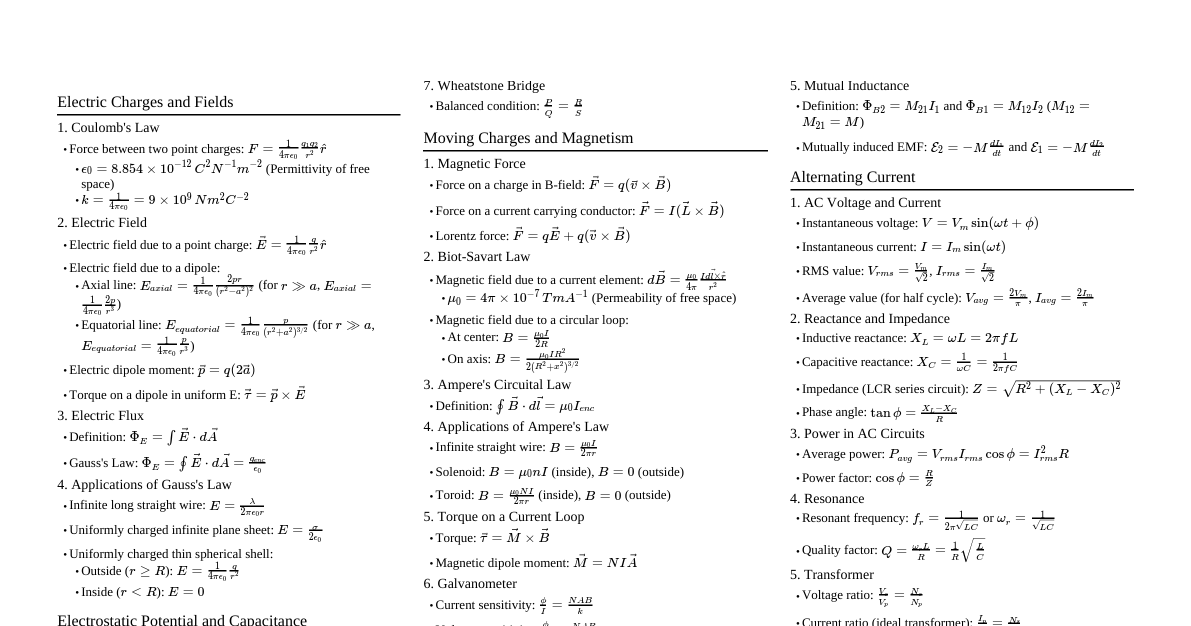
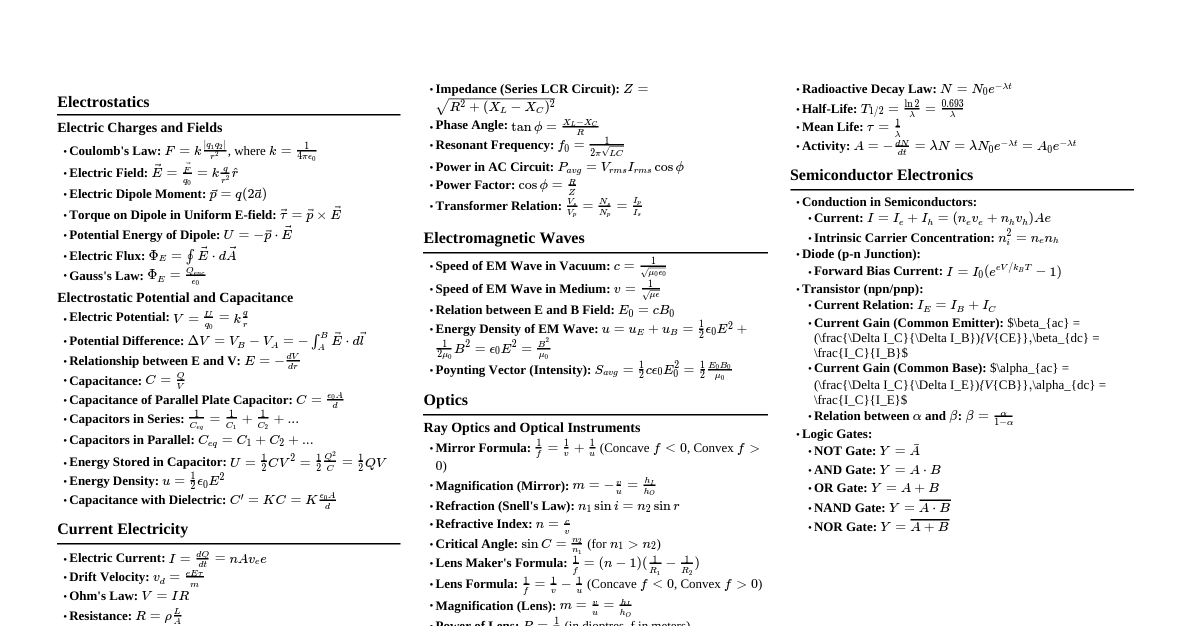
### Electromagnetic Induction Formulas #### Magnetic Flux - **Definition:** Measure of the amount of magnetic field passing through a surface. - **Formula:** $$\Phi = BA \cos \theta$$ - Where: - $\Phi$ = magnetic flux (Weber, Wb) - $B$ = magnetic field strength (Tesla, T) - $A$ = area of the surface ($m^2$) - $\theta$ = angle between magnetic field and surface normal - **Multi-Turn Coils:** $$\Phi_{total} = NBA \cos \theta$$ - Where: $N$ = number of turns in the coil #### Induced EMF (Faraday's Law) - **Definition:** Voltage produced in a conductor due to changing magnetic flux. - **Formula (Average):** $$\varepsilon = N \frac{\Delta\Phi}{\Delta t}$$ - Where: - $\varepsilon$ = induced EMF (Volt, V) - $N$ = number of turns - $\Delta\Phi$ = change in magnetic flux (Wb) - $\Delta t$ = change in time (s) - **Formula (Instantaneous):** $$\varepsilon = -N \frac{d\Phi}{dt}$$ - The negative sign indicates Lenz's Law (opposes the change in flux). #### Motional EMF - **Definition:** EMF generated when a conductor moves through a magnetic field. - **Formula:** $$\varepsilon = BLv$$ - Where: - $B$ = magnetic field strength (T) - $L$ = length of conductor (m) - $v$ = velocity of conductor (m/s) #### Electric Generators - **Definition:** Converts mechanical energy into electrical energy using electromagnetic induction. - **Generator EMF Equation:** $$\varepsilon = NAB\omega \sin(\omega t)$$ - Where: - $N$ = number of turns - $A$ = area of the coil ($m^2$) - $B$ = magnetic field strength (T) - $\omega$ = angular frequency (rad/s) - $t$ = time (s) - **Maximum EMF:** $$\varepsilon_{max} = NAB\omega$$ ### Inductance Formulas #### General Concept of Inductance - **Definition:** Property of a circuit that opposes changes in current. - **Governing Equation (Induced Voltage):** $$V = L \frac{dI}{dt}$$ - Where: - $V$ = induced voltage (Volt, V) - $L$ = inductance (Henry, H) - $\frac{dI}{dt}$ = rate of change of current (A/s) - **Energy Stored in Inductor:** $$U = \frac{1}{2}LI^2$$ - Where: - $U$ = stored energy (Joule, J) - $I$ = current (Ampere, A) #### Self Inductance - **Definition:** Induced EMF in the same coil due to its own changing current. - **Formula:** $$L = \frac{N\Phi}{I}$$ - Where: - $N$ = number of turns - $\Phi$ = magnetic flux (Wb) - $I$ = current (A) #### Series and Parallel Inductors (No Mutual Inductance) - **Series Inductors:** $$L_{eq} = L_1 + L_2 + L_3 + ...$$ - **Parallel Inductors:** $$\frac{1}{L_{eq}} = \frac{1}{L_1} + \frac{1}{L_2} + ...$$ #### Mutual Inductance - **Definition:** Ability of one coil to induce EMF in another coil due to changing current. - **Formula:** $$M = \frac{N_2\Phi_{21}}{I_1}$$ - Where: - $M$ = mutual inductance (H) - $N_2$ = number of turns in second coil - $\Phi_{21}$ = flux linking coil 2 due to coil 1 (Wb) - $I_1$ = current in coil 1 (A) - **Induced EMF due to Mutual Inductance:** $$\varepsilon = -M \frac{dI}{dt}$$ #### Series Inductors with Mutual Inductance - **Aiding Connection:** $$L_{eq} = L_1 + L_2 + 2M$$ - **Opposing Connection:** $$L_{eq} = L_1 + L_2 - 2M$$ #### Parallel Inductors with Mutual Inductance - **General Formula:** $$L_{eq} = \frac{L_1L_2 - M^2}{L_1 + L_2 \pm 2M}$$ - Use '+' for opposing magnetic fields (aiding current flow) - Use '-' for aiding magnetic fields (opposing current flow) - **Aiding Case (Magnetic fields reinforce):** $$L_{eq} = \frac{L_1L_2 - M^2}{L_1 + L_2 - 2M}$$ - **Opposing Case (Magnetic fields oppose):** $$L_{eq} = \frac{L_1L_2 - M^2}{L_1 + L_2 + 2M}$$ #### RL Circuit - **Definition:** Circuit with Resistor + Inductor. - **Equation:** $$V = IR + L \frac{dI}{dt}$$ - **Time Constant:** $$\tau = \frac{L}{R}$$ #### LC Circuit - **Definition:** Circuit with Inductor + Capacitor. - **Frequency:** $$f = \frac{1}{2\pi\sqrt{LC}}$$ ### Alternating Current Formulas #### Fundamental Concepts - **Relation between Angular Frequency and Frequency:** $$\omega = 2\pi f$$ - Where: - $\omega$ = angular frequency (rad/s) - $f$ = frequency (Hertz, Hz) - **Relation between Period and Frequency:** $$T = \frac{1}{f}$$ - Where: $T$ = period (s) #### Reactance - **Inductive Reactance (XL):** $$X_L = 2\pi f L = \omega L$$ - Where: $L$ = inductance (H) - **Capacitive Reactance (XC):** $$X_C = \frac{1}{2\pi f C} = \frac{1}{\omega C}$$ - Where: $C$ = capacitance (Farad, F) #### Impedance (Z) - **Definition:** Total opposition to AC flow, combining resistive and reactive effects. - **Complex Quantity Expression:** $$Z = R + jX$$ - Where: - $R$ = resistance (Ohm, $\Omega$) - $X$ = reactance (Ohm, $\Omega$, $X = X_L - X_C$) - $j$ = imaginary unit - **Magnitude of Impedance:** $$|Z| = \sqrt{R^2 + X^2}$$ - **Phase Angle ($\theta$):** $$\theta = \arctan\left(\frac{X}{R}\right)$$ - For RL circuit: $$\theta = \arctan\left(\frac{X_L}{R}\right)$$ - For RC circuit: $$\theta = \arctan\left(\frac{-X_C}{R}\right)$$ - For RLC circuit: $$\theta = \arctan\left(\frac{X_L - X_C}{R}\right)$$ #### Resonance - **Resonant Frequency (fr):** $$f_r = \frac{1}{2\pi\sqrt{LC}}$$ ### Wave Optics Formulas #### Interference - **Constructive Interference (Bright Fringes):** $$\Delta x = m\lambda$$ - **Destructive Interference (Dark Fringes):** $$\Delta x = (m + 1/2)\lambda$$ - Where: - $\Delta x$ = path difference - $m$ = integer (0, 1, 2, ...) - $\lambda$ = wavelength - **Fringe Spacing (Double-Slit Experiment):** $$y = \frac{\lambda L}{d}$$ - Where: - $y$ = fringe spacing (distance between bright fringes) - $L$ = distance to screen - $d$ = slit separation #### Diffraction (Single-Slit) - **Condition for Minima:** $$a \sin \theta = m\lambda$$ - Where: - $a$ = slit width - $\theta$ = angle to the minimum - $m$ = integer (1, 2, 3, ...) #### Polarization - **Malus's Law:** $$I = I_0 \cos^2 \theta$$ - Where: - $I$ = intensity of light after analyzer - $I_0$ = intensity of polarized light incident on analyzer - $\theta$ = angle between polarizer and analyzer axes #### Laser - **Relationship between Speed, Wavelength, and Frequency:** $$c = f\lambda$$ - Where: - $c$ = speed of light ($3 \times 10^8$ m/s) - $f$ = frequency (Hz) - $\lambda$ = wavelength (m) #### Refraction - **Snell's Law:** $$n_1 \sin \theta_1 = n_2 \sin \theta_2$$ - Where: - $n_1, n_2$ = refractive indices of medium 1 and 2 - $\theta_1, \theta_2$ = angles of incidence and refraction ### Atomic and Nuclear Physics Formulas #### Photoelectric Effect - **Einstein's Photoelectric Equation:** $$hf = \Phi + KE$$ - Where: - $h$ = Planck's constant ($6.626 \times 10^{-34}$ Js) - $f$ = frequency of incident light (Hz) - $\Phi$ = work function (J) - $KE$ = kinetic energy of emitted electron (J) #### Atomic Spectra - **Photon Energy (Spectral Formula):** $$E = hf = \frac{hc}{\lambda}$$ - Where: - $E$ = energy of photon (J) - $c$ = speed of light ($3 \times 10^8$ m/s) - $\lambda$ = wavelength (m) #### Radioactive Decay - **Decay Formula:** $$N = N_0 e^{-\lambda t}$$ - Where: - $N$ = remaining nuclei at time $t$ - $N_0$ = initial number of nuclei - $\lambda$ = decay constant - $t$ = time - **Half-life ($T_{1/2}$):** $$T_{1/2} = \frac{\ln(2)}{\lambda}$$ - **Remaining Atoms after n Half-lives:** $$N = \frac{N_0}{2^n}$$ - Where: $n = \frac{t}{T_{1/2}}$ #### Plasma - **Charge Density:** $$\rho = nq$$ - Where: - $\rho$ = charge density ($C/m^3$) - $n$ = number density ($m^{-3}$) - $q$ = charge of a single particle (Coulomb, C) ### Condensed Matter Physics Formulas #### Crystals - **Volume of a Unit Cell (Cubic):** $$V = a^3$$ - Where: $a$ = edge length of the unit cell #### Pure (Intrinsic) Semiconductor - **Conductivity:** $$\sigma = q(n\mu_n + p\mu_p)$$ - Where: - $\sigma$ = conductivity ($S/m$) - $q$ = charge of electron ($1.6 \times 10^{-19}$ C) - $n, p$ = electron and hole carrier concentrations ($m^{-3}$) - $\mu_n, \mu_p$ = electron and hole mobilities ($m^2/Vs$) - For intrinsic semiconductor, $n=p=n_i$ (intrinsic carrier concentration), so: $$\sigma = q n_i (\mu_n + \mu_p)$$ #### Semiconductor Diodes - **Diode Equation (Shockley Diode Equation):** $$I = I_s \left(e^{\frac{qV}{nkT}} - 1\right)$$ - Where: - $I$ = diode current (A) - $I_s$ = saturation current (A) - $q$ = electron charge ($1.6 \times 10^{-19}$ C) - $V$ = voltage across the diode (V) - $n$ = ideality factor (typically 1 to 2) - $k$ = Boltzmann constant ($1.38 \times 10^{-23}$ J/K) - $T$ = temperature (Kelvin, K) - Often simplified for forward bias at room temperature ($n \approx 1, kT/q \approx 0.026V$): $$I \approx I_s e^{\frac{V}{0.026}}$$