Synthetic Division
Cheatsheet Content
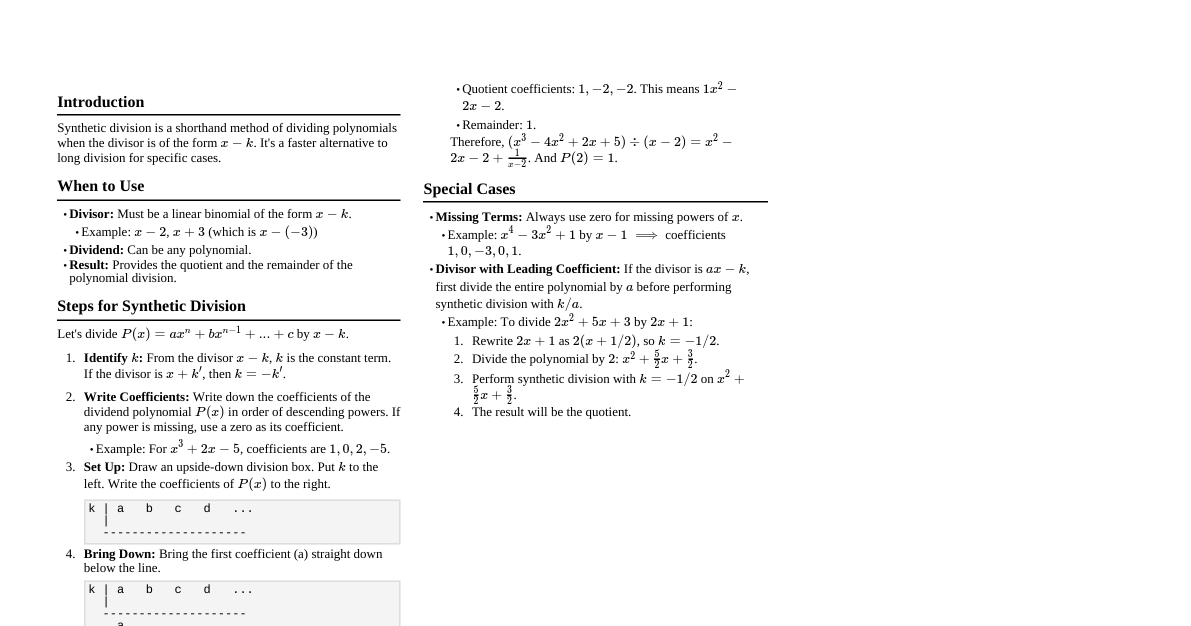
### Introduction to Synthetic Division Synthetic division is a shorthand method of dividing polynomials, specifically when the divisor is a linear factor of the form $(x - k)$. It's a much faster and more efficient way to divide polynomials than long division, especially for higher-degree polynomials. #### When to Use Synthetic Division - The divisor must be a linear binomial, i.e., of the form $(x - k)$ or $(x + k)$. - The leading coefficient of the divisor must be 1. #### Benefits - **Speed:** Significantly faster than polynomial long division. - **Simplicity:** Involves only addition and multiplication, avoiding complex algebraic manipulations. - **Remainder Theorem:** The remainder obtained from synthetic division is the value of the polynomial at $x=k$, i.e., $P(k)$. - **Factor Theorem:** If the remainder is 0, then $(x - k)$ is a factor of the polynomial $P(x)$, and $k$ is a root of the polynomial. ### Steps for Synthetic Division Procedure Let's divide a polynomial $P(x) = a_n x^n + a_{n-1} x^{n-1} + ... + a_1 x + a_0$ by a linear factor $(x - k)$. 1. **Set up the division:** * Write the constant $k$ (from $x - k$) to the left. If the divisor is $(x+k)$, then the value of $k$ to use is $-k$. * Write the coefficients of the dividend $P(x)$ to the right, ensuring all powers of $x$ are represented. If a power is missing, use a zero as its coefficient. * Draw a horizontal line below the coefficients. Example setup for $(2x^3 - 7x^2 + 5)$ divided by $(x - 3)$: $$ \begin{array}{c|cccc} 3 & 2 & -7 & 0 & 5 \\ & & & & \\ \hline & & & & \\ \end{array} $$ *Note: A $0$ is used for the missing $x$ term.* 2. **Bring down the first coefficient:** * Bring the first coefficient of the dividend straight down below the line. $$ \begin{array}{c|cccc} 3 & 2 & -7 & 0 & 5 \\ & & & & \\ \hline & 2 & & & \\ \end{array} $$ 3. **Multiply and add:** * Multiply the number just brought down by $k$ (the divisor constant). * Write the product under the next coefficient of the dividend. * Add the numbers in that column. * Write the sum below the line. $$ \begin{array}{c|cccc} 3 & 2 & -7 & 0 & 5 \\ & & 6 & & \\ \hline & 2 & -1 & & \\ \end{array} $$ 4. **Repeat the process:** * Continue multiplying the latest sum below the line by $k$ and adding it to the next coefficient, moving from left to right, until all coefficients have been processed. $$ \begin{array}{c|cccc} 3 & 2 & -7 & 0 & 5 \\ & & 6 & -3 & -9 \\ \hline & 2 & -1 & -3 & -4 \\ \end{array} $$ 5. **Interpret the results:** * The numbers below the line (except the last one) are the coefficients of the quotient, starting with a degree one less than the original polynomial. * The last number below the line is the remainder. From the example: * Quotient coefficients: $2, -1, -3$ * Remainder: $-4$ So, $2x^3 - 7x^2 + 5$ divided by $x - 3$ is $2x^2 - x - 3$ with a remainder of $-4$. This can be written as: $$ \frac{2x^3 - 7x^2 + 5}{x - 3} = 2x^2 - x - 3 - \frac{4}{x - 3} $$ ### Synthetic Division with Remainder Zero When the remainder of a synthetic division is zero, it means that the divisor $(x - k)$ is a factor of the polynomial $P(x)$, and $k$ is a root (or zero) of the polynomial. This is a powerful tool for factoring polynomials and finding their roots. #### Example 1: Divide $P(x) = x^3 - 6x^2 + 11x - 6$ by $(x - 1)$. $$ \begin{array}{c|cccc} 1 & 1 & -6 & 11 & -6 \\ & & 1 & -5 & 6 \\ \hline & 1 & -5 & 6 & 0 \\ \end{array} $$ * **Quotient:** $x^2 - 5x + 6$ * **Remainder:** $0$ This means $(x - 1)$ is a factor of $x^3 - 6x^2 + 11x - 6$, and $x=1$ is a root. We can write: $x^3 - 6x^2 + 11x - 6 = (x - 1)(x^2 - 5x + 6)$ #### Example 2: Divide $P(x) = x^4 - 16$ by $(x - 2)$. $$ \begin{array}{c|ccccc} 2 & 1 & 0 & 0 & 0 & -16 \\ & & 2 & 4 & 8 & 16 \\ \hline & 1 & 2 & 4 & 8 & 0 \\ \end{array} $$ * **Quotient:** $x^3 + 2x^2 + 4x + 8$ * **Remainder:** $0$ So, $(x - 2)$ is a factor of $x^4 - 16$. We can write: $x^4 - 16 = (x - 2)(x^3 + 2x^2 + 4x + 8)$ #### Practice Questions (Remainder Zero) Perform synthetic division for the following, where the remainder should be 0: 1. $(x^3 - 7x^2 + 14x - 8) \div (x - 1)$ 2. $(x^3 + 2x^2 - 5x - 6) \div (x + 1)$ 3. $(2x^3 + 7x^2 + 2x - 3) \div (x + 3)$ 4. $(x^4 - x^3 - 7x^2 + x + 6) \div (x - 3)$ 5. $(x^4 + 3x^3 - 16x^2 - 27x + 63) \div (x - 3)$ ### Synthetic Division with Non-Zero Remainder In most cases, when you divide a polynomial by a linear factor, you will be left with a non-zero remainder. This simply means that the divisor is not a factor of the polynomial, and the value $k$ is not a root of the polynomial. The remainder represents the value of the polynomial at $x=k$. #### Example 1: Divide $P(x) = 3x^3 - 2x^2 + 5x - 4$ by $(x - 2)$. $$ \begin{array}{c|cccc} 2 & 3 & -2 & 5 & -4 \\ & & 6 & 8 & 26 \\ \hline & 3 & 4 & 13 & 22 \\ \end{array} $$ * **Quotient:** $3x^2 + 4x + 13$ * **Remainder:** $22$ This means $P(2) = 22$. We can write: $\frac{3x^3 - 2x^2 + 5x - 4}{x - 2} = 3x^2 + 4x + 13 + \frac{22}{x - 2}$ #### Example 2: Divide $P(x) = x^4 + 3x^3 - 2x + 1$ by $(x + 1)$. $$ \begin{array}{c|ccccc} -1 & 1 & 3 & 0 & -2 & 1 \\ & & -1 & -2 & 2 & 0 \\ \hline & 1 & 2 & -2 & 0 & 1 \\ \end{array} $$ * **Quotient:** $x^3 + 2x^2 - 2x$ * **Remainder:** $1$ This means $P(-1) = 1$. We can write: $\frac{x^4 + 3x^3 - 2x + 1}{x + 1} = x^3 + 2x^2 - 2x + \frac{1}{x + 1}$ #### Practice Questions (Non-Zero Remainder) Perform synthetic division for the following, where the remainder should be non-zero: 1. $(x^3 + 4x^2 - 2x + 7) \div (x - 1)$ 2. $(2x^3 - 5x^2 + x - 8) \div (x + 2)$ 3. $(x^4 - 3x^3 + x - 5) \div (x - 3)$ 4. $(3x^3 + x^2 - 4x + 1) \div (x + 1)$ 5. $(x^5 - 2x^4 + 3x^3 - x + 1) \div (x - 1)$ 6. $(x^3 - 2x^2 + 4x - 3) \div (x - 2)$ 7. $(2x^4 + 5x^3 - x^2 + 3x - 1) \div (x + 3)$ 8. $(x^3 + 8) \div (x - 1)$ 9. $(4x^2 - 7x + 10) \div (x - 2)$ 10. $(x^4 + 2x^2 + 1) \div (x + 1)$ ### Applications of Synthetic Division Synthetic division is not just a computational trick; it has several important applications in algebra and calculus. #### 1. Factoring Polynomials If synthetic division of $P(x)$ by $(x - k)$ yields a remainder of 0, then $(x - k)$ is a factor of $P(x)$. The quotient obtained is the other factor. This helps in breaking down higher-degree polynomials into simpler factors. **Example:** We found $(x^3 - 6x^2 + 11x - 6) \div (x - 1) = x^2 - 5x + 6$ with a remainder of 0. So, $x^3 - 6x^2 + 11x - 6 = (x - 1)(x^2 - 5x + 6)$. The quadratic factor can then often be factored further: $x^2 - 5x + 6 = (x - 2)(x - 3)$. Thus, $x^3 - 6x^2 + 11x - 6 = (x - 1)(x - 2)(x - 3)$. #### 2. Finding Roots of Polynomials Related to factoring, if $(x - k)$ is a factor, then $k$ is a root (or zero) of the polynomial. By systematically testing potential rational roots (using the Rational Root Theorem), synthetic division can help find all rational roots of a polynomial. **Example:** For $P(x) = x^3 - 6x^2 + 11x - 6$, we found $x=1$ is a root. The remaining polynomial is $x^2 - 5x + 6 = 0$. Factoring this gives $(x - 2)(x - 3) = 0$, so $x=2$ and $x=3$ are also roots. The roots of $P(x)$ are $1, 2, 3$. #### 3. Evaluating Polynomials (Remainder Theorem) The Remainder Theorem states that if a polynomial $P(x)$ is divided by $(x - k)$, the remainder is equal to $P(k)$. This provides a quick way to evaluate a polynomial at a specific value of $x$. **Example:** To find $P(2)$ for $P(x) = x^4 + 3x^3 - 2x + 1$: Using synthetic division by $(x - 2)$: $$ \begin{array}{c|ccccc} 2 & 1 & 3 & 0 & -2 & 1 \\ & & 2 & 10 & 20 & 36 \\ \hline & 1 & 5 & 10 & 18 & 37 \\ \end{array} $$ The remainder is $37$, so $P(2) = 37$. This is much faster than direct substitution for complex polynomials. #### 4. Solving Polynomial Equations By finding the roots, you are effectively solving the polynomial equation $P(x) = 0$. #### 5. Graphing Polynomials Knowing the roots helps in sketching the graph of a polynomial, as these are the x-intercepts. ### Rational Root Theorem The Rational Root Theorem helps us find a list of possible rational roots for a polynomial with integer coefficients. This list provides the 'k' values to test with synthetic division. For a polynomial $P(x) = a_n x^n + a_{n-1} x^{n-1} + ... + a_1 x + a_0$, where all coefficients $a_i$ are integers: Any rational root $p/q$ (where $p$ and $q$ are integers with no common factors other than 1) must satisfy: * $p$ is a factor of the constant term $a_0$. * $q$ is a factor of the leading coefficient $a_n$. #### Steps: 1. List all factors of the constant term $a_0$ (these are your possible $p$ values). 2. List all factors of the leading coefficient $a_n$ (these are your possible $q$ values). 3. Form all possible fractions $\pm p/q$. These are your possible rational roots. 4. Use synthetic division to test these possible roots. If a remainder of 0 is found, you've found a root and a factor! #### Example: Find the rational roots of $P(x) = 2x^3 + x^2 - 7x - 6$. 1. **Factors of $a_0 = -6$ (constant term):** $p = \pm1, \pm2, \pm3, \pm6$ 2. **Factors of $a_n = 2$ (leading coefficient):** $q = \pm1, \pm2$ 3. **Possible rational roots $p/q$:** * $\frac{\pm1}{1}, \frac{\pm2}{1}, \frac{\pm3}{1}, \frac{\pm6}{1} \implies \pm1, \pm2, \pm3, \pm6$ * $\frac{\pm1}{2}, \frac{\pm2}{2}, \frac{\pm3}{2}, \frac{\pm6}{2} \implies \pm\frac{1}{2}, \pm1, \pm\frac{3}{2}, \pm3$ * Combining unique values: $\pm1, \pm2, \pm3, \pm6, \pm\frac{1}{2}, \pm\frac{3}{2}$ 4. **Test with synthetic division:** Let's try $x = 2$: $$ \begin{array}{c|cccc} 2 & 2 & 1 & -7 & -6 \\ & & 4 & 10 & 6 \\ \hline & 2 & 5 & 3 & 0 \\ \end{array} $$ Since the remainder is 0, $x=2$ is a root, and $(x - 2)$ is a factor. The quotient is $2x^2 + 5x + 3$. Now we can factor the quadratic: $2x^2 + 5x + 3 = (2x + 3)(x + 1)$. So, the factors are $(x - 2)(2x + 3)(x + 1)$. The roots are $x = 2, x = -\frac{3}{2}, x = -1$.