Class 10 HBSE Physics
Cheatsheet Content
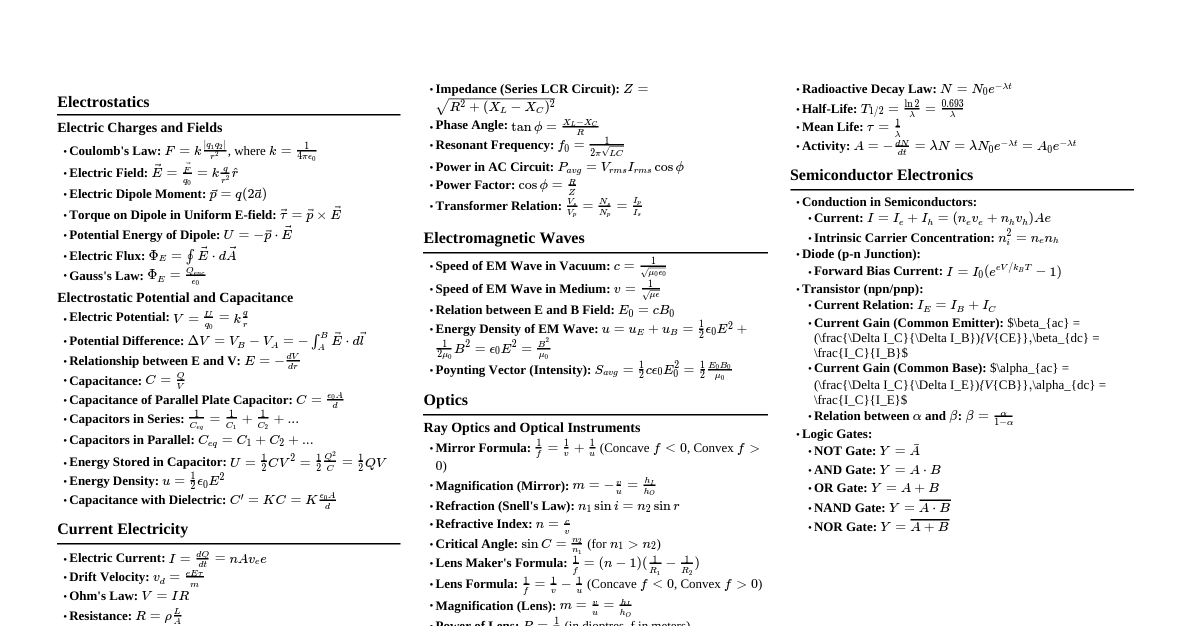
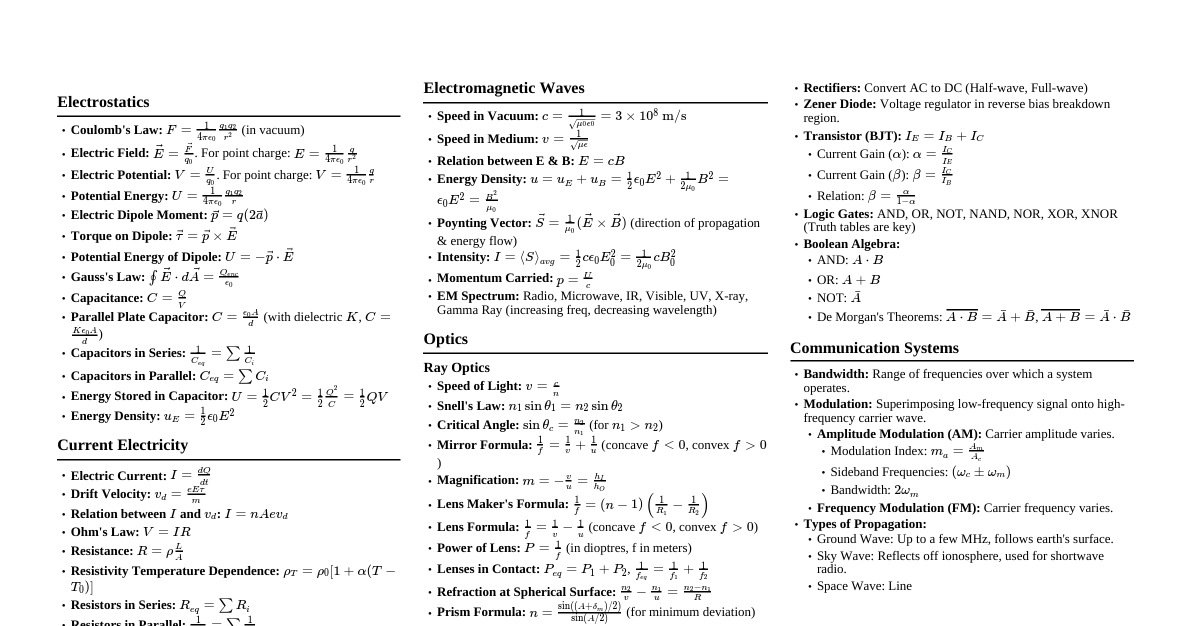
### Light: Reflection & Refraction - **Reflection of Light:** - When light bounces back after hitting a surface. - **Laws of Reflection:** 1. Angle of incidence (i) = Angle of reflection (r). 2. Incident ray, reflected ray, and normal lie in the same plane. - **Spherical Mirrors:** - **Concave Mirror:** Converging mirror. Forms real & inverted images (except when object is between P and F). - **Convex Mirror:** Diverging mirror. Always forms virtual, erect & diminished images. - **Mirror Formula:** $\frac{1}{f} = \frac{1}{v} + \frac{1}{u}$ (f = focal length, v = image distance, u = object distance) - **Magnification (m):** $m = \frac{h'}{h} = -\frac{v}{u}$ (h' = image height, h = object height) - **Refraction of Light:** - Bending of light when it passes from one medium to another. - **Laws of Refraction:** 1. Incident ray, refracted ray, and normal lie in the same plane. 2. **Snell's Law:** $\frac{\sin i}{\sin r} = \text{constant} = n$ (n = refractive index) - **Refractive Index (n):** $n = \frac{\text{speed of light in vacuum}}{\text{speed of light in medium}}$ - **Spherical Lenses:** - **Convex Lens:** Converging lens. Forms real & inverted images (except when object is between F and O). - **Concave Lens:** Diverging lens. Always forms virtual, erect & diminished images. - **Lens Formula:** $\frac{1}{f} = \frac{1}{v} - \frac{1}{u}$ - **Magnification (m):** $m = \frac{h'}{h} = \frac{v}{u}$ - **Power of Lens (P):** $P = \frac{1}{f}$ (f in meters, P in Dioptre (D)) ### Human Eye & Colourful World - **Human Eye:** - **Cornea:** Transparent front part, refracts light. - **Iris:** Controls pupil size. - **Pupil:** Regulates amount of light entering eye. - **Lens:** Focuses light on retina. - **Retina:** Light-sensitive screen. - **Optic Nerve:** Transmits signals to brain. - **Accommodation:** Eye lens's ability to adjust focal length. - **Defects of Vision:** - **Myopia (Nearsightedness):** Distant objects appear blurred. Corrected by concave lens. - **Hypermetropia (Farsightedness):** Near objects appear blurred. Corrected by convex lens. - **Presbyopia:** Age-related difficulty in seeing near objects. Corrected by bifocal lenses. - **Dispersion of Light:** Splitting of white light into its constituent colours (VIBGYOR) by a prism. - **Atmospheric Refraction:** - Twinkling of stars. - Advanced sunrise and delayed sunset. - **Scattering of Light:** - Tyndall effect (scattering by colloidal particles). - Blue colour of sky. - Reddish appearance of sun at sunrise/sunset. ### Electricity - **Electric Current (I):** Rate of flow of charge. $I = \frac{Q}{t}$ (Q = charge, t = time). Unit: Ampere (A). - **Electric Potential (V):** Work done per unit charge. $V = \frac{W}{Q}$. Unit: Volt (V). - **Potential Difference:** Difference in electric potential between two points. - **Ohm's Law:** $V = IR$ (R = Resistance). Unit: Ohm ($\Omega$). - **Resistance (R):** Opposition to current flow. - Factors affecting R: Length (L), Area of cross-section (A), Material (Resistivity, $\rho$). - $R = \rho \frac{L}{A}$. Unit of $\rho$: Ohm-meter ($\Omega \cdot m$). - **Resistors in Series:** $R_{eq} = R_1 + R_2 + R_3 + ...$ - **Resistors in Parallel:** $\frac{1}{R_{eq}} = \frac{1}{R_1} + \frac{1}{R_2} + \frac{1}{R_3} + ...$ - **Heating Effect of Electric Current (Joule's Law of Heating):** - $H = I^2Rt$ (H = heat produced). Unit: Joule (J). - **Electric Power (P):** Rate at which electrical energy is consumed. - $P = VI = I^2R = \frac{V^2}{R}$. Unit: Watt (W). - Commercial unit of energy: Kilowatt-hour (kWh). 1 kWh = $3.6 \times 10^6$ J. ### Magnetic Effects of Electric Current - **Magnetic Field:** Region around a magnet where its force can be detected. - **Magnetic Field Lines:** - Originate from North pole and end at South pole (outside magnet). - Form closed loops. - Never intersect. - Closer lines indicate stronger field. - **Right-Hand Thumb Rule:** Direction of magnetic field around a current-carrying conductor. - **Magnetic Field due to a Solenoid:** Similar to a bar magnet. - **Force on a Current-Carrying Conductor in a Magnetic Field:** - **Fleming's Left-Hand Rule:** Determines direction of force. (Thumb: Force, Forefinger: Field, Middle finger: Current). - **Electric Motor:** Converts electrical energy to mechanical energy. Based on Fleming's Left-Hand Rule. - **Electromagnetic Induction:** Production of induced current in a coil due to changing magnetic field. - **Fleming's Right-Hand Rule:** Determines direction of induced current. (Thumb: Motion, Forefinger: Field, Middle finger: Induced Current). - **Electric Generator:** Converts mechanical energy to electrical energy. Based on electromagnetic induction. - **Direct Current (DC):** Current flows in one direction only. - **Alternating Current (AC):** Current reverses direction periodically. - **Domestic Electric Circuits:** - Live wire (red), Neutral wire (black), Earth wire (green). - Series arrangement for fuses, parallel for appliances. - Overloading, short-circuiting. ### Sources of Energy - **Good Source of Energy:** - Large amount of work per unit mass/volume. - Easily accessible. - Easy to store & transport. - Economical. - Safe to handle & use. - **Conventional Sources:** - **Fossil Fuels:** Coal, petroleum, natural gas. (Non-renewable, cause pollution). - **Thermal Power Plants:** Use fossil fuels to produce electricity. - **Hydro Power Plants:** Use flowing water to generate electricity. (Renewable, but environmental issues). - **Biomass Energy:** From organic matter (wood, agricultural waste). (Renewable, but inefficient). - **Wind Energy:** From wind turbines. (Renewable, clean, but needs consistent wind). - **Non-Conventional (Renewable) Sources:** - **Solar Energy:** From sunlight. (Solar cells, solar heaters). - **Ocean Energy:** - **Tidal Energy:** From tides. - **Wave Energy:** From ocean waves. - **Ocean Thermal Energy Conversion (OTEC):** Uses temperature difference between surface & deep water. - **Geothermal Energy:** From Earth's interior heat. - **Nuclear Energy:** From nuclear fission (e.g., Uranium). (High energy release, but radioactive waste). - **Environmental Consequences:** - Burning fossil fuels causes air pollution, acid rain, greenhouse effect. - Nuclear waste disposal. - Large dams affect ecosystems. - **Sustainable Energy:** Using energy resources efficiently and promoting renewable sources.