Physics Class 11 Formulas
Shared 3/30/2026•180 views
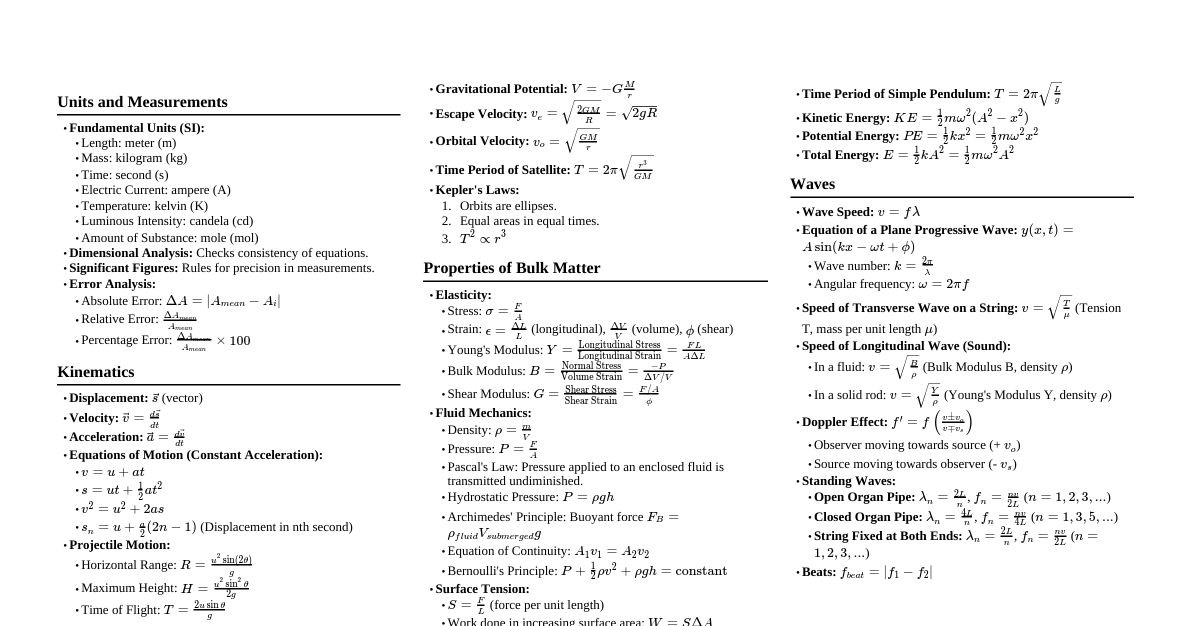
### Units and Measurements - **Significant Figures:** Rules for counting and operations. - **Dimensional Analysis:** Checking consistency of equations. - **Errors in Measurement:** - Absolute Error: $\Delta A = |A_{mean} - A_i|$ - Relative Error: $\frac{\Delta A_{mean}}{A_{mean}}$ - Percentage Error: $\frac{\Delta A_{mean}}{A_{mean}} \times 100\%$ ### Motion in a Straight Line - **Distance & Displacement:** Scalar vs. Vector. - **Speed & Velocity:** - Average Speed: $\frac{\text{Total Distance}}{\text{Total Time}}$ - Average Velocity: $\frac{\text{Total Displacement}}{\text{Total Time}}$ - Instantaneous Velocity: $v = \frac{dx}{dt}$ - **Acceleration:** $a = \frac{dv}{dt} = \frac{d^2x}{dt^2}$ - **Kinematic Equations (Constant Acceleration):** - $v = u + at$ - $s = ut + \frac{1}{2}at^2$ - $v^2 = u^2 + 2as$ - $s_n = u + \frac{a}{2}(2n-1)$ (Displacement in nth second) ### Motion in a Plane - **Vector Addition:** Triangle Law, Parallelogram Law. - **Resolution of Vectors:** $\vec{A} = A_x \hat{i} + A_y \hat{j}$ - **Projectile Motion:** - Time of Flight: $T = \frac{2u \sin\theta}{g}$ - Maximum Height: $H = \frac{u^2 \sin^2\theta}{2g}$ - Horizontal Range: $R = \frac{u^2 \sin(2\theta)}{g}$ - **Uniform Circular Motion:** - Angular Velocity: $\omega = \frac{d\theta}{dt} = \frac{2\pi}{T}$ - Linear Velocity: $v = r\omega$ - Centripetal Acceleration: $a_c = \frac{v^2}{r} = r\omega^2$ - Centripetal Force: $F_c = \frac{mv^2}{r} = mr\omega^2$ ### Laws of Motion - **Newton's First Law:** Law of Inertia. - **Newton's Second Law:** $\vec{F} = m\vec{a}$ - **Newton's Third Law:** Action-Reaction Pair. - **Impulse:** $J = \vec{F}\Delta t = \Delta \vec{p}$ - **Conservation of Momentum:** $\vec{p}_{initial} = \vec{p}_{final}$ (for isolated system) - **Friction:** - Static Friction: $f_s \le \mu_s N$ - Kinetic Friction: $f_k = \mu_k N$ ### Work, Energy and Power - **Work Done:** $W = \vec{F} \cdot \vec{d} = Fd \cos\theta$ - **Kinetic Energy:** $K = \frac{1}{2}mv^2$ - **Potential Energy:** - Gravitational: $U_g = mgh$ - Spring: $U_s = \frac{1}{2}kx^2$ - **Work-Energy Theorem:** $W_{net} = \Delta K$ - **Conservation of Mechanical Energy:** $E = K + U = \text{constant}$ (for conservative forces) - **Power:** $P = \frac{W}{t} = \vec{F} \cdot \vec{v}$ - **Collisions:** - Elastic Collision: Momentum and Kinetic Energy conserved. - Inelastic Collision: Momentum conserved, Kinetic Energy not conserved. ### System of Particles & Rotational Motion - **Center of Mass:** - For two particles: $x_{CM} = \frac{m_1x_1 + m_2x_2}{m_1+m_2}$ - For N particles: $\vec{r}_{CM} = \frac{\sum m_i \vec{r}_i}{\sum m_i}$ - **Moment of Inertia:** $I = \sum m_i r_i^2$ - **Radius of Gyration:** $k = \sqrt{\frac{I}{M}}$ - **Theorems of Moment of Inertia:** - Parallel Axis Theorem: $I = I_{CM} + Md^2$ - Perpendicular Axis Theorem: $I_z = I_x + I_y$ (for planar body) - **Torque:** $\vec{\tau} = \vec{r} \times \vec{F}$ - **Angular Momentum:** $\vec{L} = \vec{r} \times \vec{p} = I\vec{\omega}$ - **Conservation of Angular Momentum:** $\vec{L} = \text{constant}$ (for zero external torque) - **Rotational Kinematics (Constant Angular Acceleration):** - $\omega = \omega_0 + \alpha t$ - $\theta = \omega_0 t + \frac{1}{2}\alpha t^2$ - $\omega^2 = \omega_0^2 + 2\alpha\theta$ - **Rotational Kinetic Energy:** $K_{rot} = \frac{1}{2}I\omega^2$ - **Rolling Motion:** $K_{total} = K_{trans} + K_{rot} = \frac{1}{2}Mv_{CM}^2 + \frac{1}{2}I_{CM}\omega^2$ ### Gravitation - **Newton's Law of Gravitation:** $F = G \frac{m_1 m_2}{r^2}$ - **Acceleration due to Gravity (g):** - At Earth's surface: $g = \frac{GM}{R^2}$ - Variation with Altitude: $g' = g (1 - \frac{2h}{R})$ (for $h \ll R$) - Variation with Depth: $g' = g (1 - \frac{d}{R})$ - **Gravitational Potential Energy:** $U = -\frac{GMm}{r}$ - **Gravitational Potential:** $V = -\frac{GM}{r}$ - **Escape Velocity:** $v_e = \sqrt{\frac{2GM}{R}} = \sqrt{2gR}$ - **Orbital Velocity:** $v_o = \sqrt{\frac{GM}{r}}$ - **Time Period of Satellite:** $T = 2\pi \sqrt{\frac{r^3}{GM}}$ - **Kepler's Laws of Planetary Motion:** - Law of Orbits: Elliptical orbits. - Law of Areas: Equal areas in equal times. - Law of Periods: $T^2 \propto r^3$ ### Mechanical Properties of Solids - **Stress:** $\sigma = \frac{F}{A}$ - **Strain:** $\epsilon = \frac{\Delta L}{L}$ (longitudinal), $\epsilon_V = \frac{\Delta V}{V}$ (volume), $\gamma = \frac{x}{h}$ (shear) - **Hooke's Law:** Stress $\propto$ Strain - **Young's Modulus:** $Y = \frac{\text{Longitudinal Stress}}{\text{Longitudinal Strain}} = \frac{F/A}{\Delta L/L}$ - **Bulk Modulus:** $B = \frac{\text{Normal Stress}}{\text{Volume Strain}} = \frac{-P}{\Delta V/V}$ - **Shear Modulus (Modulus of Rigidity):** $G = \frac{\text{Shear Stress}}{\text{Shear Strain}} = \frac{F/A}{\gamma}$ - **Poisson's Ratio:** $\nu = \frac{\text{Lateral Strain}}{\text{Longitudinal Strain}}$ - **Elastic Potential Energy:** $U = \frac{1}{2} \text{Stress} \times \text{Strain} \times \text{Volume}$ ### Mechanical Properties of Fluids - **Pressure:** $P = \frac{F}{A}$ - **Pressure due to Fluid Column:** $P = \rho gh$ - **Pascal's Law:** Pressure applied to an enclosed fluid is transmitted undiminished. - **Archimedes' Principle:** Buoyant force $F_B = V_{displaced} \rho_{fluid} g$ - **Equation of Continuity:** $A_1v_1 = A_2v_2$ - **Bernoulli's Principle:** $P + \frac{1}{2}\rho v^2 + \rho gh = \text{constant}$ - **Viscosity:** $\vec{F} = -\eta A \frac{dv}{dz}$ (Newton's Law of Viscosity) - **Stokes' Law:** $F_v = 6\pi\eta rv$ (for spherical body) - **Terminal Velocity:** $v_t = \frac{2r^2(\rho - \sigma)g}{9\eta}$ - **Surface Tension:** $S = \frac{F}{L}$ - **Surface Energy:** $E_s = S \times \text{Area}$ - **Capillary Rise:** $h = \frac{2S \cos\theta}{\rho gr}$ - **Excess Pressure in a Liquid Drop:** $\Delta P = \frac{2S}{R}$ - **Excess Pressure in a Soap Bubble:** $\Delta P = \frac{4S}{R}$ ### Thermal Properties of Matter - **Temperature Scales:** - Celsius to Fahrenheit: $F = \frac{9}{5}C + 32$ - Celsius to Kelvin: $K = C + 273.15$ - **Thermal Expansion:** - Linear: $\Delta L = L_0 \alpha \Delta T$ - Area: $\Delta A = A_0 \beta \Delta T$ ($\beta = 2\alpha$) - Volume: $\Delta V = V_0 \gamma \Delta T$ ($\gamma = 3\alpha$) - **Heat Capacity:** $C = \frac{Q}{\Delta T}$ - **Specific Heat Capacity:** $c = \frac{Q}{m\Delta T}$ - **Latent Heat:** $Q = mL$ (Fusion or Vaporization) - **Heat Transfer:** - Conduction: $\frac{dQ}{dt} = -KA \frac{dT}{dx}$ - Convection: Depends on fluid properties. - Radiation: Stefan-Boltzmann Law: $\frac{dQ}{dt} = e\sigma A T^4$ - Wien's Displacement Law: $\lambda_m T = b$ - **Newton's Law of Cooling:** $\frac{dT}{dt} = -k(T - T_0)$ ### Thermodynamics - **First Law of Thermodynamics:** $\Delta U = Q - W$ - **Work Done:** $W = P\Delta V$ (for constant pressure) - **Specific Heat Capacities of Gases:** - $C_P - C_V = R$ (Mayer's relation) - Adiabatic Index: $\gamma = \frac{C_P}{C_V}$ - **Thermodynamic Processes:** - Isothermal: $PV = \text{constant}$, $W = nRT \ln(\frac{V_f}{V_i})$ - Adiabatic: $PV^\gamma = \text{constant}$, $T V^{\gamma-1} = \text{constant}$, $W = \frac{P_iV_i - P_fV_f}{\gamma-1}$ - Isobaric: $P = \text{constant}$, $W = P(V_f - V_i)$ - Isochoric: $V = \text{constant}$, $W = 0$ ### Kinetic Theory of Gases - **Ideal Gas Equation:** $PV = nRT = NkT$ - **Average Kinetic Energy of a Gas Molecule:** $E_{avg} = \frac{3}{2}kT$ - **Root Mean Square Speed:** $v_{rms} = \sqrt{\frac{3RT}{M_m}} = \sqrt{\frac{3kT}{m}}$ - **Degrees of Freedom (f):** - Monatomic: $f=3$ - Diatomic: $f=5$ - **Law of Equipartition of Energy:** Energy per molecule per degree of freedom is $\frac{1}{2}kT$. - **Specific Heat Capacities based on f:** - $C_V = \frac{f}{2}R$ - $C_P = (\frac{f}{2} + 1)R$ - $\gamma = 1 + \frac{2}{f}$ ### Oscillations - **Simple Harmonic Motion (SHM):** - Displacement: $x(t) = A \sin(\omega t + \phi)$ - Velocity: $v(t) = A\omega \cos(\omega t + \phi) = \omega \sqrt{A^2 - x^2}$ - Acceleration: $a(t) = -A\omega^2 \sin(\omega t + \phi) = -\omega^2 x$ - **Angular Frequency:** $\omega = 2\pi f = \frac{2\pi}{T}$ - **Time Period (T):** - Spring-Mass System: $T = 2\pi \sqrt{\frac{m}{k}}$ - Simple Pendulum: $T = 2\pi \sqrt{\frac{L}{g}}$ - **Energy in SHM:** - Kinetic Energy: $K = \frac{1}{2}mv^2 = \frac{1}{2}m\omega^2(A^2 - x^2)$ - Potential Energy: $U = \frac{1}{2}kx^2 = \frac{1}{2}m\omega^2 x^2$ - Total Energy: $E = K + U = \frac{1}{2}kA^2 = \frac{1}{2}m\omega^2 A^2$ ### Waves - **Wave Equation:** $y(x,t) = A \sin(kx - \omega t + \phi)$ - **Wave Speed:** $v = f\lambda = \frac{\omega}{k}$ - **Speed of Transverse Wave on a String:** $v = \sqrt{\frac{T}{\mu}}$ ($\mu$ = mass per unit length) - **Speed of Longitudinal Wave (Sound):** - In Fluid: $v = \sqrt{\frac{B}{\rho}}$ - In Solid: $v = \sqrt{\frac{Y}{\rho}}$ - In Air (Newton-Laplace): $v = \sqrt{\frac{\gamma P}{\rho}}$ - **Intensity of Wave:** $I = \frac{P}{A} = 2\pi^2 b^2 f^2 \rho v$ (b = amplitude) - **Principle of Superposition:** $y = y_1 + y_2$ - **Standing Waves:** - Open Organ Pipe: $f_n = \frac{nv}{2L}$, $n=1,2,3,...$ - Closed Organ Pipe: $f_n = \frac{nv}{4L}$, $n=1,3,5,...$ - String Fixed at Both Ends: $f_n = \frac{nv}{2L}$, $n=1,2,3,...$ - **Beats:** Beat Frequency $f_{beat} = |f_1 - f_2|$ - **Doppler Effect:** $f' = f \left(\frac{v \pm v_o}{v \mp v_s}\right)$ (Upper signs for approach, lower for recession)