Business vs. Project Plan for Investment
Cheatsheet Content
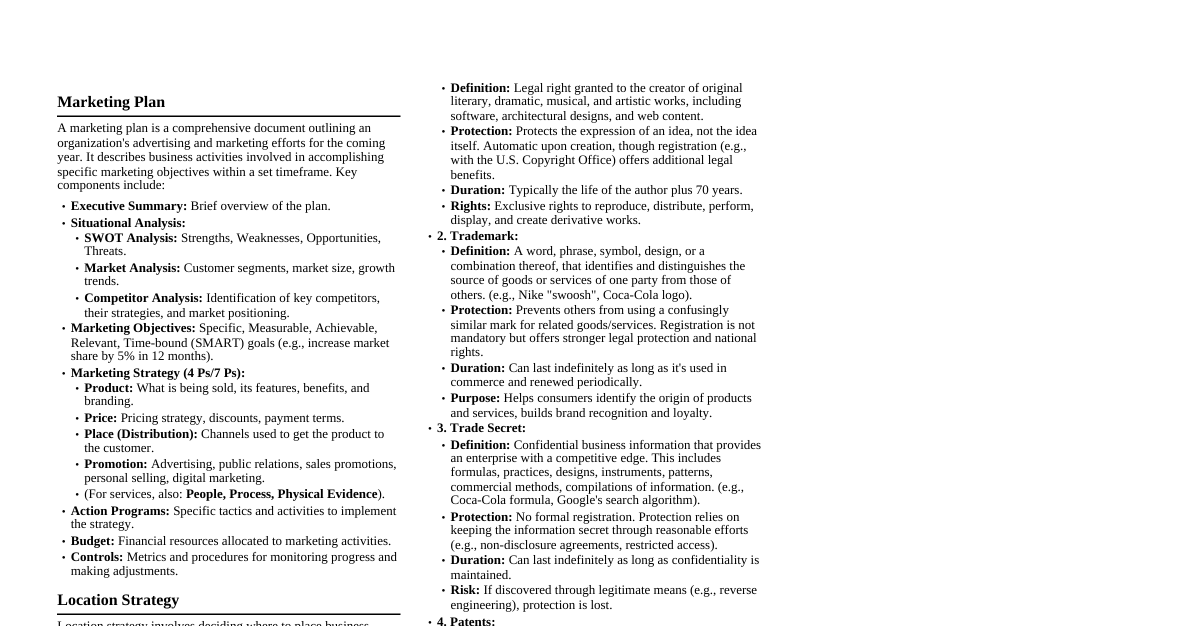
Business Plan Purpose Comprehensive document outlining a company's goals, strategies, and financial projections. Serves as a roadmap for the entire business, often for a 3-5 year horizon. Primarily used to attract investors, secure loans, or guide management. Key Components Executive Summary: Overview of the business, problem, solution, market, and financial highlights. Company Description: Mission, vision, legal structure, history, and core values. Market Analysis: Target market, market size, trends, segmentation, and competitive landscape. Organization & Management: Management team, organizational structure, and key personnel. Service or Product Line: Detailed description, intellectual property, and competitive advantages. Marketing & Sales Strategy: How to reach customers, pricing, promotion, and distribution. Funding Request: Amount needed, how funds will be used, and future financial plans. Financial Projections: Income statements, balance sheets, cash flow statements (3-5 years). Appendix: Resumes, permits, legal documents, market research data. Investment Focus Overall viability and scalability of the business. Long-term growth potential and return on investment for the entire enterprise. Strength of the management team and competitive positioning. When to Use Starting a new business. Seeking seed, angel, or venture capital funding. Applying for a bank loan for general business operations. Strategic planning for established companies. Project Plan Purpose Detailed document outlining the execution, management, and control of a specific project. Focuses on achieving a defined set of objectives within a specific timeframe and budget. Used to secure funding for a particular initiative, guide project teams, and track progress. Key Components Executive Summary: Brief overview of the project, its objectives, and expected outcomes. Project Objectives: Specific, Measurable, Achievable, Relevant, Time-bound (SMART) goals. Scope Statement: What the project will and will not include (deliverables). Deliverables: Specific outputs or results of the project. Timeline/Schedule: Key milestones, phases, tasks, and dependencies (e.g., Gantt chart). Budget: Detailed breakdown of costs associated with the project. Resource Plan: Required personnel, equipment, and materials. Risk Management Plan: Identification, assessment, and mitigation strategies for project risks. Quality Management Plan: How quality will be ensured and controlled. Communication Plan: How project information will be disseminated to stakeholders. Stakeholder Analysis: Identification and management of project stakeholders. Investment Focus Feasibility and successful execution of a discrete initiative. Return on investment for the specific project. Clear objectives, realistic timelines, and controlled costs for the project. When to Use Seeking funding for a specific new product development. Proposing a new R&D initiative. Requesting capital for a specific infrastructure upgrade or expansion. Internal approval for significant initiatives within an existing company. Comparison Summary Feature Business Plan Project Plan Scope Entire organization/venture Specific, defined initiative Time Horizon Long-term (3-5+ years) Short-to-medium term (project duration) Primary Goal Establish and grow a sustainable business Successfully complete a specific project Investment Focus Overall business viability & market position Project feasibility & specific ROI Key Question "Should we invest in this company?" "Should we fund this particular initiative?"