Population vs. Community
Cheatsheet Content
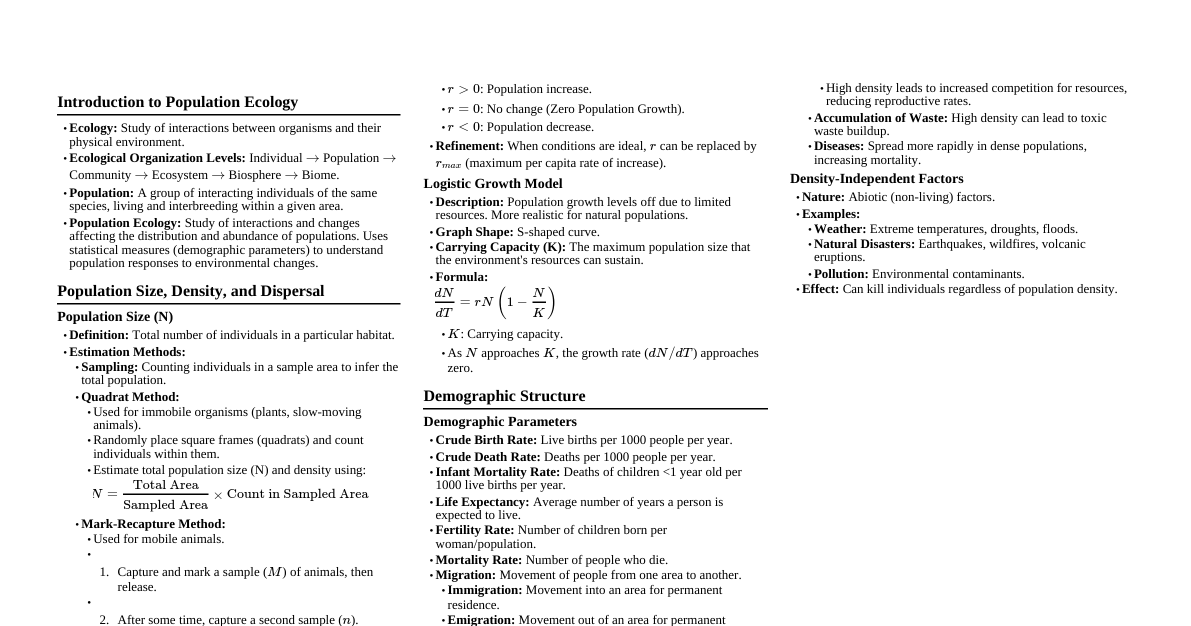
Population Definition: A group of individuals of the same species living in the same geographic area at the same time. Focus: Study of individual species, their dynamics, growth, and interactions within their own kind. Key Characteristics: Size: Total number of individuals. Density: Number of individuals per unit area or volume. Distribution: Spatial arrangement (e.g., uniform, random, clumped). Birth Rate (Natality): Number of births per unit time. Death Rate (Mortality): Number of deaths per unit time. Immigration: Movement of individuals into a population. Emigration: Movement of individuals out of a population. Age Structure: Proportion of individuals in different age groups. Sex Ratio: Proportion of males to females. Studies Involve: Population growth models (exponential, logistic), carrying capacity, factors limiting growth (e.g., food, space, predators). Example: All the white-tailed deer in a specific forest; all the human beings living in New York City. Community Definition: All the populations of different species living and interacting in the same geographic area at the same time. Focus: Study of interspecific interactions and the structure and functioning of the entire assemblage of species. Key Characteristics: Species Richness: Total number of different species present. Species Diversity: Both species richness and the relative abundance of each species. Dominant Species: Species that exert a major controlling influence on the community. Trophic Structure: Feeding relationships between species (food chains, food webs). Succession: Changes in species composition over time. Stability: Ability of a community to resist disturbance and return to its original state. Studies Involve: Interspecific competition, predation, mutualism, commensalism, parasitism, food webs, ecological succession, energy flow through different trophic levels. Example: All the deer, bears, birds, insects, trees, and fungi living in a specific forest; all the different types of plants, animals, and microorganisms in a coral reef ecosystem. Key Differences Summarized Feature Population Community Scope Single species Multiple species Interactions Intraspecific (within species) Interspecific (between species) Components Individuals of one species Multiple populations of different species Study Focus Growth, dynamics, demography of one species Interactions, diversity, structure, and succession of multiple species Complexity Relatively simpler More complex, encompassing biotic interactions