Newton
Cheatsheet Content
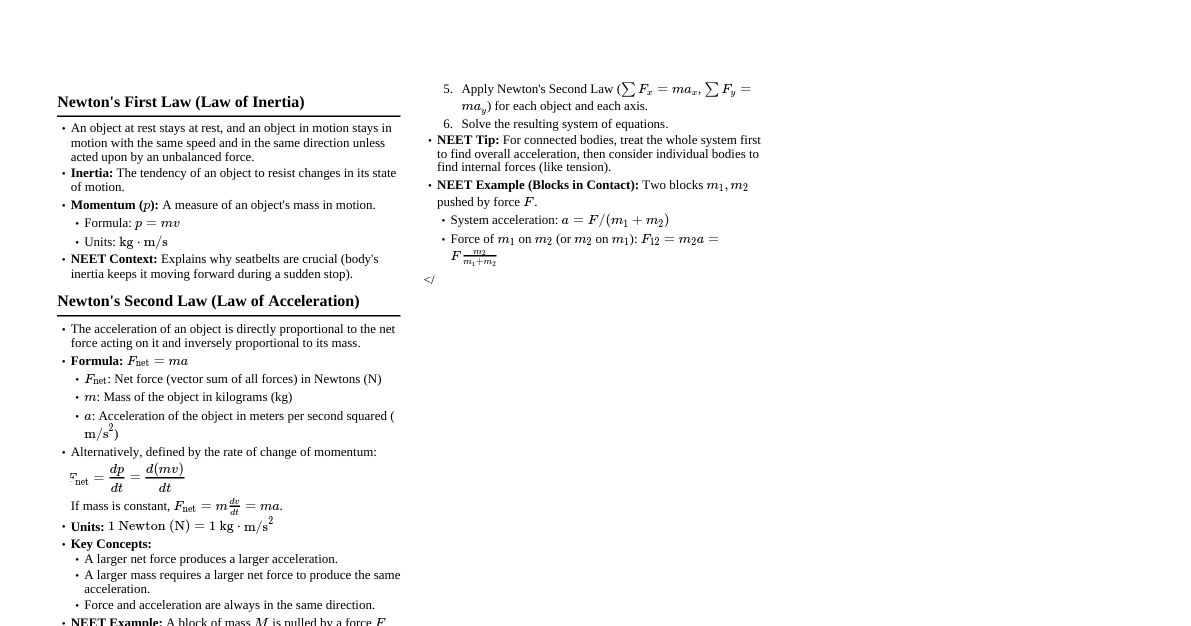
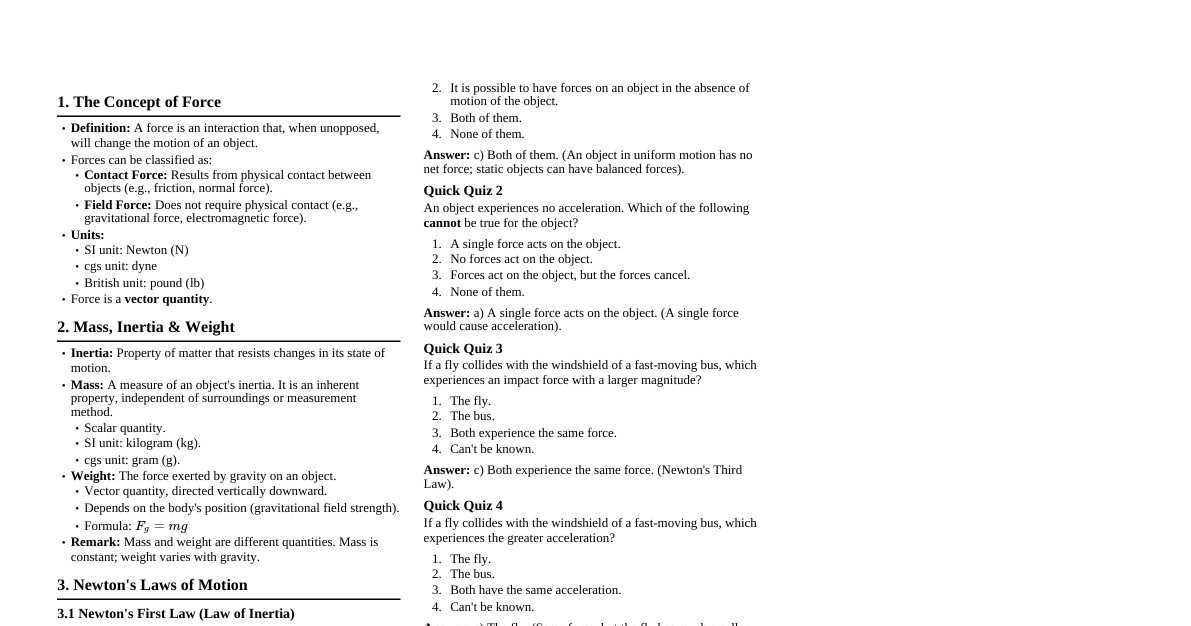
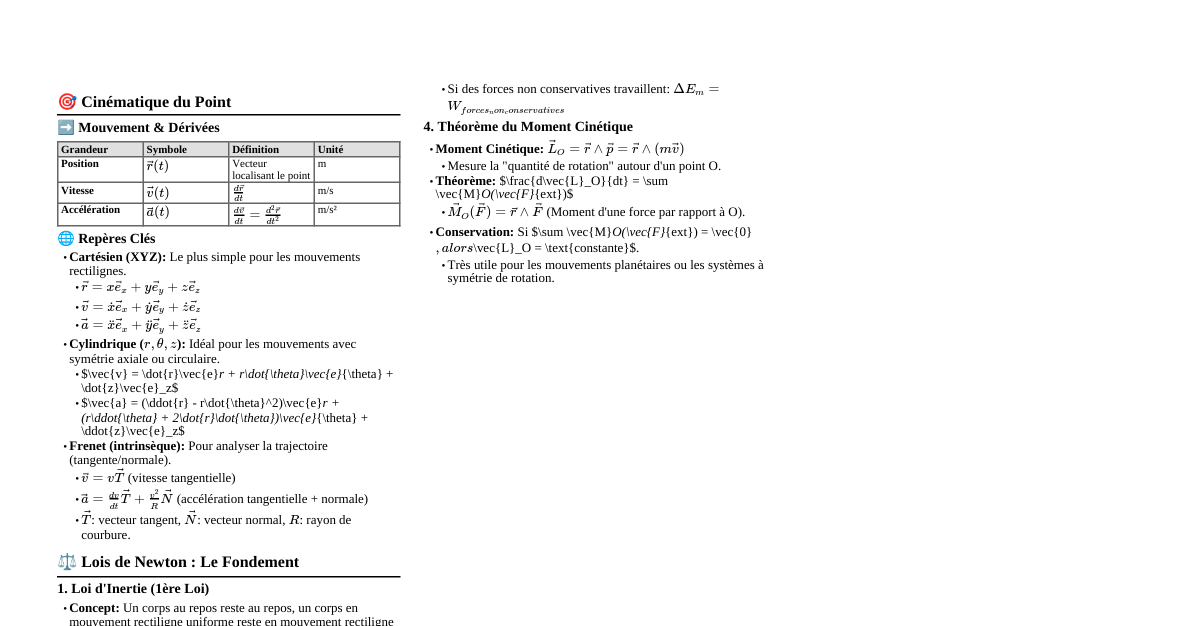
### Introduction to Motion - **Motion:** Change in position of an object over time. - **Rest:** Object not changing its position with respect to its surroundings. - **Scalar Quantity:** Has only magnitude (e.g., speed, distance). - **Vector Quantity:** Has both magnitude and direction (e.g., velocity, displacement, force). ### Distance and Displacement - **Distance:** Total path length covered by an object. - Scalar quantity. - Always positive. - **Displacement:** Shortest straight-line path between initial and final positions. - Vector quantity. - Can be positive, negative, or zero. ### Speed and Velocity - **Speed:** Rate of change of distance. - Formula: $\text{Speed} = \frac{\text{Distance}}{\text{Time}}$ - Scalar quantity. Unit: m/s. - **Velocity:** Rate of change of displacement. - Formula: $\text{Velocity} = \frac{\text{Displacement}}{\text{Time}}$ - Vector quantity. Unit: m/s. - **Uniform Motion:** Constant velocity (equal distances in equal intervals of time). - **Non-Uniform Motion:** Changing velocity (unequal distances in equal intervals of time). ### Acceleration - **Definition:** Rate of change of velocity. - Formula: $a = \frac{v - u}{t}$ (where $v$ = final velocity, $u$ = initial velocity, $t$ = time) - Vector quantity. Unit: m/s². - **Positive Acceleration:** Velocity increases. - **Negative Acceleration (Retardation/Deceleration):** Velocity decreases. ### Graphical Representation of Motion - **Distance-Time Graphs:** - Slope gives speed. - Straight line: uniform speed. - Curved line: non-uniform speed. - **Velocity-Time Graphs:** - Slope gives acceleration. - Area under graph gives displacement. - Straight line (zero slope): uniform velocity (zero acceleration). - Straight line (positive slope): uniform acceleration. - Straight line (negative slope): uniform deceleration. ### Equations of Motion (for Uniform Acceleration) 1. $v = u + at$ 2. $s = ut + \frac{1}{2}at^2$ 3. $v^2 = u^2 + 2as$ - Where: - $u$ = initial velocity - $v$ = final velocity - $a$ = acceleration - $t$ = time - $s$ = displacement ### Newton's First Law of Motion (Law of Inertia) - **Statement:** An object at rest stays at rest, and an object in motion stays in motion with the same speed and in the same direction unless acted upon by an unbalanced force. - **Inertia:** The tendency of an object to resist changes in its state of motion or rest. - **Inertia of Rest:** Tendency to resist change from rest (e.g., shaking a tree to drop fruit). - **Inertia of Motion:** Tendency to resist change from motion (e.g., passenger leaning forward when a bus stops suddenly). - **Inertia of Direction:** Tendency to resist change in direction (e.g., passenger thrown sideways when a car turns sharply). - **Mass and Inertia:** Mass is a measure of inertia. Greater the mass, greater the inertia. ### Momentum - **Definition:** The product of an object's mass and its velocity. - Formula: $p = mv$ - Vector quantity. Unit: kg·m/s. - **Importance:** A measure of the "quantity of motion" an object has. ### Newton's Second Law of Motion - **Statement:** The rate of change of momentum of an object is proportional to the applied unbalanced force in the direction of the force. - **Formula:** $F = ma$ - Where: - $F$ = force (Unit: Newton, N) - $m$ = mass (Unit: kg) - $a$ = acceleration (Unit: m/s²) - **1 Newton (N):** The force required to produce an acceleration of 1 m/s² in an object of 1 kg mass. - **Applications:** Explains why a cricket player pulls hands back while catching a ball (increases time, decreases force). ### Newton's Third Law of Motion - **Statement:** To every action, there is always an equal and opposite reaction. - **Key Points:** - Action and reaction forces always act on **two different objects**. - They are equal in magnitude and opposite in direction. - They do not cancel each other out because they act on different objects. - **Examples:** - Walking: You push the ground backward (action), the ground pushes you forward (reaction). - Rocket propulsion: Rocket pushes exhaust gases downward (action), gases push rocket upward (reaction). - Recoil of a gun: Gun pushes bullet forward (action), bullet pushes gun backward (reaction). ### Law of Conservation of Momentum - **Statement:** In an isolated system (where no external unbalanced force acts), the total momentum of the system remains constant. - **Formula:** $m_1u_1 + m_2u_2 = m_1v_1 + m_2v_2$ - Where: - $m_1, m_2$ = masses of two objects - $u_1, u_2$ = initial velocities of two objects - $v_1, v_2$ = final velocities of two objects (after collision/interaction) - **Applications:** Explains collisions, explosions, and recoil of a gun.