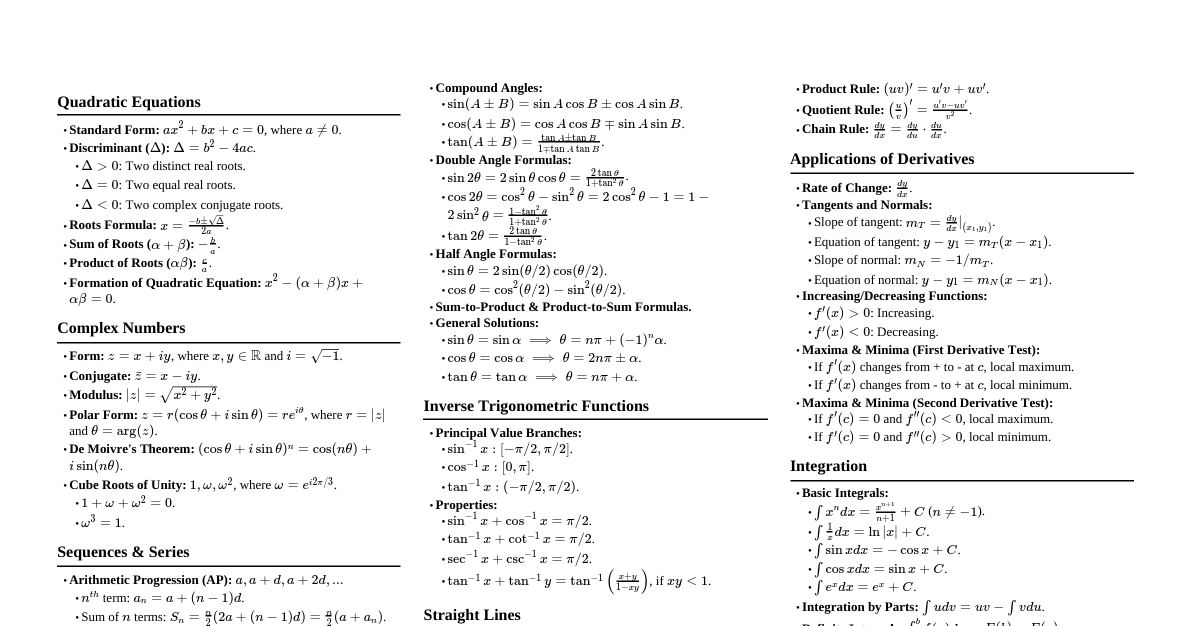
Maths 2 Core Concepts
Cheatsheet Content
### 1. Linear Equations in Two Variables (Maths 1) #### Methods of Solving Linear Equations * **Elimination Method:** 1. Make coefficients of one variable equal by multiplying equations. 2. Add or subtract equations to eliminate that variable. 3. Solve for the remaining variable. 4. Substitute back to find the eliminated variable. * **Substitution Method:** 1. Express one variable in terms of the other from one equation. 2. Substitute this expression into the second equation. 3. Solve the resulting single-variable equation. 4. Substitute back to find the other variable. * **Cramer's Rule (Determinant Method):** For equations: $a_1x + b_1y = c_1$ $a_2x + b_2y = c_2$ Calculate determinants: $D = \begin{vmatrix} a_1 & b_1 \\ a_2 & b_2 \end{vmatrix} = a_1b_2 - a_2b_1$ $D_x = \begin{vmatrix} c_1 & b_1 \\ c_2 & b_2 \end{vmatrix} = c_1b_2 - c_2b_1$ $D_y = \begin{vmatrix} a_1 & c_1 \\ a_2 & c_2 \end{vmatrix} = a_1c_2 - a_2c_1$ If $D \ne 0$, then $x = \frac{D_x}{D}$, $y = \frac{D_y}{D}$. **Exam Question Example 1.1 (Elimination Method):** Solve: 1. $2x + 3y = 7$ 2. $5x - 2y = 8$ **Solution:** To eliminate $y$, multiply (1) by 2 and (2) by 3: 1. $2 \times (2x + 3y) = 2 \times 7 \implies 4x + 6y = 14$ (Equation 3) 2. $3 \times (5x - 2y) = 3 \times 8 \implies 15x - 6y = 24$ (Equation 4) Add Equation 3 and Equation 4: $(4x + 6y) + (15x - 6y) = 14 + 24$ $19x = 38$ $x = \frac{38}{19} \implies x = 2$ Substitute $x=2$ into Equation 1: $2(2) + 3y = 7$ $4 + 3y = 7$ $3y = 7 - 4$ $3y = 3 \implies y = 1$ The solution is $(x, y) = (2, 1)$. **Exam Question Example 1.2 (Cramer's Rule):** Solve using Cramer's Rule: 1. $3x - 4y = 10$ 2. $4x + 3y = 5$ **Solution:** Comparing with $a_1x + b_1y = c_1$ and $a_2x + b_2y = c_2$: $a_1=3, b_1=-4, c_1=10$ $a_2=4, b_2=3, c_2=5$ Calculate determinants: $D = \begin{vmatrix} 3 & -4 \\ 4 & 3 \end{vmatrix} = (3)(3) - (4)(-4) = 9 - (-16) = 9 + 16 = 25$ $D_x = \begin{vmatrix} 10 & -4 \\ 5 & 3 \end{vmatrix} = (10)(3) - (5)(-4) = 30 - (-20) = 30 + 20 = 50$ $D_y = \begin{vmatrix} 3 & 10 \\ 4 & 5 \end{vmatrix} = (3)(5) - (4)(10) = 15 - 40 = -25$ Now find $x$ and $y$: $x = \frac{D_x}{D} = \frac{50}{25} = 2$ $y = \frac{D_y}{D} = \frac{-25}{25} = -1$ The solution is $(x, y) = (2, -1)$. #### Word Problems (Framing Equations) * Read the problem carefully. * Identify the two unknown quantities and assign variables (e.g., $x, y$). * Formulate two linear equations based on the given conditions. * Solve the equations using any of the methods above. **Exam Question Example 1.3:** The sum of two numbers is 35 and their difference is 13. Find the numbers. **Solution:** Let the two numbers be $x$ and $y$. According to the first condition, their sum is 35: $x + y = 35$ (Equation 1) According to the second condition, their difference is 13: $x - y = 13$ (Equation 2) Add Equation 1 and Equation 2: $(x + y) + (x - y) = 35 + 13$ $2x = 48$ $x = \frac{48}{2} \implies x = 24$ Substitute $x=24$ into Equation 1: $24 + y = 35$ $y = 35 - 24 \implies y = 11$ The two numbers are 24 and 11. ### 2. Quadratic Equations (Maths 1) #### Standard Form * The standard form of a quadratic equation is $ax^2 + bx + c = 0$, where $a, b, c$ are real numbers and $a \ne 0$. #### Methods of Solving Quadratic Equations * **Factorization Method:** 1. Write the equation in standard form. 2. Factorize the quadratic expression into two linear factors. 3. Set each factor equal to zero and solve for $x$. * **Formula Method:** The roots of $ax^2 + bx + c = 0$ are given by the quadratic formula: $x = \frac{-b \pm \sqrt{b^2 - 4ac}}{2a}$ * **Discriminant ($\Delta$ or $D$):** The expression $b^2 - 4ac$ is called the discriminant. **Exam Question Example 2.1 (Factorization Method):** Solve: $x^2 - 5x + 6 = 0$ **Solution:** We need to find two numbers whose product is 6 and sum is -5. These numbers are -2 and -3. Rewrite the middle term: $x^2 - 2x - 3x + 6 = 0$ Factor by grouping: $x(x - 2) - 3(x - 2) = 0$ $(x - 2)(x - 3) = 0$ Set each factor to zero: $x - 2 = 0 \implies x = 2$ $x - 3 = 0 \implies x = 3$ The roots of the equation are 2 and 3. **Exam Question Example 2.2 (Formula Method):** Solve: $2x^2 + 5x + 2 = 0$ **Solution:** Compare with $ax^2 + bx + c = 0$: $a=2, b=5, c=2$. First, calculate the discriminant $\Delta = b^2 - 4ac$: $\Delta = 5^2 - 4(2)(2) = 25 - 16 = 9$ Now apply the quadratic formula: $x = \frac{-b \pm \sqrt{\Delta}}{2a} = \frac{-5 \pm \sqrt{9}}{2(2)}$ $x = \frac{-5 \pm 3}{4}$ Two distinct roots: $x_1 = \frac{-5 + 3}{4} = \frac{-2}{4} = -\frac{1}{2}$ $x_2 = \frac{-5 - 3}{4} = \frac{-8}{4} = -2$ The roots of the equation are $-\frac{1}{2}$ and $-2$. #### Nature of Roots * The nature of the roots of a quadratic equation $ax^2 + bx + c = 0$ is determined by the discriminant $\Delta = b^2 - 4ac$. * If $\Delta > 0$: Roots are real and distinct (unequal). * If $\Delta = 0$: Roots are real and equal. * If $\Delta #### Relation Between Roots and Coefficients * If $\alpha$ and $\beta$ are the roots of the quadratic equation $ax^2 + bx + c = 0$: * Sum of roots: $\alpha + \beta = -\frac{b}{a}$ * Product of roots: $\alpha \beta = \frac{c}{a}$ * **Forming a quadratic equation:** If $\alpha$ and $\beta$ are the roots, the equation is $x^2 - (\alpha + \beta)x + \alpha \beta = 0$. **Exam Question Example 2.4:** If $\alpha$ and $\beta$ are the roots of $x^2 - 7x + 10 = 0$, find $\alpha + \beta$ and $\alpha \beta$. **Solution:** Compare with $ax^2 + bx + c = 0$: $a=1, b=-7, c=10$. Sum of roots: $\alpha + \beta = -\frac{b}{a} = -(\frac{-7}{1}) = 7$ Product of roots: $\alpha \beta = \frac{c}{a} = \frac{10}{1} = 10$ ### 3. Arithmetic Progressions (AP) (Maths 1) #### Sequence and Arithmetic Progression (AP) * **Sequence:** A set of numbers arranged in a definite order. * **Arithmetic Progression (AP):** A sequence in which the difference between consecutive terms is constant. This constant difference is called the common difference ($d$). $T_1, T_2, T_3, \dots, T_n$ is an AP if $T_2 - T_1 = T_3 - T_2 = \dots = d$. #### Nth Term of an AP * The $n^{th}$ term of an AP is given by: $T_n = a + (n-1)d$ Where: * $a = $ first term * $d = $ common difference * $n = $ term number * $T_n = $ the $n^{th}$ term **Exam Question Example 3.1:** Find the 10th term of the AP: $2, 7, 12, \dots$ **Solution:** Given AP: $2, 7, 12, \dots$ First term $a = 2$. Common difference $d = T_2 - T_1 = 7 - 2 = 5$. We need to find the 10th term, so $n=10$. Using the formula $T_n = a + (n-1)d$: $T_{10} = 2 + (10-1) \times 5$ $T_{10} = 2 + 9 \times 5$ $T_{10} = 2 + 45$ $T_{10} = 47$ The 10th term of the AP is 47. **Exam Question Example 3.2:** Which term of the AP $3, 8, 13, 18, \dots$ is 78? **Solution:** Given AP: $3, 8, 13, 18, \dots$ First term $a = 3$. Common difference $d = 8 - 3 = 5$. We are given $T_n = 78$. We need to find $n$. Using the formula $T_n = a + (n-1)d$: $78 = 3 + (n-1)5$ $78 - 3 = (n-1)5$ $75 = (n-1)5$ $\frac{75}{5} = n-1$ $15 = n-1$ $n = 15 + 1 \implies n = 16$ The 16th term of the AP is 78. #### Sum of N Terms of an AP * The sum of the first $n$ terms of an AP is given by: $S_n = \frac{n}{2}[2a + (n-1)d]$ * Alternatively, if the last term ($T_n$ or $l$) is known: $S_n = \frac{n}{2}[a + T_n]$ **Exam Question Example 3.3:** Find the sum of the first 20 terms of the AP: $1, 4, 7, 10, \dots$ **Solution:** Given AP: $1, 4, 7, 10, \dots$ First term $a = 1$. Common difference $d = 4 - 1 = 3$. We need to find the sum of the first 20 terms, so $n=20$. Using the formula $S_n = \frac{n}{2}[2a + (n-1)d]$: $S_{20} = \frac{20}{2}[2(1) + (20-1)3]$ $S_{20} = 10[2 + 19 \times 3]$ $S_{20} = 10[2 + 57]$ $S_{20} = 10 \times 59$ $S_{20} = 590$ The sum of the first 20 terms is 590. ### 4. Financial Planning (Maths 1) #### GST (Goods and Services Tax) Calculation * **GST:** A consumption tax levied on goods and services. * **Taxable Value:** The price of the good/service before GST. * **GST Amount:** Taxable Value $\times$ GST Rate * **Total Price (with GST):** Taxable Value + GST Amount **Exam Question Example 4.1:** The taxable value of a wrist watch is ₹ 500. Rate of GST is 12%. What is the amount of GST and the total price of the wrist watch? **Solution:** Given: Taxable Value = ₹ 500 GST Rate = 12% Amount of GST = 12% of ₹ 500 Amount of GST = $\frac{12}{100} \times 500 = 12 \times 5 = ₹ 60$ Total Price = Taxable Value + Amount of GST Total Price = ₹ 500 + ₹ 60 = ₹ 560 The amount of GST is ₹ 60 and the total price of the wrist watch is ₹ 560. #### Shares and Mutual Funds * **Face Value (FV):** The value printed on the share certificate. * **Market Value (MV):** The price at which the share is bought or sold in the market. * **Dividend:** Profit distributed to shareholders, calculated on Face Value. * Dividend = Face Value $\times$ Rate of Dividend * **Return on Investment (ROI):** * ROI = $\frac{\text{Total Dividend Income}}{\text{Total Investment}} \times 100$ * **Brokerage:** Commission paid to the broker, calculated on Market Value. * Brokerage = MV $\times$ Rate of Brokerage * **Purchase Price of 1 Share:** MV + Brokerage * **Selling Price of 1 Share:** MV - Brokerage * **Mutual Funds:** Investment scheme where money from many investors is pooled to invest in securities. * **NAV (Net Asset Value):** Value of one unit of a mutual fund. * Number of Units = $\frac{\text{Total Investment}}{\text{NAV per unit}}$ **Exam Question Example 4.2:** Smt. D'Souza purchased 200 shares of FV ₹ 100 at a premium of ₹ 50. She paid brokerage at 0.5% and 18% GST on brokerage. Find her total investment. **Solution:** 1. **Face Value (FV) per share:** ₹ 100 2. **Premium:** ₹ 50 3. **Market Value (MV) per share:** FV + Premium = ₹ 100 + ₹ 50 = ₹ 150 4. **Cost of 200 shares (without brokerage):** $200 \times 150 = ₹ 30,000$ 5. **Brokerage per share:** 0.5% of MV = $\frac{0.5}{100} \times 150 = ₹ 0.75$ 6. **Total Brokerage for 200 shares:** $200 \times 0.75 = ₹ 150$ 7. **GST on Brokerage:** 18% of Total Brokerage = $\frac{18}{100} \times 150 = ₹ 27$ 8. **Total Investment:** Cost of shares + Total Brokerage + GST on Brokerage Total Investment = $30,000 + 150 + 27 = ₹ 30,177$ Smt. D'Souza's total investment is ₹ 30,177. ### 5. Probability (Maths 1) #### Basic Terms * **Random Experiment:** An experiment whose outcome cannot be predicted with certainty, but all possible outcomes are known. * **Sample Space (S):** The set of all possible outcomes of a random experiment. * $n(S)$ denotes the number of sample points in the sample space. * **Event (A):** A subset of the sample space. An event is a specific outcome or a collection of outcomes. * $n(A)$ denotes the number of sample points in event $A$. * **Probability of an Event:** The likelihood of an event occurring. $P(A) = \frac{\text{Number of favorable outcomes}}{\text{Total number of possible outcomes}} = \frac{n(A)}{n(S)}$ * **Properties of Probability:** * $0 \le P(A) \le 1$ (Probability is always between 0 and 1, inclusive). * $P(S) = 1$ (Probability of the sure event; an outcome from the sample space will definitely occur). * $P(\emptyset) = 0$ (Probability of an impossible event). * $P(A') = 1 - P(A)$ (Probability of the complement of an event, where $A'$ is the event that $A$ does not occur). #### Examples of Sample Spaces * **Coin Toss:** * One coin: $S = \{H, T\}$, $n(S) = 2$ * Two coins: $S = \{HH, HT, TH, TT\}$, $n(S) = 4$ * Three coins: $S = \{HHH, HHT, HTH, THH, HTT, THT, TTH, TTT\}$, $n(S) = 8$ * **Die Roll:** * One die: $S = \{1, 2, 3, 4, 5, 6\}$, $n(S) = 6$ * Two dice: $S = \{(1,1), (1,2), \dots, (6,6)\}$, $n(S) = 36$ * **Cards:** A standard deck has 52 cards. * 4 suits: Spades ($\spadesuit$), Clubs ($\clubsuit$), Hearts ($\heartsuit$), Diamonds ($\diamondsuit$). * 13 cards per suit: A, 2, 3, ..., 10, J, Q, K. * Face cards: J, Q, K (12 total). * Red cards: 26 (Hearts + Diamonds). * Black cards: 26 (Spades + Clubs). **Exam Question Example 5.1:** A die is thrown. 1. Write the sample space. 2. Find the probability of getting an even number. 3. Find the probability of getting a prime number. **Solution:** 1. **Sample Space (S):** When a die is thrown, the possible outcomes are the numbers on its faces. $S = \{1, 2, 3, 4, 5, 6\}$ $n(S) = 6$ 2. **Event A: Getting an even number.** The even numbers in the sample space are $\{2, 4, 6\}$. $A = \{2, 4, 6\}$ $n(A) = 3$ Probability of event A: $P(A) = \frac{n(A)}{n(S)} = \frac{3}{6} = \frac{1}{2}$. 3. **Event B: Getting a prime number.** The prime numbers in the sample space are $\{2, 3, 5\}$. (Note: 1 is not a prime number). $B = \{2, 3, 5\}$ $n(B) = 3$ Probability of event B: $P(B) = \frac{n(B)}{n(S)} = \frac{3}{6} = \frac{1}{2}$. **Exam Question Example 5.2:** Two coins are tossed simultaneously. Find the probability of getting: 1. Exactly one head. 2. At least one head. **Solution:** When two coins are tossed, the sample space is: $S = \{HH, HT, TH, TT\}$ $n(S) = 4$ 1. **Event A: Getting exactly one head.** The outcomes with exactly one head are $\{HT, TH\}$. $A = \{HT, TH\}$ $n(A) = 2$ Probability of event A: $P(A) = \frac{n(A)}{n(S)} = \frac{2}{4} = \frac{1}{2}$. 2. **Event B: Getting at least one head.** "At least one head" means one head or two heads. The outcomes are $\{HH, HT, TH\}$. $B = \{HH, HT, TH\}$ $n(B) = 3$ Probability of event B: $P(B) = \frac{n(B)}{n(S)} = \frac{3}{4}$. ### 6. Statistics (Maths 1) #### Measures of Central Tendency * **Mean ($\bar{x}$):** The average of a set of data. * **Direct Method:** $\bar{x} = \frac{\sum x_i}{N}$ (for ungrouped data) * **Direct Method (Grouped Data):** $\bar{x} = \frac{\sum f_i x_i}{\sum f_i}$ * $x_i$: class mark (midpoint of class interval) * $f_i$: frequency * **Assumed Mean Method (Grouped Data):** $\bar{x} = A + \frac{\sum f_i d_i}{\sum f_i}$ * $A$: assumed mean * $d_i = x_i - A$: deviation * **Step Deviation Method (Grouped Data):** $\bar{x} = A + h \left(\frac{\sum f_i u_i}{\sum f_i}\right)$ * $h$: class width * $u_i = \frac{x_i - A}{h}$: step deviation * **Median:** The middle-most value of a data set when arranged in ascending or descending order. * **For ungrouped data:** * If $N$ is odd, Median = $\left(\frac{N+1}{2}\right)^{th}$ observation. * If $N$ is even, Median = Average of $\left(\frac{N}{2}\right)^{th}$ and $\left(\frac{N}{2}+1\right)^{th}$ observations. * **For grouped data:** Median $= L + \left(\frac{\frac{N}{2} - CF}{f}\right) \times h$ * $L$: lower boundary of median class * $N$: total frequency * $CF$: cumulative frequency of class preceding median class * $f$: frequency of median class * $h$: class width * **Mode:** The value that appears most frequently in a data set. * **For grouped data:** Mode $= L + \left(\frac{f_1 - f_0}{2f_1 - f_0 - f_2}\right) \times h$ * $L$: lower boundary of modal class * $f_1$: frequency of modal class * $f_0$: frequency of class preceding modal class * $f_2$: frequency of class succeeding modal class * $h$: class width **Exam Question Example 6.1 (Mean - Direct Method for Grouped Data):** Find the mean of the following data: | Class Interval | Frequency ($f_i$) | | :------------- | :---------------- | | 0-10 | 3 | | 10-20 | 5 | | 20-30 | 4 | | 30-40 | 3 | | 40-50 | 5 | **Solution:** First, calculate the class mark ($x_i$) for each interval. | Class Interval | Frequency ($f_i$) | Class Mark ($x_i$) | $f_i x_i$ | | :------------- | :---------------- | :----------------- | :-------- | | 0-10 | 3 | 5 | 15 | | 10-20 | 5 | 15 | 75 | | 20-30 | 4 | 25 | 100 | | 30-40 | 3 | 35 | 105 | | 40-50 | 5 | 45 | 225 | | **Total** | $\sum f_i = 20$ | | $\sum f_i x_i = 520$ | Mean $\bar{x} = \frac{\sum f_i x_i}{\sum f_i} = \frac{520}{20} = 26$ The mean of the data is 26. **Exam Question Example 6.2 (Median for Grouped Data):** Find the median of the following data: | Class Interval | Frequency ($f_i$) | | :------------- | :---------------- | | 0-10 | 5 | | 10-20 | 8 | | 20-30 | 12 | | 30-40 | 7 | | 40-50 | 3 | **Solution:** First, calculate the cumulative frequency (CF). | Class Interval | Frequency ($f_i$) | Cumulative Frequency (CF) | | :------------- | :---------------- | :------------------------ | | 0-10 | 5 | 5 | | 10-20 | 8 | 5 + 8 = 13 | | 20-30 | 12 | 13 + 12 = 25 | | 30-40 | 7 | 25 + 7 = 32 | | 40-50 | 3 | 32 + 3 = 35 | | **Total** | $N = 35$ | | $N = 35$, so $\frac{N}{2} = \frac{35}{2} = 17.5$. The cumulative frequency just greater than 17.5 is 25, which corresponds to the class interval 20-30. Thus, the median class is 20-30. From the median class: $L = 20$ (lower boundary) $f = 12$ (frequency of median class) $CF = 13$ (cumulative frequency of class preceding median class) $h = 10$ (class width) Median $= L + \left(\frac{\frac{N}{2} - CF}{f}\right) \times h$ Median $= 20 + \left(\frac{17.5 - 13}{12}\right) \times 10$ Median $= 20 + \left(\frac{4.5}{12}\right) \times 10$ Median $= 20 + \left(\frac{45}{12}\right) = 20 + 3.75 = 23.75$ The median of the data is 23.75. **Exam Question Example 6.3 (Mode for Grouped Data):** Find the mode of the following data: | Class Interval | Frequency ($f_i$) | | :------------- | :---------------- | | 0-10 | 5 | | 10-20 | 12 | | 20-30 | 15 | | 30-40 | 8 | | 40-50 | 3 | **Solution:** The highest frequency is 15, which corresponds to the class interval 20-30. Thus, the modal class is 20-30. From the modal class: $L = 20$ (lower boundary of modal class) $f_1 = 15$ (frequency of modal class) $f_0 = 12$ (frequency of class preceding modal class) $f_2 = 8$ (frequency of class succeeding modal class) $h = 10$ (class width) Mode $= L + \left(\frac{f_1 - f_0}{2f_1 - f_0 - f_2}\right) \times h$ Mode $= 20 + \left(\frac{15 - 12}{2(15) - 12 - 8}\right) \times 10$ Mode $= 20 + \left(\frac{3}{30 - 12 - 8}\right) \times 10$ Mode $= 20 + \left(\frac{3}{10}\right) \times 10$ Mode $= 20 + 3 = 23$ The mode of the data is 23. ### 7. Similarity (Maths 2) #### Ratio of Areas of Two Triangles * **General Case:** The ratio of the areas of two triangles is equal to the ratio of the products of their bases and corresponding heights. $$\frac{A(\triangle ABC)}{A(\triangle PQR)} = \frac{BC \times AD}{QR \times PS}$$ (where AD and PS are heights corresponding to bases BC and QR) * **Property 1 (Equal Heights):** If $h_1 = h_2$, then $\frac{A(\triangle ABC)}{A(\triangle PQR)} = \frac{b_1}{b_2}$. (Areas are proportional to their bases) * **Property 2 (Equal Bases):** If $b_1 = b_2$, then $\frac{A(\triangle ABC)}{A(\triangle PQR)} = \frac{h_1}{h_2}$. (Areas are proportional to their heights) **Exam Question Example 7.1:** In $\triangle ABC$, point $D$ is on side $BC$ such that $BD=4$, $DC=6$. Find $\frac{A(\triangle ABD)}{A(\triangle ADC)}$. **Solution:** In $\triangle ABD$ and $\triangle ADC$: * Their bases are $BD$ and $DC$ respectively, which lie on the same line $BC$. * They share a common vertex $A$. Therefore, the height from vertex $A$ to base $BC$ (let's call it $h$) is common for both triangles. Since the heights are equal, by Property 1: $$ \frac{A(\triangle ABD)}{A(\triangle ADC)} = \frac{BD}{DC} $$ Given $BD=4$ and $DC=6$. $$ \frac{A(\triangle ABD)}{A(\triangle ADC)} = \frac{4}{6} = \frac{2}{3} $$ #### Basic Proportionality Theorem (BPT) (Thales' Theorem) * **Theorem:** If a line parallel to a side of a triangle intersects the remaining sides in two distinct points, then the line divides the sides in the same proportion. In $\triangle ABC$, if $DE \parallel BC$, then $\frac{AD}{DB} = \frac{AE}{EC}$. * **Converse of BPT:** If a line divides any two sides of a triangle in the same ratio, then the line is parallel to the third side. **Exam Question Example 7.2:** In $\triangle PQR$, line $ST$ is parallel to side $QR$. If $PS=3$, $SQ=6$, and $PR=15$. Find $PT$ and $TR$. **Solution:** Given $ST \parallel QR$. By the Basic Proportionality Theorem (BPT): $$ \frac{PS}{SQ} = \frac{PT}{TR} $$ We are given $PS=3$, $SQ=6$. So, $\frac{3}{6} = \frac{1}{2}$. Thus, $\frac{PT}{TR} = \frac{1}{2}$. We also know that $PR = PT + TR = 15$. Let $PT = x$. Then $TR = 15 - x$. Substitute these into the ratio: $$ \frac{x}{15-x} = \frac{1}{2} $$ Cross-multiply: $2x = 1(15-x)$ $2x = 15 - x$ $2x + x = 15$ $3x = 15$ $x = \frac{15}{3} \implies x = 5$ So, $PT = 5$. $TR = 15 - PT = 15 - 5 = 10$. Thus, $PT=5$ and $TR=10$. #### Angle Bisector Theorem * **Theorem:** The bisector of an angle of a triangle divides the side opposite to the angle in the ratio of the remaining sides. In $\triangle ABC$, if ray $BD$ bisects $\angle ABC$, then $\frac{AB}{BC} = \frac{AD}{DC}$. * **Converse:** If in $\triangle ABC$, point $D$ on side $BC$ such that $\frac{AB}{AC} = \frac{BD}{DC}$, then ray $AD$ bisects $\angle BAC$. **Exam Question Example 7.3:** In $\triangle XYZ$, ray $YM$ is the angle bisector of $\angle XYZ$. If $XY=10$, $YZ=15$, $XZ=12$. Find $XM$ and $MZ$. **Solution:** Given that ray $YM$ is the angle bisector of $\angle XYZ$. By the Angle Bisector Theorem: $$ \frac{XY}{YZ} = \frac{XM}{MZ} $$ Given $XY=10$, $YZ=15$. So, $\frac{10}{15} = \frac{2}{3}$. Thus, $\frac{XM}{MZ} = \frac{2}{3}$. We also know that $XZ = XM + MZ = 12$. Let $XM = x$. Then $MZ = 12 - x$. Substitute these into the ratio: $$ \frac{x}{12-x} = \frac{2}{3} $$ Cross-multiply: $3x = 2(12-x)$ $3x = 24 - 2x$ $3x + 2x = 24$ $5x = 24$ $x = \frac{24}{5} \implies x = 4.8$ So, $XM = 4.8$. $MZ = 12 - XM = 12 - 4.8 = 7.2$. Thus, $XM=4.8$ and $MZ=7.2$. #### Property of Three Parallel Lines and their Transversals * If three parallel lines are intersected by two transversals, then the ratio of the intercepts made on one transversal is equal to the ratio of the corresponding intercepts made on the other transversal. If line $l \parallel$ line $m \parallel$ line $n$, and $t_1, t_2$ are transversals intersecting them at $A,B,C$ and $P,Q,R$ respectively, then $\frac{AB}{BC} = \frac{PQ}{QR}$. **Exam Question Example 7.4:** Lines $p, q, r$ are parallel. Transversals $l$ and $m$ intersect them at $A, B, C$ and $P, Q, R$ respectively. If $AB=6$, $BC=9$, $PQ=8$. Find $QR$. **Solution:** Given that lines $p, q, r$ are parallel. By the property of three parallel lines and their transversals: $$ \frac{AB}{BC} = \frac{PQ}{QR} $$ Given $AB=6$, $BC=9$, $PQ=8$. $$ \frac{6}{9} = \frac{8}{QR} $$ Simplify the left side: $\frac{6}{9} = \frac{2}{3}$. $$ \frac{2}{3} = \frac{8}{QR} $$ Cross-multiply: $2 \times QR = 3 \times 8$ $2 \times QR = 24$ $QR = \frac{24}{2} \implies QR = 12$ The length of $QR$ is 12 units. #### Tests of Similarity of Triangles * **AA Test (Angle-Angle):** If two corresponding angles of two triangles are congruent, then the two triangles are similar. * **SAS Test (Side-Angle-Side):** If two pairs of corresponding sides are in the same proportion and the angles between them are congruent, then the two triangles are similar. * **SSS Test (Side-Side-Side):** If three sides of a triangle are in proportion to corresponding three sides of another triangle, then the two triangles are similar. **Exam Question Example 7.5:** In $\triangle ABC$ and $\triangle PQR$, $\angle A = 50^\circ$, $\angle B = 70^\circ$, $\angle P = 50^\circ$, $\angle Q = 70^\circ$. Are the triangles similar? If yes, by which test? **Solution:** Given: In $\triangle ABC$: $\angle A = 50^\circ$, $\angle B = 70^\circ$. In $\triangle PQR$: $\angle P = 50^\circ$, $\angle Q = 70^\circ$. We observe that: $\angle A = \angle P = 50^\circ$ $\angle B = \angle Q = 70^\circ$ Since two corresponding angles of $\triangle ABC$ and $\triangle PQR$ are congruent, the triangles are similar by the **AA Test of Similarity**. So, $\triangle ABC \sim \triangle PQR$. #### Theorem of Areas of Similar Triangles * When two triangles are similar, the ratio of their areas is equal to the ratio of the squares of their corresponding sides. If $\triangle ABC \sim \triangle PQR$, then $\frac{A(\triangle ABC)}{A(\triangle PQR)} = \frac{AB^2}{PQ^2} = \frac{BC^2}{QR^2} = \frac{AC^2}{PR^2}$. **Exam Question Example 7.6:** $\triangle DEF \sim \triangle LMN$. If $DE=4$, $LM=6$, and $A(\triangle DEF)=20$ sq. units, find $A(\triangle LMN)$. **Solution:** Given $\triangle DEF \sim \triangle LMN$. By the Theorem of Areas of Similar Triangles: $$ \frac{A(\triangle DEF)}{A(\triangle LMN)} = \frac{DE^2}{LM^2} $$ Substitute the given values: $$ \frac{20}{A(\triangle LMN)} = \frac{4^2}{6^2} $$ $$ \frac{20}{A(\triangle LMN)} = \frac{16}{36} $$ Simplify the ratio $\frac{16}{36}$ by dividing by 4: $\frac{4}{9}$. $$ \frac{20}{A(\triangle LMN)} = \frac{4}{9} $$ Cross-multiply: $4 \times A(\triangle LMN) = 20 \times 9$ $4 \times A(\triangle LMN) = 180$ $A(\triangle LMN) = \frac{180}{4}$ $A(\triangle LMN) = 45 \text{ sq. units}$ ### 8. Pythagoras Theorem (Maths 2) #### Pythagorean Triplet * A triplet of natural numbers $(a, b, c)$ is called a Pythagorean triplet if $a^2 + b^2 = c^2$. The largest number ($c$) represents the hypotenuse of a right-angled triangle, and $a, b$ represent the other two sides. * Examples: $(3, 4, 5)$ because $3^2 + 4^2 = 9 + 16 = 25 = 5^2$. * $(5, 12, 13)$ because $5^2 + 12^2 = 25 + 144 = 169 = 13^2$. #### 30°-60°-90° Theorem * In a right-angled triangle with angles 30°, 60°, and 90°: * The side opposite the 30° angle is half the length of the hypotenuse. * The side opposite the 60° angle is $\frac{\sqrt{3}}{2}$ times the length of the hypotenuse. **Exam Question Example 8.1:** In $\triangle ABC$, $\angle B = 90^\circ$, $\angle C = 30^\circ$, $AC=10$. Find $AB$ and $BC$. **Solution:** Given $\triangle ABC$ is a right-angled triangle with $\angle B = 90^\circ$. $\angle C = 30^\circ$. The sum of angles in a triangle is $180^\circ$, so $\angle A = 180^\circ - 90^\circ - 30^\circ = 60^\circ$. Thus, $\triangle ABC$ is a 30°-60°-90° triangle. The hypotenuse is $AC = 10$. By the 30°-60°-90° Theorem: * Side opposite 30° angle ($\angle C$) is $AB$: $AB = \frac{1}{2} \times \text{hypotenuse} = \frac{1}{2} \times AC = \frac{1}{2} \times 10 = 5$. * Side opposite 60° angle ($\angle A$) is $BC$: $BC = \frac{\sqrt{3}}{2} \times \text{hypotenuse} = \frac{\sqrt{3}}{2} \times AC = \frac{\sqrt{3}}{2} \times 10 = 5\sqrt{3}$. So, $AB=5$ and $BC=5\sqrt{3}$. #### 45°-45°-90° Theorem * In a right-angled triangle with angles 45°, 45°, and 90°: * Each of the perpendicular sides (legs) is $\frac{1}{\sqrt{2}}$ times the length of the hypotenuse. **Exam Question Example 8.2:** In $\triangle PQR$, $\angle Q = 90^\circ$, $\angle P = 45^\circ$, $PQ=7$. Find $QR$ and $PR$. **Solution:** Given $\triangle PQR$ is a right-angled triangle with $\angle Q = 90^\circ$. $\angle P = 45^\circ$. The sum of angles in a triangle is $180^\circ$, so $\angle R = 180^\circ - 90^\circ - 45^\circ = 45^\circ$. Thus, $\triangle PQR$ is a 45°-45°-90° triangle. Since $\angle P = \angle R = 45^\circ$, the sides opposite to these angles are equal: $QR = PQ$. Given $PQ=7$, so $QR=7$. By the 45°-45°-90° Theorem: $PQ = \frac{1}{\sqrt{2}} \times \text{hypotenuse}$ $7 = \frac{1}{\sqrt{2}} \times PR$ $PR = 7\sqrt{2}$. So, $QR=7$ and $PR=7\sqrt{2}$. #### Similarity in Right Angled Triangles * In a right-angled triangle, if the altitude is drawn to the hypotenuse, then the two triangles formed are similar to the original triangle and to each other. In $\triangle ABC$, if $\angle B = 90^\circ$ and $BD \perp AC$, then $\triangle ADB \sim \triangle BDC \sim \triangle ABC$. #### Theorem of Geometric Mean * In a right-angled triangle, the perpendicular segment to the hypotenuse from the right-angle vertex is the geometric mean of the segments into which the hypotenuse is divided. In $\triangle ABC$, if $\angle B = 90^\circ$ and $BD \perp AC$, then $BD^2 = AD \times DC$. (This follows from $\triangle ADB \sim \triangle BDC$) **Exam Question Example 8.3:** In right-angled $\triangle PQR$, $\angle Q=90^\circ$. $QS \perp PR$. If $PS=4$, $SR=9$. Find $QS$. **Solution:** Given $\triangle PQR$ is a right-angled triangle with $\angle Q = 90^\circ$. $QS \perp PR$. By the Theorem of Geometric Mean: $$ QS^2 = PS \times SR $$ Given $PS=4$ and $SR=9$. $$ QS^2 = 4 \times 9 $$ $$ QS^2 = 36 $$ Take the square root of both sides: $$ QS = \sqrt{36} $$ $$ QS = 6 $$ The length of $QS$ is 6 units. #### Pythagoras Theorem * In a right-angled triangle, the square of the hypotenuse is equal to the sum of the squares of the other two sides (legs). If $\triangle ABC$ is right-angled at $B$, then $AC^2 = AB^2 + BC^2$. **Exam Question Example 8.4:** In $\triangle XYZ$, $\angle Y = 90^\circ$. $XY=5$, $YZ=12$. Find $XZ$. **Solution:** Given $\triangle XYZ$ is a right-angled triangle at $Y$. The sides are $XY=5$, $YZ=12$. The hypotenuse is $XZ$. By Pythagoras Theorem: $$ XZ^2 = XY^2 + YZ^2 $$ $$ XZ^2 = 5^2 + 12^2 $$ $$ XZ^2 = 25 + 144 $$ $$ XZ^2 = 169 $$ Take the square root of both sides: $$ XZ = \sqrt{169} $$ $$ XZ = 13 $$ The length of $XZ$ is 13 units. #### Converse of Pythagoras Theorem * In a triangle, if the square of one side is equal to the sum of the squares of the remaining two sides, then the triangle is a right-angled triangle. The angle opposite the largest side is the right angle. **Exam Question Example 8.5:** The sides of a triangle are 7 cm, 24 cm, and 25 cm. Determine if it is a right-angled triangle. **Solution:** Let the sides be $a=7$, $b=24$, $c=25$. We need to check if the square of the largest side is equal to the sum of the squares of the other two sides. Largest side is 25. $c^2 = 25^2 = 625$ $a^2 + b^2 = 7^2 + 24^2 = 49 + 576 = 625$ Since $c^2 = a^2 + b^2$ ($625 = 625$), by the Converse of Pythagoras Theorem, the triangle is a right-angled triangle. #### Apollonius Theorem * In $\triangle ABC$, if $M$ is the midpoint of side $BC$, then $AB^2 + AC^2 = 2AM^2 + 2BM^2$. **Exam Question Example 8.6:** In $\triangle PQR$, $S$ is the midpoint of side $QR$. If $PQ=11$, $PR=17$, $PS=13$. Find $QR$. **Solution:** Given $\triangle PQR$ and $S$ is the midpoint of $QR$. By Apollonius Theorem: $$ PQ^2 + PR^2 = 2PS^2 + 2QS^2 $$ Given $PQ=11$, $PR=17$, $PS=13$. $$ 11^2 + 17^2 = 2(13^2) + 2QS^2 $$ $$ 121 + 289 = 2(169) + 2QS^2 $$ $$ 410 = 338 + 2QS^2 $$ Subtract 338 from both sides: $410 - 338 = 2QS^2$ $72 = 2QS^2$ $QS^2 = \frac{72}{2} \implies QS^2 = 36$ Take the square root of both sides: $QS = \sqrt{36} \implies QS = 6$ Since $S$ is the midpoint of $QR$, $QR = 2 \times QS$. $QR = 2 \times 6 = 12$. The length of $QR$ is 12 units. ### 9. Circle (Maths 2) #### Tangent Theorem * A tangent at any point of a circle is perpendicular to the radius at the point of contact. If line $l$ is tangent to a circle at point $P$, and $OP$ is the radius, then $l \perp OP$. * **Converse:** A line perpendicular to a radius at its point on the circle is a tangent to the circle. #### Tangent Segments Theorem * Tangent segments drawn from an external point to a circle are congruent. If $PA$ and $PB$ are tangent segments drawn from an external point $P$ to a circle, then $PA = PB$. **Exam Question Example 9.1:** Point $P$ is outside a circle with centre $O$. Tangents $PA$ and $PB$ are drawn to the circle. If $PA=12$ cm, what is the length of $PB$? **Solution:** By the Tangent Segments Theorem, tangent segments drawn from an external point to a circle are congruent. Therefore, $PB = PA$. Given $PA = 12$ cm. So, $PB = 12$ cm. #### Theorem of Touching Circles * If two circles touch each other, their point of contact lies on the line joining their centres. * **External Touch:** The distance between their centres is equal to the sum of their radii ($d = r_1 + r_2$). * **Internal Touch:** The distance between their centres is equal to the absolute difference of their radii ($d = |r_1 - r_2|$). #### Chord Theorems * **Perpendicular from Centre:** The perpendicular drawn from the centre of a circle to a chord bisects the chord. * **Congruent Chords:** * Congruent chords are equidistant from the centre of the circle. * Chords equidistant from the centre of a circle are congruent. #### Inscribed Angle Theorem * The measure of an inscribed angle is half of the measure of the arc intercepted by it. $\angle BAC = \frac{1}{2} m(\text{arc } BC)$. * **Corollaries:** * Angles inscribed in the same arc are congruent. * Angle inscribed in a semicircle is a right angle ($90^\circ$). **Exam Question Example 9.2:** In a circle, $m(\text{arc } PQR) = 130^\circ$. Find the measure of inscribed angle $\angle PSR$. **Solution:** Given $m(\text{arc } PQR) = 130^\circ$. Angle $\angle PSR$ is an inscribed angle that intercepts arc $PQR$. By the Inscribed Angle Theorem: $$ \angle PSR = \frac{1}{2} m(\text{arc } PQR) $$ $$ \angle PSR = \frac{1}{2} \times 130^\circ $$ $$ \angle PSR = 65^\circ $$ #### Cyclic Quadrilateral * **Definition:** A quadrilateral whose all four vertices lie on the same circle. * **Theorem:** Opposite angles of a cyclic quadrilateral are supplementary (their sum is $180^\circ$). In cyclic quadrilateral $ABCD$, $\angle A + \angle C = 180^\circ$ and $\angle B + \angle D = 180^\circ$. * **Converse:** If a pair of opposite angles of a quadrilateral is supplementary, then the quadrilateral is cyclic. * **Exterior Angle Theorem:** An exterior angle of a cyclic quadrilateral is congruent to the angle opposite to its adjacent interior angle. **Exam Question Example 9.3:** Quadrilateral $ABCD$ is a cyclic quadrilateral. If $\angle A = 75^\circ$, find $\angle C$. **Solution:** Given that $ABCD$ is a cyclic quadrilateral. By the theorem of cyclic quadrilaterals, opposite angles are supplementary. $$ \angle A + \angle C = 180^\circ $$ Given $\angle A = 75^\circ$. $$ 75^\circ + \angle C = 180^\circ $$ $$ \angle C = 180^\circ - 75^\circ $$ $$ \angle C = 105^\circ $$ #### Theorem of Angle Between Tangent and Secant * If an angle has its vertex on the circle, its one side touches the circle (tangent) and the other intersects the circle in one more point (secant), then the measure of the angle is half the measure of its intercepted arc. $\angle ABC = \frac{1}{2} m(\text{arc } ADB)$ (where $BC$ is tangent at $B$). #### Theorem of Intersecting Chords (Power of a Point Theorem) * **Internal Intersection:** If two chords $AB$ and $CD$ intersect inside the circle at point $E$, then the product of the segments of one chord is equal to the product of the segments of the other chord. $AE \times EB = CE \times ED$. * **External Intersection (Secant Segments):** If secants containing chords $AB$ and $CD$ intersect outside the circle at point $E$, then $EA \times EB = EC \times ED$. * **Tangent Secant Segments Theorem:** If a secant through $E$ intersects the circle at $A$ and $B$, and a tangent through $E$ touches the circle at $T$, then $EA \times EB = ET^2$. **Exam Question Example 9.4:** Chords $AB$ and $CD$ intersect at point $E$ inside a circle. If $AE=6$, $EB=4$, $CE=3$. Find $ED$. **Solution:** Given that chords $AB$ and $CD$ intersect internally at $E$. By the Theorem of Intersecting Chords (internal intersection): $$ AE \times EB = CE \times ED $$ Given $AE=6$, $EB=4$, $CE=3$. $$ 6 \times 4 = 3 \times ED $$ $$ 24 = 3 \times ED $$ $$ ED = \frac{24}{3} $$ $$ ED = 8 $$ The length of $ED$ is 8 units. ### 10. Geometric Constructions (Maths 2) #### Construction of Similar Triangles * **Key Idea:** Use corresponding angles or proportional sides. For exam, usually involves a common vertex and a scale factor. **Exam Question Example 10.1 (Similar Triangle with Common Vertex):** Construct $\triangle ABC$ such that $AB=5$ cm, $BC=6$ cm, $AC=7$ cm. Then construct $\triangle A'BC'$ similar to $\triangle ABC$ such that $BC' = \frac{4}{5} BC$. **Solution Steps:** 1. **Construct $\triangle ABC$:** * Draw segment $BC = 6$ cm. * With $B$ as center, draw an arc of radius 5 cm ($AB$). * With $C$ as center, draw an arc of radius 7 cm ($AC$) intersecting the previous arc at $A$. * Join $AB$ and $AC$ to form $\triangle ABC$. 2. **Draw a ray for ratio division:** * Draw a ray $BX$ making an acute angle with $BC$, on the opposite side of vertex $A$. 3. **Mark points for the ratio:** * The ratio is $\frac{4}{5}$. The larger number is 5. So, mark 5 points $B_1, B_2, B_3, B_4, B_5$ on ray $BX$ such that $BB_1 = B_1B_2 = B_2B_3 = B_3B_4 = B_4B_5$. 4. **Join the denominator point:** * Join $B_5$ to $C$. (The denominator of the ratio is 5, so join $B_5$ to $C$). 5. **Draw parallel line for $C'$:** * Draw a line through $B_4$ (the numerator of the ratio is 4) parallel to $B_5C$. This line will intersect $BC$ at point $C'$. 6. **Draw parallel line for $A'$:** * Draw a line through $C'$ parallel to $AC$. This line will intersect $AB$ at point $A'$. 7. **Result:** $\triangle A'BC'$ is the required similar triangle. #### Construction of a Tangent to a Circle * **Type 1: From a point on the circle (using the center):** 1. Draw a circle with center $O$ and a given radius. 2. Take any point $P$ on the circle. 3. Draw ray $OP$. 4. Construct a line perpendicular to ray $OP$ at point $P$. This line is the required tangent. * **Type 2: From a point outside the circle:** 1. Draw a circle with center $O$ and a given radius. 2. Take a point $P$ outside the circle. 3. Draw segment $OP$. 4. Find the midpoint $M$ of segment $OP$ by drawing its perpendicular bisector. 5. With $M$ as center and $MO$ (or $MP$) as radius, draw a circle. 6. This new circle intersects the original circle at two points, say $A$ and $B$. 7. Draw lines $PA$ and $PB$. These are the two required tangents. **Exam Question Example 10.2 (Tangent from External Point):** Draw a circle with radius 3 cm. Take a point $P$ at a distance of 7 cm from its center. Draw tangents to the circle from point $P$. **Solution Steps:** 1. **Draw the circle and point P:** * Draw a circle with center $O$ and radius 3 cm. * Mark a point $P$ such that the distance $OP = 7$ cm. 2. **Find midpoint of OP:** * Draw segment $OP$. * Construct the perpendicular bisector of $OP$. Let $M$ be the midpoint of $OP$. 3. **Draw a second circle:** * With $M$ as center and radius $MO$ (or $MP$), draw another circle. 4. **Identify points of contact:** * This new circle intersects the original circle at two points. Label them $A$ and $B$. 5. **Draw the tangents:** * Draw lines $PA$ and $PB$. These are the required tangents from point $P$ to the circle. ### 11. Co-ordinate Geometry (Maths 2) #### Distance Formula * The distance between any two points $A(x_1, y_1)$ and $B(x_2, y_2)$ is given by: $d(A, B) = \sqrt{(x_2 - x_1)^2 + (y_2 - y_1)^2}$ * The distance of a point $P(x,y)$ from the origin $O(0,0)$ is $\sqrt{x^2 + y^2}$. **Exam Question Example 11.1:** Find the distance between points $P(-1, 1)$ and $Q(5, -7)$. **Solution:** Let $(x_1, y_1) = (-1, 1)$ and $(x_2, y_2) = (5, -7)$. Using the distance formula: $d(P, Q) = \sqrt{(x_2 - x_1)^2 + (y_2 - y_1)^2}$ $d(P, Q) = \sqrt{(5 - (-1))^2 + (-7 - 1)^2}$ $d(P, Q) = \sqrt{(5 + 1)^2 + (-8)^2}$ $d(P, Q) = \sqrt{6^2 + 64}$ $d(P, Q) = \sqrt{36 + 64}$ $d(P, Q) = \sqrt{100}$ $d(P, Q) = 10$ units. #### Collinearity of Points * Three points $A, B, C$ are collinear if they lie on the same straight line. * **Using Distance Formula:** Points $A, B, C$ are collinear if the sum of the lengths of any two segments equals the length of the third segment (e.g., $d(A,B) + d(B,C) = d(A,C)$). * **Using Slope Formula:** Points $A, B, C$ are collinear if the slope of $AB$ is equal to the slope of $BC$. #### Section Formula * The coordinates of a point $P(x,y)$ that divides the line segment joining $A(x_1, y_1)$ and $B(x_2, y_2)$ internally in the ratio $m:n$ are: $x = \frac{mx_2 + nx_1}{m+n}$, $y = \frac{my_2 + ny_1}{m+n}$ **Exam Question Example 11.2:** Find the coordinates of point $P$ which divides the segment joining $A(-1, 7)$ and $B(4, -3)$ in the ratio $2:3$. **Solution:** Let $(x_1, y_1) = (-1, 7)$, $(x_2, y_2) = (4, -3)$, and the ratio $m:n = 2:3$. Using the section formula: $x = \frac{m x_2 + n x_1}{m+n} = \frac{2(4) + 3(-1)}{2+3} = \frac{8 - 3}{5} = \frac{5}{5} = 1$ $y = \frac{m y_2 + n y_1}{m+n} = \frac{2(-3) + 3(7)}{2+3} = \frac{-6 + 21}{5} = \frac{15}{5} = 3$ The coordinates of point $P$ are $(1, 3)$. #### Midpoint Formula * The coordinates of the midpoint $M(x,y)$ of a line segment joining $A(x_1, y_1)$ and $B(x_2, y_2)$ are: $x = \frac{x_1 + x_2}{2}$, $y = \frac{y_1 + y_2}{2}$ **Exam Question Example 11.3:** Find the midpoint of the segment joining $P(2, -5)$ and $Q(-6, 3)$. **Solution:** Let $(x_1, y_1) = (2, -5)$ and $(x_2, y_2) = (-6, 3)$. Using the midpoint formula: $x = \frac{x_1 + x_2}{2} = \frac{2 + (-6)}{2} = \frac{2-6}{2} = \frac{-4}{2} = -2$ $y = \frac{y_1 + y_2}{2} = \frac{-5 + 3}{2} = \frac{-2}{2} = -1$ The midpoint of the segment $PQ$ is $M(-2, -1)$. #### Centroid Formula * If $(x_1, y_1)$, $(x_2, y_2)$, and $(x_3, y_3)$ are the vertices of a triangle, then the coordinates of the centroid $G(x,y)$ are: $x = \frac{x_1 + x_2 + x_3}{3}$, $y = \frac{y_1 + y_2 + y_3}{3}$ **Exam Question Example 11.4:** Find the centroid of the triangle whose vertices are $A(1, -1)$, $B(4, 2)$, $C(-3, 5)$. **Solution:** Let $(x_1, y_1) = (1, -1)$, $(x_2, y_2) = (4, 2)$, and $(x_3, y_3) = (-3, 5)$. Using the centroid formula: $x = \frac{x_1 + x_2 + x_3}{3} = \frac{1 + 4 + (-3)}{3} = \frac{1+4-3}{3} = \frac{2}{3}$ $y = \frac{y_1 + y_2 + y_3}{3} = \frac{-1 + 2 + 5}{3} = \frac{6}{3} = 2$ The centroid of the triangle is $G(\frac{2}{3}, 2)$. #### Slope of a Line * The slope $m$ of a line passing through two points $(x_1, y_1)$ and $(x_2, y_2)$ is: $m = \frac{y_2 - y_1}{x_2 - x_1}$ (provided $x_2 \ne x_1$) * The slope $m$ of a line making an angle $\theta$ with the positive X-axis is: $m = \tan \theta$ * **Properties:** * **Horizontal Line (parallel to X-axis):** Slope is 0. * **Vertical Line (parallel to Y-axis):** Slope is undefined. * **Parallel Lines:** Have equal slopes ($m_1 = m_2$). * **Perpendicular Lines:** The product of their slopes is -1 ($m_1 \times m_2 = -1$). **Exam Question Example 11.5:** Find the slope of the line passing through points $A(2, 3)$ and $B(4, 7)$. **Solution:** Let $(x_1, y_1) = (2, 3)$ and $(x_2, y_2) = (4, 7)$. Using the slope formula: $m = \frac{y_2 - y_1}{x_2 - x_1} = \frac{7 - 3}{4 - 2} = \frac{4}{2} = 2$ The slope of the line is 2. **Exam Question Example 11.6:** Line $L_1$ passes through $(1, 2)$ and $(3, 4)$. Line $L_2$ passes through $(0, 1)$ and $(2, -1)$. Are these lines parallel or perpendicular? **Solution:** First, find the slope of each line. Slope of $L_1$ ($m_1$) passing through $(1, 2)$ and $(3, 4)$: $m_1 = \frac{4 - 2}{3 - 1} = \frac{2}{2} = 1$ Slope of $L_2$ ($m_2$) passing through $(0, 1)$ and $(2, -1)$: $m_2 = \frac{-1 - 1}{2 - 0} = \frac{-2}{2} = -1$ Now, check the relationship between the slopes: $m_1 \times m_2 = 1 \times (-1) = -1$ Since the product of their slopes is -1, the lines $L_1$ and $L_2$ are **perpendicular**. ### 12. Trigonometry (Maths 2) #### Trigonometric Ratios * In a right-angled $\triangle ABC$ with $\angle B = 90^\circ$: * $\sin \theta = \frac{\text{Opposite Side}}{\text{Hypotenuse}}$ * $\cos \theta = \frac{\text{Adjacent Side}}{\text{Hypotenuse}}$ * $\tan \theta = \frac{\text{Opposite Side}}{\text{Adjacent Side}}$ * $\csc \theta = \frac{1}{\sin \theta} = \frac{\text{Hypotenuse}}{\text{Opposite Side}}$ * $\sec \theta = \frac{1}{\cos \theta} = \frac{\text{Hypotenuse}}{\text{Adjacent Side}}$ * $\cot \theta = \frac{1}{\tan \theta} = \frac{\text{Adjacent Side}}{\text{Opposite Side}}$ #### Trigonometric Identities * $\sin^2 \theta + \cos^2 \theta = 1$ * $1 + \tan^2 \theta = \sec^2 \theta$ * $1 + \cot^2 \theta = \csc^2 \theta$ **Exam Question Example 12.1:** If $\sin \theta = \frac{3}{5}$, find $\cos \theta$ and $\tan \theta$. **Solution:** We use the identity $\sin^2 \theta + \cos^2 \theta = 1$. Substitute $\sin \theta = \frac{3}{5}$: $(\frac{3}{5})^2 + \cos^2 \theta = 1$ $\frac{9}{25} + \cos^2 \theta = 1$ $\cos^2 \theta = 1 - \frac{9}{25}$ $\cos^2 \theta = \frac{25 - 9}{25} = \frac{16}{25}$ $\cos \theta = \sqrt{\frac{16}{25}} = \frac{4}{5}$ (Assuming $\theta$ is an acute angle, so $\cos \theta$ is positive) Now, find $\tan \theta$: $\tan \theta = \frac{\sin \theta}{\cos \theta} = \frac{3/5}{4/5} = \frac{3}{4}$ #### Ratios of Complementary Angles * $\sin (90^\circ - \theta) = \cos \theta$ * $\cos (90^\circ - \theta) = \sin \theta$ * $\tan (90^\circ - \theta) = \cot \theta$ * $\cot (90^\circ - \theta) = \tan \theta$ * $\sec (90^\circ - \theta) = \csc \theta$ * $\csc (90^\circ - \theta) = \sec \theta$ **Exam Question Example 12.2:** Evaluate: $\frac{\sin 30^\circ}{\cos 60^\circ}$ **Solution:** We use the complementary angle identity: $\cos (90^\circ - \theta) = \sin \theta$. For $\theta = 30^\circ$, we have $\cos (90^\circ - 30^\circ) = \cos 60^\circ = \sin 30^\circ$. So, the expression becomes: $$ \frac{\sin 30^\circ}{\cos 60^\circ} = \frac{\sin 30^\circ}{\sin 30^\circ} = 1 $$ (Alternatively, using specific values: $\sin 30^\circ = \frac{1}{2}$ and $\cos 60^\circ = \frac{1}{2}$. So $\frac{1/2}{1/2} = 1$). #### Values for Special Angles | $\theta$ | 0° | 30° | 45° | 60° | 90° | | :-------------- | :------- | :------------------ | :------------------ | :------------------ | :------- | | $\sin \theta$ | 0 | $\frac{1}{2}$ | $\frac{1}{\sqrt{2}}$ | $\frac{\sqrt{3}}{2}$ | 1 | | $\cos \theta$ | 1 | $\frac{\sqrt{3}}{2}$ | $\frac{1}{\sqrt{2}}$ | $\frac{1}{2}$ | 0 | | $\tan \theta$ | 0 | $\frac{1}{\sqrt{3}}$ | 1 | $\sqrt{3}$ | Undefined | **Exam Question Example 12.3:** Find the value of $2 \sin 30^\circ + 3 \tan 45^\circ$. **Solution:** From the table of special angles: $\sin 30^\circ = \frac{1}{2}$ $\tan 45^\circ = 1$ Substitute these values into the expression: $$ 2 \sin 30^\circ + 3 \tan 45^\circ = 2 \times \frac{1}{2} + 3 \times 1 $$ $$ = 1 + 3 $$ $$ = 4 $$ #### Applications of Trigonometry (Heights and Distances) * **Line of Sight:** The imaginary line from the observer's eye to the object. * **Angle of Elevation:** The angle formed by the line of sight with the horizontal, when the object is above the horizontal level (looking upwards). * **Angle of Depression:** The angle formed by the line of sight with the horizontal, when the object is below the horizontal level (looking downwards). * **Steps to solve problems:** 1. Draw a clear diagram representing the situation. 2. Identify the right-angled triangle(s) formed. 3. Label the known values (angles, sides) and the unknown quantity to be found. 4. Choose the appropriate trigonometric ratio ($\sin, \cos, \tan$) that relates the known and unknown quantities. 5. Formulate an equation and solve for the unknown. **Exam Question Example 12.4:** A ladder is placed against a wall such that its foot is at a distance of 5 m from the wall and its top reaches a window 5$\sqrt{3}$ m above the ground. Find the angle made by the ladder with the ground. **Solution:** Let $AB$ represent the wall and $BC$ be the ground. Let $AC$ be the ladder. This forms a right-angled triangle $\triangle ABC$ at $B$. Given: Distance of foot from wall, $BC = 5$ m. Height of the window, $AB = 5\sqrt{3}$ m. We need to find the angle made by the ladder with the ground, which is $\angle ACB$. In $\triangle ABC$: Opposite side to $\angle ACB$ is $AB = 5\sqrt{3}$ m. Adjacent side to $\angle ACB$ is $BC = 5$ m. The tangent ratio relates opposite and adjacent sides: $$ \tan(\angle ACB) = \frac{\text{Opposite}}{\text{Adjacent}} = \frac{AB}{BC} $$ $$ \tan(\angle ACB) = \frac{5\sqrt{3}}{5} $$ $$ \tan(\angle ACB) = \sqrt{3} $$ From the table of special angles, we know that $\tan 60^\circ = \sqrt{3}$. Therefore, $\angle ACB = 60^\circ$. The ladder makes an angle of $60^\circ$ with the ground. ### 13. Mensuration (Maths 2) #### Basic Formulas (Surface Area & Volume) * **Cuboid:** * LSA (Lateral Surface Area) = $2h(l+b)$ * TSA (Total Surface Area) = $2(lb+bh+hl)$ * Volume = $lbh$ * **Cube:** * LSA = $4l^2$ * TSA = $6l^2$ * Volume = $l^3$ * **Cylinder:** * CSA (Curved Surface Area) = $2\pi rh$ * TSA (Total Surface Area) = $2\pi r(r+h)$ (CSA + 2 Base Areas) * Volume = $\pi r^2 h$ * **Cone:** * Slant height $l = \sqrt{h^2+r^2}$ * CSA = $\pi rl$ * TSA = $\pi r(r+l)$ (CSA + Base Area) * Volume = $\frac{1}{3} \pi r^2 h$ * **Sphere:** * Surface Area = $4\pi r^2$ * Volume = $\frac{4}{3} \pi r^3$ * **Hemisphere:** * CSA = $2\pi r^2$ * TSA = $3\pi r^2$ (CSA + Base Area) * Volume = $\frac{2}{3} \pi r^3$ **Exam Question Example 13.1 (Cylinder):** A cylinder has a radius of 7 cm and a height of 10 cm. Find its Curved Surface Area and Volume. (Use $\pi = \frac{22}{7}$) **Solution:** Given: Radius ($r$) = 7 cm Height ($h$) = 10 cm * **Curved Surface Area (CSA):** Formula: $CSA = 2\pi rh$ $CSA = 2 \times \frac{22}{7} \times 7 \times 10$ $CSA = 2 \times 22 \times 10$ $CSA = 440 \text{ cm}^2$ * **Volume:** Formula: $Volume = \pi r^2 h$ $Volume = \frac{22}{7} \times 7^2 \times 10$ $Volume = \frac{22}{7} \times 49 \times 10$ $Volume = 22 \times 7 \times 10$ $Volume = 1540 \text{ cm}^3$ **Exam Question Example 13.2 (Cone):** A cone has a radius of 3 cm and a height of 4 cm. Find its slant height, Curved Surface Area, and Volume. (Use $\pi = 3.14$) **Solution:** Given: Radius ($r$) = 3 cm Height ($h$) = 4 cm * **Slant height ($l$):** Formula: $l = \sqrt{h^2+r^2}$ $l = \sqrt{4^2+3^2} = \sqrt{16+9} = \sqrt{25}$ $l = 5 \text{ cm}$ * **Curved Surface Area (CSA):** Formula: $CSA = \pi rl$ $CSA = 3.14 \times 3 \times 5$ $CSA = 3.14 \times 15$ $CSA = 47.1 \text{ cm}^2$ * **Volume:** Formula: $Volume = \frac{1}{3} \pi r^2 h$ $Volume = \frac{1}{3} \times 3.14 \times 3^2 \times 4$ $Volume = \frac{1}{3} \times 3.14 \times 9 \times 4$ $Volume = 3.14 \times 3 \times 4$ $Volume = 3.14 \times 12$ $Volume = 37.68 \text{ cm}^3$ #### Frustum of a Cone * A frustum is the part of a cone remaining when its top part is cut off by a plane parallel to the base. Let $r_1$ and $r_2$ be the radii of the two circular bases ($r_1 > r_2$), $h$ be its height, and $l$ be its slant height. * **Slant height ($l$):** $l = \sqrt{h^2 + (r_1 - r_2)^2}$ * **Curved Surface Area (CSA):** $\pi l (r_1 + r_2)$ * **Total Surface Area (TSA):** $\pi l (r_1 + r_2) + \pi r_1^2 + \pi r_2^2$ * **Volume:** $\frac{1}{3} \pi h (r_1^2 + r_2^2 + r_1 r_2)$ #### Sector and Segment of a Circle * **Sector:** The region enclosed by two radii and the arc joining their endpoints. * **Area of Sector:** $A = \frac{\theta}{360^\circ} \times \pi r^2$ (where $\theta$ is the central angle in degrees) * **Length of Arc:** $L = \frac{\theta}{360^\circ} \times 2\pi r$ * **Relation between Area and Arc Length:** $A = \frac{1}{2} Lr$ * **Segment:** The region enclosed by a chord and its corresponding arc. * **Area of Segment:** $A_{\text{segment}} = A_{\text{sector}} - A_{\text{triangle}}$ * For a sector with central angle $\theta$: $A_{\text{triangle}} = \frac{1}{2} r^2 \sin \theta$ * So, $A_{\text{segment}} = \frac{\theta}{360^\circ} \pi r^2 - \frac{1}{2} r^2 \sin \theta$ **Exam Question Example 13.3 (Sector):** A sector of a circle has radius 7 cm and central angle $90^\circ$. Find the area of the sector and the length of its arc. (Use $\pi = \frac{22}{7}$) **Solution:** Given: Radius ($r$) = 7 cm Central angle ($\theta$) = $90^\circ$ * **Area of Sector:** Formula: $A = \frac{\theta}{360^\circ} \times \pi r^2$ $A = \frac{90}{360} \times \frac{22}{7} \times 7^2$ $A = \frac{1}{4} \times \frac{22}{7} \times 49$ $A = \frac{1}{4} \times 22 \times 7$ $A = \frac{154}{4} = 38.5 \text{ cm}^2$ * **Length of Arc ($L$):** Formula: $L = \frac{\theta}{360^\circ} \times 2\pi r$ $L = \frac{90}{360} \times 2 \times \frac{22}{7} \times 7$ $L = \frac{1}{4} \times 2 \times 22$ $L = \frac{44}{4} = 11 \text{ cm}$