Engineering Mechanics (Statics) Essentia
Cheatsheet Content
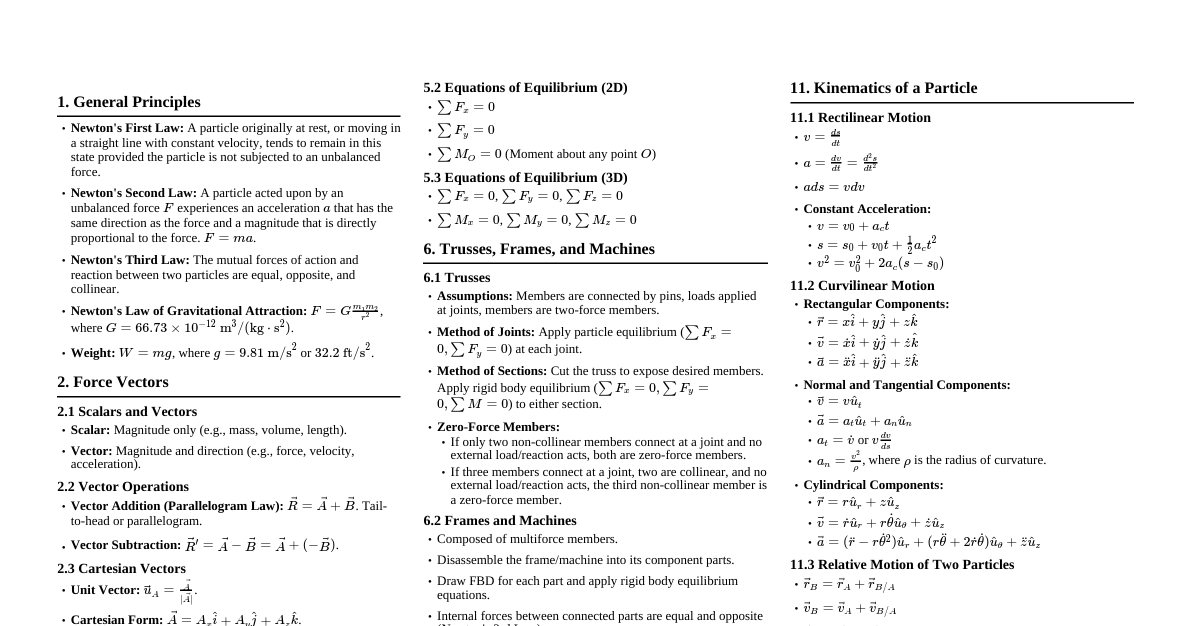
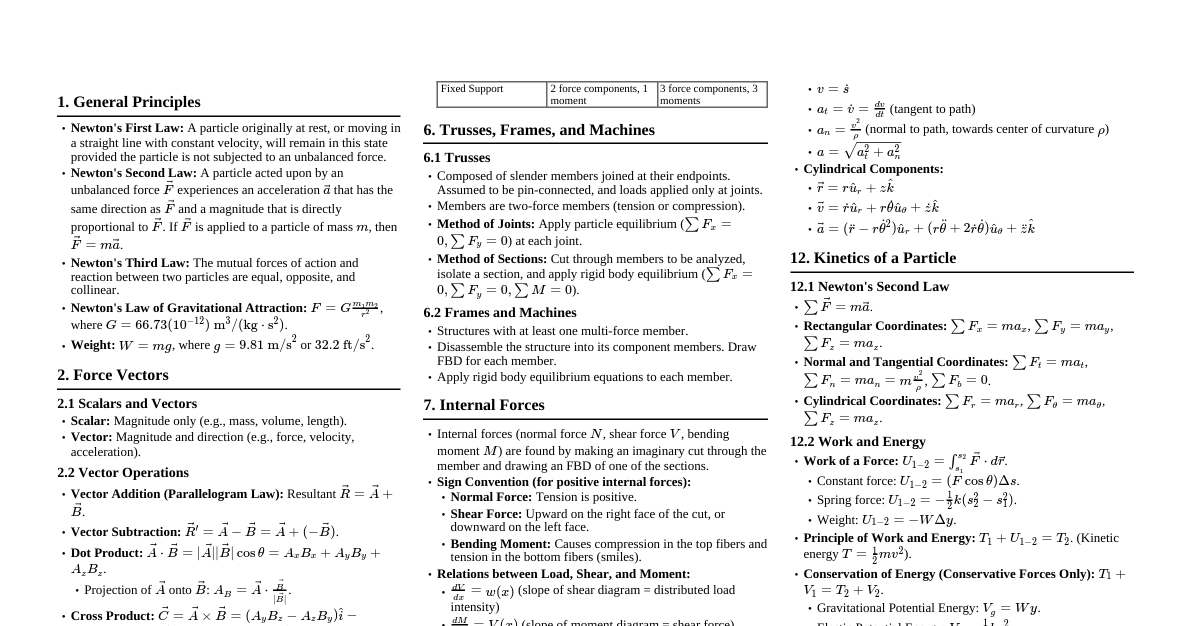
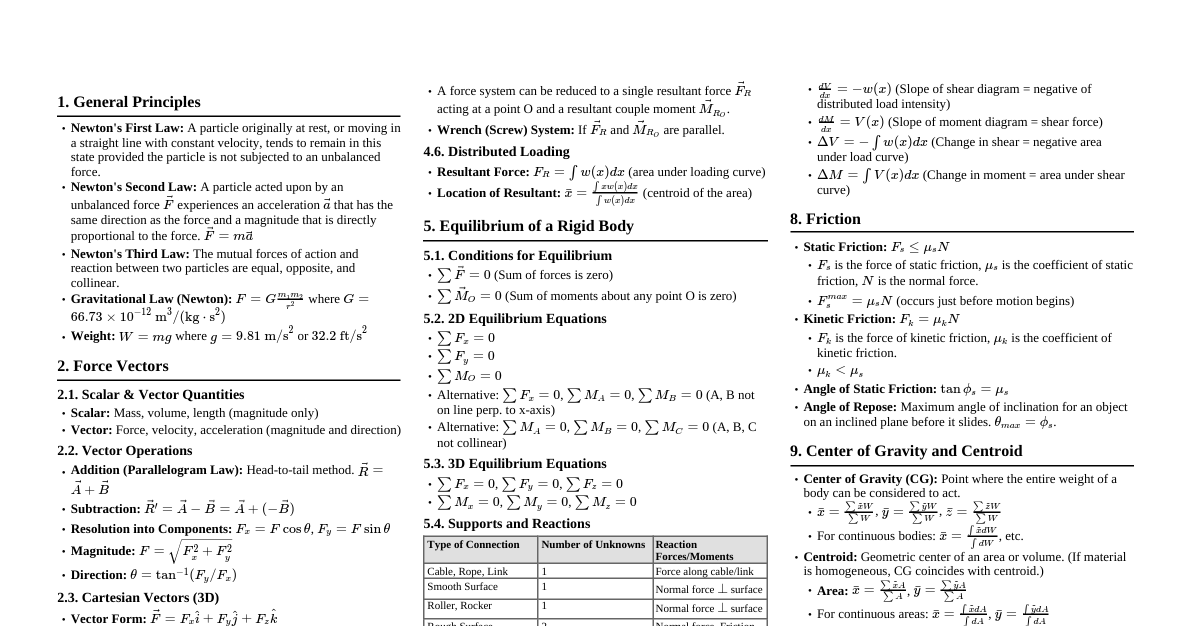
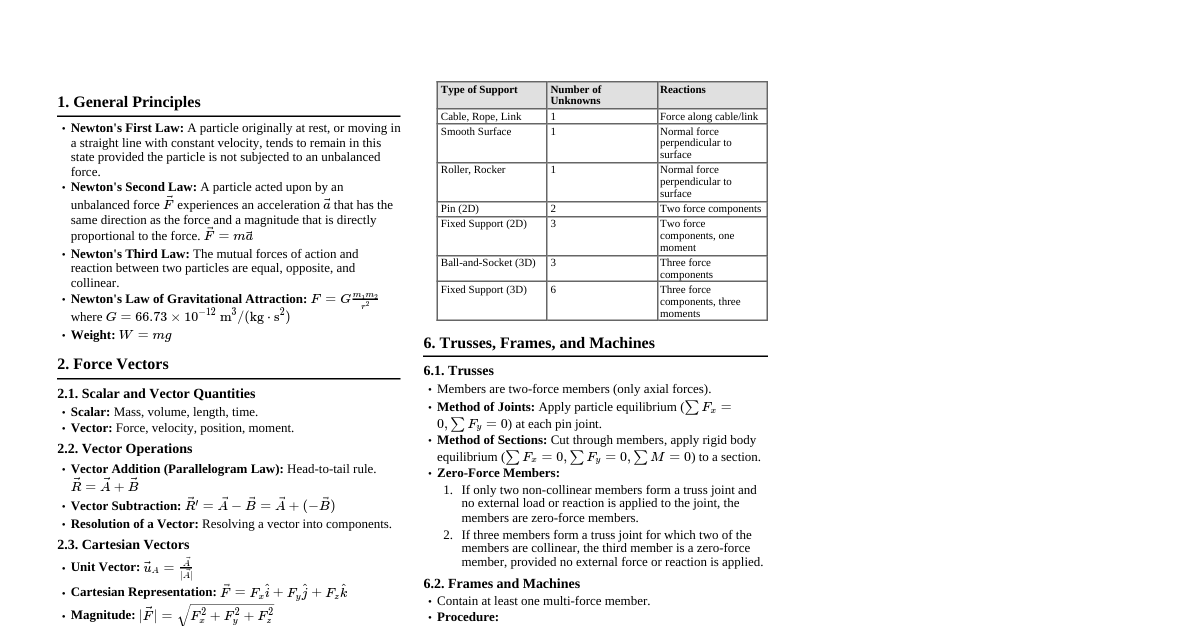
1. Fundamental Concepts Mechanics: Branch of physical sciences concerned with the state of rest or motion of bodies subjected to forces. Statics: Deals with bodies at rest or moving at a constant velocity (zero acceleration). Equilibrium is the primary focus. Dynamics: Deals with bodies in motion with acceleration. Space: The geometric region occupied by bodies. Position is defined by coordinates ($x, y, z$). Time: A measure of the succession of events. Mass: A measure of the inertia of a body, representing its resistance to a change in velocity. Also a measure of the quantity of matter. Force: A vector quantity representing the action of one body on another (e.g., push, pull). It is characterized by its magnitude, direction, and point of application. Particle: A body whose dimensions are negligible for the analysis of its motion or equilibrium. Rigid Body: A body whose deformation is negligible for the analysis of its motion or equilibrium. 2. Newton's Laws of Motion First Law (Law of Inertia): A particle remains at rest or continues to move with constant velocity if there is no unbalanced force acting on it. (Principle of Equilibrium: $\sum \vec{F} = 0$) Second Law (Law of Acceleration): The acceleration of a particle is proportional to the resultant force acting on it and is in the direction of this force. $\sum \vec{F} = m \vec{a}$. Third Law (Law of Action-Reaction): The forces of action and reaction between interacting bodies are equal in magnitude, opposite in direction, and collinear. Newton's Law of Gravitation: The gravitational force between two particles is directly proportional to the product of their masses and inversely proportional to the square of the distance between their centers. $F = G \frac{m_1 m_2}{r^2}$, where $G = 6.674 \times 10^{-11} \text{ N} \cdot \text{m}^2/\text{kg}^2$. Weight: The gravitational force exerted by the Earth on a body. $W = mg$, where $g$ is the acceleration due to gravity ($9.81 \text{ m/s}^2$ or $32.2 \text{ ft/s}^2$). 3. Units of Measurement SI Units (International System of Units): Length: meter (m) Mass: kilogram (kg) Time: second (s) Force: Newton (N) ($1 \text{ N} = 1 \text{ kg} \cdot \text{m/s}^2$) US Customary Units (FPS - Foot-Pound-Second): Length: foot (ft) Force: pound (lb) Time: second (s) Mass: slug ($1 \text{ slug} = 1 \text{ lb} \cdot \text{s}^2/\text{ft}$) Common Conversions: $1 \text{ ft} = 0.3048 \text{ m}$ $1 \text{ lb} = 4.448 \text{ N}$ $1 \text{ kg} = 2.2046 \text{ lb}$ (This is a mass conversion; weight in pounds is $m \text{ (kg)} \times 2.2046 \text{ lb/kg}$) 4. Scalars and Vectors Scalar: A quantity characterized by its magnitude only (e.g., mass, length, time, temperature). Vector: A quantity characterized by both magnitude and direction (e.g., force, velocity, acceleration, position). Represented graphically by an arrow. Vector Notation: $\vec{A}$ or $\mathbf{A}$ (bold). Its magnitude is $A = |\vec{A}|$. Types of Vectors: Fixed Vector: Has a specific point of application (e.g., force on a deformable body). Free Vector: Not restricted to a specific line or point of action (e.g., moment of a couple). Sliding Vector: Can be applied anywhere along its line of action (e.g., force on a rigid body). 5. Vector Operations Vector Addition (Resultant): Parallelogram Law: The resultant $\vec{R}$ of two vectors $\vec{A}$ and $\vec{B}$ is the diagonal of the parallelogram formed by placing their tails at the same point. $\vec{R} = \vec{A} + \vec{B}$. Triangle Rule: Place the tail of $\vec{B}$ at the head of $\vec{A}$. The resultant $\vec{R}$ connects the tail of $\vec{A}$ to the head of $\vec{B}$. Polygon Rule: For multiple vectors, connect them head-to-tail. The resultant connects the tail of the first to the head of the last vector. Vector Subtraction: $\vec{A} - \vec{B} = \vec{A} + (-\vec{B})$. The vector $-\vec{B}$ has the same magnitude as $\vec{B}$ but opposite direction. Scalar Multiplication: $k\vec{A}$. The magnitude is scaled by $|k|$. The direction is the same if $k > 0$ and opposite if $k 6. Components of a Vector Rectangular Components (2D): A force $\vec{F}$ in the $xy$-plane can be resolved into components $F_x$ and $F_y$. If $\theta$ is the angle with the positive x-axis: $F_x = F \cos \theta$, $F_y = F \sin \theta$. Magnitude: $F = \sqrt{F_x^2 + F_y^2}$. Direction: $\theta = \arctan \left( \frac{F_y}{F_x} \right)$. (Quadrant must be considered). Unit Vectors: $\hat{i}, \hat{j}, \hat{k}$ are unit vectors (magnitude 1) along the positive $x, y, z$ axes, respectively. Rectangular Components (3D): A force $\vec{F}$ can be expressed as $\vec{F} = F_x \hat{i} + F_y \hat{j} + F_z \hat{k}$. Magnitude: $F = \sqrt{F_x^2 + F_y^2 + F_z^2}$. Direction Cosines: $\cos \alpha = \frac{F_x}{F}$, $\cos \beta = \frac{F_y}{F}$, $\cos \gamma = \frac{F_z}{F}$. These are the angles $\vec{F}$ makes with the $x, y, z$ axes. Property: $\cos^2 \alpha + \cos^2 \beta + \cos^2 \gamma = 1$. Unit Vector in direction of $\vec{F}$: $\hat{u}_F = \frac{\vec{F}}{F} = \cos \alpha \hat{i} + \cos \beta \hat{j} + \cos \gamma \hat{k}$. 7. Dot Product (Scalar Product) Definition: $\vec{A} \cdot \vec{B} = AB \cos \theta$, where $\theta$ is the angle between $\vec{A}$ and $\vec{B}$. Component form: $\vec{A} \cdot \vec{B} = A_x B_x + A_y B_y + A_z B_z$. Properties: Commutative: $\vec{A} \cdot \vec{B} = \vec{B} \cdot \vec{A}$. Distributive: $\vec{A} \cdot (\vec{B} + \vec{C}) = \vec{A} \cdot \vec{B} + \vec{A} \cdot \vec{C}$. If $\vec{A} \cdot \vec{B} = 0$ and $A, B \neq 0$, then $\vec{A}$ is perpendicular to $\vec{B}$. $\hat{i} \cdot \hat{i} = \hat{j} \cdot \hat{j} = \hat{k} \cdot \hat{k} = 1$. $\hat{i} \cdot \hat{j} = \hat{j} \cdot \hat{k} = \hat{k} \cdot \hat{i} = 0$. Applications: Finding the angle between two vectors: $\cos \theta = \frac{\vec{A} \cdot \vec{B}}{AB}$. Finding the projection of one vector onto another: $\text{Proj}_{\vec{B}} \vec{A} = (\vec{A} \cdot \hat{u}_B) \hat{u}_B = \frac{\vec{A} \cdot \vec{B}}{B^2} \vec{B}$. The scalar component is $\vec{A} \cdot \hat{u}_B$. 8. Cross Product (Vector Product) Definition: $\vec{C} = \vec{A} \times \vec{B}$. The resultant vector $\vec{C}$ has: Magnitude: $C = AB \sin \theta$, where $\theta$ is the angle between $\vec{A}$ and $\vec{B}$. This is the area of the parallelogram formed by $\vec{A}$ and $\vec{B}$. Direction: Perpendicular to the plane containing $\vec{A}$ and $\vec{B}$, determined by the right-hand rule. Component form (determinant): $$ \vec{A} \times \vec{B} = \begin{vmatrix} \hat{i} & \hat{j} & \hat{k} \\ A_x & A_y & A_z \\ B_x & B_y & B_z \end{vmatrix} $$ $$ = (A_y B_z - A_z B_y)\hat{i} - (A_x B_z - A_z B_x)\hat{j} + (A_x B_y - A_y B_x)\hat{k} $$ Properties: Not Commutative: $\vec{A} \times \vec{B} = -(\vec{B} \times \vec{A})$. Distributive: $\vec{A} \times (\vec{B} + \vec{C}) = \vec{A} \times \vec{B} + \vec{A} \times \vec{C}$. If $\vec{A}$ is parallel to $\vec{B}$ (or $\theta = 0^\circ$ or $180^\circ$), then $\vec{A} \times \vec{B} = 0$. $\hat{i} \times \hat{j} = \hat{k}$, $\hat{j} \times \hat{k} = \hat{i}$, $\hat{k} \times \hat{i} = \hat{j}$. $\hat{i} \times \hat{i} = \hat{j} \times \hat{j} = \hat{k} \times \hat{k} = 0$. Application: Calculating the moment of a force. 9. Moment of a Force (Torque) Scalar Formulation (2D): The magnitude of the moment of a force $F$ about a point $O$ is $M_O = Fd$, where $d$ is the perpendicular distance from point $O$ to the line of action of force $F$. Convention: Counter-clockwise (CCW) moments are typically positive (+), Clockwise (CW) moments are negative (-). Vector Formulation (3D): The moment of a force $\vec{F}$ about a point $O$ is given by the cross product: $\vec{M}_O = \vec{r} \times \vec{F}$. $\vec{r}$ is the position vector from the moment center $O$ to any point on the line of action of $\vec{F}$. The magnitude is $M_O = rF \sin \theta = Fd$. The direction of $\vec{M}_O$ is perpendicular to the plane defined by $\vec{r}$ and $\vec{F}$, determined by the right-hand rule. Varignon's Theorem: The moment of a force about any point is equal to the sum of the moments of its components about the same point. $\vec{M}_O = \vec{r} \times (\vec{F}_1 + \vec{F}_2 + ...) = (\vec{r} \times \vec{F}_1) + (\vec{r} \times \vec{F}_2) + ...$ Moment about an Axis: The scalar component of the moment $\vec{M}_O$ about a specific axis $L$ (defined by a unit vector $\hat{u}_L$) is $M_L = \hat{u}_L \cdot \vec{M}_O = \hat{u}_L \cdot (\vec{r} \times \vec{F})$. This is a scalar triple product. 10. Couple A couple consists of two parallel forces that are equal in magnitude, opposite in direction, and separated by a perpendicular distance $d$. A couple produces pure rotation; its resultant force is zero. Moment of a Couple: The moment produced by a couple is $M = Fd$. The moment of a couple is a free vector : its effect is the same regardless of where it is applied in the rigid body. Vector form: $\vec{M} = \vec{r} \times \vec{F}$, where $\vec{r}$ is the position vector from the line of action of one force to the line of action of the other. Equivalent Couples: Two couples are equivalent if they produce the same moment (same magnitude and direction), even if the forces and distances are different. 11. Force-Couple Systems Any force $\vec{F}$ acting at a point $A$ on a rigid body can be replaced by an equivalent system consisting of the same force $\vec{F}$ acting at another point $O$ and a couple $\vec{M}_O = \vec{r}_{OA} \times \vec{F}$. Here $\vec{r}_{OA}$ is the position vector from $O$ to $A$. Resultant of a Force System: For a system of forces and couples acting on a rigid body, it can be reduced to: A single resultant force $\vec{R} = \sum \vec{F}$ acting at a chosen point $O$. A resultant couple $\vec{M}_R = \sum (\vec{r}_i \times \vec{F}_i) + \sum \vec{M}_{couples}$. This equivalent system ($\vec{R}$ and $\vec{M}_R$) is called a wrench if $\vec{R}$ and $\vec{M}_R$ are not zero and are parallel. If $\vec{R} \neq 0$ and $\vec{M}_R \perp \vec{R}$, the system can be reduced to a single resultant force acting at a specific location. If $\vec{R} = 0$, the system reduces to a pure resultant couple $\vec{M}_R$. 12. Equilibrium of a Particle A particle is in equilibrium if the resultant of all forces acting on it is zero. Condition for Equilibrium: $\sum \vec{F} = 0$. 2D Scalar Equations: $\sum F_x = 0$ $\sum F_y = 0$ 3D Scalar Equations: $\sum F_x = 0$ $\sum F_y = 0$ $\sum F_z = 0$ Free-Body Diagram (FBD): Essential for solving equilibrium problems. Isolate the particle. Show all external forces acting on the particle, including known (applied) and unknown (reaction) forces. Indicate the magnitude and direction of each force. 13. Equilibrium of a Rigid Body A rigid body is in equilibrium if the resultant of all forces and the resultant of all moments acting on it are both zero. Conditions for Equilibrium: $\sum \vec{F} = 0$ (translational equilibrium - no acceleration of center of mass) $\sum \vec{M}_O = 0$ (rotational equilibrium - no angular acceleration about any point $O$) 2D Scalar Equations (3 independent equations): $\sum F_x = 0$ $\sum F_y = 0$ $\sum M_A = 0$ (moment about any convenient point $A$) Alternative sets of 2D equilibrium equations: $\sum F_x = 0$, $\sum M_A = 0$, $\sum M_B = 0$ (where the line AB is not perpendicular to the x-axis). $\sum M_A = 0$, $\sum M_B = 0$, $\sum M_C = 0$ (where points A, B, C are not collinear). 3D Scalar Equations (6 independent equations): $\sum F_x = 0$ $\sum F_y = 0$ $\sum F_z = 0$ $\sum M_x = 0$ (moment about x-axis) $\sum M_y = 0$ (moment about y-axis) $\sum M_z = 0$ (moment about z-axis) The moments can be summed about any point $O$. The moment components are then taken about the axes passing through $O$. 14. Common Supports and Reactions Support Type 2D Reactions (Unknowns) 3D Reactions (Unknowns) Cable, Rope, Link 1 Force (tension along cable/link) 1 Force (tension along cable/link) Smooth Surface, Roller, Rocker 1 Force (normal to surface) 1 Force (normal to surface) Pin Connection, Hinge 2 Force Components ($F_x, F_y$) 3 Force Components ($F_x, F_y, F_z$) Fixed Support (Cantilever) 2 Force Components ($F_x, F_y$) + 1 Moment ($M_z$) 3 Force Components ($F_x, F_y, F_z$) + 3 Moment Components ($M_x, M_y, M_z$) Ball-and-socket joint N/A 3 Force Components ($F_x, F_y, F_z$) Journal bearing (no axial thrust) N/A 2 Force Components (perpendicular to shaft axis) Thrust bearing (or journal bearing with axial thrust) N/A 3 Force Components