Hibbeler
Cheatsheet Content
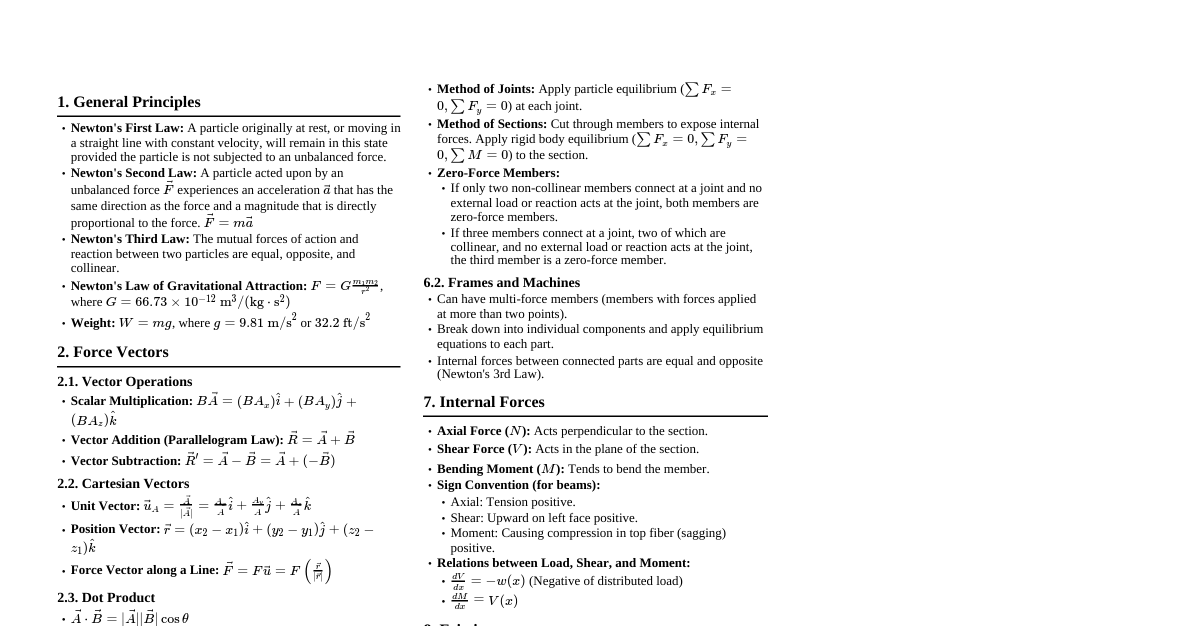
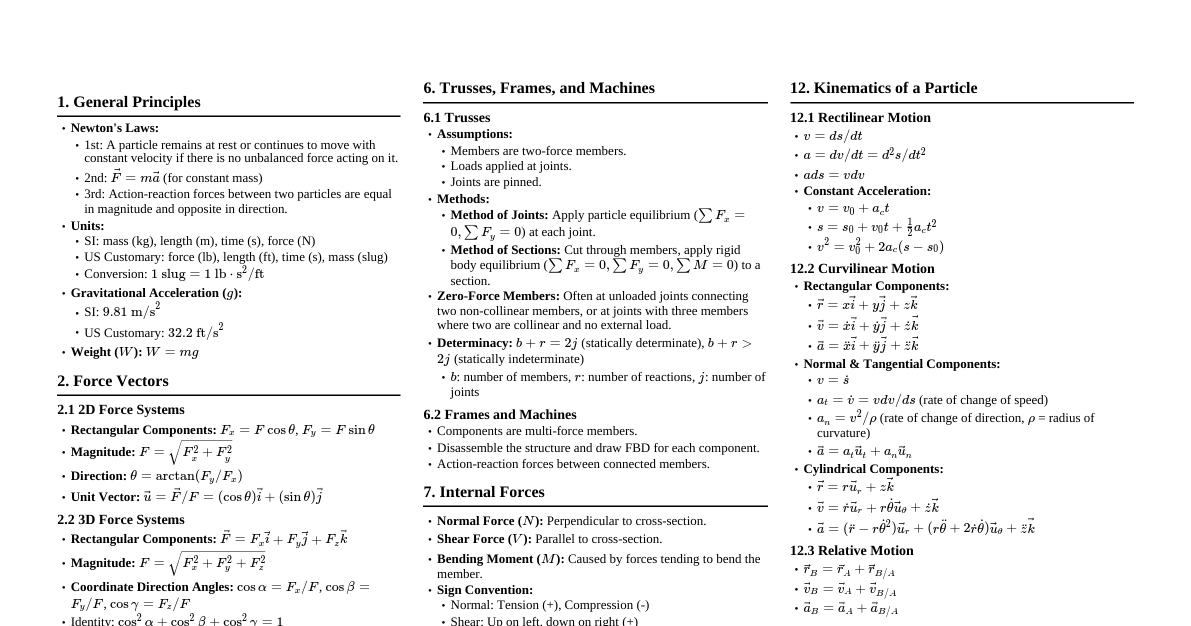
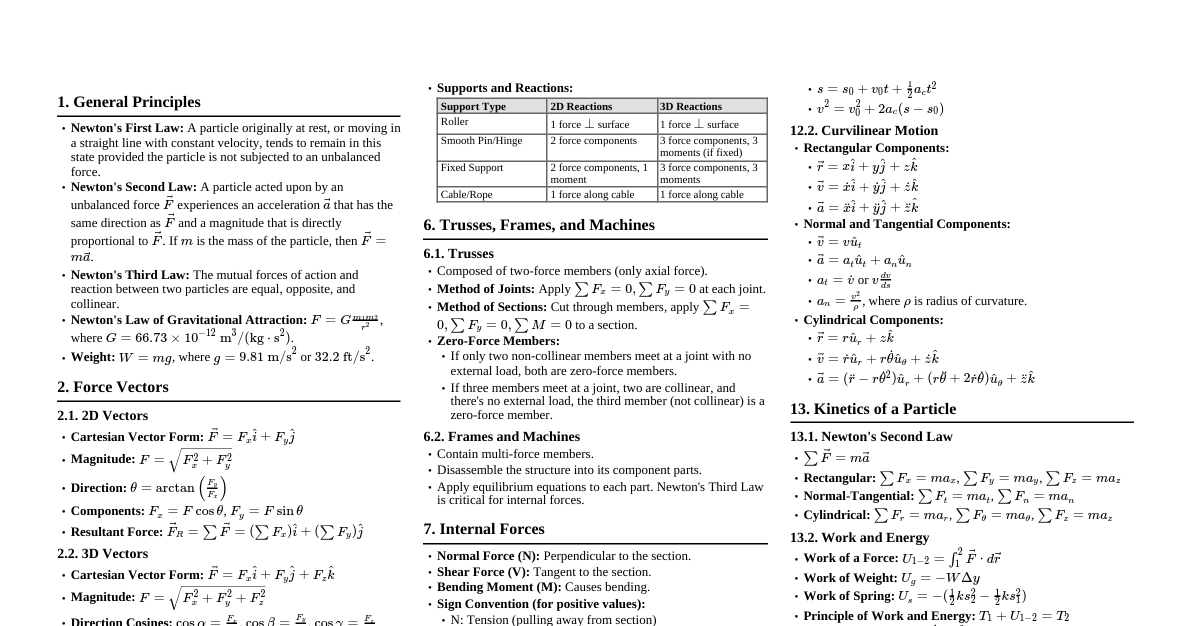
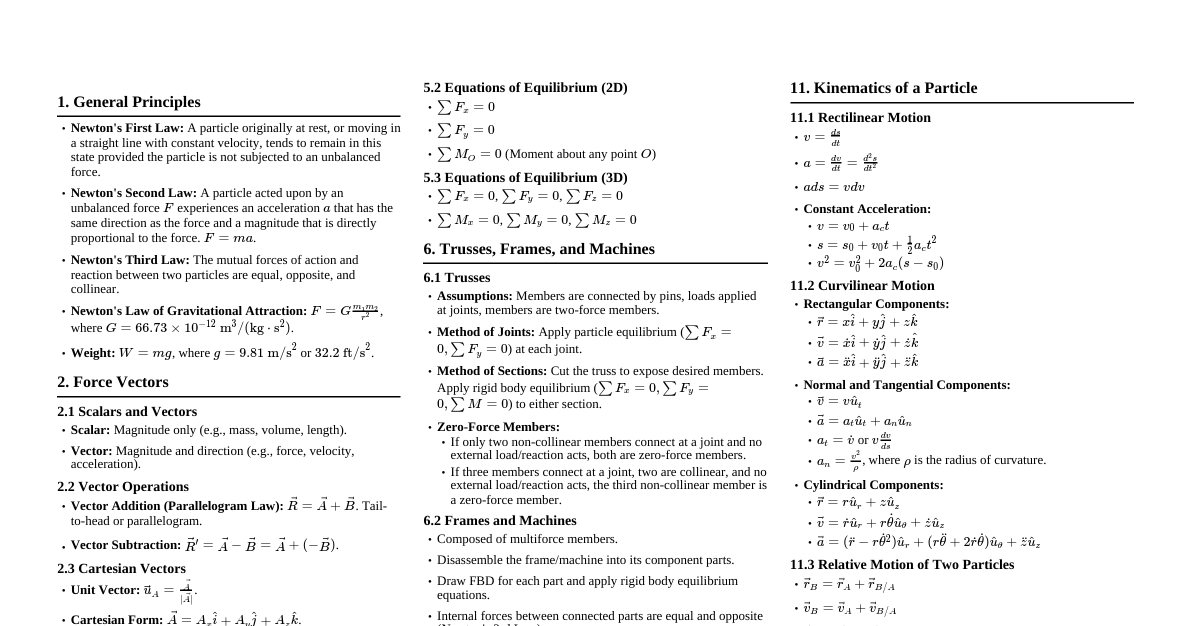
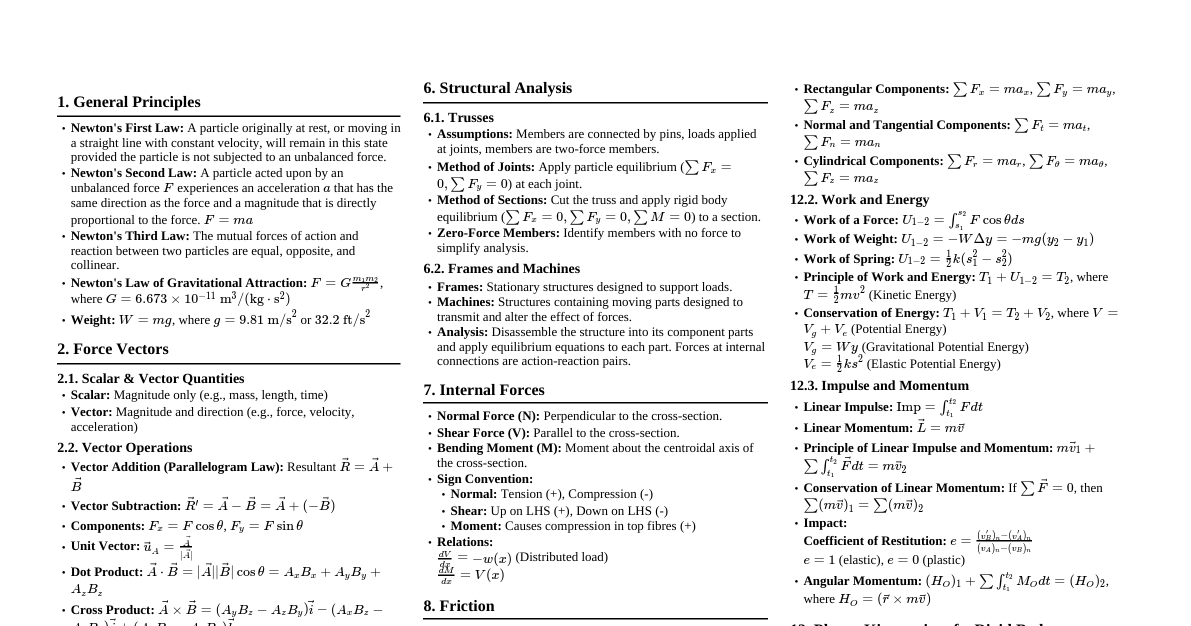
1. General Principles Newton's First Law: A particle originally at rest, or moving in a straight line with constant velocity, tends to remain in this state provided the particle is not subjected to an unbalanced force. Newton's Second Law: A particle acted upon by an unbalanced force $\vec{F}$ experiences an acceleration $\vec{a}$ that has the same direction as $\vec{F}$ and a magnitude that is directly proportional to $\vec{F}$. If $\vec{F}$ is applied to a particle of mass $m$, then $\vec{F} = m\vec{a}$. Newton's Third Law: The mutual forces of action and reaction between two particles are equal, opposite, and collinear. Units: SI: mass (kg), length (m), time (s), force (N) where $1 \text{ N} = 1 \text{ kg} \cdot \text{m/s}^2$ US Customary: force (lb), length (ft), time (s), mass (slug) where $1 \text{ slug} = 1 \text{ lb} \cdot \text{s}^2/\text{ft}$ Weight: $W = mg$, where $g = 9.81 \text{ m/s}^2$ or $32.2 \text{ ft/s}^2$. 2. Force Vectors 2.1. 2D Force Vectors Cartesian Components: $\vec{F} = F_x \hat{i} + F_y \hat{j}$ Magnitude: $F = \sqrt{F_x^2 + F_y^2}$ Direction: $\theta = \arctan(F_y/F_x)$ Resultant Force: $\vec{F}_R = \sum \vec{F}_x = (\sum F_x) \hat{i} + (\sum F_y) \hat{j}$ 2.2. 3D Force Vectors Cartesian Components: $\vec{F} = F_x \hat{i} + F_y \hat{j} + F_z \hat{k}$ Magnitude: $F = \sqrt{F_x^2 + F_y^2 + F_z^2}$ Direction Cosines: $\cos \alpha = F_x/F$, $\cos \beta = F_y/F$, $\cos \gamma = F_z/F$ $\cos^2 \alpha + \cos^2 \beta + \cos^2 \gamma = 1$ Unit Vector: $\vec{u}_F = \vec{F}/F = \cos \alpha \hat{i} + \cos \beta \hat{j} + \cos \gamma \hat{k}$ Force from two points: $\vec{r} = (x_B - x_A)\hat{i} + (y_B - y_A)\hat{j} + (z_B - z_A)\hat{k}$ $\vec{F} = F \vec{u}_{AB} = F (\vec{r}/r)$ 2.3. Dot Product $\vec{A} \cdot \vec{B} = AB \cos \theta$ $\vec{A} \cdot \vec{B} = A_x B_x + A_y B_y + A_z B_z$ Angle between vectors: $\theta = \arccos \left( \frac{\vec{A} \cdot \vec{B}}{AB} \right)$ Projection of $\vec{A}$ onto $\vec{B}$: $A_B = \vec{A} \cdot \vec{u}_B$ $\vec{A}_B = (A_B) \vec{u}_B = (\vec{A} \cdot \vec{u}_B) \vec{u}_B$ 3. Equilibrium of a Particle Condition: $\sum \vec{F} = 0$ 2D: $\sum F_x = 0$, $\sum F_y = 0$ 3D: $\sum F_x = 0$, $\sum F_y = 0$, $\sum F_z = 0$ Free-Body Diagram (FBD): Essential for identifying all forces acting on the particle. 4. Force System Resultants 4.1. Cross Product $\vec{C} = \vec{A} \times \vec{B}$ Magnitude: $C = AB \sin \theta$ Direction: Right-hand rule Cartesian: $\vec{A} \times \vec{B} = (A_y B_z - A_z B_y)\hat{i} - (A_x B_z - A_z B_x)\hat{j} + (A_x B_y - A_y B_x)\hat{k}$ Determinant form: $$ \begin{vmatrix} \hat{i} & \hat{j} & \hat{k} \\ A_x & A_y & A_z \\ B_x & B_y & B_z \end{vmatrix} $$ 4.2. Moment of a Force (Torque) Scalar (2D): $M_O = Fd$, where $d$ is perpendicular distance. Counter-clockwise is positive. Vector (3D): $\vec{M}_O = \vec{r} \times \vec{F}$ Varignon's Theorem: The moment of a force about a point is equal to the sum of the moments of the force's components about the point. $\vec{M}_O = \vec{r} \times (\vec{F}_1 + \vec{F}_2) = \vec{r} \times \vec{F}_1 + \vec{r} \times \vec{F}_2$ 4.3. Moment of a Couple $\vec{M} = \vec{r} \times \vec{F}$ (where $\vec{r}$ is from negative to positive force) Magnitude: $M = Fd$ 4.4. Reduction of a Simple Distributed Loading Resultant Force: $F_R = \int_L w(x) dx$ (Area under the loading curve) Location of Resultant: $\bar{x} = \frac{\int_L x w(x) dx}{\int_L w(x) dx}$ (Centroid of the area) 5. Equilibrium of a Rigid Body Conditions: $\sum \vec{F} = 0$ and $\sum \vec{M}_O = 0$ 2D (Coplanar): $\sum F_x = 0$ $\sum F_y = 0$ $\sum M_O = 0$ 3D: $\sum F_x = 0$, $\sum F_y = 0$, $\sum F_z = 0$ $\sum M_x = 0$, $\sum M_y = 0$, $\sum M_z = 0$ Supports: Properly identify reaction forces and moments from support types (e.g., roller, pin, fixed). 6. Structural Analysis 6.1. Trusses Assumptions: Members are two-force members, loads applied at joints. Method of Joints: Apply particle equilibrium ($\sum F_x=0, \sum F_y=0$) at each joint. Method of Sections: Cut through members, apply rigid body equilibrium ($\sum F_x=0, \sum F_y=0, \sum M=0$) to a section. Zero-Force Members: Two non-collinear members at an unloaded joint $\implies$ both are zero-force. Three members, two collinear, at an unloaded joint $\implies$ the third is zero-force. 6.2. Frames and Machines Composed of multi-force members. Disassemble the structure into its component parts. Draw FBD for each part. Apply rigid body equilibrium to each part. 7. Internal Forces Normal Force ($N$): Perpendicular to the cross-section. Shear Force ($V$): Tangent to the cross-section. Bending Moment ($M$): Moment about an axis in the cross-section. Sign Convention: Standard positive directions for $N, V, M$. Shear and Moment Diagrams: $dV/dx = w(x)$ (slope of shear diagram = distributed load) $dM/dx = V(x)$ (slope of moment diagram = shear force) $\Delta V = \int w(x) dx$ (change in shear = area under load curve) $\Delta M = \int V(x) dx$ (change in moment = area under shear curve) 8. Friction Static Friction: $F_s \le \mu_s N$ Kinetic Friction: $F_k = \mu_k N$ $\mu_s > \mu_k$ Angle of Static Friction: $\tan \phi_s = F_s/N = \mu_s$ Wedges: Often involve friction on multiple surfaces. Belts: $T_2 = T_1 e^{\mu \beta}$, where $\beta$ is angle of contact in radians. 9. Center of Gravity and Centroid Center of Gravity: Point where the entire weight of the body acts. $\bar{x} = \frac{\int \bar{x}_{el} dW}{\int dW}$, $\bar{y} = \frac{\int \bar{y}_{el} dW}{\int dW}$, $\bar{z} = \frac{\int \bar{z}_{el} dW}{\int dW}$ Centroid (Area): $\bar{x} = \frac{\int \bar{x}_{el} dA}{\int dA}$, $\bar{y} = \frac{\int \bar{y}_{el} dA}{\int dA}$ For composite areas: $\bar{x} = \frac{\sum \bar{x}_i A_i}{\sum A_i}$, $\bar{y} = \frac{\sum \bar{y}_i A_i}{\sum A_i}$ Centroid (Volume): $\bar{x} = \frac{\int \bar{x}_{el} dV}{\int dV}$, etc. For composite volumes: $\bar{x} = \frac{\sum \bar{x}_i V_i}{\sum V_i}$, etc. Theorems of Pappus and Guldinus: Area of Surface of Revolution: $A = \theta \bar{r} L$ Volume of Body of Revolution: $V = \theta \bar{r} A$ 10. Moments of Inertia 10.1. Area Moment of Inertia $I_x = \int y^2 dA$, $I_y = \int x^2 dA$ Polar Moment of Inertia: $J_O = \int r^2 dA = I_x + I_y$ Parallel-Axis Theorem: $I = \bar{I} + Ad^2$ Radius of Gyration: $k = \sqrt{I/A}$ 10.2. Mass Moment of Inertia $I = \int r^2 dm$ Parallel-Axis Theorem: $I = \bar{I} + md^2$ 11. Virtual Work Principle of Virtual Work: For a body in equilibrium, the virtual work done by all external forces and couples acting on the body is zero for any virtual displacement consistent with the constraints. $\delta U = 0$. $\sum F_x \delta x + \sum F_y \delta y + \sum M \delta \theta = 0$ Used to find equilibrium positions or reaction forces without disassembling structures. 12. Kinematics of a Particle 12.1. Rectilinear Motion $v = ds/dt$ $a = dv/dt = d^2s/dt^2$ $a ds = v dv$ Constant Acceleration: $v = v_0 + a_c t$ $s = s_0 + v_0 t + \frac{1}{2} a_c t^2$ $v^2 = v_0^2 + 2 a_c (s - s_0)$ 12.2. Curvilinear Motion Rectangular Components: $\vec{r} = x\hat{i} + y\hat{j} + z\hat{k}$ $\vec{v} = \dot{x}\hat{i} + \dot{y}\hat{j} + \dot{z}\hat{k}$ $\vec{a} = \ddot{x}\hat{i} + \ddot{y}\hat{j} + \ddot{z}\hat{k}$ Normal and Tangential Components: $\vec{v} = v \hat{u}_t$ $\vec{a} = \dot{v} \hat{u}_t + \frac{v^2}{\rho} \hat{u}_n$ $\rho$ = radius of curvature Cylindrical Components: $\vec{r} = r \hat{u}_r + z \hat{k}$ $\vec{v} = \dot{r} \hat{u}_r + r \dot{\theta} \hat{u}_\theta + \dot{z} \hat{k}$ $\vec{a} = (\ddot{r} - r \dot{\theta}^2) \hat{u}_r + (r \ddot{\theta} + 2 \dot{r} \dot{\theta}) \hat{u}_\theta + \ddot{z} \hat{k}$ 12.3. Relative Motion $\vec{r}_{B/A} = \vec{r}_B - \vec{r}_A$ $\vec{v}_B = \vec{v}_A + \vec{v}_{B/A}$ $\vec{a}_B = \vec{a}_A + \vec{a}_{B/A}$ 13. Kinetics of a Particle 13.1. Equation of Motion $\sum \vec{F} = m\vec{a}$ Rectangular: $\sum F_x = m a_x$, $\sum F_y = m a_y$, $\sum F_z = m a_z$ Normal/Tangential: $\sum F_t = m a_t$, $\sum F_n = m a_n = m (v^2/\rho)$ Cylindrical: $\sum F_r = m a_r$, $\sum F_\theta = m a_\theta$, $\sum F_z = m a_z$ 13.2. Work and Energy Work of a Force: $U_{1-2} = \int \vec{F} \cdot d\vec{r}$ Kinetic Energy: $T = \frac{1}{2} m v^2$ Principle of Work and Energy: $T_1 + U_{1-2} = T_2$ Conservation of Energy: $T_1 + V_1 = T_2 + V_2$ (if only conservative forces) Gravitational Potential Energy: $V_g = W y$ Elastic Potential Energy: $V_e = \frac{1}{2} k s^2$ 13.3. Impulse and Momentum Linear Impulse: $\vec{I} = \int \vec{F} dt$ Linear Momentum: $\vec{L} = m\vec{v}$ Principle of Linear Impulse and Momentum: $m\vec{v}_1 + \sum \int_{t_1}^{t_2} \vec{F} dt = m\vec{v}_2$ Conservation of Linear Momentum: $\sum m\vec{v}_1 = \sum m\vec{v}_2$ (if no external impulses) Impact: Coefficient of Restitution: $e = \frac{(v_B)_2 - (v_A)_2}{(v_A)_1 - (v_B)_1}$ $e=1$ (elastic), $e=0$ (plastic) Angular Impulse: $\int \vec{M}_O dt$ Angular Momentum: $\vec{H}_O = \vec{r} \times m\vec{v}$ Principle of Angular Impulse and Momentum: $(\vec{H}_O)_1 + \sum \int_{t_1}^{t_2} \vec{M}_O dt = (\vec{H}_O)_2$ Conservation of Angular Momentum: $(\vec{H}_O)_1 = (\vec{H}_O)_2$ (if no external moments)