Aptitude: Percentages
Shared 4/5/2026•119 views
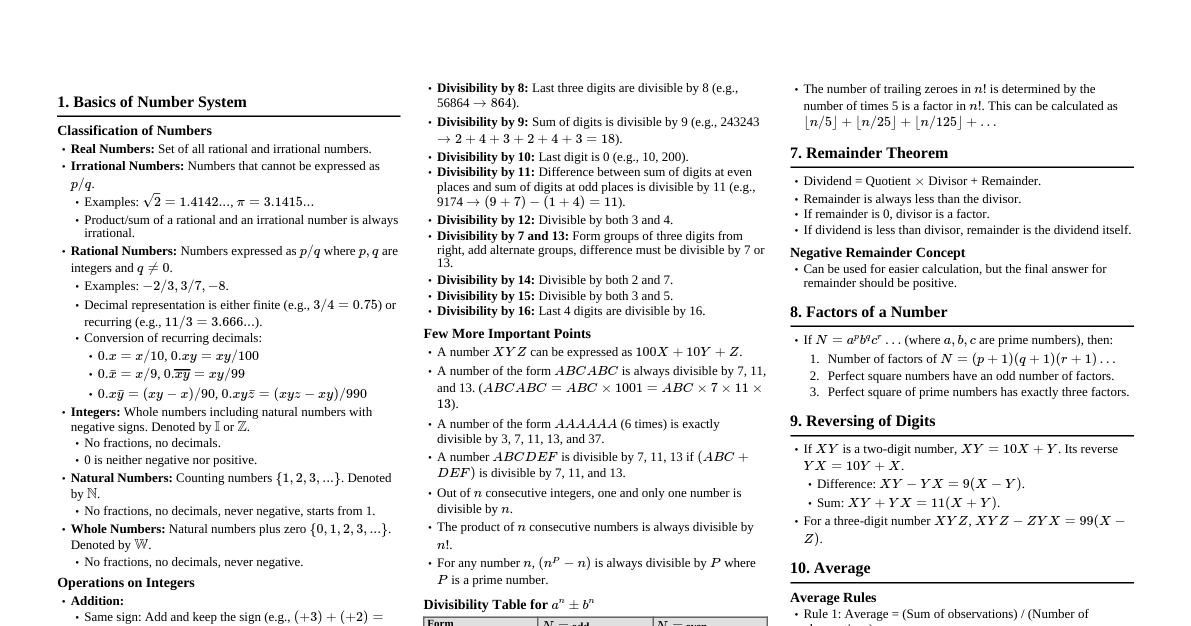
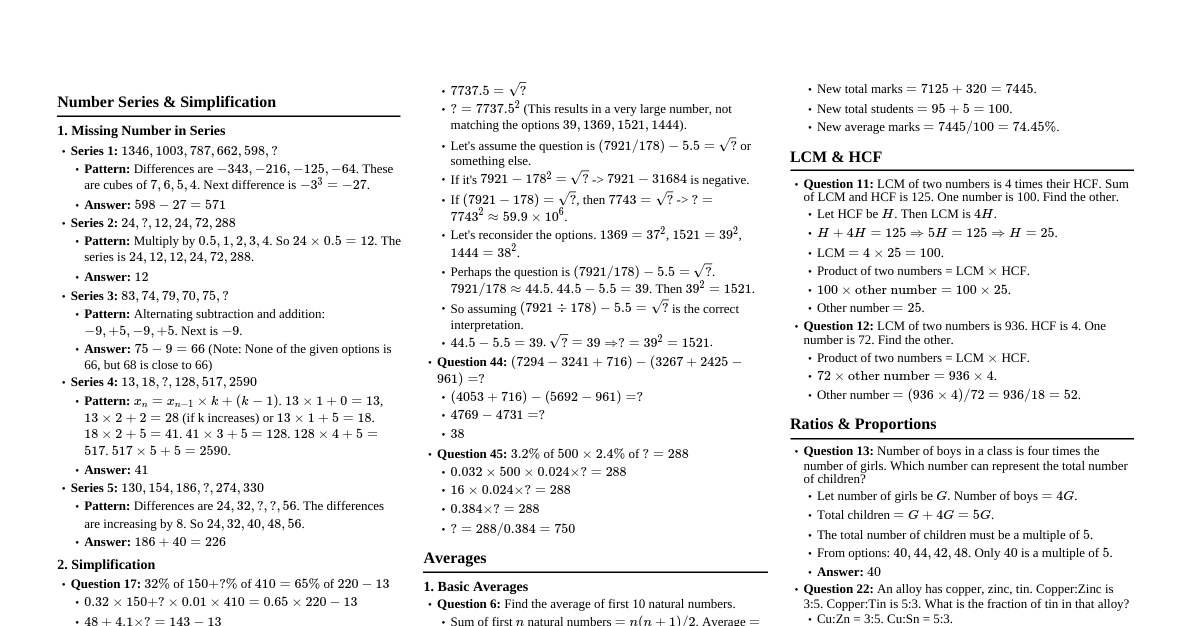
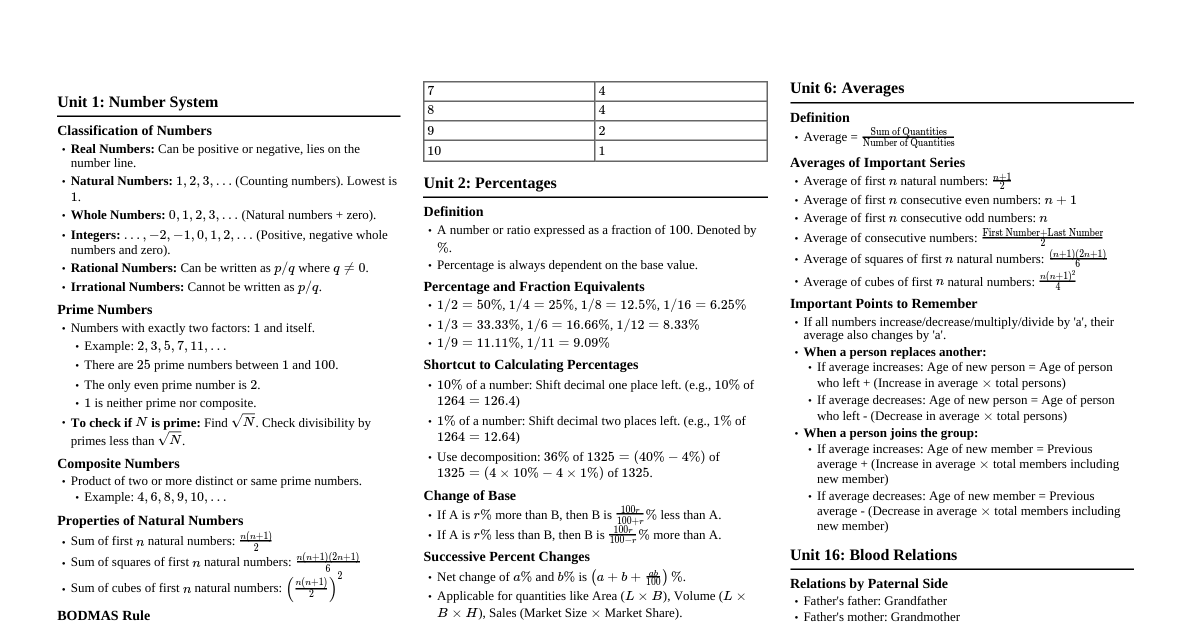
### Introduction to Percentages - **Definition:** A percentage is a number or ratio expressed as a fraction of 100. It is often denoted using the percent sign "%". - **Meaning:** "Per cent" means "per hundred". - **Basic Formula:** Percentage = (Value / Total Value) * 100 #### Converting Between Forms - **Fraction to Percentage:** Multiply by 100. - Example: $1/4 = (1/4) * 100 = 25\%$ - **Decimal to Percentage:** Multiply by 100. - Example: $0.75 = 0.75 * 100 = 75\%$ - **Percentage to Fraction:** Divide by 100. - Example: $50\% = 50/100 = 1/2$ - **Percentage to Decimal:** Divide by 100. - Example: $25\% = 25/100 = 0.25$ #### Key Percentage Equivalents (Memorize these!) | Fraction | Percentage | Decimal | |----------|------------|---------| | 1/1 | 100% | 1.0 | | 1/2 | 50% | 0.5 | | 1/3 | 33.33% | 0.333...| | 1/4 | 25% | 0.25 | | 1/5 | 20% | 0.2 | | 1/6 | 16.66% | 0.166...| | 1/7 | 14.28% | 0.1428..| | 1/8 | 12.5% | 0.125 | | 1/9 | 11.11% | 0.111...| | 1/10 | 10% | 0.1 | | 1/11 | 9.09% | 0.0909..| | 1/12 | 8.33% | 0.0833..| ### Percentage Calculations #### 1. Finding a Percentage of a Number - **Formula:** $X\%$ of $Y = (X/100) * Y$ - **Example:** Find $20\%$ of $300$. - $(20/100) * 300 = 0.20 * 300 = 60$ #### 2. Expressing One Quantity as a Percentage of Another - **Formula:** $(Quantity_1 / Quantity_2) * 100\%$ - **Example:** What percentage of $500$ is $125$? - $(125 / 500) * 100\% = (1/4) * 100\% = 25\%$ #### 3. Percentage Increase / Decrease - **Percentage Increase:** - Formula: $[(New Value - Original Value) / Original Value] * 100\%$ - Example: Price increased from $200 to $250. - $[(250 - 200) / 200] * 100\% = (50 / 200) * 100\% = 25\%$ - **Percentage Decrease:** - Formula: $[(Original Value - New Value) / Original Value] * 100\%$ - Example: Price decreased from $200 to $150. - $[(200 - 150) / 200] * 100\% = (50 / 200) * 100\% = 25\%$ #### 4. Finding the Original Value - If a number $N$ is $X\%$ of an unknown original number $O$: - Formula: $O = (N / X) * 100$ - **Example:** $60$ is $20\%$ of what number? - $O = (60 / 20) * 100 = 3 * 100 = 300$ #### 5. Successive Percentage Changes - If a value is first increased/decreased by $A\%$ and then by $B\%$. - **Net Change Formula (for two changes):** $A + B + (A*B/100)$ - Use positive values for increase, negative for decrease. - **Example:** Price increased by $10\%$, then decreased by $20\%$. - Net change = $10 + (-20) + (10 * -20 / 100) = -10 - 2 = -12\%$ (12% decrease) - **Alternative Method (Multiplier):** - Increase by $X\% \implies$ Multiply by $(1 + X/100)$ - Decrease by $X\% \implies$ Multiply by $(1 - X/100)$ - Final Value = Original Value * $(1 \pm A/100)$ * $(1 \pm B/100)$ * ... - Example: Original price $P$. Increased by $10\%$ then decreased by $20\%$. - Final Price = $P * (1 + 10/100) * (1 - 20/100) = P * (1.10) * (0.80) = 0.88 P$ - Net change = $(0.88P - P)/P * 100\% = -0.12 * 100\% = -12\%$ ### Applications of Percentages #### 1. Profit and Loss - **Cost Price (CP):** The price at which an article is bought. - **Selling Price (SP):** The price at which an article is sold. - **Profit:** $SP > CP \implies Profit = SP - CP$ - **Loss:** $CP > SP \implies Loss = CP - SP$ - **Profit Percentage:** $(Profit / CP) * 100\%$ - **Loss Percentage:** $(Loss / CP) * 100\%$ - **Important:** Profit/Loss % is always calculated on CP. #### 2. Discounts - **Marked Price (MP):** The price listed on the article. - **Discount:** Reduction offered on the Marked Price. - **Selling Price:** $SP = MP - Discount$ - **Discount Percentage:** $(Discount / MP) * 100\%$ - **Important:** Discount % is always calculated on MP. #### 3. Simple Interest - **Formula:** $SI = (P * R * T) / 100$ - $P$ = Principal amount - $R$ = Rate of interest (per annum) - $T$ = Time (in years) - **Amount (A):** $A = P + SI$ #### 4. Compound Interest - **Formula:** $A = P * (1 + R/100)^T$ - $P$ = Principal amount - $R$ = Rate of interest (per annum) - $T$ = Time (in years) - **Compound Interest (CI):** $CI = A - P$ - **Note:** If compounded half-yearly, $R$ becomes $R/2$ and $T$ becomes $2T$. - **Note:** If compounded quarterly, $R$ becomes $R/4$ and $T$ becomes $4T$. #### 5. Population Growth/Depreciation - Similar to compound interest. - **Growth:** $P_{final} = P_{initial} * (1 + R/100)^T$ - **Depreciation:** $P_{final} = P_{initial} * (1 - R/100)^T$ #### 6. Elections and Votes - Total Votes = Valid Votes + Invalid Votes - Votes for Candidate A = $X\%$ of Valid Votes - Votes for Candidate B = $Y\%$ of Valid Votes #### 7. Mixtures and Solutions - Percentage of component = (Amount of component / Total amount of mixture) * 100% #### 8. Income, Expenditure, and Savings - Income = Expenditure + Savings - Often, components are given as percentages of income. #### 9. Data Interpretation - Percentages are frequently used in charts (pie, bar) and tables to represent proportions. - Pay attention to the base value for percentage calculations. ### Tricks and Tips for Faster Calculation #### 1. Use Fractions for Common Percentages - $25\%$ of $80 = 1/4 * 80 = 20$ - $33.33\%$ of $90 = 1/3 * 90 = 30$ #### 2. Break Down Complex Percentages - $15\%$ of $200 = (10\% + 5\%)$ of $200$ - $10\%$ of $200 = 20$ - $5\%$ of $200 = 10$ - Total = $20 + 10 = 30$ - $99\%$ of $500 = (100\% - 1\%)$ of $500$ - $100\%$ of $500 = 500$ - $1\%$ of $500 = 5$ - Total = $500 - 5 = 495$ #### 3. The "Of" Rule - $X\%$ of $Y$ is the same as $Y\%$ of $X$. - Example: $16\%$ of $25 = 25\%$ of $16 = 1/4 * 16 = 4$. - This can simplify calculations significantly! #### 4. Base Value Change - If $A$ is $X\%$ more than $B$, then $B$ is NOT $X\%$ less than $A$. - If $A = B * (1 + X/100)$, then $B = A / (1 + X/100)$. - **Example:** If $A$ is $25\%$ more than $B$. Then $A = B * 1.25$. - To find how much percent $B$ is less than $A$: - $B = A / 1.25 = A * (4/5) = 0.8 A$. - $B$ is $0.2 A$ less than $A$, which is $20\%$ less than $A$. - **General Rule:** If $A$ is $X\%$ more than $B$, then $B$ is $[X / (100+X)] * 100\%$ less than $A$. - **General Rule:** If $A$ is $X\%$ less than $B$, then $B$ is $[X / (100-X)] * 100\%$ more than $A$. #### 5. Approximation - For competitive exams, sometimes approximating percentages can save time. - Example: Find $19.8\%$ of $403$. - Approx $20\%$ of $400 = 80$. (Actual: $0.198 * 403 \approx 79.794$) - Be careful with approximation and check options. #### 6. Visualizing with Ratios - A $20\%$ increase means the new value is $120\%$ of the original, or $6/5$ times the original. - A $25\%$ decrease means the new value is $75\%$ of the original, or $3/4$ times the original. ### Practice Examples #### Example 1: Basic Calculation - **Question:** What is $30\%$ of $150$? - **Solution:** $(30/100) * 150 = 0.30 * 150 = 45$. #### Example 2: Percentage Increase - **Question:** A person's salary increased from $5000 to $6000. What is the percentage increase? - **Solution:** - Increase = $6000 - 5000 = 1000$ - Percentage Increase = $(1000 / 5000) * 100\% = (1/5) * 100\% = 20\%$. #### Example 3: Successive Percentage Change - **Question:** The price of an item is $400. It is first increased by $10\%$ and then decreased by $10\%$. What is the final price? - **Solution (Multiplier Method):** - Final Price = $400 * (1 + 10/100) * (1 - 10/100)$ - Final Price = $400 * (1.10) * (0.90)$ - Final Price = $400 * 0.99 = 396$. - **Note:** A $10\%$ increase followed by a $10\%$ decrease does NOT result in the original price. Net change: $10 + (-10) + (10 * -10 / 100) = 0 - 1 = -1\%$. So, $1\%$ decrease. #### Example 4: Finding Original Value after Discount - **Question:** After a $20\%$ discount, a shirt costs $400. What was the original price of the shirt? - **Solution:** - If there is a $20\%$ discount, the selling price is $100\% - 20\% = 80\%$ of the original price. - Let original price be $P$. - $0.80 * P = 400$ - $P = 400 / 0.80 = 400 / (4/5) = 400 * (5/4) = 100 * 5 = 500$. - Original price was $500. #### Example 5: Profit and Loss - **Question:** A shopkeeper sells an item for $600, making a profit of $20\%$. What was the cost price of the item? - **Solution:** - If profit is $20\%$, then Selling Price (SP) is $100\% + 20\% = 120\%$ of Cost Price (CP). - $1.20 * CP = 600$ - $CP = 600 / 1.20 = 600 / (6/5) = 600 * (5/6) = 100 * 5 = 500$. - Cost price was $500.