Trigonometry - Grade 12
Cheatsheet Content
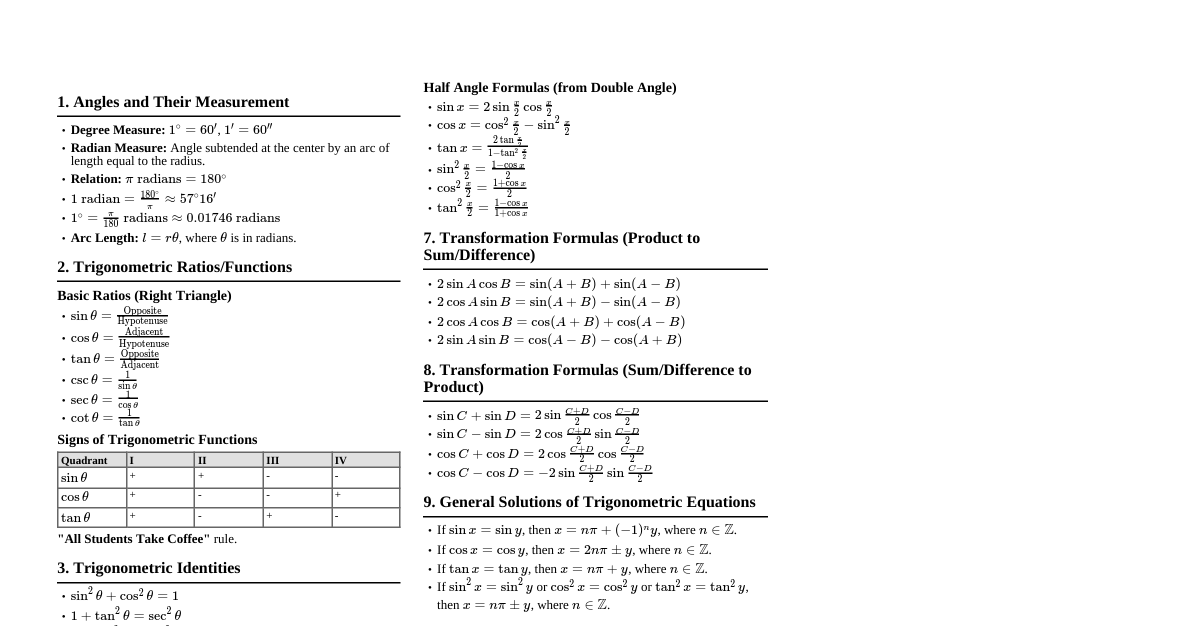
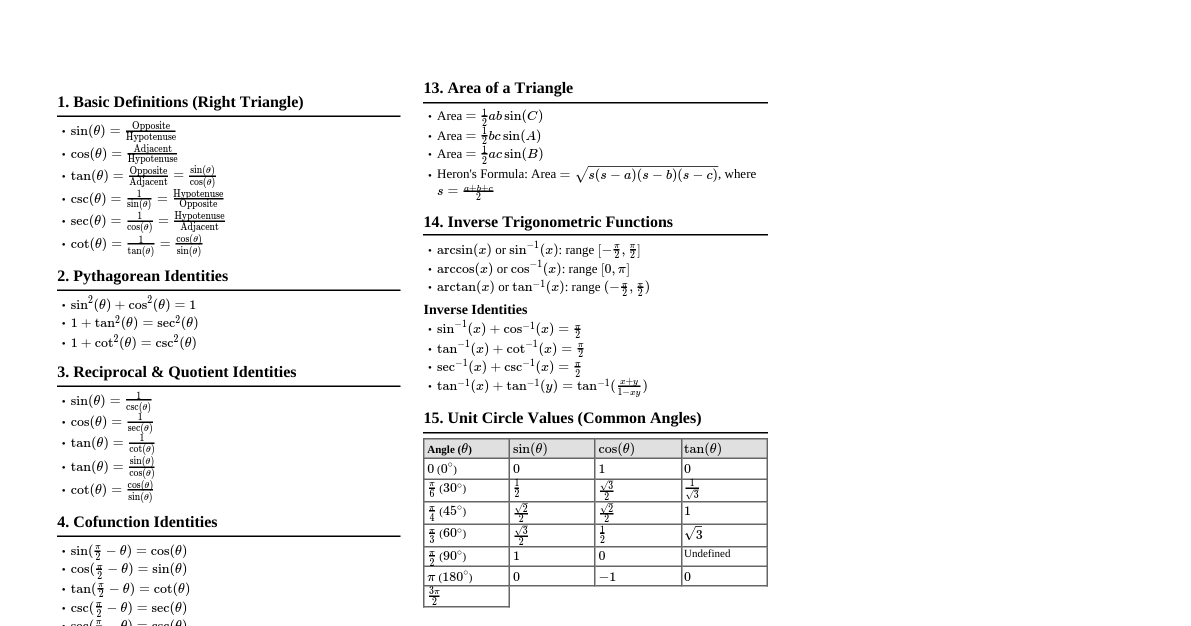
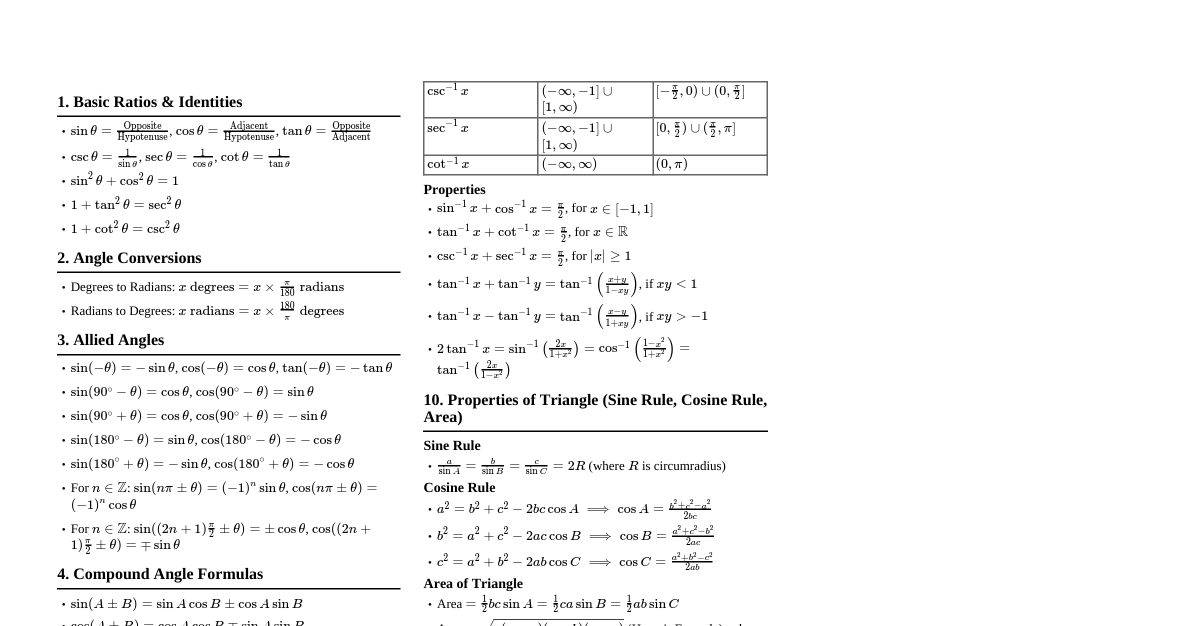
### Basic Definitions - **SOH CAH TOA:** - $\sin(\theta) = \frac{\text{Opposite}}{\text{Hypotenuse}}$ - $\cos(\theta) = \frac{\text{Adjacent}}{\text{Hypotenuse}}$ - $\tan(\theta) = \frac{\text{Opposite}}{\text{Adjacent}}$ - **Reciprocal Ratios:** - $\csc(\theta) = \frac{1}{\sin(\theta)}$ - $\sec(\theta) = \frac{1}{\cos(\theta)}$ - $\cot(\theta) = \frac{1}{\tan(\theta)}$ - **Tangent Identity:** $\tan(\theta) = \frac{\sin(\theta)}{\cos(\theta)}$ ### Pythagorean Identities - $\sin^2(\theta) + \cos^2(\theta) = 1$ - $1 + \tan^2(\theta) = \sec^2(\theta)$ - $1 + \cot^2(\theta) = \csc^2(\theta)$ ### Unit Circle - A circle with radius 1 centered at the origin $(0,0)$. - For any point $(x,y)$ on the unit circle, $x = \cos(\theta)$ and $y = \sin(\theta)$, where $\theta$ is the angle from the positive x-axis. #### Special Angles (in Radians and Degrees) | $\theta$ (rad) | $\theta$ (deg) | $\sin(\theta)$ | $\cos(\theta)$ | $\tan(\theta)$ | |:--------------:|:--------------:|:--------------:|:--------------:|:--------------:| | $0$ | $0^\circ$ | $0$ | $1$ | $0$ | | $\frac{\pi}{6}$| $30^\circ$ | $\frac{1}{2}$ | $\frac{\sqrt{3}}{2}$ | $\frac{1}{\sqrt{3}}$ | | $\frac{\pi}{4}$| $45^\circ$ | $\frac{\sqrt{2}}{2}$ | $\frac{\sqrt{2}}{2}$ | $1$ | | $\frac{\pi}{3}$| $60^\circ$ | $\frac{\sqrt{3}}{2}$ | $\frac{1}{2}$ | $\sqrt{3}$ | | $\frac{\pi}{2}$| $90^\circ$ | $1$ | $0$ | Undefined | | $\pi$ | $180^\circ$ | $0$ | $-1$ | $0$ | | $\frac{3\pi}{2}$| $270^\circ$ | $-1$ | $0$ | Undefined | | $2\pi$ | $360^\circ$ | $0$ | $1$ | $0$ | ### Quadrants and Signs - **All Students Take Calculus (ASTC) Rule:** - **A**ll positive in Quadrant I - **S**in positive in Quadrant II - **T**an positive in Quadrant III - **C**os positive in Quadrant IV | Quadrant | $\sin(\theta)$ | $\cos(\theta)$ | $\tan(\theta)$ | |:--------:|:--------------:|:--------------:|:--------------:| | I | $+$ | $+$ | $+$ | | II | $+$ | $-$ | $-$ | | III | $-$ | $-$ | $+$ | | IV | $-$ | $+$ | $-$ | ### Compound Angle Formulas - $\sin(A \pm B) = \sin A \cos B \pm \cos A \sin B$ - $\cos(A \pm B) = \cos A \cos B \mp \sin A \sin B$ - $\tan(A \pm B) = \frac{\tan A \pm \tan B}{1 \mp \tan A \tan B}$ ### Double Angle Formulas - $\sin(2A) = 2 \sin A \cos A$ - $\cos(2A) = \cos^2 A - \sin^2 A$ - $\cos(2A) = 2 \cos^2 A - 1$ - $\cos(2A) = 1 - 2 \sin^2 A$ - $\tan(2A) = \frac{2 \tan A}{1 - \tan^2 A}$ ### Half Angle Formulas - $\sin^2(\frac{A}{2}) = \frac{1 - \cos A}{2}$ - $\cos^2(\frac{A}{2}) = \frac{1 + \cos A}{2}$ - $\tan(\frac{A}{2}) = \frac{1 - \cos A}{\sin A} = \frac{\sin A}{1 + \cos A}$ ### Product-to-Sum Formulas - $2 \sin A \cos B = \sin(A+B) + \sin(A-B)$ - $2 \cos A \sin B = \sin(A+B) - \sin(A-B)$ - $2 \cos A \cos B = \cos(A+B) + \cos(A-B)$ - $2 \sin A \sin B = \cos(A-B) - \cos(A+B)$ ### Sum-to-Product Formulas - $\sin A + \sin B = 2 \sin\left(\frac{A+B}{2}\right)\cos\left(\frac{A-B}{2}\right)$ - $\sin A - \sin B = 2 \cos\left(\frac{A+B}{2}\right)\sin\left(\frac{A-B}{2}\right)$ - $\cos A + \cos B = 2 \cos\left(\frac{A+B}{2}\right)\cos\left(\frac{A-B}{2}\right)$ - $\cos A - \cos B = -2 \sin\left(\frac{A+B}{2}\right)\sin\left(\frac{A-B}{2}\right)$ ### Solving Trigonometric Equations #### General Solutions - If $\sin x = \sin \alpha$: $x = n\pi + (-1)^n \alpha$, for integer $n$. - If $\cos x = \cos \alpha$: $x = 2n\pi \pm \alpha$, for integer $n$. - If $\tan x = \tan \alpha$: $x = n\pi + \alpha$, for integer $n$. #### Steps 1. Isolate the trigonometric function. 2. Find the reference angle. 3. Determine the quadrants where the function has the required sign. 4. Find all solutions in the given interval (usually $0 \le x ### Graphs of Trigonometric Functions #### General Form: $y = A \sin(B(x-C)) + D$ - **Amplitude:** $|A|$ (vertical stretch) - **Period:** $T = \frac{2\pi}{|B|}$ (horizontal stretch/compression) - **Phase Shift:** $C$ (horizontal translation, right if $C>0$, left if $C ### Inverse Trigonometric Functions #### $\arcsin(x)$ or $\sin^{-1}(x)$ - **Domain:** $[-1, 1]$ - **Range:** $[-\frac{\pi}{2}, \frac{\pi}{2}]$ #### $\arccos(x)$ or $\cos^{-1}(x)$ - **Domain:** $[-1, 1]$ - **Range:** $[0, \pi]$ #### $\arctan(x)$ or $\tan^{-1}(x)$ - **Domain:** $(-\infty, \infty)$ - **Range:** $(-\frac{\pi}{2}, \frac{\pi}{2})$ ### Sine Rule (Law of Sines) - For any triangle with sides $a, b, c$ and opposite angles $A, B, C$: $$\frac{a}{\sin A} = \frac{b}{\sin B} = \frac{c}{\sin C}$$ - Used to find: - An unknown side when two angles and one side are known (AAS or ASA). - An unknown angle when two sides and one non-included angle are known (SSA - ambiguous case possible). ### Cosine Rule (Law of Cosines) - For any triangle with sides $a, b, c$ and opposite angles $A, B, C$: $$a^2 = b^2 + c^2 - 2bc \cos A$$ $$b^2 = a^2 + c^2 - 2ac \cos B$$ $$c^2 = a^2 + b^2 - 2ab \cos C$$ - Used to find: - An unknown side when two sides and the included angle are known (SAS). - An unknown angle when all three sides are known (SSS). ### Area of a Triangle - Given two sides and the included angle (SAS): $$\text{Area} = \frac{1}{2}ab \sin C = \frac{1}{2}bc \sin A = \frac{1}{2}ac \sin B$$