Important Theorems
Cheatsheet Content
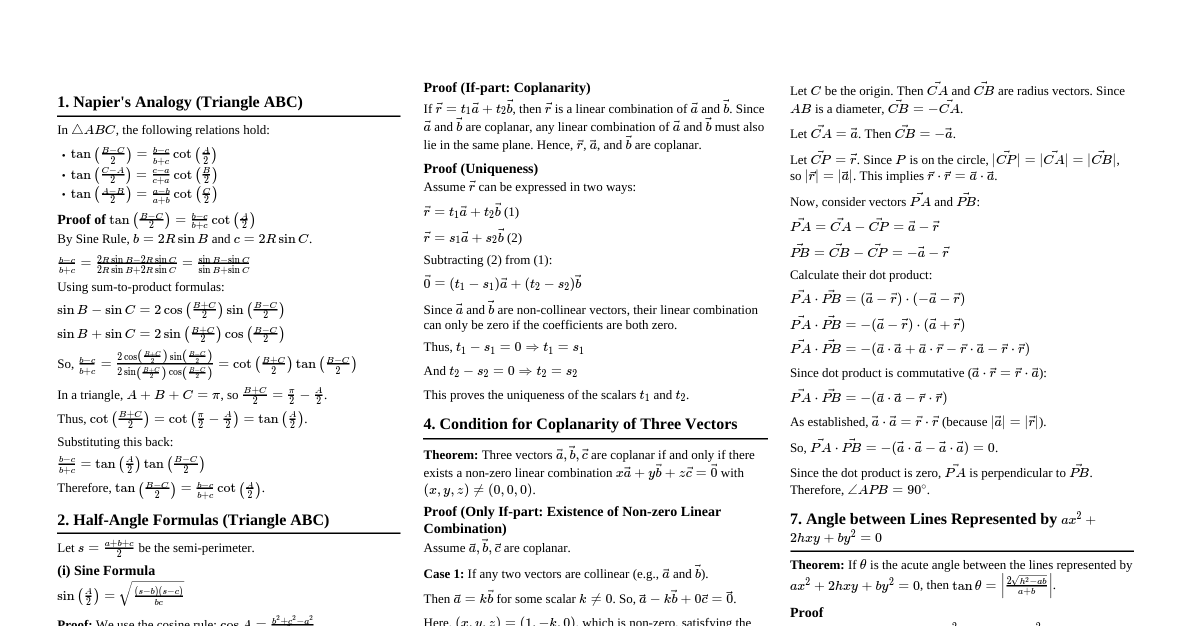
1. Napier's Analogy In $\triangle ABC$, $\tan\left(\frac{B-C}{2}\right) = \frac{b-c}{b+c} \cot\left(\frac{A}{2}\right)$ Proof: By sine rule, $b=2R\sin B$ and $c=2R\sin C$. $\frac{b-c}{b+c} = \frac{2R\sin B - 2R\sin C}{2R\sin B + 2R\sin C} = \frac{\sin B - \sin C}{\sin B + \sin C}$ Using sum-to-product formulas: $\frac{\sin B - \sin C}{\sin B + \sin C} = \frac{2\cos\left(\frac{B+C}{2}\right)\sin\left(\frac{B-C}{2}\right)}{2\sin\left(\frac{B+C}{2}\right)\cos\left(\frac{B-C}{2}\right)}$ $= \cot\left(\frac{B+C}{2}\right)\tan\left(\frac{B-C}{2}\right)$ Since $A+B+C=\pi$, $\frac{B+C}{2} = \frac{\pi}{2} - \frac{A}{2}$. So, $\cot\left(\frac{B+C}{2}\right) = \cot\left(\frac{\pi}{2} - \frac{A}{2}\right) = \tan\left(\frac{A}{2}\right)$. Thus, $\frac{b-c}{b+c} = \tan\left(\frac{A}{2}\right)\tan\left(\frac{B-C}{2}\right)$. Rearranging, $\tan\left(\frac{B-C}{2}\right) = \frac{b-c}{b+c} \cot\left(\frac{A}{2}\right)$. Similarly, we can prove: $\tan\left(\frac{C-A}{2}\right) = \frac{c-a}{c+a} \cot\left(\frac{B}{2}\right)$ $\tan\left(\frac{A-B}{2}\right) = \frac{a-b}{a+b} \cot\left(\frac{C}{2}\right)$ 2. Half-angle Formulae in $\triangle ABC$ If $a+b+c=2s$, then: (i) $\sin\left(\frac{A}{2}\right) = \sqrt{\frac{(s-b)(s-c)}{bc}}$ (ii) $\cos\left(\frac{A}{2}\right) = \sqrt{\frac{s(s-a)}{bc}}$ (iii) $\tan\left(\frac{A}{2}\right) = \sqrt{\frac{(s-b)(s-c)}{s(s-a)}}$ Proof for (i) $\sin\left(\frac{A}{2}\right)$ formula: We know $1 - \cos A = 2\sin^2\left(\frac{A}{2}\right)$. From the cosine rule, $\cos A = \frac{b^2+c^2-a^2}{2bc}$. $1 - \frac{b^2+c^2-a^2}{2bc} = 2\sin^2\left(\frac{A}{2}\right)$ $\frac{2bc - b^2 - c^2 + a^2}{2bc} = 2\sin^2\left(\frac{A}{2}\right)$ $\frac{a^2 - (b^2 - 2bc + c^2)}{2bc} = 2\sin^2\left(\frac{A}{2}\right)$ $\frac{a^2 - (b-c)^2}{2bc} = 2\sin^2\left(\frac{A}{2}\right)$ Using $X^2-Y^2=(X-Y)(X+Y)$: $\frac{(a-(b-c))(a+(b-c))}{2bc} = 2\sin^2\left(\frac{A}{2}\right)$ $\frac{(a-b+c)(a+b-c)}{2bc} = 2\sin^2\left(\frac{A}{2}\right)$ Since $a+b+c=2s$, we have: $a-b+c = (a+c-b) = (a+b+c) - 2b = 2s-2b = 2(s-b)$ $a+b-c = (a+b-c) = (a+b+c) - 2c = 2s-2c = 2(s-c)$ So, $\frac{2(s-b)2(s-c)}{2bc} = 2\sin^2\left(\frac{A}{2}\right)$ $\frac{4(s-b)(s-c)}{2bc} = 2\sin^2\left(\frac{A}{2}\right)$ $\sin^2\left(\frac{A}{2}\right) = \frac{(s-b)(s-c)}{bc}$ $\sin\left(\frac{A}{2}\right) = \sqrt{\frac{(s-b)(s-c)}{bc}}$ (Since $A/2$ is acute, $\sin(A/2)>0$). Proof for (ii) $\cos\left(\frac{A}{2}\right)$ formula: We know $1 + \cos A = 2\cos^2\left(\frac{A}{2}\right)$. $1 + \frac{b^2+c^2-a^2}{2bc} = 2\cos^2\left(\frac{A}{2}\right)$ $\frac{2bc + b^2 + c^2 - a^2}{2bc} = 2\cos^2\left(\frac{A}{2}\right)$ $\frac{(b+c)^2 - a^2}{2bc} = 2\cos^2\left(\frac{A}{2}\right)$ $\frac{(b+c-a)(b+c+a)}{2bc} = 2\cos^2\left(\frac{A}{2}\right)$ Since $a+b+c=2s$, we have: $b+c-a = (b+c+a) - 2a = 2s-2a = 2(s-a)$ $b+c+a = 2s$ So, $\frac{2s \cdot 2(s-a)}{2bc} = 2\cos^2\left(\frac{A}{2}\right)$ $\frac{4s(s-a)}{2bc} = 2\cos^2\left(\frac{A}{2}\right)$ $\cos^2\left(\frac{A}{2}\right) = \frac{s(s-a)}{bc}$ $\cos\left(\frac{A}{2}\right) = \sqrt{\frac{s(s-a)}{bc}}$ (Since $A/2$ is acute, $\cos(A/2)>0$). Proof for (iii) $\tan\left(\frac{A}{2}\right)$ formula: $\tan\left(\frac{A}{2}\right) = \frac{\sin(A/2)}{\cos(A/2)} = \frac{\sqrt{\frac{(s-b)(s-c)}{bc}}}{\sqrt{\frac{s(s-a)}{bc}}} = \sqrt{\frac{(s-b)(s-c)}{s(s-a)}}$ Similarly, formulae for $\sin(B/2)$, $\cos(B/2)$, $\tan(B/2)$, $\sin(C/2)$, $\cos(C/2)$, $\tan(C/2)$ can be derived by cyclic permutation. $\sin\left(\frac{B}{2}\right) = \sqrt{\frac{(s-a)(s-c)}{ac}}$ $\cos\left(\frac{B}{2}\right) = \sqrt{\frac{s(s-b)}{ac}}$ $\tan\left(\frac{B}{2}\right) = \sqrt{\frac{(s-a)(s-c)}{s(s-b)}}$ $\sin\left(\frac{C}{2}\right) = \sqrt{\frac{(s-a)(s-b)}{ab}}$ $\cos\left(\frac{C}{2}\right) = \sqrt{\frac{s(s-c)}{ab}}$ $\tan\left(\frac{C}{2}\right) = \sqrt{\frac{(s-a)(s-b)}{s(s-c)}}$ 3. Coplanarity of Vectors Theorem: If $\vec{a}$ and $\vec{b}$ are two non-zero and non-collinear vectors, then any vector $\vec{r}$ coplanar with $\vec{a}$ and $\vec{b}$ can be expressed as $\vec{r} = t_1\vec{a} + t_2\vec{b}$, where $t_1$ and $t_2$ are unique scalars. Proof: Only If-part: Assume $\vec{r}$ is coplanar with $\vec{a}$ and $\vec{b}$. Let $\vec{a}$ be along $OA$ and $\vec{b}$ along $OB$. Given a vector $\vec{r}$ with initial point $O$, let $OP=\vec{r}$. Draw lines parallel to $OB$ meeting $OA$ in $M$ and parallel to $OA$ meeting $OB$ in $N$. Then $\vec{ON} = t_2\vec{b}$ and $\vec{OM} = t_1\vec{a}$ for some $t_1, t_2 \in \mathbb{R}$. By triangle law or parallelogram law, we have $\vec{r} = t_1\vec{a} + t_2\vec{b}$. O A B P M N t₁a t₂b r If-part: Suppose $\vec{r} = t_1\vec{a} + t_2\vec{b}$. Since $\vec{a}$ and $\vec{b}$ are coplanar, $t_1\vec{a}$ and $t_2\vec{b}$ are also coplanar. Therefore, their sum $t_1\vec{a} + t_2\vec{b} = \vec{r}$ is also coplanar with $\vec{a}$ and $\vec{b}$. Uniqueness: Suppose $\vec{r}$ can also be written as $\vec{r} = s_1\vec{a} + s_2\vec{b}$. Then $t_1\vec{a} + t_2\vec{b} = s_1\vec{a} + s_2\vec{b}$. $(t_1-s_1)\vec{a} + (t_2-s_2)\vec{b} = \vec{0}$. Since $\vec{a}$ and $\vec{b}$ are non-collinear and non-zero, this implies that the coefficients must be zero: $t_1-s_1=0 \Rightarrow t_1=s_1$ $t_2-s_2=0 \Rightarrow t_2=s_2$ Thus, the scalars $t_1, t_2$ are unique. 4. Condition for Coplanarity of Three Vectors Theorem: Three vectors $\vec{a}, \vec{b}, \vec{c}$ are coplanar if and only if there exists a non-zero linear combination $x\vec{a} + y\vec{b} + z\vec{c} = \vec{0}$ with $(x,y,z) \neq (0,0,0)$. Proof: Only If-part: Assume $\vec{a}, \vec{b}, \vec{c}$ are coplanar. Case 1: Suppose any two of $\vec{a}, \vec{b}, \vec{c}$ are collinear, say $\vec{a}$ and $\vec{b}$. Then there exist scalars $x, y$, at least one of which is non-zero, such that $x\vec{a} + y\vec{b} = \vec{0}$. This can be written as $x\vec{a} + y\vec{b} + 0\vec{c} = \vec{0}$. Here $(x,y,0) \neq (0,0,0)$, so the condition holds. Case 2: No two vectors $\vec{a}, \vec{b}, \vec{c}$ are collinear. Since $\vec{c}$ is coplanar with non-collinear vectors $\vec{a}$ and $\vec{b}$, by the previous theorem, there exist unique scalars $x, y$ such that $\vec{c} = x\vec{a} + y\vec{b}$. Rearranging, $x\vec{a} + y\vec{b} - \vec{c} = \vec{0}$. Here $(x,y,-1) \neq (0,0,0)$, so the condition holds. If-part: Conversely, suppose $x\vec{a} + y\vec{b} + z\vec{c} = \vec{0}$ where one of $x, y, z$ is non-zero. Without loss of generality, assume $z \neq 0$. Then $z\vec{c} = -x\vec{a} - y\vec{b}$. $\vec{c} = -\frac{x}{z}\vec{a} - \frac{y}{z}\vec{b}$. This shows that $\vec{c}$ is a linear combination of $\vec{a}$ and $\vec{b}$. Therefore, $\vec{c}$ lies in the plane spanned by $\vec{a}$ and $\vec{b}$, meaning $\vec{a}, \vec{b}, \vec{c}$ are coplanar vectors. 5. Condition for Collinearity of Two Vectors Theorem: Two non-zero vectors $\vec{a}$ and $\vec{b}$ are collinear if and only if there exist scalars $m$ and $n$, at least one of them is non-zero, such that $m\vec{a} + n\vec{b} = \vec{0}$. Proof: Only If-part: Suppose $\vec{a}$ and $\vec{b}$ are collinear. Then there exists a scalar $t \neq 0$ such that $\vec{a} = t\vec{b}$. Rearranging, $\vec{a} - t\vec{b} = \vec{0}$. This is of the form $m\vec{a} + n\vec{b} = \vec{0}$ with $m=1$ and $n=-t$. Since $m=1 \neq 0$, at least one scalar is non-zero. If-part: Conversely, suppose $m\vec{a} + n\vec{b} = \vec{0}$ and $m \neq 0$. Then $m\vec{a} = -n\vec{b}$. $\vec{a} = -\frac{n}{m}\vec{b}$. Let $t = -\frac{n}{m}$. Then $\vec{a} = t\vec{b}$. This implies that $\vec{a}$ is a scalar multiple of $\vec{b}$, so $\vec{a}$ and $\vec{b}$ are collinear. 6. Concurrency of Angle Bisectors of a Triangle Theorem: The angle bisectors of a triangle are concurrent. Proof (Vector Method): Let $A, B, C$ be vertices of a triangle with position vectors $\vec{a}, \vec{b}, \vec{c}$ respectively. Let $AD, BE, CF$ be the angle bisectors. The angle bisector $AD$ divides $BC$ in the ratio $c:b$. So, the position vector of $D$ is $\vec{d} = \frac{b\vec{b} + c\vec{c}}{b+c}$. The point $H$ on $AD$ divides $AD$ in the ratio $(b+c):a$. So, the position vector of $H$ is $\vec{h} = \frac{a\vec{a} + (b+c)\vec{d}}{a+b+c} = \frac{a\vec{a} + (b+c)\frac{b\vec{b} + c\vec{c}}{b+c}}{a+b+c} = \frac{a\vec{a} + b\vec{b} + c\vec{c}}{a+b+c}$. Similarly, for angle bisector $BE$, $E$ divides $AC$ in ratio $c:a$. $\vec{e} = \frac{a\vec{a} + c\vec{c}}{a+c}$. A point $H'$ on $BE$ divides $BE$ in ratio $(a+c):b$. $\vec{h'} = \frac{b\vec{b} + (a+c)\vec{e}}{a+b+c} = \frac{b\vec{b} + (a+c)\frac{a\vec{a} + c\vec{c}}{a+c}}{a+b+c} = \frac{a\vec{a} + b\vec{b} + c\vec{c}}{a+b+c}$. For angle bisector $CF$, $F$ divides $AB$ in ratio $b:a$. $\vec{f} = \frac{a\vec{a} + b\vec{b}}{a+b}$. A point $H''$ on $CF$ divides $CF$ in ratio $(a+b):c$. $\vec{h''} = \frac{c\vec{c} + (a+b)\vec{f}}{a+b+c} = \frac{c\vec{c} + (a+b)\frac{a\vec{a} + b\vec{b}}{a+b}}{a+b+c} = \frac{a\vec{a} + b\vec{b} + c\vec{c}}{a+b+c}$. Since $\vec{h} = \vec{h'} = \vec{h''}$, the three angle bisectors $AD, BE, CF$ intersect at a common point $H$. This point is called the incenter of the triangle. A B C D E F I 7. Concurrency of Medians of a Triangle Theorem: The medians of a triangle are concurrent. Proof (Vector Method): Let $A, B, C$ be vertices of a triangle with position vectors $\vec{a}, \vec{b}, \vec{c}$ respectively. Let $D, E, F$ be the midpoints of sides $BC, CA, AB$ respectively. Position vectors of midpoints: $\vec{d} = \frac{\vec{b} + \vec{c}}{2}$ $\vec{e} = \frac{\vec{c} + \vec{a}}{2}$ $\vec{f} = \frac{\vec{a} + \vec{b}}{2}$ The median $AD$ connects $\vec{a}$ to $\vec{d}$. Let $G$ be a point on $AD$ dividing it in ratio $2:1$. Position vector of $G$: $\vec{g} = \frac{1\cdot\vec{a} + 2\cdot\vec{d}}{1+2} = \frac{\vec{a} + 2\left(\frac{\vec{b} + \vec{c}}{2}\right)}{3} = \frac{\vec{a} + \vec{b} + \vec{c}}{3}$. Similarly, for median $BE$, let $G'$ be a point on $BE$ dividing it in ratio $2:1$. Position vector of $G'$: $\vec{g'} = \frac{1\cdot\vec{b} + 2\cdot\vec{e}}{1+2} = \frac{\vec{b} + 2\left(\frac{\vec{c} + \vec{a}}{2}\right)}{3} = \frac{\vec{a} + \vec{b} + \vec{c}}{3}$. For median $CF$, let $G''$ be a point on $CF$ dividing it in ratio $2:1$. Position vector of $G''$: $\vec{g''} = \frac{1\cdot\vec{c} + 2\cdot\vec{f}}{1+2} = \frac{\vec{c} + 2\left(\frac{\vec{a} + \vec{b}}{2}\right)}{3} = \frac{\vec{a} + \vec{b} + \vec{c}}{3}$. Since $\vec{g} = \vec{g'} = \vec{g''}$, the three medians $AD, BE, CF$ intersect at a common point $G$. This point is called the centroid of the triangle. A B C D E F G 8. Concurrency of Altitudes of a Triangle Theorem: The altitudes of a triangle are concurrent. Proof (Vector Method): Let $A, B, C$ be the vertices of a triangle with position vectors $\vec{a}, \vec{b}, \vec{c}$ respectively. Let $AD, BE, CF$ be the altitudes from $A, B, C$ to $BC, CA, AB$ respectively. Let $P$ be the point of intersection of altitudes $AD$ and $BE$, with position vector $\vec{p}$. Since $AD \perp BC$, $\vec{AP} \cdot \vec{BC} = 0$. $\vec{AP} = \vec{p} - \vec{a}$ and $\vec{BC} = \vec{c} - \vec{b}$. $(\vec{p} - \vec{a}) \cdot (\vec{c} - \vec{b}) = 0 \quad (1)$ Since $BE \perp AC$, $\vec{BP} \cdot \vec{AC} = 0$. $\vec{BP} = \vec{p} - \vec{b}$ and $\vec{AC} = \vec{c} - \vec{a}$. $(\vec{p} - \vec{b}) \cdot (\vec{c} - \vec{a}) = 0 \quad (2)$ From (1): $\vec{p} \cdot \vec{c} - \vec{p} \cdot \vec{b} - \vec{a} \cdot \vec{c} + \vec{a} \cdot \vec{b} = 0$. From (2): $\vec{p} \cdot \vec{c} - \vec{p} \cdot \vec{a} - \vec{b} \cdot \vec{c} + \vec{a} \cdot \vec{b} = 0$. Subtracting (2) from (1): $(-\vec{p} \cdot \vec{b} - \vec{a} \cdot \vec{c}) - (-\vec{p} \cdot \vec{a} - \vec{b} \cdot \vec{c}) = 0$ $-\vec{p} \cdot \vec{b} - \vec{a} \cdot \vec{c} + \vec{p} \cdot \vec{a} + \vec{b} \cdot \vec{c} = 0$ $\vec{p} \cdot (\vec{a} - \vec{b}) + \vec{c} \cdot (\vec{b} - \vec{a}) = 0$ $\vec{p} \cdot (\vec{a} - \vec{b}) - \vec{c} \cdot (\vec{a} - \vec{b}) = 0$ $(\vec{p} - \vec{c}) \cdot (\vec{a} - \vec{b}) = 0$. This implies $\vec{CP} \cdot \vec{AB} = 0$, where $\vec{CP} = \vec{p} - \vec{c}$ and $\vec{AB} = \vec{b} - \vec{a}$. Thus, $CP \perp AB$, which means the third altitude $CF$ also passes through point $P$. Therefore, the altitudes are concurrent at $P$, called the orthocenter. A B C D E F H 9. Angle Subtended by a Semicircle Theorem: The angle subtended by a semicircle at any point on the circumference is a right angle ($90^\circ$). Proof (Vector Method): Let $O$ be the center of a circle and $AB$ be a diameter. Let $P$ be any point on the circumference. We need to prove $\angle APB = 90^\circ$. Let $O$ be the origin. Let the position vectors of $A, B, P$ be $\vec{a}, \vec{b}, \vec{p}$ respectively. Since $AB$ is a diameter and $O$ is the center, $\vec{OA} = -\vec{OB}$. So, $\vec{a} = -\vec{b}$, or $\vec{b} = -\vec{a}$. Also, $OA = OB = OP = r$ (radius). So $|\vec{a}| = |\vec{b}| = |\vec{p}| = r$. The vector $\vec{PA} = \vec{a} - \vec{p}$. The vector $\vec{PB} = \vec{b} - \vec{p} = -\vec{a} - \vec{p}$. To prove $\angle APB = 90^\circ$, we need to show $\vec{PA} \cdot \vec{PB} = 0$. $\vec{PA} \cdot \vec{PB} = (\vec{a} - \vec{p}) \cdot (-\vec{a} - \vec{p})$ $= -(\vec{a} - \vec{p}) \cdot (\vec{a} + \vec{p})$ $= -(\vec{a} \cdot \vec{a} - \vec{p} \cdot \vec{p})$ $= -(|\vec{a}|^2 - |\vec{p}|^2)$ Since $|\vec{a}| = r$ and $|\vec{p}| = r$, we have: $= -(r^2 - r^2) = 0$. Since $\vec{PA} \cdot \vec{PB} = 0$, the vectors $\vec{PA}$ and $\vec{PB}$ are perpendicular. Therefore, $\angle APB = 90^\circ$. O A B P 10. Angle Between Lines Represented by a Quadratic Equation Theorem: If $\theta$ is the acute angle between the lines represented by the equation $ax^2 + 2hxy + by^2 = 0$, then $\tan\theta = \left|\frac{2\sqrt{h^2-ab}}{a+b}\right|$. Proof: The homogeneous equation $ax^2 + 2hxy + by^2 = 0$ represents a pair of straight lines passing through the origin. Divide by $x^2$ (assuming $x \neq 0$): $a + 2h\left(\frac{y}{x}\right) + b\left(\frac{y}{x}\right)^2 = 0$. Let $m = \frac{y}{x}$ be the slope of a line. Then $bm^2 + 2hm + a = 0$. Let $m_1$ and $m_2$ be the slopes of the two lines. From Vieta's formulas: $m_1 + m_2 = -\frac{2h}{b}$ $m_1 m_2 = \frac{a}{b}$ The formula for the angle $\theta$ between two lines with slopes $m_1$ and $m_2$ is $\tan\theta = \left|\frac{m_1 - m_2}{1 + m_1 m_2}\right|$. First, find $m_1 - m_2$: $(m_1 - m_2)^2 = (m_1 + m_2)^2 - 4m_1 m_2$ $= \left(-\frac{2h}{b}\right)^2 - 4\left(\frac{a}{b}\right)$ $= \frac{4h^2}{b^2} - \frac{4a}{b} = \frac{4h^2 - 4ab}{b^2} = \frac{4(h^2 - ab)}{b^2}$. So, $m_1 - m_2 = \pm\frac{2\sqrt{h^2 - ab}}{b}$. Now substitute into the $\tan\theta$ formula: $\tan\theta = \left|\frac{\pm\frac{2\sqrt{h^2 - ab}}{b}}{1 + \frac{a}{b}}\right| = \left|\frac{\pm\frac{2\sqrt{h^2 - ab}}{b}}{\frac{b+a}{b}}\right|$ $\tan\theta = \left|\frac{2\sqrt{h^2 - ab}}{a+b}\right|$. For the angle to be acute, we take the absolute value.