Population Ecology
Shared 3/23/2026•68 views
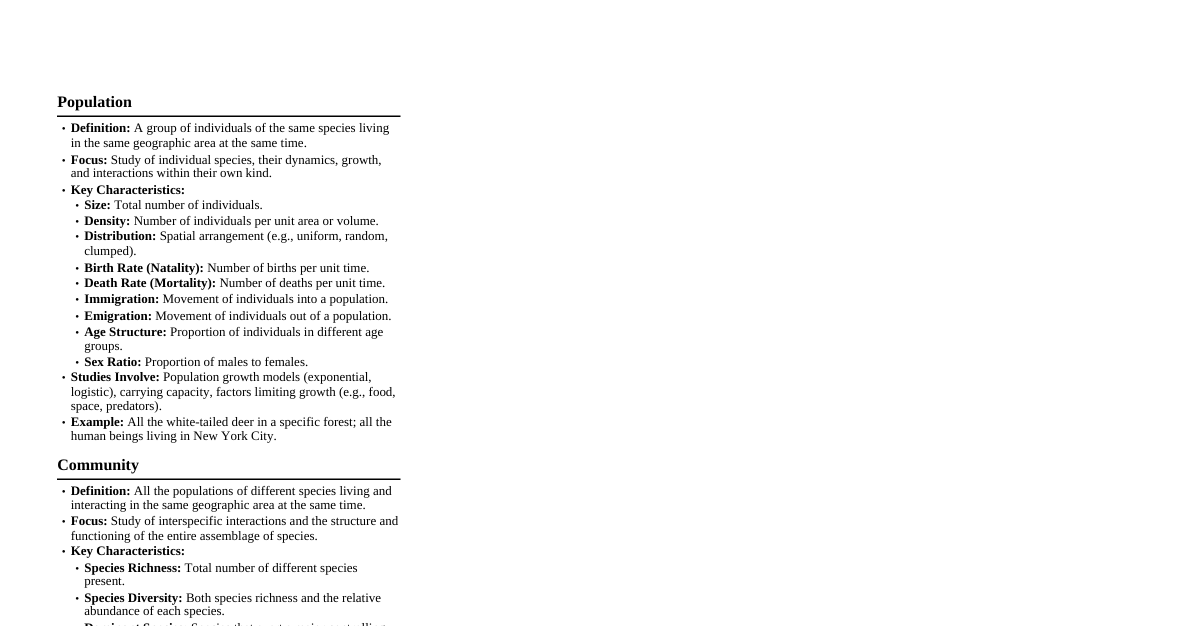
### Introduction to Population Ecology - **Ecology:** Study of interactions between organisms and their physical environment. - **Ecological Organization Levels:** Individual $\rightarrow$ Population $\rightarrow$ Community $\rightarrow$ Ecosystem $\rightarrow$ Biosphere $\rightarrow$ Biome. - **Population:** A group of interacting individuals of the same species, living and interbreeding within a given area. - **Population Ecology:** Study of interactions and changes affecting the distribution and abundance of populations. Uses statistical measures (demographic parameters) to understand population responses to environmental changes. ### Population Size, Density, and Dispersal #### Population Size (N) - **Definition:** Total number of individuals in a particular habitat. - **Estimation Methods:** - **Sampling:** Counting individuals in a sample area to infer the total population. - **Quadrat Method:** - Used for immobile organisms (plants, slow-moving animals). - Randomly place square frames (quadrats) and count individuals within them. - Estimate total population size (N) and density using: $$N = \frac{\text{Total Area}}{\text{Sampled Area}} \times \text{Count in Sampled Area}$$ - **Mark-Recapture Method:** - Used for mobile animals. - 1. Capture and mark a sample ($M$) of animals, then release. - 2. After some time, capture a second sample ($n$). - 3. Count marked individuals ($X$) in the second sample. - **Formula:** $$N = \frac{M \times n}{X}$$ - **Significance:** Large populations generally sustain genetic variation better and have advantages in adapting to environmental changes, diseases, and predators. #### Population Density - **Definition:** Number of individuals within a specific area or volume. - **Calculation:** Population Size / Total Land Area. - **Dynamic Characteristic:** Changes due to births, immigration (increase density) and deaths, emigration (decrease density). #### Population Dispersal Patterns - **Definition:** How individuals are distributed in space. - **Types:** 1. **Uniform Dispersion:** Individuals are spaced evenly (e.g., territorial animals). 2. **Random Dispersion:** Individuals are distributed unpredictably (e.g., wind-dispersed seeds). 3. **Clumped Dispersion:** Individuals are clustered in groups (e.g., social animals, resource patchy areas). - **Significance:** Provides insights into interactions within the population and with the environment. ### Studying the Human Population #### Census - **Definition:** Systematic collection of information from all individuals in a population; a complete enumeration. - **Data Collected:** Age, sex, ethnic group, religion, marital status, household size, occupation, economic activity. - **Uses:** Calculate population size, density, birth/death rates, fertility, life expectancy, growth rate. - **Methods:** - **De Facto Method:** Census conducted on a single fixed date, counting individuals where they are found at that moment. - **De Jure Method:** Census conducted over a period, counting individuals based on their permanent residence. ### Population Growth Models #### Population Growth - **Definition:** Increase in the number of individuals in a population. - **Population Growth Rate:** Percentage rate of change in population size over a specified period. - **Models:** - **Exponential Growth Model:** Describes populations increasing without environmental limits. - **Logistic Growth Model:** Describes populations increasing with limits due to resource scarcity. #### Exponential Growth Model - **Description:** Population grows rapidly in an ideal environment with unlimited resources. - **Graph Shape:** J-shaped curve. - **Formula:** $$\frac{dN}{dT} = rN$$ - $dN/dT$: Growth rate of the population at a given instance. - $N$: Population size. - $r$: Per capita (per individual) rate of increase ($r = B - D$, where $B$ is birth rate, $D$ is death rate). - **Interpretation of 'r':** - $r > 0$: Population increase. - $r = 0$: No change (Zero Population Growth). - $r ### Demographic Structure #### Demographic Parameters - **Crude Birth Rate:** Live births per 1000 people per year. - **Crude Death Rate:** Deaths per 1000 people per year. - **Infant Mortality Rate:** Deaths of children ### Population Regulation #### Resistances to Population Growth - Population growth is eventually limited by resistance factors, leading to the carrying capacity (K). - **Factors:** - **Density-Dependent Factors:** Affect growth rate based on population density. - **Density-Independent Factors:** Influence growth rate regardless of population density. #### Density-Dependent Factors - **Nature:** Biotic (living) factors. - **Examples:** - **Predation:** Higher density can attract more predators. - **Competition:** - **Intraspecific:** Competition among individuals of the same species. - **Interspecific:** Competition between different species. - High density leads to increased competition for resources, reducing reproductive rates. - **Accumulation of Waste:** High density can lead to toxic waste buildup. - **Diseases:** Spread more rapidly in dense populations, increasing mortality. #### Density-Independent Factors - **Nature:** Abiotic (non-living) factors. - **Examples:** - **Weather:** Extreme temperatures, droughts, floods. - **Natural Disasters:** Earthquakes, wildfires, volcanic eruptions. - **Pollution:** Environmental contaminants. - **Effect:** Can kill individuals regardless of population density.