Environment & Ecology (BAS-104)
Cheatsheet Content
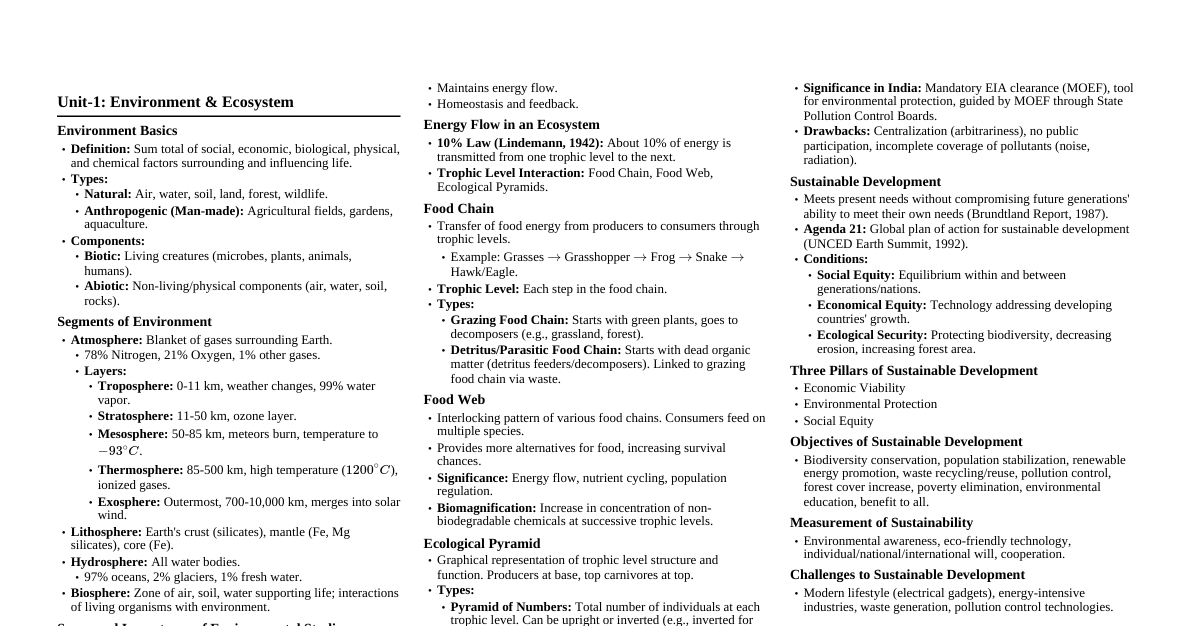
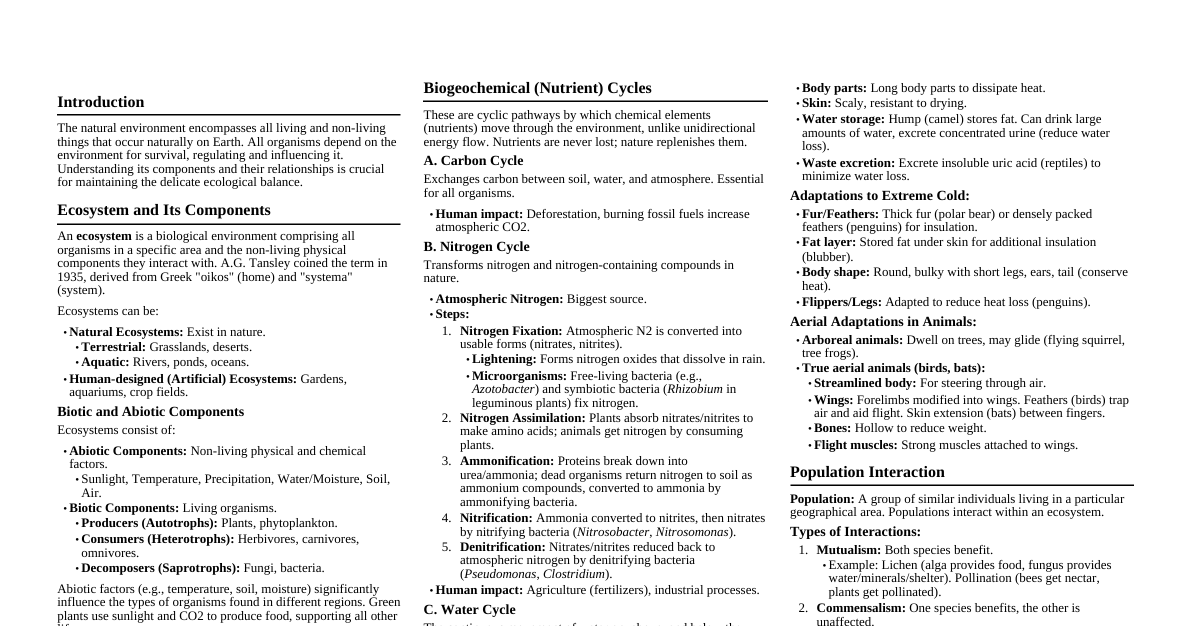
Unit 1: Environment & Ecosystem Environment: Definition, Types, Components, Segments, Scope & Importance, Public Awareness. Ecosystem: Definition, Types, Structure, Food Chain, Food Web, Ecological Pyramid, Balance. Human Activities Effects: Food, Shelter, Housing, Agriculture, Industry, Mining, Transportation, Economic & Social Security, Environmental Impact Assessment, Sustainable Development. Unit 2: Natural Resources Introduction & Classification Water Resources: Availability, Sources, Quality Aspects, Water-borne & Water-induced Diseases, Fluoride & Arsenic Problems. Mineral Resources: Material Cycles (Carbon, Nitrogen, Sulphur). Energy Resources: Conventional & Non-conventional Sources. Forest Resources: Availability, Depletion, Environmental Impact of Depletion. Unit 3: Pollution & Effects Pollution & their Effects: Water, Air, Soil, Noise. Public Health Aspects: Solid Waste Management. Unit 4: Current Environmental Issues Global Warming, Green House Effects, Climate Change. Acid Rain, Ozone Layer Formation & Depletion. Population Growth & Automobile Pollution. Burning of Paddy Straw. Unit 5: Environmental Protection Environmental Protection Act 1986. Initiatives by Non-Governmental Organizations (NGO's). Human Population & the Environment: Population Growth, Environmental Education, Women Education. Natural Resources - Key Concepts Resources: Objects, materials, creatures, or energy found in nature for useful function. Potential Economic Interest: May become economically valuable due to inherent properties. Reserves: Part of a resource fully evaluated and commercially viable considering mining, metallurgical, economic, marketing, legal, environmental, social, and governmental factors. Natural Resources Definition: Resources existing independently of human actions, found in the environment, developed without human intervention. Examples: Air, sunlight, water, soil, stone, plants, animals, fossil fuels. Naturally occurring materials useful to man (or potentially useful under technological, economic, social circumstances). Supplies drawn from Earth: food, building/clothing materials, fertilizers, metals, water, geothermal power. Types of Natural Resources Perpetual, Renewable & Non-renewable Natural Resources Biotic & Abiotic Natural Resources Major Natural Resources: Water resource Mineral resource Forest resource Energy resource Food resource Land resource Perpetual, Renewable and Non-renewable Resources (A) Perpetual Resources: Naturally perpetuate themselves, unaffected by human use. Examples: Sunlight, wind, rainfall water, tides. (B) Renewable Resources: Ability to renew or replenish given reasonable time. Examples: Soil, fresh water, forest. (C) Non-renewable (or Exhaustible) Resources: Cannot be regenerated, renewed, or replaced within a time framework. Examples: Fossil fuels (coal, petroleum, natural gas), nuclear power. (D) Intangible Resources: Available in huge quantities but can be easily destroyed. Example: Tourism industry. Biotic and Abiotic Natural Resources (A) Biotic Resources: Originated from living organisms or have life. Examples: Renewable: Livestock, fisheries, flora, fauna, humans. Non-renewable: Coal, petroleum. (B) Abiotic Resources: Non-living origin. Examples: Minerals, rocks, water. Water Resources Sources of water useful or potentially useful to humans. Prerequisite for life (plants, animals, humans cannot survive without water). Used in agricultural, household, industrial, recreational, and environmental activities. The Water Cycle Continuous movement of water above and below Earth's surface, driven by the sun. Sun heats water in seas/oceans $\rightarrow$ Water evaporates into air as vapor. Snow and ice can sublime directly into water vapor. Rising air currents carry vapor into atmosphere $\rightarrow$ cooler temperatures condense to clouds. Air currents move clouds $\rightarrow$ collide, grow, fall as precipitation. Most water falls back to oceans or land as rain $\rightarrow$ flows as surface run-off. Evaporation: Transformation from liquid to gaseous phase. Sublimation: State change directly from snow/ice to water vapor. Condensation: Transformation of water vapors to liquid water droplets (fog/clouds). Precipitation: Condensed water vapor falling to Earth's surface as rain. Surface run-off: Water movement across land. Percolation: Infiltration of surface water for groundwater storage. Sources of Water Total Water on Earth: Saline Water (oceans): 97% Fresh Water: 3% Icecaps and Glaciers: 68.7% Ground Water: 30.1% Other: 0.9% Surface Water: 0.3% Lakes: 87% Swamps: 11% Rivers: 2% Causes of Water Crisis Growing population & better lifestyles $\rightarrow$ increased per capita fresh water use $\rightarrow$ shortage. Spatial & temporal variations in available water. Freshwater resources reduced by pollution. Extreme weather conditions (floods, droughts, typhoons, cyclones) $\rightarrow$ worsening water quality & availability. Impacts of Over-Utilisation of Underground & Surface Water (i) Loss of Integrity of Freshwater Ecosystems (ii) Risk to Ecosystem Functions (iii) Depletion of Living Resources & Biodiversity (iv) Pollution of Water Bodies Uses & Overuses of Water Resources (Flowchart) Natural Water Resources Direct Uses: Aquatic organisms Human-related water uses Ecosystems Drinking Household Industry Agriculture Indirect Uses: Human-related water activities Hydro-energy Navigation Recreation Sectoral Demand of Water (Billion Cubic Metres) Sector Year 2010 Year 2025 Irrigation 688 910 Drinking water 56 73 Industry 12 23 Energy 5 15 Others 52 72 Total 813 1093 Water Conservation Methods & Practices Rainwater harvesting Reuse water Lessen pollution Organic farming practice Protect forests Use water wisely Avoid transmission and distribution losses Reservoirs and dams building Adopt fairer policies Measures to Conserve Water Recharge groundwater by harvesting rainwater. Use water wisely for household, agricultural, and domestic purposes. Reuse water whenever possible (e.g., waste water after bath for toilet). Avoid transmission and distribution losses by checking leaks in pipes, hoses. Prevent flow of untreated sewage to lakes and rivers (reduces pollution, aids conservation). Collect water by building dams, reservoirs, and digging wells. Use drip irrigation, precision sprinklers for agriculture. Practice organic farming. Adopt fairer policies for treatment, access, and pricing of water. Prevent flow of industrial effluents to natural water resources. Protect forests to protect rivers, lakes, wells, and other sources of water. Characteristics of a Good-Quality Water Transparent, colourless, and odourless. Sufficient oxygen concentration for marine life. Free from bacteriological contamination. Free from any water pollution. Free from excessive nutrients (N, P), which cause eutrophication. Fit for the intended use. Major Factors Responsible for Water-Quality Degradation Insufficient and incomplete treatment of domestic and industrial wastewater. Eutrophication. Pathogens and pesticide contamination. Stagnation of domestic sewage and contamination of groundwater. Important Quality Issues of Water (Flowchart) Surface water: Eutrophication Oxygen depletion Ecological health Common issues of surface and ground water: Pathogenic pollution Salinity Toxicity (industrial pollutants) Groundwater: Fluoride Nitrate Arsenic Iron Sea-water intrusion Water-Borne Diseases (Flowchart) Water Related diseases: Physical Health Hazards: Spinal injury, Drowning. Chemical Health Hazards: Fluorosis, Lead poisoning. Biological Health Hazards: Water-borne diseases, Water-related insect-vector diseases. Nutritional Health Hazards: Anaemia, Malnutrition. Illnesses caused by consuming contaminated water. Ways to Prevent Water-Borne Diseases Avoid drinking untreated water. Avoid consuming undercooked food. Maintain good personal hygiene (e.g., wash hands before eating). Educate for clean sanitation. Fluoride Problem in Drinking Water Low concentrations beneficial for teeth, but excessive exposure causes adverse effects. Sources of Fluoride: Fluoridated water supplies. Food processed with fluoridated water. Mouthwash enhanced with fluoride. Toothpaste enhanced with fluoride. Food supplements. Dangers of Fluoride Consumption Fluoride damages the teeth: Permanent discoloration and mottling of tooth enamel (dental fluorosis) from ingestion of $0.5-1.5$ ppm fluoride before permanent teeth erupt. Fluoride damages the bone: In areas with high natural fluoride ($1.5-5.5$ ppm), it weakens bone and increases fracture risk. Fluoride damages the brain: Lowers children's IQ even at $1.8$ ppm; interferes with brain functions. Defluoridation of Water Can be carried out by: Reverse osmosis filtration. Activated alumina defluoridation filter. Nalgonda technique (addition of aluminium salt, lime, bleaching powder to raw water, followed by flocculation, sedimentation, and filtration). Nalgonda Process Water treatment method to remove excess fluoride from groundwater. Involves pre-treatment, adsorption, coagulation, sedimentation, filtration, and disinfection. Uses locally available adsorbents to remove fluoride ions, and coagulating agents for particle removal. Treated water is then filtered and disinfected. Successful in reducing fluoride levels, providing safe drinking water, and addressing health issues like dental and skeletal fluorosis. Arsenic Problem in Drinking Water Naturally occurring metalloid in Earth's crust. Microscopic quantities in rock, air, water, soil. Drinking water standard for arsenic is $10$ ppb. Inorganic arsenic compounds are more harmful than organic ones. Exposure effects: Significant skin changes (thickening, pigmentation). Large ingestion effects (short term): Severe, stomach-related symptoms (vomiting), nervous system damage. Carcinogenic: Can affect skin, lungs, bladder, and kidney. Prevention of Arsenic Problem Measures to protect people from groundwater arsenic: Education and community engagement. Arsenic removal systems in homes. Testing nearby water sources for arsenic. Care when harvesting rainwater. Considering the depth of wells. Mineral Resources Natural resources in the form of minerals. Include ores of base metals (copper, iron, lead) and strategic/critical metals (chromium, titanium, platinum, cobalt, manganese, palladium). Minerals and Their Classification Minerals: Naturally occurring, inorganic, solid, crystalline substances with a specific composition of elements. Ore: Mineral that can be extracted and processed at a profit. Classification: Metallic: Ferrous (Fe, Co, Ni) Nonferrous (Cu, Pb, Sn) Nonmetallic: Mineral fuels (Coal, fossil fuels) Precious stones (Ag, Au, Pt) Importance of Minerals Almost all rocks are made of minerals. High aesthetic value (e.g., gemstones). Natural resource value: Sources of metals for electronic manufacture, airplanes, cars. Raw materials for window glass, plaster. Mineral Resource of India Produces ~100 minerals, important for foreign exchange and domestic needs. Imports: graphite, mercury, cobalt. Exports: iron ore, granite, bauxite, titanium, manganese. North-Eastern Peninsular Belt (Mineral Heartland): Chhota Nagpur Plateau, Orissa Plateau (Jharkhand, West Bengal, Orissa). Found: Coal, iron ore, manganese, mica, bauxite, copper. Central Belt (Second Largest): Chhattisgarh, Andhra Pradesh, Madhya Pradesh, Maharashtra. Found: Gems, marble, coal, mica, graphite, manganese. Environmental Effects of Extracting & Using Mineral Resources Impacts on forest, land, occupation, water, ecological functions, rehabilitation, flowers due to pollution: Deforestation (loss of flora and fauna). Degradation of land due to excavations. Occupational health hazards. Pollution of ground and surface water resources from accidental/periodic discharge of pollutants. Damage to local ecological functions, nutrient cycling, biodiversity due to altered water availability/quality. Problem in rehabilitation of affected population. Air pollution from dust and gases during mining/processing. Problems in safe disposal of tremendous solid waste from mining. Conservation of Mineral Resources Essential for growth and development; rapid consumption due to increasing population and improved lifestyles. Need for planned and sustainable use. Four steps (4R's) for conservation: Encourage use of improved technologies to reduce waste generation. Encourage recycling of metals. Regulate the use of mineral resources. Reduce the purchase of unwanted products made from mineral resources. Encourage research for eco-friendly alternatives to fossil fuels, metals. The Carbon Cycle Complex series of processes through which all carbon atoms rotate. Plants absorb $\text{CO}_2$ from atmosphere, convert $\text{CO}_2$ and water to oxygen and carbohydrates via photosynthesis. Animals breathe oxygen, eat plants, use carbohydrate carbon for tissues. Animals return $\text{CO}_2$ to air by breathing, and to soil via decomposition upon death. Carbon atoms in soil can be used by new plants or microorganisms. Burning fossil fuels combines carbon with atmospheric oxygen to form $\text{CO}_2$. Every ton of $\text{CO}_2$ from fossil fuels combustion changes carbon cycle for thousands of years, upsetting atmospheric carbon balance. Excessive $\text{CO}_2$ levels lead to global warming, climate change, floods, droughts. The Nitrogen Cycle Process of converting atmospheric nitrogen into useful nitrogenous compounds by plants, passing to animals, and then decomposition to return free nitrogen to atmosphere. Steps: Fixation of Nitrogen: Conversion of free atmospheric nitrogen to useful nitrates. Entry of Nitrogen in Plants and Animals: Nitrates absorbed by plants as mineral salts; plant proteins enter animal bodies as food. Ammonification and Nitrification Processes: Ammonification: $\text{NH}_2$ groups converted to ammonia or ammonium ($\text{NH}_4^+$). Nitrification: Ammonia/nitrogen compounds converted to nitrite ($\text{NO}_2^-$) then nitrate ($\text{NO}_3^-$). Denitrification: Denitrifying bacteria convert soil nitrates to free nitrogen, which escapes to the atmosphere. Sulphur Cycle Movement of sulphur through atmosphere, mineral forms, and living things. Primarily found in sedimentary rocks or seawater. Important for living things as a component of many proteins. Enters atmosphere from natural and human sources as sulphur oxides ($\text{SO}_x$). Reacts with rain and falls to Earth as acidic sulphate ($\text{SO}_4^{2-}$) deposition. Process of Sulphur Cycle Sulphur released by weathering of rocks. Sulphur contacts air, converted to sulphates. Sulphates taken up by plants and microbes, converted to organic forms. Organic sulphur consumed by animals through food, moving through food chain. Animals die: some sulphur released by decomposition, some enters microbe tissues. Natural sources (volcanic eruptions, water evaporation, organic matter breakdown in swamps) release sulphur directly into atmosphere. Atmospheric sulphur falls to Earth with rainfall. Energy Resources Materials used as a basis or source of energy to generate electricity and other forms of power. Vital for daily life and economic infrastructure. Basic input for economic growth. Two kinds: Renewable Energy Resources and Non-Renewable Energy Resources. Examples: Renewable: Hydro, wind, solar, biomass, geothermal. Non-renewable: Coal, petroleum. Energy Sources (Diagrammatic) Renewable Energy: Wind, Hydropower, Solar, Geothermal, Biomass. Non-Renewable Energy: Oil, Coal, Nuclear, Natural Gas. Sources of Energy (Conventional vs. Non-conventional) Conventional sources: Commercial: Coal, Petroleum, Electricity. Non-Commercial: Firewood, Straw, Dried dung. Non-conventional sources: Bio energy, Solar energy, Wind energy, Tidal energy, Energy from urban waste. Conventional Sources of Energy Also known as non-renewable sources, available in limited quantity. Classified under commercial and non-commercial energy. Commercial Energy Sources: Coal, electricity, petroleum (consumer pays for them). Non-commercial Energy Sources: Freely available energy sources (e.g., straw, dried dung, firewood). Commercial Energy Sources Coal: Most important energy source. India has >148,790 coal deposits, annual production ~343 million tons (2005-2006). India is 4th largest producer. Deposits in Bihar, Orissa, Madhya Pradesh, Jharkhand, Bengal. Oil and Natural Gas: "Liquid gold", crucial energy source. Used in planes, automobiles, trains, ships. India's oil production increased from 0.3 million tons (1950-51) to 32.4 million tons (2000-01). Found in Assam, Gujarat, Mumbai. Electricity: Common for domestic and commercial use. Utilized in electrical appliances (fridges, TV, washing machines, AC). Non-conventional Sources of Energy Also known as renewable sources. Examples: Solar energy, bioenergy, tidal energy, wind energy. Solar Energy: Produced by sunlight. Photovoltaic cells convert sunlight into electricity. Used for cooking and water distillation. Wind Energy: Generated by harnessing wind power. Used for operating water pumps for irrigation. India is 2nd largest in wind power generation. Tidal Energy: Generated by exploiting tidal waves. Untapped due to lack of cost-effective technology. Difference Between Conventional and Non-conventional Sources of Energy Conventional Sources of Energy Non-conventional Sources of Energy Non-renewable source of energy Renewable source of energy Used for commercial and industrial purposes Mainly used for household purposes Responsible for pollution Not responsible for pollution Examples: Coal, fossil fuels Examples: Wind, solar energy, biomass Bio-energy Energy made or generated from biomass (recently living/dead organisms, mainly plants). Types of biomass for bioenergy: Wood, food crops (corn), energy crops, forest waste. Solar Energy Transformation of energy from the sun, a renewable energy. Sunlight (visible light and infrared radiation) passes through Earth's atmosphere. Plants use it for photosynthesis to convert into sugar and starches. Solar cell panels convert solar energy into electricity. Solar Energy Advantages & Disadvantages Advantages: Clean: No $\text{CO}_2$ emissions (unlike fossil fuels), cleanest form of energy. Renewable: Ample energy available as long as the sun exists. Reliable: Energy can be stored in batteries. Disadvantages: Low production during winters and on cloudy days. Expensive installation and initial material cost. High space consumption. Uses of Solar Energy Water heating: Replaces electric heaters and gas. Heating of swimming pools: Solar blankets or solar water heaters keep pools warm. Cooking purposes: Solar cookers heat, cook, and pasteurize food using an elevated heat sink. Wind Energy Wind is air in motion. Wind power uses turbines to transform wind kinetic energy into mechanical or electrical energy. Components: Rotor (Hub, Blade), Nacelle (Generator, Drive train, Control, Yaw system), Tower, Cable, Foundation, Balance of electrical system, To grid. Advantages of Wind Energy (Clean Source) Windmills do not release emissions that pollute water or air. Do not require water for cooling. Reduce electricity generation from fossil-fuel based thermal power plants. Many windmills on farm, grazing, forest land provide extra income for farmers. Best alternative to mountain-top removal coal-mining for thermal power generation. Power generation using windmills is very economical. Limitations of Wind Energy Variable, irregular, erratic, intermittent, unsteady, and sometimes dangerous. Location sites for wind farms are generally away from cities. Design, manufacture, and installation of wind turbines is complex. Continuous whirling and whistling sound from rotating blades. Output of a single windmill is small, not suitable for commercial applications. Very high maintenance cost. Some windmills located on migratory bird routes, causing bird deaths. Tidal Energy Form of hydropower converting tide energy into electricity or other useful hydro power. Renewable energy resource; Earth's tides are practically inexhaustible. Periodic changes in water levels and associated tidal currents are due to gravitational attraction of sun and moon. Merits of Tidal Energy Resources Clean, renewable source of energy. No pollution. Reduces dependence on fossil fuels. Highly efficient. Power generation does not create greenhouse gases. Demerits of Tidal Energy Resources High initial construction cost for harnessing tidal energy. Required technology not fully developed. Ecological impacts of altering tides and waves not fully understood. Waves are irregular in size, durability, and direction; a diffuse energy source. Forest Resources Biotic community of trees, shrubs, or woody vegetation in a closed canopy. Derived from Latin 'foris' meaning 'outside'. India's Forest Cover: $676,000$ sq.km ($20.55\%$ of geographic area). Dense growth of trees and other plants covering significant land. Ecosystem: Community of interacting plants and animals. Types: Tropical forests, Temperate Forests, Boreal Forests. Functions of Forest Important for humans and nature. Habitats for millions of plants, animals, and wildlife. Recycle rain water. Remove pollutants from air. Control water quality. Moderate temperature and weather. Influence soil condition and prevent soil erosion. Tropical Forests Biodiversity wonderlands with more diverse plants and animals than anywhere else. Year-round temperatures above $65^\circ \text{F}$ and abundant water support thriving creatures. Temperate Forests Typically have three plant levels with high species variety. Forest floor: Covered with lichen, moss, ferns, wildflowers, small plants. Middle level: Shrubs. Top level: Hardwood trees (maple, beech, oak, aspen, walnut, lime, chestnut, birch, elm, cypress, cedar, pine, Douglas fir, redwood, spruce). Found in USA, Canada, Europe, Russia, China, Japan. Boreal Forests Also known as Taiga forests. Forests growing in freezing temperatures. Trees can reach minimum $5$ meters, with a canopy cover of $10\%$. Forest Depletion Reduction in size, quality, or health of forests due to human activities or natural causes. Factors contributing to depletion: Deforestation Climate Change Urbanization and Infrastructure Mining and Resource Extraction Agricultural Expansion Deforestation Involves cutting down, burning, and damaging forests. Defined as change of forest with depletion of tree crown cover of more than $90\%$. Depletion of forest-tree-crown cover less than $90\%$ is considered forest degradation. Causes: Population explosion. Commercial logging (cutting trees for timber). Mining, Dams, Infrastructure creation. Forest fires, Acid rain. Development projects and housing projects. Effects of Deforestation Soil Erosion Harm to Fisheries More Floods and Droughts Habitat Loss of Wildlife Extinction of Some Species Local and Global Climate Changes Global Warming Danger for the Survival of Local Communities Impact of Forest Depletion on Society Multifaceted impact extending across human life and environment. Loss of Biodiversity Climate Change Disruption of Water Cycles Erosion and Soil Degradation Loss of Livelihoods Increased Vulnerability to Natural Disasters