Wireless Comms (Post Mid-Sem)
Cheatsheet Content
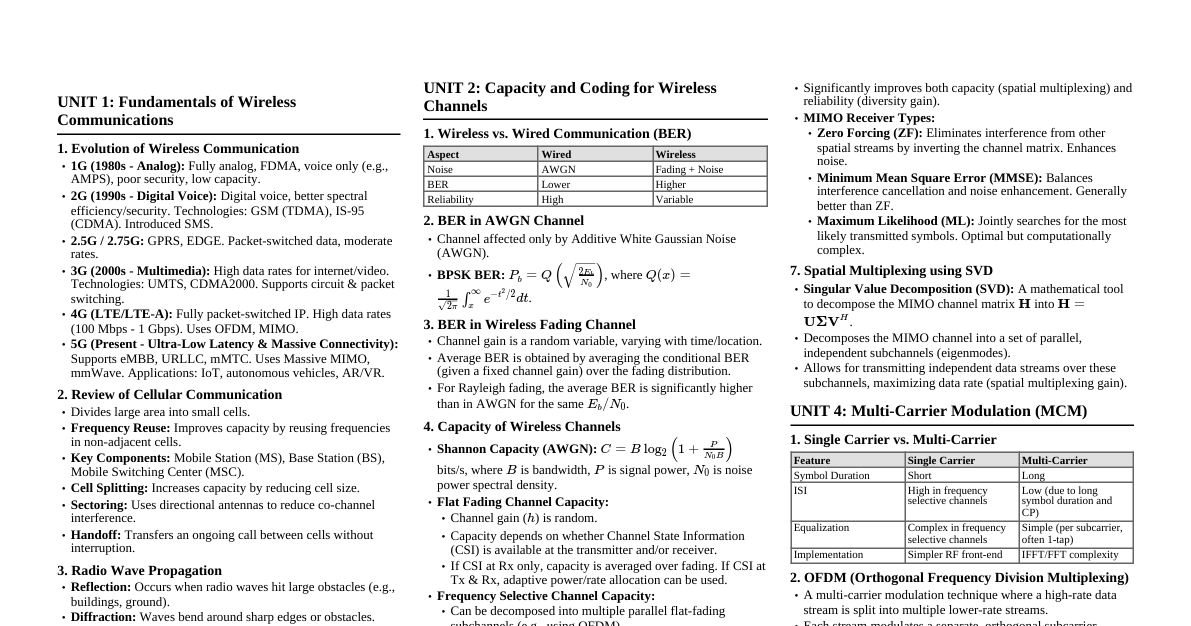
Deep Fade and Diversity Techniques Deep Fade Definition Severe attenuation due to destructive multipath interference. Characteristics: Instantaneous signal drop (20-30 dB), brief duration, random occurrence, high BER. Probability (Rayleigh): $P(\gamma Diversity Techniques Concept Combat fading by providing multiple signal replicas through independent channels. Principle: If $p$ is deep fade probability for one channel, for $L$ independent branches, $P_{all\_fade} = p^L$. Diversity Gain Increase in average SNR or decrease in error probability. Mathematical: $10 \log_{10}(L)$ dB (optimal combining). Types: Array gain (avg SNR), Diversity gain (fading reduction), Multiplexing gain (data rate). Space Diversity Exploits spatial separation of antennas. Antenna Spacing: $d \geq \frac{\lambda}{2} = \frac{c}{2f}$ for independent fading. Receive Diversity Techniques Selection Combining (SC) Principle: Selects branch with highest instantaneous SNR. Output SNR: $\gamma_{SC} = \max(\gamma_1, ..., \gamma_L)$. CDF (Rayleigh): $F_{\gamma_{SC}}(\gamma) = [1 - e^{-\gamma/\bar{\gamma}}]^L$. Average Output SNR: $\bar{\gamma}_{SC} = \bar{\gamma} \sum_{k=1}^{L} \frac{1}{k} \approx \bar{\gamma}[\ln(L) + 0.577]$ (for large L). Advantages: Simple, one receiver chain active. Disadvantages: Requires continuous monitoring, not optimal. Threshold Combining (TC) Principle: Switches to another branch if current SNR falls below threshold $\gamma_{th}$. Threshold: $\gamma_{th} = k \cdot \bar{\gamma}$ (k typically 0.5-0.8). Advantages: Simpler than SC, lower switching rate. Disadvantages: Performance dependent on threshold. Maximal-Ratio Combining (MRC) Principle: Co-phases and weights all branch signals proportional to amplitude, then sums. Optimal. Received Signal $r_i = a_i s + n_i$. Optimal Weights: $w_i = a_i^*/N_0$. Output SNR: $\gamma_{MRC} = \sum_{i=1}^{L} \gamma_i$. Average Output SNR (Rayleigh): $\bar{\gamma}_{MRC} = L\bar{\gamma}$. Outage Probability: $P_{out} = 1 - e^{-\gamma_{th}/\bar{\gamma}}\sum_{k=0}^{L-1}\frac{(\gamma_{th}/\bar{\gamma})^k}{k!}$. Advantages: Optimal, maximum SNR improvement. Disadvantages: Complex, requires CSI for all branches. Equal Gain Combining (EGC) Principle: Co-phases branches and sums with equal weights. Weights: $w_i = a_i^*/|a_i|$ (phase correction only). Avg Output SNR (Rayleigh, Approx): $\bar{\gamma}_{EGC} \approx \bar{\gamma}\left[L - \frac{(L-1)\pi}{4}\right]$. Performance: Close to MRC (within 1 dB). Advantages: Simpler than MRC, near-optimal performance. Disadvantages: Requires co-phasing, not optimal for unequal SNRs. Transmit Diversity Transmit Beamforming Concept: Focuses signal energy towards receiver using multiple TX antennas, requires CSI at TX. System Model: $\mathbf{r} = \mathbf{h}^H\mathbf{w}s + n$. Optimal Weight: $\mathbf{w} = \frac{\mathbf{h}^*}{||\mathbf{h}||}$. Received SNR: $\gamma = \frac{P||\mathbf{h}||^2}{N_0} = \frac{P}{N_0}\sum_{i=1}^{M}|h_i|^2$. Gain: Achieves M-fold diversity gain. Alamouti Space-Time Block Code (STBC) Concept: Achieves full diversity without CSI at transmitter for 2 TX antennas. Encoding: Time t t+1 Antenna 1 $s_1$ $-s_2^*$ Antenna 2 $s_2$ $s_1^*$ Received Signals: $r_1 = h_1 s_1 + h_2 s_2 + n_1$, $r_2 = -h_1 s_2^* + h_2 s_1^* + n_2$. Decoding: $\tilde{s}_1 = (|h_1|^2 + |h_2|^2)s_1 + h_1^*n_1 + h_2 n_2^*$. Received SNR: $\gamma = \frac{(|h_1|^2 + |h_2|^2)E_s}{N_0} = \gamma_1 + \gamma_2$. Avg SNR (Rayleigh): $\bar{\gamma}_{Alamouti} = 2\bar{\gamma}$. (Full diversity order 2). Properties: Orthogonal, Full Rate (1), Full Diversity (2), No CSI at TX. Time Diversity Concept: Transmits information at different time instants, separated by $T_c$. Coherence Time: $T_c \approx \frac{0.423}{f_m}$. Separation: $\Delta T > T_c$. Methods: Interleaving, Repetition Coding, ARQ. Advantages: No extra antennas. Disadvantages: Increased delay, reduced spectral efficiency. Frequency Diversity Concept: Transmits information over different frequency bands, separated by $B_c$. Coherence Bandwidth: $B_c \approx \frac{1}{5\tau_{rms}}$. Separation: $\Delta f > B_c$. Methods: Spread Spectrum (DSSS, FHSS), Multi-carrier (OFDM), Multi-band. Advantages: Effective against frequency-selective fading, no time delay penalty. Disadvantages: Wider bandwidth, complex receiver. Multiple-Input Multiple-Output (MIMO) MIMO Introduction Definition: Uses multiple antennas at TX and RX for diversity, multiplexing, or beamforming. Configuration: M transmit, N receive (M×N). Channel Matrix: $\mathbf{H}$ (N×M), $h_{ij}$ from TX j to RX i. System Model: $\mathbf{r} = \mathbf{H}\mathbf{x} + \mathbf{n}$. MIMO Receiver Processing Zero-Forcing (ZF): $\mathbf{W}_{ZF} = (\mathbf{H}^H\mathbf{H})^{-1}\mathbf{H}^H$. Eliminates interference, but enhances noise. Requires M $\leq$ N. Minimum Mean Square Error (MMSE): $\mathbf{W}_{MMSE} = (\mathbf{H}^H\mathbf{H} + \frac{N_0}{P}\mathbf{I}_M)^{-1}\mathbf{H}^H$. Balances interference cancellation and noise enhancement. Better than ZF at low SNR. Maximum Likelihood (ML): $\hat{\mathbf{x}} = \arg\min_{\mathbf{x} \in \mathcal{X}^M} ||\mathbf{r} - \mathbf{H}\mathbf{x}||^2$. Optimal error probability, but exponential complexity. Singular Value Decomposition (SVD) for MIMO SVD of Channel Matrix: $\mathbf{H} = \mathbf{U}\mathbf{\Sigma}\mathbf{V}^H$. $\mathbf{\Sigma}$ contains singular values $\sigma_1 \geq \sigma_2 \geq ... \geq \sigma_r$. Spatial Multiplexing using SVD Concept: Decomposes MIMO channel into $r = \min(M,N)$ parallel independent scalar channels (eigenmodes). Precoding: $\mathbf{x} = \mathbf{V}\mathbf{s}$. Receiver: $\tilde{\mathbf{r}} = \mathbf{\Sigma}\mathbf{s} + \tilde{\mathbf{n}}$. Parallel Channels: $\tilde{r}_i = \sigma_i s_i + \tilde{n}_i$. Channel Capacity: $C = \sum_{i=1}^{r} \log_2\left(1 + \frac{\sigma_i^2 P_i}{N_0}\right)$. Water-filling: $P_i = \max\left(0, \mu - \frac{N_0}{\sigma_i^2}\right)$. MIMO Beamforming Concept: Maximizes received signal power by transmitting along strongest eigenmode. Transmit Weight: $\mathbf{w}_t = \mathbf{v}_1$ (first right singular vector). Receive Weight: $\mathbf{w}_r = \mathbf{u}_1$ (first left singular vector). Received Signal: $r = \sigma_1 s + \tilde{n}$. Received SNR: $\gamma = \frac{\sigma_1^2 P}{N_0}$. Achieves diversity gain ($\min(M,N)$) and array gain. Comparison: Spatial Multiplexing vs. Beamforming Feature Spatial Multiplexing Beamforming Data Streams Multiple Single Data Rate High Lower Reliability Lower Higher Use Case High SNR, capacity Low SNR, coverage Multi-Carrier Modulation (MCM) Schemes Single Carrier vs. Multi-Carrier Single Carrier: Entire bandwidth to one carrier. Suffers from ISI in wideband channels ($T_s Requires complex equalization. Multi-Carrier: Divides bandwidth into narrow subcarriers, each experiencing flat fading. Converts frequency-selective fading to flat fading per subcarrier. Simple equalization, robust to narrowband interference. Disadvantages: High PAPR, sensitive to frequency offsets. Orthogonal Frequency Division Multiplexing (OFDM) Principle: Uses orthogonal subcarriers to eliminate ICI and allow overlapping spectra. Orthogonality: $\Delta f = 1/T$ (subcarrier spacing). OFDM Transmission Block Diagram: Input $\to$ Ser/Par $\to$ Modulation $\to$ IFFT $\to$ Add CP $\to$ DAC $\to$ RF. IFFT: $x[n] = \frac{1}{\sqrt{N}}\sum_{k=0}^{N-1} X[k] e^{j2\pi kn/N}$. OFDM Reception Block Diagram: RF $\to$ ADC $\to$ Remove CP $\to$ FFT $\to$ Equalization $\to$ Par/Ser $\to$ Demod. Channel Effect (Freq Domain): $Y[k] = H[k]X[k] + N[k]$. One-Tap Equalization: $\hat{X}[k] = Y[k]/H[k]$. Cyclic Prefix (CP) Purpose: Eliminate ISI (linear to circular convolution), maintain orthogonality. Length: $L_{CP} \geq L_h - 1$ or $L_{CP} = \lceil \tau_{max} \cdot f_s \rceil$. Why it works: CP makes effective channel circular, so convolution becomes multiplication in frequency domain ($Y[k] = H[k]X[k]$). Overhead: $\eta = \frac{N}{N + L_{CP}}$. BER Performance of OFDM SNR per Subcarrier: $\gamma_k = \frac{|H[k]|^2 E_s}{N_0}$. BER (BPSK/QPSK): $P_b(k) = Q(\sqrt{2\gamma_k})$. Average BER: $\bar{P}_b = \frac{1}{N}\sum P_b(k)$. Frequency Diversity: Achieved by coding across subcarriers. Problems in OFDM Carrier Frequency Offset (CFO) Causes: Oscillator mismatch, Doppler shift. Effects: Attenuation: $\text{sinc}(\pi\epsilon)$ factor. Inter-Carrier Interference (ICI): Dominant issue. SIR (small $\epsilon$): $\text{SIR} \approx 1/(\pi\epsilon)^2/3$. Mitigation: Synchronization algorithms (Schmidl-Cox), CFO estimation, tight oscillator specs ($\Delta f Peak-to-Average Power Ratio (PAPR) Definition: $\text{PAPR} = \frac{\max |x[n]|^2}{E[|x[n]|^2]}$. Problem: When subcarriers constructively interfere, $|x[n]|_{max} \approx N \times |X[k]|_{avg}$. Maximum PAPR: $N$ (or $10\log_{10}(N)$ dB). High PAPR forces Power Amplifier (PA) to operate inefficiently or non-linearly (distortion, out-of-band emissions). PAPR Reduction Techniques: Clipping & Filtering: Simple, but causes distortion. Selective Mapping (SLM): Generates multiple candidates, selects lowest PAPR. Requires side info. (3-4 dB reduction). Partial Transmit Sequence (PTS): Divides subcarriers, multiplies by phase factors, minimizes PAPR. (3-5 dB reduction). Tone Reservation (TR): Reserves subcarriers to cancel peaks. Active Constellation Extension (ACE): Extends outer constellation points. Coding: Uses codes that naturally produce low PAPR. OFDM System Design Parameters & Trade-offs Number of Subcarriers (N): $\uparrow$N: Better spectral efficiency, lower per-subcarrier data rate. $\uparrow$N: Higher PAPR, more sensitive to CFO, longer FFT. Cyclic Prefix Length ($L_{CP}$): $\uparrow L_{CP}$: Better ISI protection. $\uparrow L_{CP}$: Lower efficiency (overhead). Subcarrier Spacing ($\Delta f$): $\uparrow \Delta f$: Less sensitive to CFO and phase noise. $\downarrow \Delta f$: Longer symbol duration, better delay spread tolerance. Constraint: $\Delta f = 1/T_s$. Practical OFDM Systems WiFi (802.11a/g): N=64, $\Delta f$=312.5 kHz, $T_{CP}$=0.8 μs. LTE (4G): Scalable N, $\Delta f$=15 kHz, $T_{CP}$≈4.7 μs. 5G NR: Flexible numerology ($\Delta f$=15, 30, 60, 120 kHz). Summary Tables Diversity Combining Comparison Technique SNR Gain Complexity CSI Required Notes Selection $\bar{\gamma}\ln(L)$ Low Yes (all branches) Simple, suboptimal Threshold Similar to SC Very Low Partial Reduced monitoring MRC $L\bar{\gamma}$ High Yes (amplitude & phase) Optimal EGC $\approx 0.9L\bar{\gamma}$ Medium Yes (phase only) Near-optimal Transmit Diversity Comparison Technique CSI at TX Diversity Order Rate Complexity Tx Beamforming Yes M 1 Medium Alamouti No 2 1 Low OFDM Advantages and Disadvantages Advantages Disadvantages Simple equalization High PAPR Frequency diversity CFO sensitivity Flexible allocation Synchronization Multipath robustness CP overhead Spectral efficiency Phase noise sensitivity