Kinematics Cheatsheet
Shared 5/13/2026•0 views
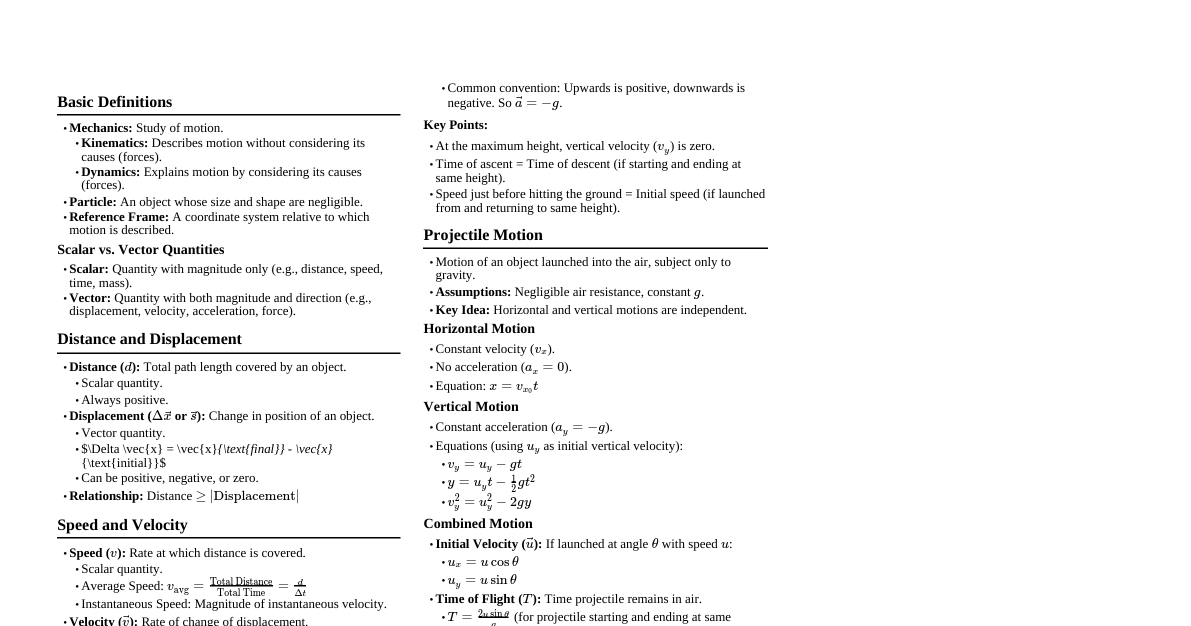
### Key Definitions - **Position ($x$ or $y$):** Location of an object relative to an origin. Units: meters (m). - **Displacement ($\Delta x$ or $\Delta y$):** Change in position. $\Delta x = x_f - x_i$. Vector quantity. Units: meters (m). - **Distance:** Total path length traveled. Scalar quantity. Units: meters (m). - **Velocity ($v$):** Rate of change of position. Vector quantity. Units: m/s. - Average Velocity: $v_{avg} = \frac{\Delta x}{\Delta t}$ - Instantaneous Velocity: $v = \frac{dx}{dt}$ - **Speed:** Magnitude of velocity. Scalar quantity. Units: m/s. - **Acceleration ($a$):** Rate of change of velocity. Vector quantity. Units: m/s$^2$. - Average Acceleration: $a_{avg} = \frac{\Delta v}{\Delta t}$ - Instantaneous Acceleration: $a = \frac{dv}{dt} = \frac{d^2x}{dt^2}$ ### Constant Acceleration (1D) These equations apply when acceleration ($a$) is constant. 1. $v = v_0 + at$ 2. $\Delta x = v_0 t + \frac{1}{2}at^2$ 3. $v^2 = v_0^2 + 2a\Delta x$ 4. $\Delta x = \frac{1}{2}(v_0 + v)t$ Where: - $v_0$: initial velocity - $v$: final velocity - $a$: constant acceleration - $t$: time interval - $\Delta x$: displacement **Graphical Interpretation:** - **Position-Time ($x$ vs $t$):** - Slope = instantaneous velocity - Concavity indicates acceleration - **Velocity-Time ($v$ vs $t$):** - Slope = instantaneous acceleration - Area under curve = displacement ($\Delta x$) - **Acceleration-Time ($a$ vs $t$):** - Area under curve = change in velocity ($\Delta v$) ### Free Fall (Vertical Motion) - A special case of constant acceleration where $a = -g$ (assuming upward is positive). - $g \approx 9.81 \text{ m/s}^2$ (acceleration due to gravity). - Equations are the same as 1D constant acceleration, replacing $\Delta x$ with $\Delta y$ and $a$ with $-g$. 1. $v_y = v_{0y} - gt$ 2. $\Delta y = v_{0y} t - \frac{1}{2}gt^2$ 3. $v_y^2 = v_{0y}^2 - 2g\Delta y$ 4. $\Delta y = \frac{1}{2}(v_{0y} + v_y)t$ ### Projectile Motion (2D) - Independent motion in horizontal ($x$) and vertical ($y$) directions. - **Horizontal Motion:** Constant velocity ($a_x = 0$) - $v_x = v_{0x}$ - $\Delta x = v_{0x} t$ - **Vertical Motion:** Constant acceleration ($a_y = -g$) - $v_y = v_{0y} - gt$ - $\Delta y = v_{0y} t - \frac{1}{2}gt^2$ - $v_y^2 = v_{0y}^2 - 2g\Delta y$ **Initial Velocity Components:** If initial speed is $v_0$ at an angle $\theta$ above the horizontal: - $v_{0x} = v_0 \cos\theta$ - $v_{0y} = v_0 \sin\theta$ ### Relative Velocity - Used to describe motion from different reference frames. - $\vec{v}_{AE} = \vec{v}_{AB} + \vec{v}_{BE}$ - $\vec{v}_{AE}$: velocity of A relative to E (Earth) - $\vec{v}_{AB}$: velocity of A relative to B - $\vec{v}_{BE}$: velocity of B relative to E - General form: $\vec{v}_{AC} = \vec{v}_{AB} + \vec{v}_{BC}$ - Note: $\vec{v}_{BA} = -\vec{v}_{AB}$