Integration Applied Mathematic
Cheatsheet Content
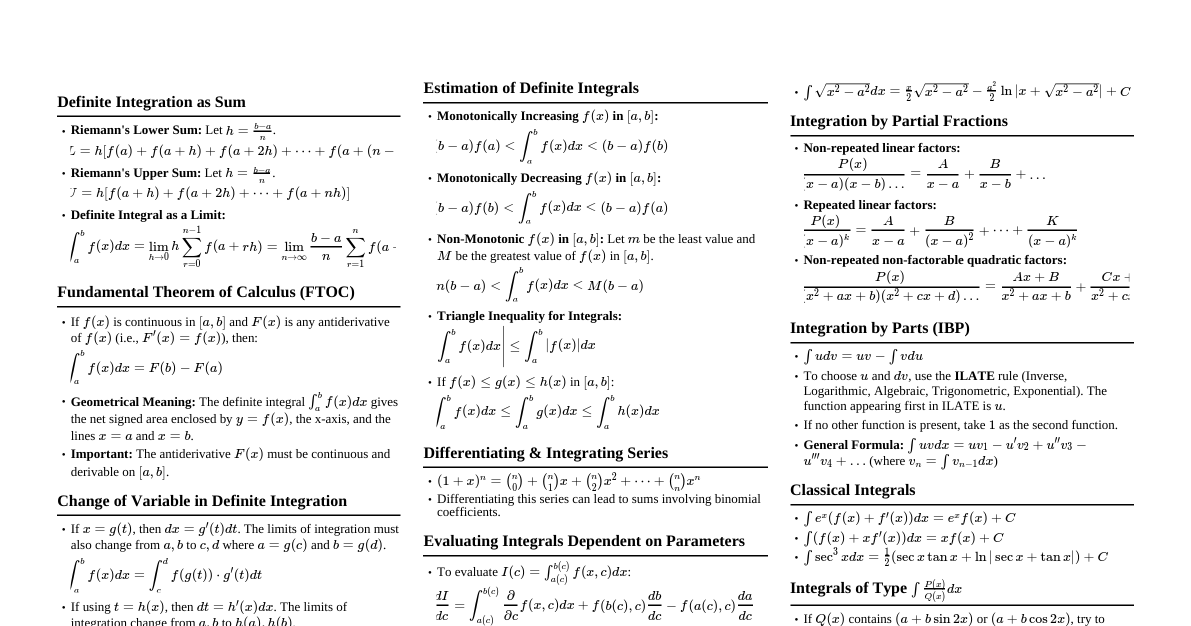
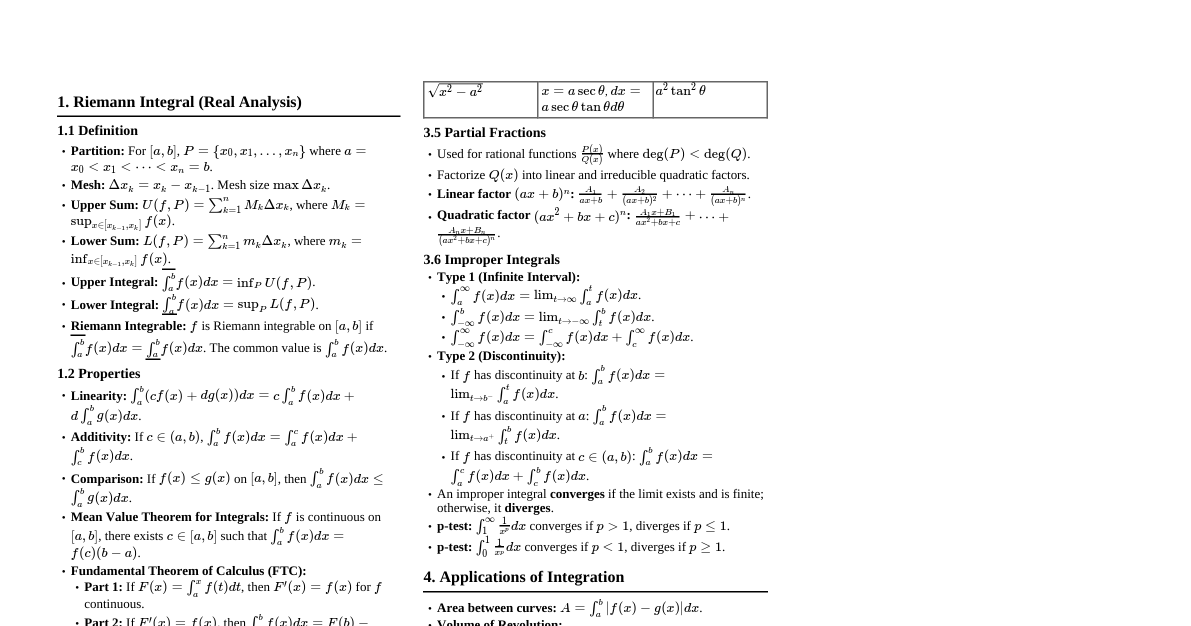
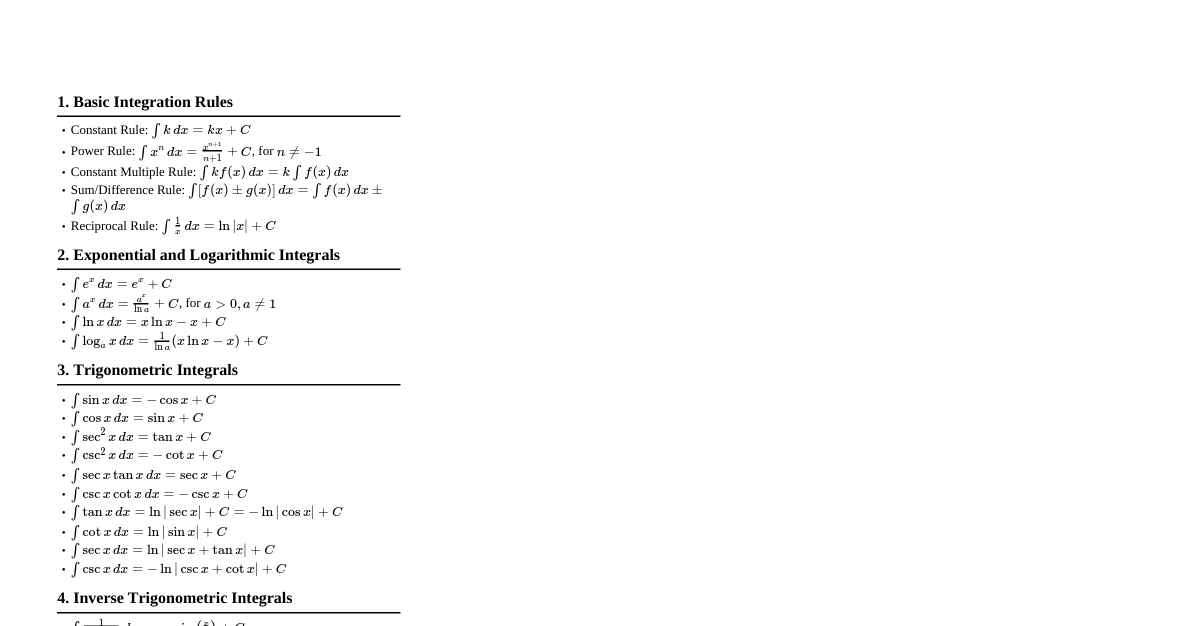
### Introduction to Integration Integration is a fundamental concept in calculus, serving as the inverse process of differentiation. It allows us to find the accumulated quantity of a function, such as the area under a curve, volume of solids, or total change given a rate. #### Indefinite Integrals An indefinite integral represents the family of all antiderivatives of a function. If $F'(x) = f(x)$, then the indefinite integral of $f(x)$ is given by: $$\int f(x) \, dx = F(x) + C$$ where $F(x)$ is any antiderivative of $f(x)$, and $C$ is the constant of integration. This constant arises because the derivative of any constant is zero, so $F(x) + C$ will have the same derivative as $F(x)$. ### Basic Integration Formulas These are the fundamental rules for finding antiderivatives of common functions. - **Power Rule:** $$\int x^n \, dx = \frac{x^{n+1}}{n+1} + C \quad \text{for } n \neq -1$$ - **Logarithmic Rule (for $n=-1$):** $$\int \frac{1}{x} \, dx = \ln|x| + C$$ - **Exponential Rule:** $$\int e^x \, dx = e^x + C$$ $$\int a^x \, dx = \frac{a^x}{\ln a} + C \quad \text{for } a > 0, a \neq 1$$ - **Constant Multiple Rule:** $$\int c \cdot f(x) \, dx = c \int f(x) \, dx$$ - **Sum/Difference Rule:** $$\int [f(x) \pm g(x)] \, dx = \int f(x) \, dx \pm \int g(x) \, dx$$ ### Integration Techniques: Substitution The substitution method (also known as u-substitution) is a powerful technique for integrating composite functions. It's essentially the reverse of the chain rule for differentiation. #### Method Steps: 1. **Choose `u`:** Select a part of the integrand to be $u$. Often, $u$ is the "inner" function of a composite function or a term whose derivative also appears in the integrand. 2. **Find `du`:** Differentiate $u$ with respect to $x$ to find $\frac{du}{dx}$, then solve for $dx$ in terms of $du$ and $x$ (or $u$). 3. **Substitute:** Replace all terms in the integral with $u$ and $du$. The goal is to transform the integral into a simpler form involving only $u$. 4. **Integrate:** Evaluate the new integral with respect to $u$. 5. **Substitute Back:** Replace $u$ with its original expression in terms of $x$ to get the final answer. #### Example: Evaluate $\int (2x+1)^3 \, dx$. 1. Let $u = 2x+1$. 2. Then $\frac{du}{dx} = 2$, so $dx = \frac{1}{2} du$. 3. Substitute: $\int u^3 \left(\frac{1}{2} du\right) = \frac{1}{2} \int u^3 \, du$. 4. Integrate: $\frac{1}{2} \left(\frac{u^{3+1}}{3+1}\right) + C = \frac{1}{2} \frac{u^4}{4} + C = \frac{u^4}{8} + C$. 5. Substitute back: $\frac{(2x+1)^4}{8} + C$. ### Integration Techniques: Integration by Parts Integration by Parts is used for integrating products of functions and is derived from the product rule for differentiation. #### Formula: $$\int u \, dv = uv - \int v \, du$$ #### Choosing `u` and `dv` (LIATE Rule): A common mnemonic for choosing $u$ is **LIATE**: 1. **L**ogarithmic functions ($\ln x$, $\log_a x$) 2. **I**nverse trigonometric functions (not in syllabus for this course) 3. **A**lgebraic functions ($x^n$, polynomials) 4. **T**rigonometric functions (not in syllabus for this course) 5. **E**xponential functions ($e^x$, $a^x$) Choose $u$ as the function that comes first in the LIATE list. The remaining part of the integrand becomes $dv$. The goal is to make $\int v \, du$ simpler to integrate than the original integral. #### Example: Evaluate $\int x e^x \, dx$. 1. Choose $u$ and $dv$: - According to LIATE, Algebraic ($x$) comes before Exponential ($e^x$). - Let $u = x$. - Let $dv = e^x \, dx$. 2. Find $du$ and $v$: - $du = dx$. - $v = \int e^x \, dx = e^x$. 3. Apply the formula: $$\int x e^x \, dx = x \cdot e^x - \int e^x \, dx$$ 4. Evaluate the remaining integral: $$x e^x - e^x + C$$ $$e^x(x-1) + C$$ ### Integration Techniques: Partial Fractions This method is used to integrate rational functions (fractions where the numerator and denominator are polynomials) by decomposing them into simpler fractions. This is applicable when the degree of the numerator is less than the degree of the denominator. If not, perform polynomial long division first. #### Case 1: Distinct Linear Factors If the denominator $Q(x)$ can be factored into distinct linear factors $(ax+b)(cx+d)$, then: $$\frac{P(x)}{(ax+b)(cx+d)} = \frac{A}{ax+b} + \frac{B}{cx+d}$$ #### Case 2: Repeated Linear Factors If $Q(x)$ has a repeated linear factor $(ax+b)^n$, then for each such factor, include $n$ terms: $$\frac{P(x)}{(ax+b)^n} = \frac{A_1}{ax+b} + \frac{A_2}{(ax+b)^2} + \dots + \frac{A_n}{(ax+b)^n}$$ #### Case 3: Distinct Irreducible Quadratic Factors If $Q(x)$ has a distinct irreducible quadratic factor $(ax^2+bx+c)$ (cannot be factored into real linear factors), then: $$\frac{P(x)}{(ax^2+bx+c)(dx+e)} = \frac{Ax+B}{ax^2+bx+c} + \frac{C}{dx+e}$$ #### Example (Distinct Linear Factors): Evaluate $\int \frac{1}{x^2-1} \, dx$. 1. Factor the denominator: $x^2-1 = (x-1)(x+1)$. 2. Set up partial fraction decomposition: $$\frac{1}{(x-1)(x+1)} = \frac{A}{x-1} + \frac{B}{x+1}$$ 3. Multiply by the common denominator: $$1 = A(x+1) + B(x-1)$$ 4. Solve for A and B: - Let $x=1$: $1 = A(1+1) + B(1-1) \Rightarrow 1 = 2A \Rightarrow A = \frac{1}{2}$. - Let $x=-1$: $1 = A(-1+1) + B(-1-1) \Rightarrow 1 = -2B \Rightarrow B = -\frac{1}{2}$. 5. Substitute back into the integral: $$\int \left(\frac{1/2}{x-1} - \frac{1/2}{x+1}\right) \, dx$$ 6. Integrate: $$\frac{1}{2} \ln|x-1| - \frac{1}{2} \ln|x+1| + C$$ $$\frac{1}{2} \ln\left|\frac{x-1}{x+1}\right| + C$$ ### Definite Integrals A definite integral represents the net signed area between the graph of a function $f(x)$ and the x-axis over a given interval $[a, b]$. #### The Fundamental Theorem of Calculus (Part 2): If $f(x)$ is continuous on the interval $[a, b]$ and $F(x)$ is any antiderivative of $f(x)$ (i.e., $F'(x) = f(x)$), then: $$\int_a^b f(x) \, dx = F(b) - F(a)$$ Here, $a$ is the lower limit of integration and $b$ is the upper limit of integration. The constant of integration $C$ is not included in definite integrals because it cancels out ($F(b)+C - (F(a)+C) = F(b)-F(a)$). #### Interpretation: - If $f(x) > 0$ on $[a,b]$, the definite integral gives the exact area under the curve. - If $f(x) ### Area Under a Curve The area $A$ of the region bounded by the curve $y=f(x)$, the x-axis, and the vertical lines $x=a$ and $x=b$ (where $f(x) \ge 0$ on $[a, b]$) is given by the definite integral: $$A = \int_a^b f(x) \, dx$$ #### Example: Find the area under the curve $y=x^2$ from $x=0$ to $x=2$. 1. The function is $f(x) = x^2$, which is non-negative on $[0, 2]$. 2. The interval is $[a, b] = [0, 2]$. 3. Set up the definite integral: $$A = \int_0^2 x^2 \, dx$$ 4. Evaluate the integral: $$A = \left[\frac{x^3}{3}\right]_0^2 = \frac{2^3}{3} - \frac{0^3}{3} = \frac{8}{3} - 0 = \frac{8}{3}$$ The area is $\frac{8}{3}$ square units. ### Area Between Two Curves If $f(x)$ and $g(x)$ are two continuous functions such that $f(x) \ge g(x)$ over an interval $[a, b]$, the area $A$ of the region bounded by these two curves and the vertical lines $x=a$ and $x=b$ is given by: $$A = \int_a^b [f(x) - g(x)] \, dx$$ Here, $f(x)$ is the "upper" function and $g(x)$ is the "lower" function. #### Steps: 1. **Sketch the graphs:** This helps to identify which function is upper and which is lower, and to find the points of intersection if the limits $a$ and $b$ are not given. 2. **Find points of intersection:** Set $f(x) = g(x)$ and solve for $x$ to find the limits of integration ($a$ and $b$). 3. **Determine upper and lower functions:** Choose a test point within the interval $(a, b)$ and evaluate $f(x)$ and $g(x)$ to see which is greater. 4. **Set up the integral:** Form the integral $\int_a^b [f_{\text{upper}}(x) - f_{\text{lower}}(x)] \, dx$. 5. **Evaluate the integral.** #### Example: Find the area bounded by $y = x^2$ and $y = x$. 1. **Sketch:** $y=x^2$ is a parabola opening upwards, $y=x$ is a straight line through the origin. 2. **Intersection points:** Set $x^2 = x \Rightarrow x^2 - x = 0 \Rightarrow x(x-1) = 0$. So, $x=0$ and $x=1$. These are our limits of integration, $a=0, b=1$. 3. **Upper and lower functions:** In the interval $(0, 1)$, pick $x=0.5$. - $f(0.5) = (0.5)^2 = 0.25$ - $g(0.5) = 0.5$ Since $0.5 > 0.25$, $y=x$ is the upper function ($f_{\text{upper}}(x) = x$) and $y=x^2$ is the lower function ($f_{\text{lower}}(x) = x^2$). 4. **Set up integral:** $$A = \int_0^1 (x - x^2) \, dx$$ 5. **Evaluate:** $$A = \left[\frac{x^2}{2} - \frac{x^3}{3}\right]_0^1$$ $$A = \left(\frac{1^2}{2} - \frac{1^3}{3}\right) - \left(\frac{0^2}{2} - \frac{0^3}{3}\right)$$ $$A = \left(\frac{1}{2} - \frac{1}{3}\right) - (0)$$ $$A = \frac{3-2}{6} = \frac{1}{6}$$ The area is $\frac{1}{6}$ square units.