Microbiology Basics
Cheatsheet Content
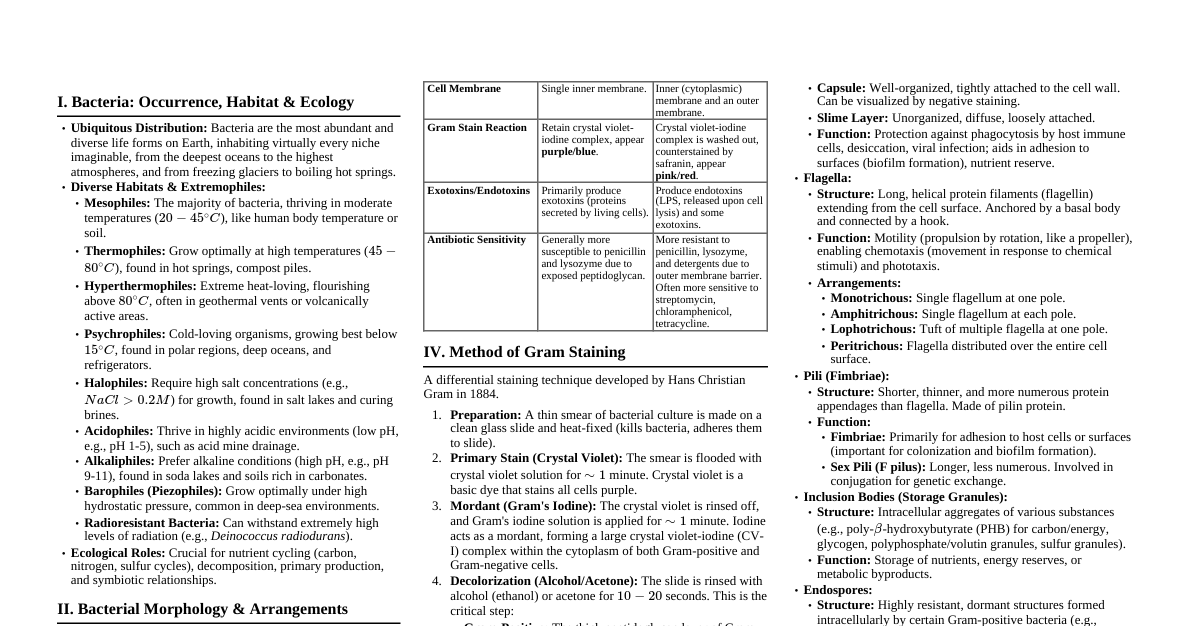
What is Microbiology? Definition: The scientific study of microorganisms, which are microscopic organisms, including bacteria, archaea, viruses, fungi, prions, and protozoa. Focus: Their structure, function, growth, reproduction, metabolism, identification, and interaction with their environment and other organisms (including hosts). Scale: Typically involves organisms that are too small to be seen with the naked eye, requiring microscopes for observation. Major Branches of Microbiology Bacteriology: Study of bacteria. Virology: Study of viruses. Mycology: Study of fungi (including yeasts and molds). Parasitology: Study of parasites (often protozoa and helminths). Immunology: Study of the immune system and its response to microorganisms. Phycology (Algology): Study of algae. Protozoology: Study of protozoa. Importance of Microorganisms Ecology: Nutrient cycling (e.g., nitrogen fixation by bacteria, decomposition). Primary producers (e.g., photosynthetic bacteria, algae). Bioremediation (cleaning up pollutants). Human Health: Pathogens (cause infectious diseases). Normal microbiota (commensals, mutualists that aid digestion, vitamin production, immune development). Industry & Biotechnology: Food production (e.g., fermentation in bread, cheese, yogurt, beer). Antibiotic production. Enzyme production. Biofuels. Genetic engineering. Characteristics of Microorganisms Bacteria Prokaryotic: No membrane-bound nucleus or organelles. Size: Typically $0.5 - 5 \mu m$. Cell Wall: Contains peptidoglycan (distinguishes Gram-positive/negative). Reproduction: Asexual (binary fission). Shapes: Cocci (spherical), Bacilli (rod-shaped), Spirilla (spiral). Archaea Prokaryotic: Similar to bacteria but distinct evolutionary lineage. Cell Wall: Lacks peptidoglycan; unique membrane lipids. Habitat: Often extremophiles (e.g., thermophiles, halophiles). Metabolism: Diverse, including methanogenesis. Viruses Acellular: Not considered "living" organisms outside a host cell. Structure: Genetic material (DNA or RNA) enclosed in a protein coat (capsid). Size: Extremely small, $20 - 300 nm$. Reproduction: Obligate intracellular parasites, replicate only within host cells. Fungi Eukaryotic: Membrane-bound nucleus and organelles. Cell Wall: Contains chitin. Forms: Yeasts (unicellular), Molds (multicellular filaments called hyphae). Reproduction: Sexual and asexual spores. Nutrition: Heterotrophic, absorb nutrients from environment (decomposers, parasites). Protozoa Eukaryotic: Unicellular, animal-like protists. Motility: Cilia, flagella, pseudopods. Nutrition: Heterotrophic (ingest food particles or other microbes). Habitat: Aquatic environments, soil, hosts. Algae Eukaryotic: Unicellular or multicellular plant-like protists. Nutrition: Photoautotrophic (perform photosynthesis). Cell Wall: Contains cellulose. Habitat: Aquatic environments. Key Techniques in Microbiology Microscopy: Light microscopy (bright-field, phase-contrast, fluorescence). Electron microscopy (TEM, SEM). Culturing: Growing microorganisms in artificial media (agar plates, broths). Staining: Gram Stain (differential stain for bacteria). Acid-Fast Stain. Sterilization: Eliminating all microbial life (autoclaving, filtration, radiation). Aseptic Technique: Procedures to prevent contamination. Molecular Techniques: PCR, DNA sequencing, genomics, proteomics. Microbial Growth Curve Describes the growth of a bacterial population in a batch culture: Lag Phase: Adaptation to new environment, little to no cell division. Log (Exponential) Phase: Cells divide rapidly at a constant rate. Stationary Phase: Growth rate equals death rate; nutrient depletion, waste accumulation. Death Phase: Death rate exceeds growth rate; decline in viable cells. Factors affecting growth: temperature, pH, oxygen, nutrients. Antimicrobial Agents Antibiotics: Drugs that kill or inhibit the growth of bacteria. Antivirals: Drugs that inhibit viral replication. Antifungals: Drugs that treat fungal infections. Disinfectants: Chemical agents used on inanimate objects. Antiseptics: Chemical agents used on living tissue.