Subject-Verb Agreement
Cheatsheet Content
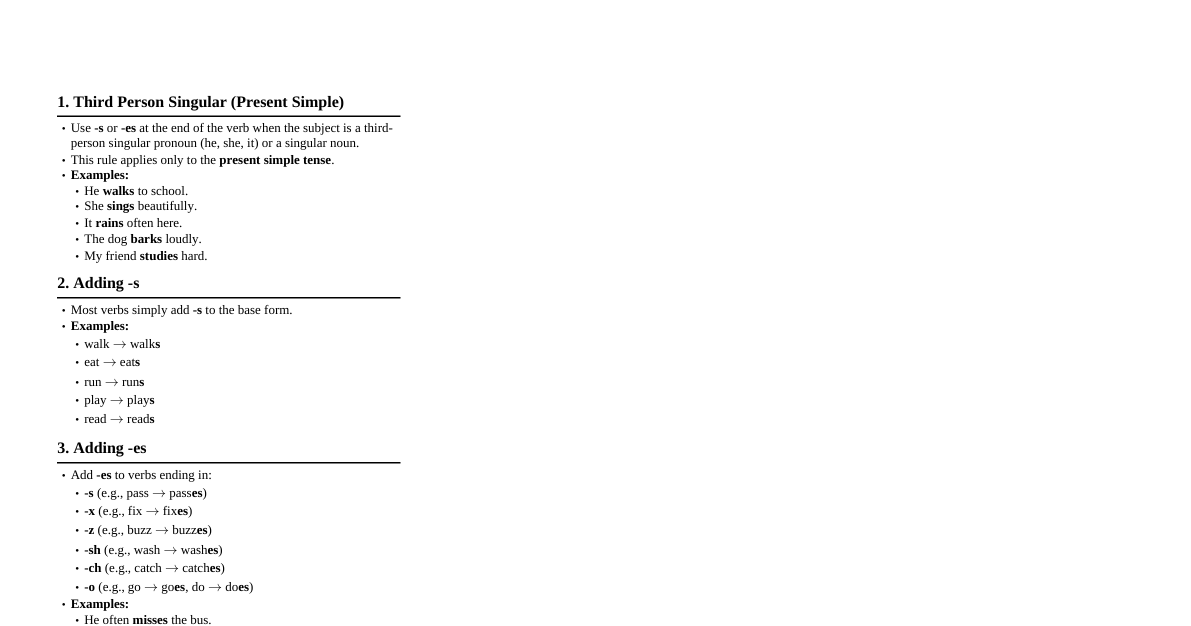
### What is Subject-Verb Agreement? - It means the subject (who or what the sentence is about) and the verb (the action word) must match! - If the subject is singular (one person/thing), the verb is singular. - If the subject is plural (more than one person/thing), the verb is plural. ### Rule 1: The Basic Match - **One subject** (singular) needs a **verb ending in -s** (singular verb, usually). - **Example:** The **dog** *barks* loudly. (One dog) - **Example:** **She** *reads* a book. (One person) - **Many subjects** (plural) need a **verb without -s** (plural verb, usually). - **Example:** The **dogs** *bark* loudly. (More than one dog) - **Example:** **They** *read* a book. (More than one person) - **Special Cases:** "I" and "you" - **I** *walk* to school. (No -s) - **You** *play* games. (No -s) ### Rule 2: Don't Get Tricked by Extra Words! - Sometimes, there are words between the subject and the verb. Ignore them! Find the real subject. - **Wrong:** The **box** of chocolates *are* empty. - **Right:** The **box** of chocolates *is* empty. (The box is empty, not the chocolates.) - **Wrong:** The **flowers** in the vase *looks* pretty. - **Right:** The **flowers** in the vase *look* pretty. (The flowers look pretty, not the vase.) ### Rule 3: "And" Means More Than One - If you join two subjects with "and," they become plural, so use a plural verb. - **Example:** **My friend and I** *go* to the park. - **Example:** **Apples and bananas** *are* healthy. - **Exception:** If "and" joins two words that make up ONE thing (like a common dish or idea), use a singular verb. - **Example:** **Bread and butter** *is* a simple meal. - **Example:** **Peanut butter and jelly** *is* my favorite sandwich. ### Rule 4: "Or" and "Nor" - Look Closest! - If subjects are joined by "or" or "nor," the verb agrees with the subject that is **closer** to it. - **Example:** Neither the **boy** nor his **friends** *like* spinach. (Friends is closer, friends are plural) - **Example:** Neither his **friends** nor the **boy** *likes* spinach. (Boy is closer, boy is singular) ### Rule 5: Special Words That Are Always Singular - Words like *each, every, either, neither, one, nobody, everyone, everything, something* are always singular. They need a singular verb. - **Example:** **Each** of the students *has* a book. - **Example:** **Everyone** *is* happy today. - **Example:** **Nobody** *was* at home. ### Rule 6: Special Words That Are Always Plural - Words like *both, few, many, several* are always plural. They need a plural verb. - **Example:** **Both** of the answers *are* correct. - **Example:** **Many** students *attend* the class. ### Rule 7: Some Words Can Be Both! - Words like *all, any, none, most, some* can be singular OR plural. It depends on what they are talking about. - **If they refer to something you can't count (like water, sugar), use a singular verb.** - **Example:** **Some** of the **water** *is* spilled. - **If they refer to something you CAN count (like chairs, apples), use a plural verb.** - **Example:** **Some** of the **chairs** *are* broken. ### Rule 8: Group Words (Collective Nouns) - Words like *team, family, class, audience, committee* are called collective nouns. - If the group acts **as one unit**, use a singular verb. - **Example:** The **team** *is* ready for the game. (The whole team acts together) - If the members of the group are acting **separately**, use a plural verb (less common, often rephrased). - **Example:** The **team** *are* putting on their shoes. (Each member doing their own thing) ### Rule 9: "There Is/Are" and "Here Is/Are" - When a sentence starts with "there is/are" or "here is/are," the verb agrees with the subject that comes **after** it. - **Example:** There *are* many **birds** in the sky. (Birds is plural) - **Example:** Here *is* my **book**. (Book is singular) ### Rule 10: Titles of Books/Movies - The title of a book, movie, song, or organization (even if it sounds plural) always takes a singular verb. - **Example:** "**The Avengers**" *is* a popular movie. - **Example:** "**Harry Potter and the Goblet of Fire**" *was* a great book. ### Rule 11: Amounts and Measurements - When talking about an amount of time, money, distance, etc., as a **single unit**, use a singular verb. - **Example:** **Ten dollars** *is* enough for the ticket. - **Example:** **Two hours** *is* a long time to wait. ### Rule 12: "Who," "Which," "That" - When these words are subjects, the verb agrees with the word they are talking about (the word before them). - **Example:** He is the **boy** who *sings* well. (Who refers to "boy" - singular) - **Example:** They are the **girls** who *sing* well. (Who refers to "girls" - plural)