Verb Conjugation: -s/-es Rules
Cheatsheet Content
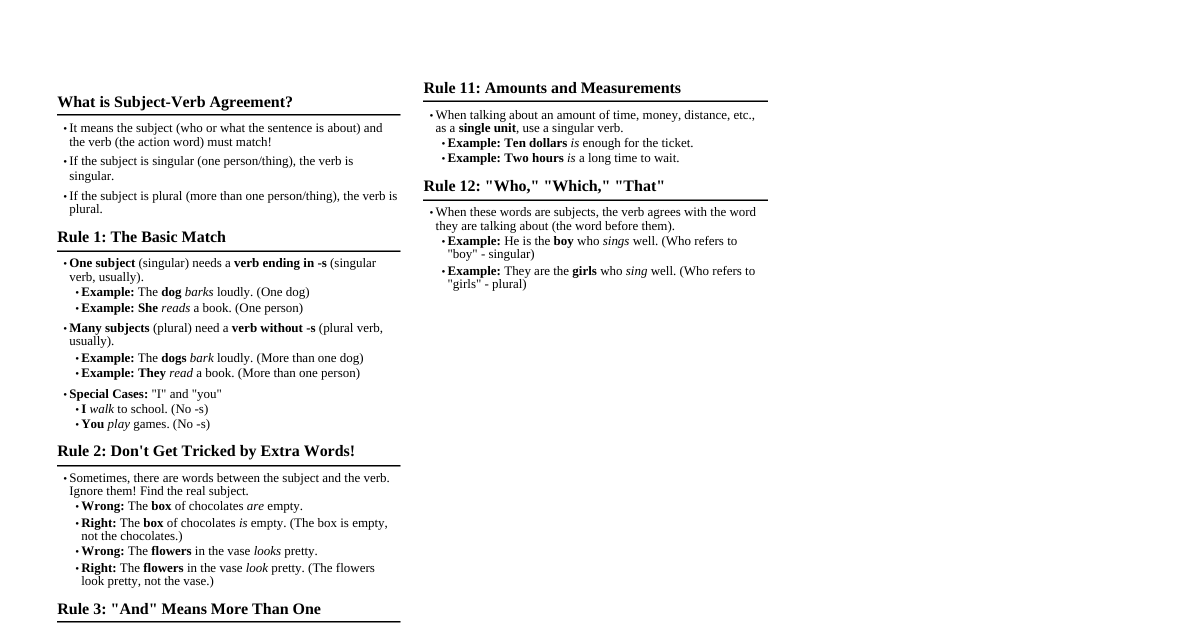
1. Third Person Singular (Present Simple) Use -s or -es at the end of the verb when the subject is a third-person singular pronoun (he, she, it) or a singular noun. This rule applies only to the present simple tense . Examples: He walks to school. She sings beautifully. It rains often here. The dog barks loudly. My friend studies hard. 2. Adding -s Most verbs simply add -s to the base form. Examples: walk $\rightarrow$ walk s eat $\rightarrow$ eat s run $\rightarrow$ run s play $\rightarrow$ play s read $\rightarrow$ read s 3. Adding -es Add -es to verbs ending in: -s (e.g., pass $\rightarrow$ pass es ) -x (e.g., fix $\rightarrow$ fix es ) -z (e.g., buzz $\rightarrow$ buzz es ) -sh (e.g., wash $\rightarrow$ wash es ) -ch (e.g., catch $\rightarrow$ catch es ) -o (e.g., go $\rightarrow$ go es , do $\rightarrow$ do es ) Examples: He often misses the bus. She always washes her hands. The mechanic fixes cars. My cat catches mice. He goes to work early. 4. Verbs Ending in -y If the verb ends in a consonant + -y: Change -y to -i and add -es . Examples: study $\rightarrow$ stud ies try $\rightarrow$ tr ies carry $\rightarrow$ carr ies fly $\rightarrow$ fl ies If the verb ends in a vowel + -y: Simply add -s . Examples: play $\rightarrow$ play s enjoy $\rightarrow$ enjoy s say $\rightarrow$ say s buy $\rightarrow$ buy s 5. Irregular Verbs The verb "to have" is irregular in the third person singular. Have $\rightarrow$ Has Example: She has a new car. 6. Summary Table Verb Ending Rule Example Most verbs Add -s work $\rightarrow$ work s -s, -x, -z, -sh, -ch, -o Add -es watch $\rightarrow$ watch es Consonant + -y Change -y to -i, add -es cry $\rightarrow$ cr ies Vowel + -y Add -s stay $\rightarrow$ stay s Irregular (have) Has She has