Semiconductor Physics Formulas
Shared 5/4/2026•0 views
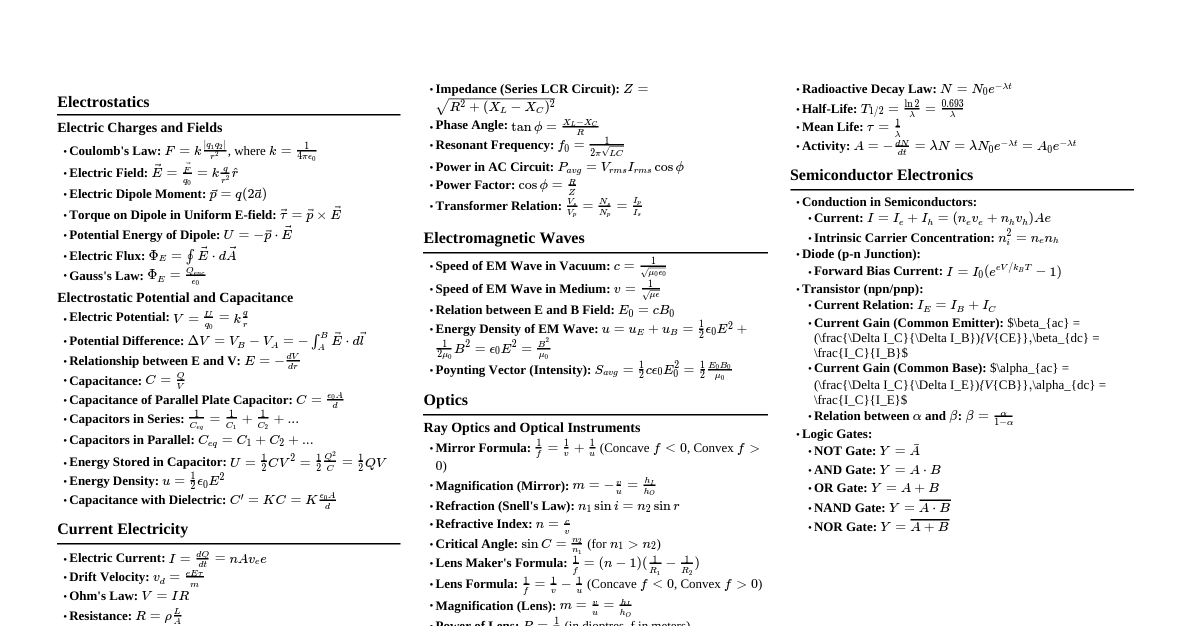
### Current Density - **Definition:** Current flowing per unit cross-sectional area. $$j = \frac{I}{A}$$ where $I$ is current, $A$ is cross-sectional area. - **SI Unit:** A/m$^2$ - **In terms of electron properties:** $$j = -ne v_d$$ where $n$ is electron concentration, $e$ is elementary charge, $v_d$ is drift velocity. ### Drift Velocity - **Definition:** Average velocity of free electrons under an electric field. - **Formula (from current density):** $$v_d = \frac{I}{Ane}$$ where $I$ is current, $A$ is cross-sectional area, $n$ is electron concentration, $e$ is elementary charge. - **Formula (from mobility):** $$v_d = \mu E$$ where $\mu$ is mobility, $E$ is electric field. - **SI Unit:** m/s ### Relaxation Time - **Definition:** Average time between two successive collisions of free electrons. - **SI Unit:** s ### Mean Free Path - **Definition:** Average distance between two successive collisions of free electrons. - **SI Unit:** m ### Mobility - **Definition:** Drift speed acquired per unit applied electric field. $$\mu = \frac{v_d}{E}$$ where $v_d$ is drift velocity, $E$ is electric field. - **SI Unit:** m$^2$ V$^{-1}$ s$^{-1}$ ### Electrical Conductivity - **Ohm's Law (Microscopic Form):** $$j = \sigma E$$ where $j$ is current density, $\sigma$ is electrical conductivity, $E$ is electric field. - **In terms of electron properties:** $$\sigma = ne\mu$$ where $n$ is electron concentration, $e$ is elementary charge, $\mu$ is mobility. - **In terms of relaxation time:** $$\sigma = \frac{ne^2 \tau}{m}$$ where $n$ is electron concentration, $e$ is elementary charge, $\tau$ is relaxation time, $m$ is electron mass. - **Relation to Resistivity:** $$\sigma = \frac{1}{\rho}$$ where $\rho$ is resistivity. ### Electrical Resistivity - **Definition:** Inverse of electrical conductivity. $$\rho = \frac{1}{\sigma}$$ - **In terms of electron properties:** $$\rho = \frac{m}{ne^2 \tau}$$ where $m$ is electron mass, $n$ is electron concentration, $e$ is elementary charge, $\tau$ is relaxation time. - **SI Unit:** $\Omega$ m ### Wiedemann-Franz Law - **Statement:** The ratio of thermal conductivity ($\sigma_T$) to electrical conductivity ($\sigma$) is directly proportional to absolute temperature ($T$). $$\frac{\sigma_T}{\sigma} = LT$$ where $L$ is the Lorentz number. - **Lorentz Number ($L$):** $$L = \frac{\sigma_T}{\sigma T}$$ - **Experimental Value:** $2.2 \times 10^{-8}$ W $\Omega$ K$^{-2}$ (approximately for all metals at room temperature). - **Thermal Conductivity ($\sigma_T$):** $$\sigma_T = LT\sigma = \frac{LT}{\rho}$$ where $L$ is Lorentz number, $T$ is absolute temperature, $\sigma$ is electrical conductivity, $\rho$ is electrical resistivity. ### Fermi-Dirac Distribution - **Mathematical Expression:** Describes the probability $f(E)$ of an energy state $E$ being occupied by a fermion. $$f(E) = \frac{1}{\exp\left(\frac{E-E_F}{k_B T}\right) + 1}$$ where $E_F$ is the Fermi energy, $k_B$ is the Boltzmann constant, $T$ is the absolute temperature. - **At $E = E_F$:** $$f(E_F) = \frac{1}{2}$$ - **Derivative with respect to E:** $$\frac{df}{dE} = -\frac{f(1-f)}{k_B T}$$ - **Sum of probabilities:** For energies $E_1 = E_F - \Delta E$ and $E_2 = E_F + \Delta E$: $$f(E_1) + f(E_2) = 1$$ ### Effective Mass - **Definition:** $$m^* = \frac{\hbar^2}{\frac{d^2E}{dk^2}}$$ where $\hbar$ is the reduced Planck constant, $E$ is energy, $k$ is wave vector. - **For free electron ($E = \frac{\hbar^2 k^2}{2m_e}$):** $$m^* = m_e$$ where $m_e$ is the actual mass of the electron. - **For $E(k) = E_0 - 2\beta \cos(ka)$:** $$\frac{d^2E}{dk^2} = 2\beta a^2 \cos(ka)$$ At $k = \frac{2\pi}{a}$: $$m^* = \frac{\hbar^2}{2\beta a^2}$$ - **For $E = -Ak^2$:** $$\frac{d^2E}{dk^2} = -2A$$ $$m^* = -\frac{\hbar^2}{2A}$$ - **For $E(k) = E_0 [1 - \exp(-2a^2k^2)]$:** At $k = 0$: $$\frac{d^2E}{dk^2}\Big|_{k=0} = 4E_0a^2$$ $$m^* = \frac{\hbar^2}{4E_0a^2}$$