Basic Organic Chemistry
Cheatsheet Content
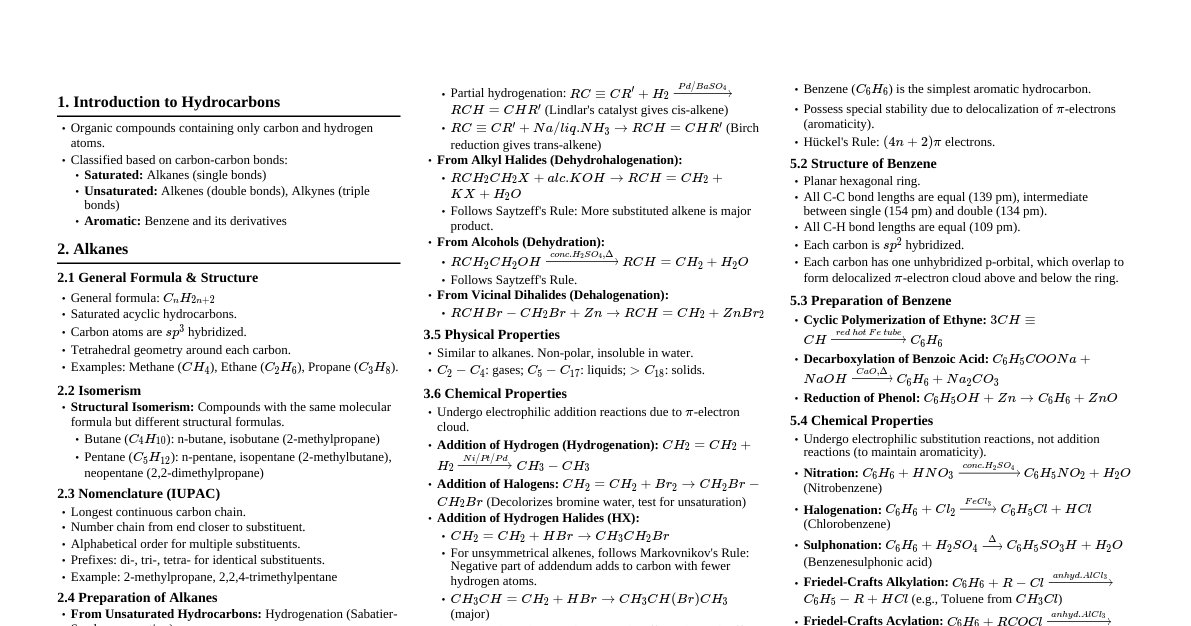
Hydrocarbons: Fundamentals Definition: Organic compounds consisting entirely of hydrogen and carbon atoms. Classification: Alkanes: Saturated hydrocarbons (single bonds). General formula: $C_nH_{2n+2}$. Alkenes: Unsaturated hydrocarbons with at least one carbon-carbon double bond. General formula: $C_nH_{2n}$. Alkynes: Unsaturated hydrocarbons with at least one carbon-carbon triple bond. General formula: $C_nH_{2n-2}$. Benzene: Aromatic hydrocarbon, cyclic structure with delocalized $\pi$-electrons. Nomenclature: IUPAC rules for naming alkanes, alkenes, alkynes, and simple aromatic compounds. Physical Properties of Hydrocarbons Physical State: $C_1-C_4$: Gases (e.g., methane, ethane). $C_5-C_{17}$: Liquids (e.g., pentane, octane). $C_{18}$ and above: Solids (e.g., paraffin wax). Melting & Boiling Points: Increase with increasing molecular weight (longer carbon chain). Branching decreases surface area, leading to lower boiling points. Alkanes $ Benzene has higher melting/boiling points than aliphatic hydrocarbons of similar molecular weight due to its planar structure and efficient packing. Solubility: Non-polar, hence insoluble in water (polar solvent). Soluble in non-polar organic solvents (e.g., ether, carbon tetrachloride). Chemical Properties of Alkanes (Mechanisms Excluded) Halogenation ($\star$): Substitution reaction with halogens (e.g., $Cl_2$, $Br_2$) in the presence of UV light or heat. $CH_4 + Cl_2 \xrightarrow{UV light} CH_3Cl + HCl$ Combustion: Complete combustion yields carbon dioxide and water; incomplete combustion yields carbon monoxide or carbon. $CH_4 + 2O_2 \rightarrow CO_2 + 2H_2O$ Aromatization: Conversion of alkanes (typically $C_6$ or $C_7$) into aromatic hydrocarbons under high temperature and pressure with catalysts. Pyrolysis (Cracking): Thermal decomposition of large alkane molecules into smaller alkanes, alkenes, and hydrogen at high temperatures without oxygen. Chemical Properties of Alkenes & Alkynes (Mechanisms Excluded) Addition of Hydrogen (Hydrogenation) ($\star$): Addition of $H_2$ across double/triple bonds in the presence of catalysts (Ni, Pt, Pd). $CH_2=CH_2 + H_2 \xrightarrow{Ni} CH_3-CH_3$ $CH \equiv CH + 2H_2 \xrightarrow{Ni} CH_3-CH_3$ Addition of Halogens (Halogenation): Addition of $X_2$ (e.g., $Br_2$, $Cl_2$) across double/triple bonds. This is a common test for unsaturation (decolorizes bromine water). $CH_2=CH_2 + Br_2 \rightarrow BrCH_2-CH_2Br$ Oxidation ($\star$): With cold, dilute alkaline $KMnO_4$ (Baeyer's reagent): Forms diols. (Test for unsaturation). With hot, acidic $KMnO_4$: Cleavage of double/triple bond, forming carboxylic acids, ketones, or $CO_2$. Polymerization ($\star$): Monomer units (alkenes/alkynes) join to form long polymer chains. $n(CH_2=CH_2) \xrightarrow{catalyst, heat, pressure} (-CH_2-CH_2-)_n$ (Polyethylene) Chemical Properties of Benzene (Mechanisms Excluded) Halogenation ($\star$): Electrophilic substitution with halogens in the presence of a Lewis acid catalyst ($FeCl_3$, $AlCl_3$). $C_6H_6 + Cl_2 \xrightarrow{FeCl_3} C_6H_5Cl + HCl$ Sulphonation: Reaction with fuming $H_2SO_4$ or concentrated $H_2SO_4$ to form benzenesulfonic acid. $C_6H_6 + H_2SO_4 \rightleftharpoons C_6H_5SO_3H + H_2O$ Friedel-Crafts Alkylation ($\star$): Reaction with an alkyl halide in the presence of a Lewis acid catalyst ($AlCl_3$) to form an alkylbenzene. $C_6H_6 + CH_3Cl \xrightarrow{AlCl_3} C_6H_5CH_3 + HCl$ Friedel-Crafts Acylation ($\star$): Reaction with an acyl halide or acid anhydride in the presence of a Lewis acid catalyst ($AlCl_3$) to form a ketone (acylbenzene). $C_6H_6 + CH_3COCl \xrightarrow{AlCl_3} C_6H_5COCH_3 + HCl$ Combustion: Burns with a sooty flame due to high carbon content. $2C_6H_6 + 15O_2 \rightarrow 12CO_2 + 6H_2O$ Industrial Applications of Hydrocarbons Fuels: Petrol, diesel, kerosene, LPG (liquefied petroleum gas), CNG (compressed natural gas) are all hydrocarbon mixtures. Petrochemicals: Raw materials for plastics (polyethylene, polypropylene), synthetic rubbers, synthetic fibers (nylon, polyester), solvents, lubricants, and pharmaceuticals. Solvents: Benzene, toluene, xylene are used as industrial solvents. Asphalt/Bitumen: Used in road construction. Waxes: Paraffin wax used in candles, polishes, and coatings.