Matrices & Cramer
Cheatsheet Content
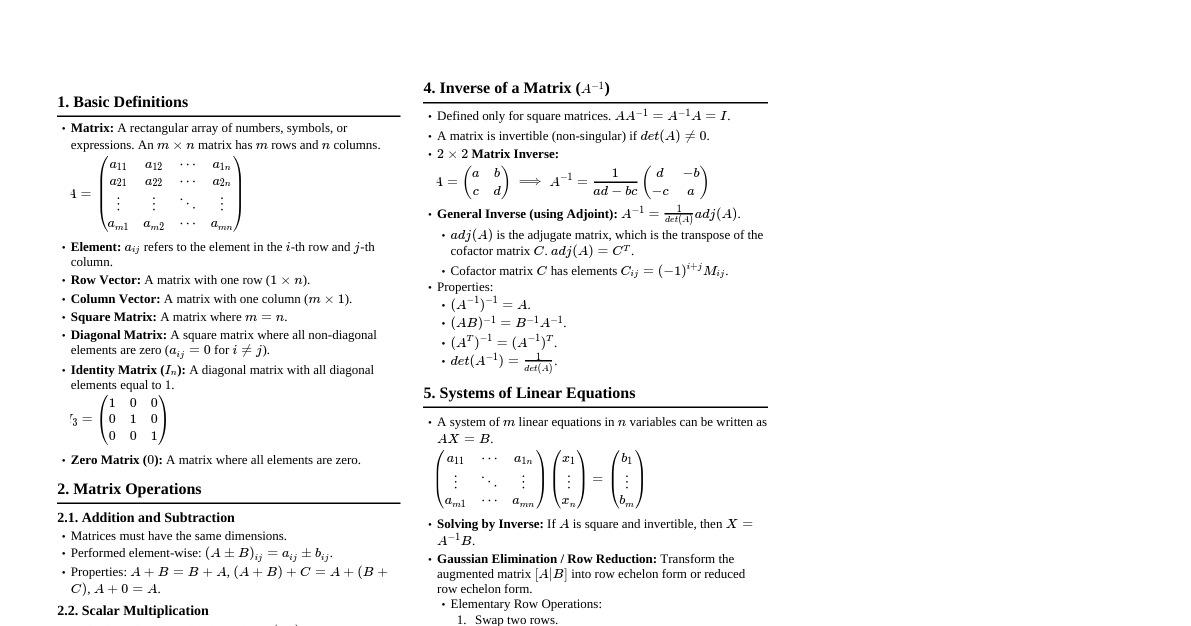
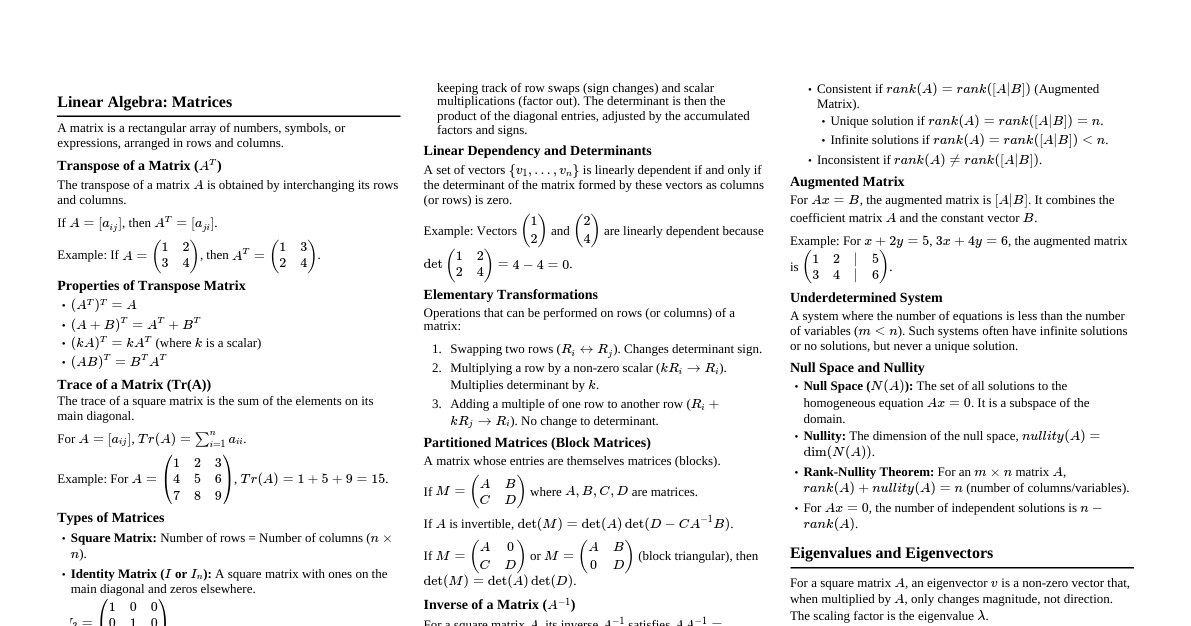
Matrices Basics Definition: A rectangular array of numbers, symbols, or expressions arranged in rows and columns. Notation: $A = [a_{ij}]$, where $a_{ij}$ is the element in the $i$-th row and $j$-th column. Order: $m \times n$ (m rows, n columns). Types: Square Matrix: $m = n$. Identity Matrix ($I$): Square matrix with 1s on the main diagonal, 0s elsewhere. $AI = IA = A$. Zero Matrix ($0$): All elements are zero. $A+0 = A$. Matrix Operations Addition/Subtraction: Element-wise, matrices must have the same order. $C = A \pm B \implies c_{ij} = a_{ij} \pm b_{ij}$ Scalar Multiplication: Multiply each element by the scalar. $kA = [ka_{ij}]$ Matrix Multiplication: $C = AB$. Number of columns in $A$ must equal number of rows in $B$. If $A$ is $m \times p$ and $B$ is $p \times n$, then $C$ is $m \times n$. $c_{ij} = \sum_{k=1}^p a_{ik}b_{kj}$ Transpose ($A^T$): Rows become columns, columns become rows. $(A^T)_{ij} = A_{ji}$. Determinant of a Matrix Definition: A scalar value that can be computed from the elements of a square matrix. Denoted as $\det(A)$ or $|A|$. For $2 \times 2$ Matrix: $A = \begin{pmatrix} a & b \\ c & d \end{pmatrix}$ $\det(A) = ad - bc$ For $3 \times 3$ Matrix (Sarrus' Rule): $A = \begin{pmatrix} a & b & c \\ d & e & f \\ g & h & i \end{pmatrix}$ $\det(A) = a(ei - fh) - b(di - fg) + c(dh - eg)$ Trick (Sarrus' Rule): Repeat the first two columns next to the matrix: $\begin{pmatrix} a & b & c \\ d & e & f \\ g & h & i \end{pmatrix} \begin{matrix} a & b \\ d & e \\ g & h \end{matrix}$ Sum of products of diagonals going $\searrow$ (top-left to bottom-right) minus sum of products of diagonals going $\swarrow$ (top-right to bottom-left). $\det(A) = (aei + bfg + cdh) - (ceg + afh + bdi)$ Cramer's Rule for $3 \times 3$ Systems Purpose: To solve a system of linear equations using determinants. Given the system: $a_1x + b_1y + c_1z = d_1$ $a_2x + b_2y + c_2z = d_2$ $a_3x + b_3y + c_3z = d_3$ Step 1: Form the Coefficient Matrix ($D$) $D = \begin{pmatrix} a_1 & b_1 & c_1 \\ a_2 & b_2 & c_2 \\ a_3 & b_3 & c_3 \end{pmatrix}$ Calculate $\det(D)$. If $\det(D) = 0$, Cramer's Rule cannot be used (either no unique solution or no solution). Step 2: Form $D_x$ (Replace x-column with constants) $D_x = \begin{pmatrix} d_1 & b_1 & c_1 \\ d_2 & b_2 & c_2 \\ d_3 & b_3 & c_3 \end{pmatrix}$ Calculate $\det(D_x)$. Step 3: Form $D_y$ (Replace y-column with constants) $D_y = \begin{pmatrix} a_1 & d_1 & c_1 \\ a_2 & d_2 & c_2 \\ a_3 & d_3 & c_3 \end{pmatrix}$ Calculate $\det(D_y)$. Step 4: Form $D_z$ (Replace z-column with constants) $D_z = \begin{pmatrix} a_1 & b_1 & d_1 \\ a_2 & b_2 & d_2 \\ a_3 & b_3 & d_3 \end{pmatrix}$ Calculate $\det(D_z)$. Step 5: Solve for $x, y, z$ $x = \frac{\det(D_x)}{\det(D)}$ $y = \frac{\det(D_y)}{\det(D)}$ $z = \frac{\det(D_z)}{\det(D)}$ Trick to Remember Cramer's Rule Think of it as "D for Denominator, D with replaced column for Numerator" : The denominator for all variables ($x, y, z$) is always the determinant of the original coefficient matrix, $\det(D)$. For the numerator of each variable ($x, y, z$), replace the column corresponding to that variable in the original coefficient matrix ($D$) with the column of constants ($d_1, d_2, d_3$). For $x$, replace the first column of $D$ with constants to get $D_x$. For $y$, replace the second column of $D$ with constants to get $D_y$. For $z$, replace the third column of $D$ with constants to get $D_z$. Then, simply calculate the determinants and divide. This rule elegantly connects the position of the variable to the column replaced in the determinant calculation.