Inheritance & Variation
Cheatsheet Content
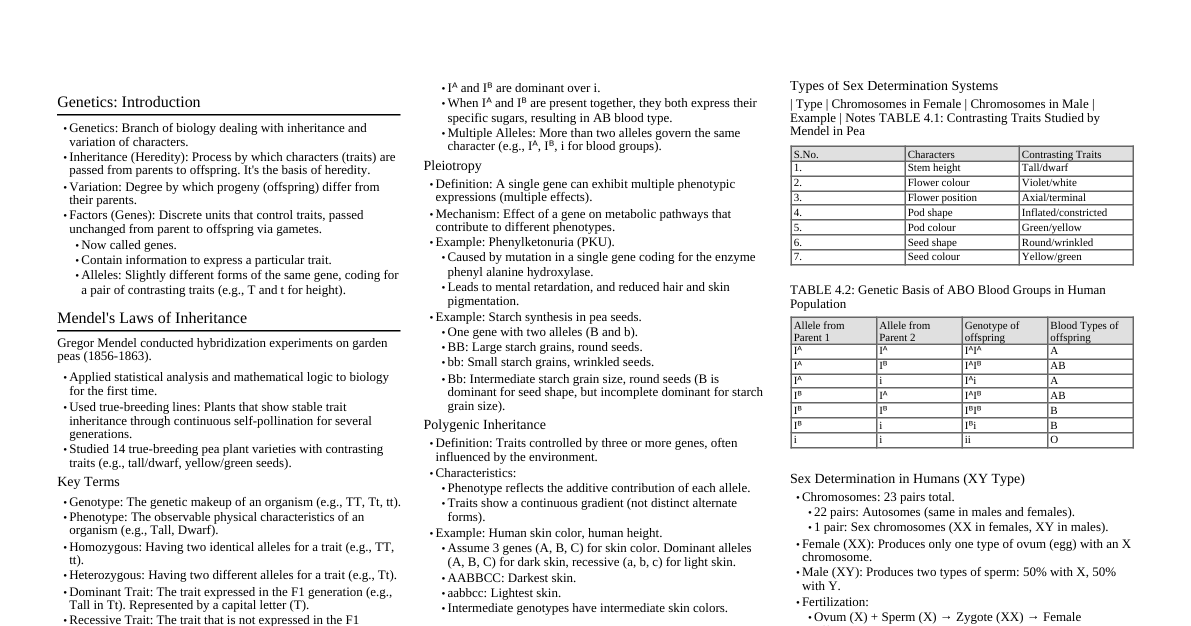
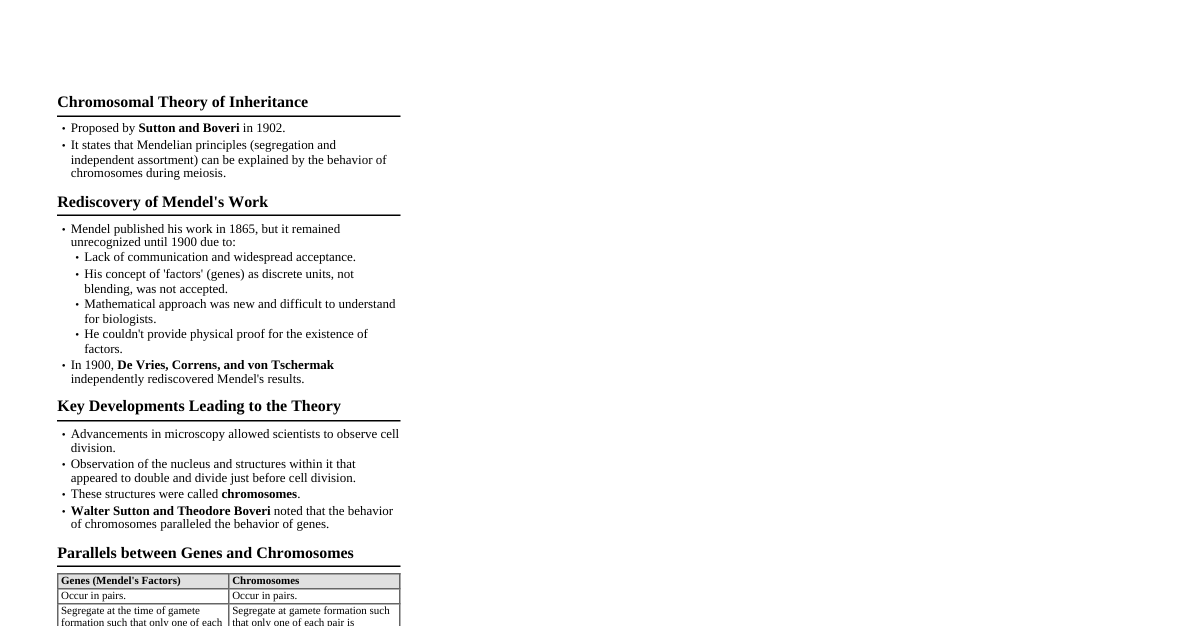
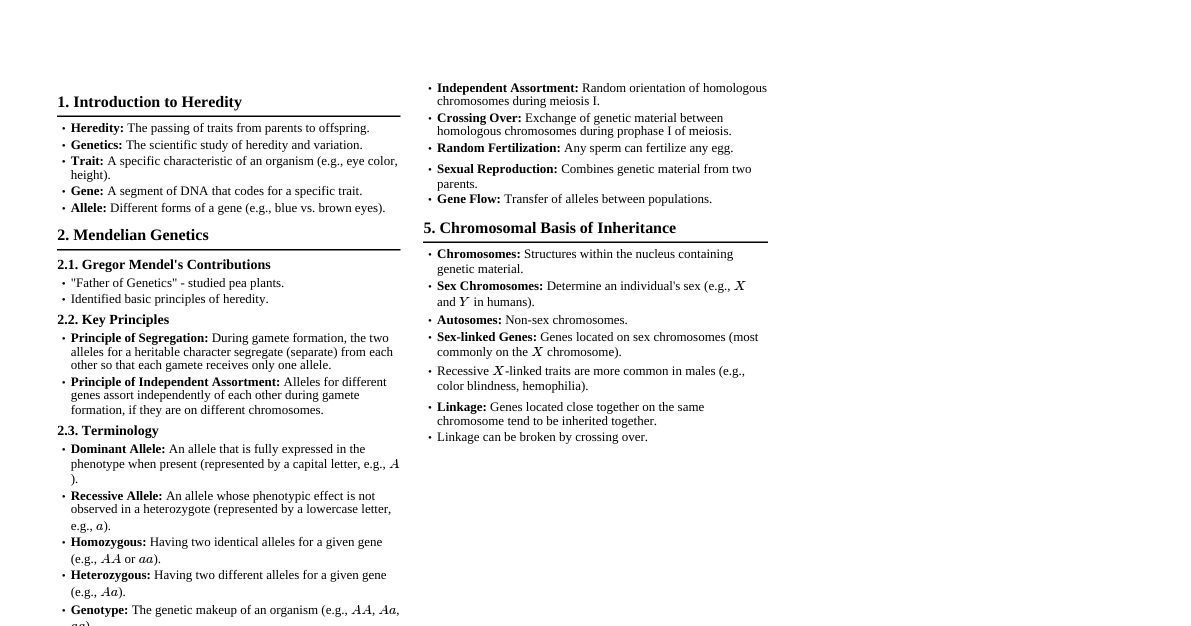
### Mendelian Genetics - **Heredity:** Transmission of characters from parents to offspring. - **Variation:** Degree by which progeny differ from parents. - **Genetics:** Study of heredity and variation. #### Mendel's Laws of Inheritance 1. **Law of Dominance:** - Characters are controlled by discrete units called **factors (genes)**. - Factors occur in pairs. - In a dissimilar pair, one factor dominates (dominant) the other (recessive). - *Example:* Tall (T) is dominant over dwarf (t) in pea plants. 2. **Law of Segregation (Purity of Gametes):** - Alleles do not blend and both characters are recovered in F2 generation. - During gamete formation, alleles separate (segregate) from each other such that each gamete receives only one of the two alleles. - Gametes are always pure for a character. 3. **Law of Independent Assortment:** - When two pairs of traits are combined in a hybrid, segregation of one pair of characters is independent of the other pair of characters. - *Example:* Dihybrid cross (RrYy x RrYy) gives a phenotypic ratio of 9:3:3:1. #### Terms - **Allele:** Alternative forms of a gene (e.g., T and t). - **Homozygous:** Identical alleles for a trait (TT or tt). - **Heterozygous:** Different alleles for a trait (Tt). - **Phenotype:** Observable characteristics (e.g., Tall, Dwarf). - **Genotype:** Genetic makeup (e.g., TT, Tt, tt). - **Monohybrid Cross:** Cross involving one pair of contrasting characters. - Phenotypic ratio: 3:1 (in F2) - Genotypic ratio: 1:2:1 (in F2) - **Dihybrid Cross:** Cross involving two pairs of contrasting characters. - Phenotypic ratio: 9:3:3:1 (in F2) - Genotypic ratio: 1:2:1:2:4:2:1:2:1 (in F2) - **Test Cross:** Cross between F1 hybrid and recessive parent to determine genotype of F1. - Monohybrid test cross ratio: 1:1 - Dihybrid test cross ratio: 1:1:1:1 ### Deviations from Mendelian Inheritance #### 1. Incomplete Dominance - F1 phenotype is intermediate between the two parental phenotypes. - Neither allele is completely dominant. - *Example:* Snapdragon (Antirrhinum majus) flower color. Red (RR) x White (rr) → Pink (Rr) in F1. - F2 phenotypic ratio: 1 Red : 2 Pink : 1 White. - F2 genotypic ratio: 1 RR : 2 Rr : 1 rr. (Same as phenotypic ratio) #### 2. Codominance - Both alleles express themselves fully in the heterozygote. - *Example:* ABO blood groups in humans. - Alleles: $I^A$, $I^B$, i. - $I^A$ and $I^B$ are codominant. - $I^A$ and $I^B$ are dominant over i. - Genotypes and Phenotypes: - $I^A I^A$, $I^A i$ → Blood Group A - $I^B I^B$, $I^B i$ → Blood Group B - $I^A I^B$ → Blood Group AB (Codominance) - $ii$ → Blood Group O #### 3. Multiple Alleles - More than two alleles for a single gene. - *Example:* ABO blood grouping ($I^A, I^B, i$). - A single individual can have only two alleles. #### 4. Pleiotropy - A single gene exhibits multiple phenotypic expressions. - *Example:* Phenylketonuria, Sickle-cell anemia. - In phenylketonuria, a single gene mutation leads to mental retardation, reduction in hair, and skin pigmentation. #### 5. Polygenic Inheritance - Traits controlled by three or more genes (multiple genes). - Shows continuous variation. - *Example:* Human skin color, human height. - The phenotype reflects the contribution of each allele, and the effect of each allele is additive. #### 6. Epistasis - One gene (epistatic gene) masks the expression of another gene (hypostatic gene) at a different locus. - *Example:* Coat color in mice (Agouti, Black, Albino). #### 7. Chromosomal Theory of Inheritance - Proposed by Sutton and Boveri (1902). - States that Mendelian factors (genes) are located on chromosomes. - Chromosomes, like genes, occur in pairs. - Segregation of homologous chromosomes during meiosis explains the segregation of Mendelian factors. - Independent assortment of chromosomes explains independent assortment of genes. ### Linkage and Recombination #### Linkage - Physical association of genes on a chromosome. - Genes located closely on the same chromosome tend to be inherited together. - Proposed by T.H. Morgan based on experiments on *Drosophila melanogaster*. - **Linkage Groups:** All genes on a chromosome form a linkage group. The number of linkage groups equals the haploid number of chromosomes. #### Recombination - Generation of non-parental gene combinations. - Occurs due to crossing over during meiosis. - The frequency of recombination between two genes is directly proportional to the distance between them on the chromosome. - Morgan's student, Alfred Sturtevant, used recombination frequency to map gene positions on chromosomes (genetic mapping). #### Sex Determination - Mechanism by which the sex of an individual is established. 1. **XY Type (Humans, *Drosophila*):** - Males: XY (heterogametic, produce X and Y sperm) - Females: XX (homogametic, produce only X eggs) - Sex is determined by the male parent. 2. **ZW Type (Birds):** - Males: ZZ (homogametic) - Females: ZW (heterogametic) - Sex is determined by the female parent. 3. **XO Type (Grasshoppers):** - Males: XO (heterogametic, produce X and no-X sperm) - Females: XX (homogametic) - Sex is determined by the male parent. 4. **Haplodiploidy (Honeybees):** - Males (drones): Haploid (develop from unfertilized eggs). - Females (queen, worker): Diploid (develop from fertilized eggs). ### Mutations - Sudden heritable changes in the genetic material. - Can be at gene level (point mutations) or chromosome level (chromosomal aberrations). #### 1. Gene Mutations (Point Mutations) - Change in a single base pair of DNA. - **Substitution:** One base replaced by another. - *Example:* Sickle-cell anemia (GAG to GUG at 6th codon of beta-globin chain, resulting in glutamic acid replaced by valine). - **Insertion/Deletion (Frameshift Mutations):** Addition or removal of one or more base pairs, leading to a shift in the reading frame. - Can have drastic effects on protein synthesis. #### 2. Chromosomal Mutations (Chromosomal Aberrations) - Changes in chromosome structure or number. - **Aneuploidy:** Gain or loss of one or more chromosomes. - **Trisomy:** Gain of an extra chromosome (2n+1). - *Example:* Down's Syndrome (Trisomy 21). - **Monosomy:** Loss of a chromosome (2n-1). - *Example:* Turner's Syndrome (XO, monosomy of X chromosome). - **Polyploidy:** Increase in whole set of chromosomes (e.g., 3n, 4n). - Common in plants, rare in animals. ### Genetic Disorders #### Mendelian Disorders - Determined by alteration or mutation in a single gene. - Follow Mendel's laws of inheritance. - Can be dominant or recessive, autosomal or sex-linked. 1. **Autosomal Dominant:** - Affected individuals have at least one affected parent. - Does not skip generations. - Males and females are equally affected. - *Example:* Myotonic Dystrophy. 2. **Autosomal Recessive:** - Affected individuals often have unaffected parents (carriers). - Can skip generations. - Males and females are equally affected. - *Examples:* Sickle-cell Anemia, Phenylketonuria, Cystic Fibrosis. 3. **X-linked Recessive:** - More common in males. - Affected father cannot pass to son. - Affected mother can pass to sons and daughters (daughters will be carriers if heterozygous). - *Examples:* Hemophilia, Color Blindness. 4. **X-linked Dominant:** - Rare. - Affected fathers pass to all daughters, but no sons. - Affected mothers pass to half sons and half daughters. - *Example:* Vitamin D resistant Rickets. #### Chromosomal Disorders - Caused by absence or excess or abnormal arrangement of one or more chromosomes. 1. **Down's Syndrome (Trisomy 21):** - Presence of an extra copy of chromosome 21 (47, XX or XY, +21). - Symptoms: Short stature, small round head, furrowed tongue, partially open mouth, broad palm with characteristic palm crease, mental retardation. 2. **Klinefelter's Syndrome (XXY):** - Presence of an extra X chromosome in males (47, XXY). - Symptoms: Overall masculine development, but feminine features (gynecomastia - development of breasts), sterile. 3. **Turner's Syndrome (XO):** - Absence of one X chromosome in females (45, XO). - Symptoms: Sterile ovaries (rudimentary), lack of secondary sexual characters, short stature, webbed neck. ### Pedigree Analysis - Study of inheritance of genetic traits in several generations of a human family. - Uses standard symbols to represent individuals and relationships. #### Symbols - **Square:** Male - **Circle:** Female - **Shaded:** Affected individual - **Unshaded:** Unaffected individual - **Half-shaded:** Carrier (for recessive traits) - **Horizontal line:** Mating - **Vertical line:** Offspring - **Double horizontal line:** Consanguineous mating (mating between relatives) #### Characteristics of different inheritance patterns: - **Autosomal Dominant:** Appears in every generation; affected individuals have at least one affected parent; males and females equally affected. - **Autosomal Recessive:** Can skip generations; affected individuals can have unaffected parents (carriers); males and females equally affected. - **X-linked Recessive:** More males affected; affected father cannot pass to son; affected mother passes to sons. - **X-linked Dominant:** All daughters of affected father are affected; no sons of affected father are affected; affected mother passes to half sons and half daughters. ### Important Terms - **Genome:** Total genetic content of an organism. - **Genomics:** Study of genomes. - **Karyotype:** The number and appearance of chromosomes in the nucleus of a eukaryotic cell. - **Locus:** Specific physical location of a gene or other DNA sequence on a chromosome. - **Gene pool:** Sum total of all the genes and their alleles present in a population. - **Genetic drift:** Random change in allele frequencies in a population over generations. - **Founder effect:** Loss of genetic variation that occurs when a new population is established by a very small number of individuals from a larger population. - **Bottleneck effect:** Sharp reduction in the size of a population due to environmental events. - **Hardy-Weinberg Principle:** Describes a state of constant allele and genotype frequencies in a population in the absence of evolutionary influences. - $p^2 + 2pq + q^2 = 1$ - $p + q = 1$ - Where $p$ = frequency of dominant allele, $q$ = frequency of recessive allele. - $p^2$ = frequency of homozygous dominant genotype. - $q^2$ = frequency of homozygous recessive genotype. - $2pq$ = frequency of heterozygous genotype.